Haute Black Journal
What Is Resort Credit and How to Use It Well

Marlene Azeez
Director, HauteBlack
View all articles →

A resort credit is a property-specific spending allowance applied to eligible on-property purchases such as dining, spa treatments, and activities, not a cash discount on the room rate. A $500 credit can represent $500 in potential value, but only if you use qualifying services before checkout and follow the property's rules.
You arrive at a five-star resort, hand over your passport, and hear the welcome phrase every luxury traveler likes: “You have a $500 resort credit during your stay.” The number feels settled. You start thinking about the seafood dinner, the couples' massage, and perhaps a private excursion.
At checkout, the folio tells a different story. The credit applied to some dining, but not taxes, gratuities, the resort fee, or a charge from an excluded outlet. A portion expired because it was tied to specific dates or a per-night allowance. The experience was generous, but the usable value came closer to $300.
That gap isn't usually a billing mistake. It comes from treating a controlled hotel benefit like prepaid cash. Resort credit is a redemption problem, and the outcome depends on the rate, the outlet, the folio, and the timing. If you're booking through a preferred travel advisor, ask for the complete terms before arrival, not just the headline amount.
A $500 Credit That Wasn't Really $500
The guest in this example had done what most travelers do. They saw the credit in the confirmation, assumed it could absorb any resort spending, and waited until the last day to review the bill. That approach gives the hotel system control over the result.
The first dinner qualified, but the service charge and gratuity did not. The spa treatment qualified, but a retail item purchased at the spa did not. A third-party excursion charged through the concierge desk looked like a resort experience, yet the operator posted it outside the eligible outlet structure. The guest had spent heavily on property, but not every charge belonged to the credit ledger.
Advisor's view: A credit isn't valuable because the number is large. It's valuable when the eligible experiences match what you already planned to buy.
This is why a $500 allowance can feel disappointing without being misleading. Its nominal value is fixed, while its realized value depends on qualifying spend. If you wouldn't normally visit the participating restaurant, book the included spa service, or reserve the eligible activity, chasing the full allowance can lead to unnecessary spending.
The better approach is simple. Identify the experiences you want, confirm that they qualify, post every charge correctly, and review the folio before departure. HauteBlack clients typically have an advisor who can request those details in advance, but any traveler can ask the same questions directly.
The useful question isn't “How much credit do I get?” It's “Which part of my planned stay can this credit genuinely replace?”
What a Resort Credit Actually Is
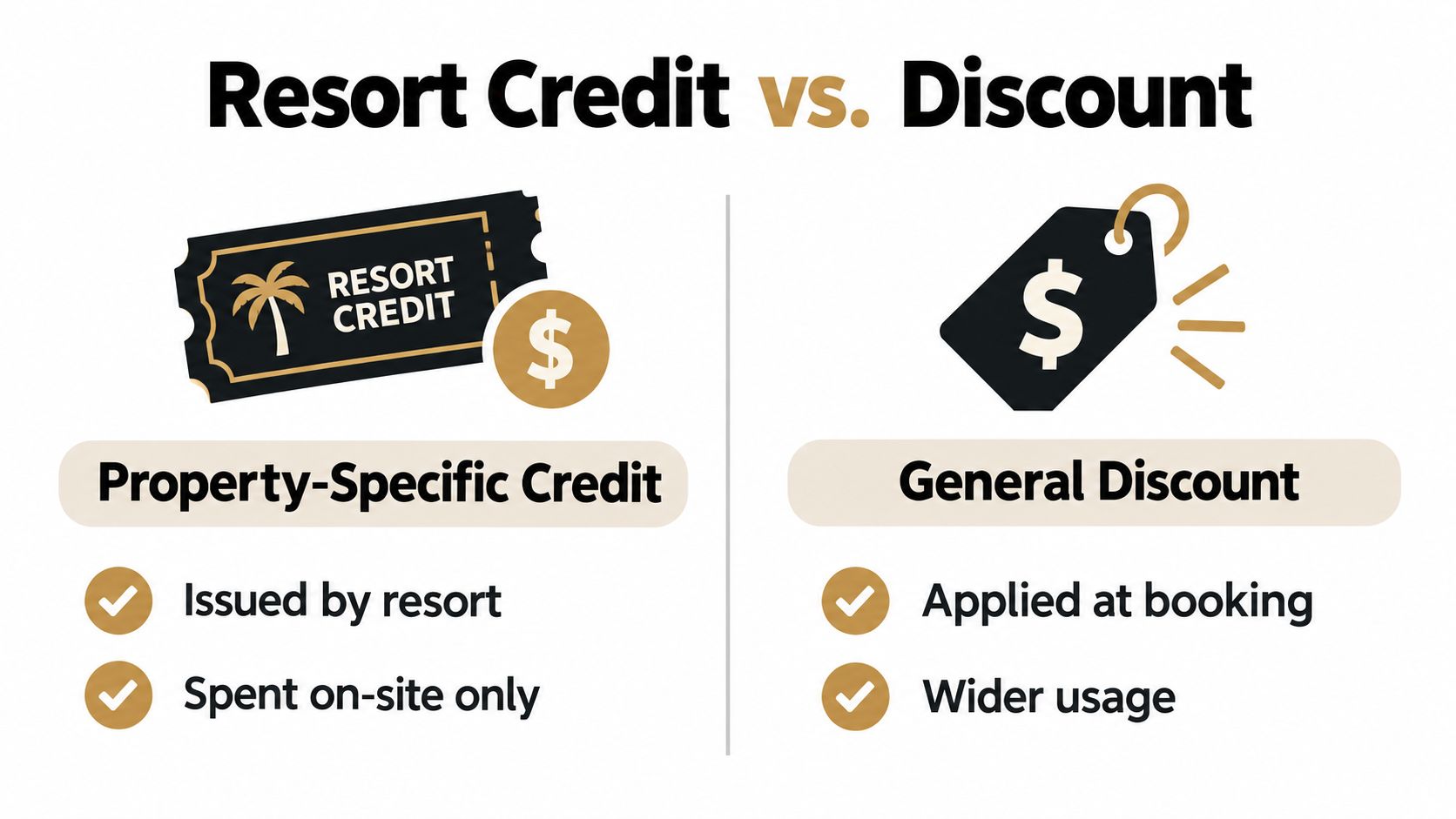
A resort credit is an allowance attached to an eligible hotel rate, package, or preferred-partner booking. The property applies it to qualifying purchases made during the stay, such as dining, spa treatments, activities, or other designated experiences. It generally doesn't reduce the room rate, create a cash refund, or change the underlying accommodation price.
That makes it different from a general booking discount. A discount is applied to the reservation price. A resort credit is usually tracked after you arrive and deducted from qualifying charges on your guest folio.
Credit versus mandatory fee
A resort fee works in the opposite direction. The Federal Trade Commission defines resort fees as mandatory per-room, per-night charges for purported amenities such as Wi-Fi, pools, fitness facilities, bottled water, or parking. The FTC explains that resort fees emerged in the late 1990s and remain separate from promotional credits. Read the Federal Trade Commission's economic analysis of hotel resort fees.
The distinction matters financially. A $100 resort credit is potential value you must redeem at eligible outlets. A $21 nightly resort fee adds approximately $84 over a four-night stay, whether or not you use the included amenities, based on the verified example in the FTC-related lodging analysis. The credit benefits you only when you spend in the permitted categories. The fee increases what you owe.
A University of Hawaiʻi summary reported that more than 1,000 U.S. hotels required resort fees, with approximately 7% of U.S. hotels charging them, average fees of about $21, and annual domestic hotel revenue of roughly $2.7 billion. Those figures make the distinction more than a vocabulary exercise. Travelers need to know whether a number is a benefit or a compulsory cost.
The credit's headline amount is therefore only the starting point. Terms determine value.
How Resort Credit Works Behind the Scenes
A resort credit is managed through the hotel's reservation and folio systems. The property attaches the benefit to a qualifying booking, then eligible charges are posted to the guest folio and deducted before final settlement. That process turns the headline allowance into a redemption question: every charge must reach the right account and meet the offer's terms.
Before arrival, confirm five details with the property or your advisor:
- Booking channel: The benefit may apply only to a preferred-partner reservation or a specific hotel offer.
- Rate code: A qualifying room category or promotional rate may be required.
- Stay dates: Blackout dates or excluded periods can remove the benefit.
- Length of stay: Some offers require a minimum stay before the credit applies.
- Participating outlets: The restaurant, spa, activity desk, or minibar must appear in the published terms.
The reservation link also controls who receives the allowance. A family occupying several rooms should not assume one room's credit covers the whole party. The terms may assign it to the reservation, room, registered guest, or defined stay.

Where the process fails
Operational mistakes can prevent an eligible charge from reaching the credit. Paying directly instead of charging to the room is a common example. A restaurant may operate inside the resort but belong to a separate company. A family assistant may post expenses to another room, while a concierge-arranged excursion is billed by an outside operator.
Handle folio instructions before arrival. Ask the property to identify the correct room account, then tell each participating outlet to post charges there. At check-in, repeat the request and review the folio before checkout.
For context on the booking relationship behind many preferred-partner benefits, see what a Virtuoso travel agent does. A capable advisor clarifies the rate, eligible benefit, room assignment, and posting process before the stay, so the credit has a practical chance of becoming saved spend.
Common Restrictions and Exclusions to Know
Published luxury-offer terms are usually clear once you know what to scan for. The most important exclusions concern charges that look connected to the stay but aren't treated as eligible spending.
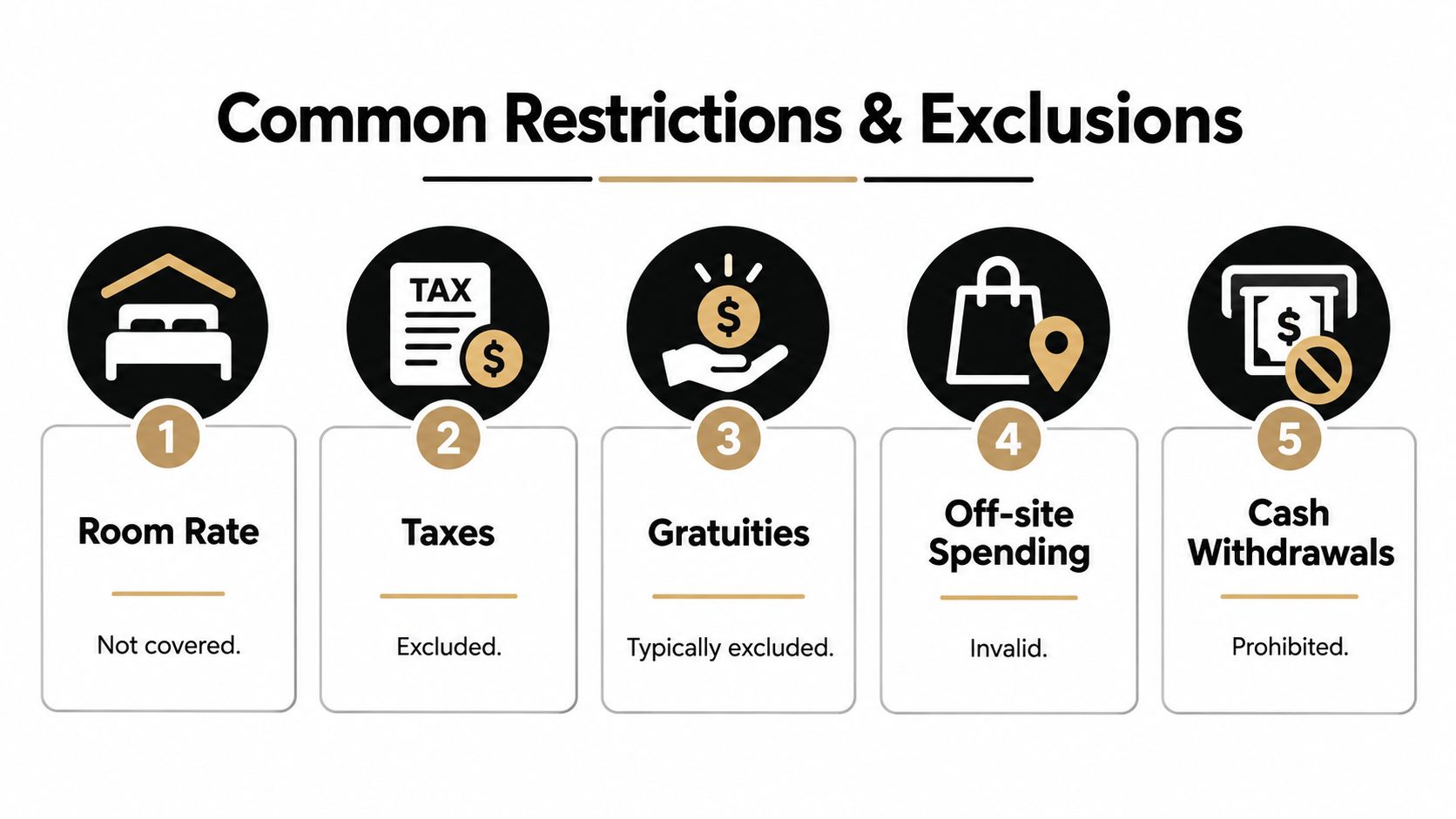
Room rate, taxes, service charges, gratuities, destination fees, and resort fees are commonly excluded. That means a dinner may consume the food portion of the bill while leaving taxes and gratuities payable separately. A credit also generally can't be used to reduce the accommodation charge.
Look for these clauses before you book:
- Minimum stay: An offer may require a defined number of nights before the benefit activates.
- Per stay or per night: A one-time allowance is not equivalent to a daily allowance.
- Blackout dates: The offer may be unavailable during selected periods.
- Eligible outlets: A property can name specific restaurants, spas, activities, or bars.
- Expiration: Unused value generally expires at checkout and isn't paid in cash or carried into a future stay.
- Non-transferability: The benefit may belong only to the qualifying room or reservation.
A published luxury offer illustrates the point. Certain terms specify credits of up to US$100 per day, a three-night minimum, and exclusions for room rate, taxes, service charges, destination fees, and resort fees. The same terms state that unused value can't be converted to cash or carried into a future stay. Review the published luxury offer terms.
The five-minute review
Before arrival, find the words that answer five questions: What qualifies? Where can I spend it? Is it daily or per stay? What does it exclude? When does it expire?
Don't rely on a booking page that says “resort credit” without linking to the full conditions. A $500 allowance issued once during a long stay can be less useful than a smaller daily benefit if your spending is distributed across the visit. Families, honeymooners, and guests with tightly planned itineraries often have very different redemption patterns.
Fine-print rule: If the terms don't name the outlet, the posting method, and the expiration point, get confirmation in writing before you arrive.
Where You Can and Cannot Spend a Resort Credit
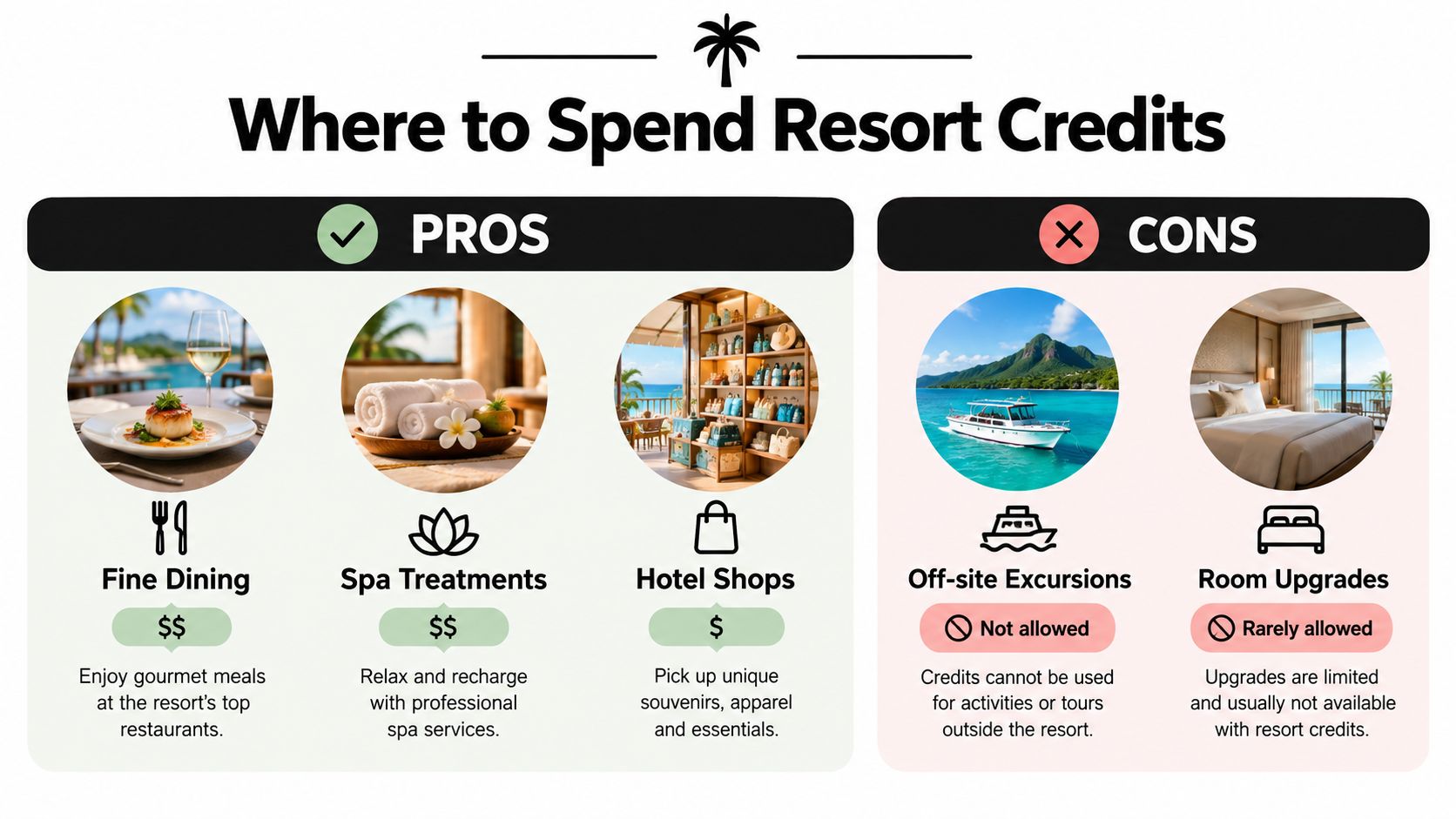
The most sensible use of a resort credit is usually an experience you would have purchased anyway. A signature restaurant, a spa treatment, a private meal, or a qualifying hotel activity can turn the allowance into something memorable instead of forcing you to buy minor items just to exhaust the balance.
Dining is often the cleanest example. A meal at the resort's principal restaurant may qualify, while an independent restaurant located on the same grounds may not. Ask whether the outlet posts directly to the hotel folio and whether beverages are treated differently from food.
Spa spending can be attractive, but don't assume every spa transaction qualifies. Treatments may be included while products, retail goods, or gratuities remain outside the allowance. The same logic applies to activities. A resort-run snorkeling session may qualify, while a helicopter tour operated and billed by a third party may not.
A practical comparison
| Spending choice | Likely treatment | What to confirm |
|---|---|---|
| Signature restaurant | Often eligible | Outlet participation and folio posting |
| Spa treatment | Often eligible | Whether products and gratuities are excluded |
| Private hotel experience | May be eligible | Whether the resort operates the experience |
| Minibar | Property-specific | Whether the minibar is a participating outlet |
| Room service | Property-specific | Whether delivery charges and service fees qualify |
| Retail shop | Often excluded or limited | Whether the shop is hotel-operated |
| Off-site tour | Frequently excluded | Who bills the charge and where it posts |
| Room upgrade | Rarely covered | Whether the credit can be exchanged for another benefit |
The key distinction is between where the experience happens and who supplies and bills it. A resort can arrange an off-site excursion without making it an eligible resort charge.
Spend the credit on one or two meaningful, eligible experiences. Don't manufacture consumption with purchases you wouldn't otherwise make.
Real Examples From Preferred-Partner Programs
Preferred-partner programs show why travelers should stop treating every resort credit as the same product. The amount, timing, and companion benefits can change by property and booking arrangement.
At certain Auberge Resorts properties, HauteBlack cites a typical approximately $100 resort credit, alongside daily breakfast for two per bedroom and a one-category upgrade when available. That example represents a one-time stay credit, not a daily allowance. See how preferred-partner benefits can work at Four Seasons.
Overwater-bungalow bookings can carry a different structure. HauteBlack describes standard benefits that can include $100 or more per day for private dinners, spa treatments, or island excursions, depending on the applicable partnership and booking conditions. During a seven-night stay, a full seven-day daily allowance would represent at least $700 in potential on-property value, before restrictions, exclusions, and unused balances are considered. Explore curated golf-lesson vouchers if you're pairing a luxury stay with a separately planned golf experience, but don't assume an external purchase can be charged against the hotel credit.
The upper end of the range
HauteBlack reports that preferred-partner bookings at Cheval Blanc Randheli may include approximately $150 to $250 per day, in addition to daily breakfast and a one-category upgrade subject to availability on arrival. A five-day eligible stay at that range represents $750 to $1,250 in potential resort credit before accounting for eligible categories, reservation requirements, taxes, gratuities, or unused value.
That is a meaningful benefit, but it still isn't cash. A traveler who prefers quiet beach days and rarely uses the spa may realize less value than a couple planning private dinners and wellness treatments. A family may value activities, while an executive traveler may prefer dining and a late departure.
The right question is not which property advertises the largest figure. It's which benefit structure aligns with the way you'll spend.
Smart Ways to Maximize the Credit
The strongest strategy is to reserve one marquee experience before arrival. A private chef dinner, a couples' spa circuit, or a guided activity is usually easier to plan and verify than a collection of small incidental purchases.
Start with the experience you would buy without the credit. Then ask whether the property can apply the allowance to it. That order matters. If you start with the credit, you may spend money to pursue a balance. If you start with your itinerary, the credit replaces spending already in your plan.
Use this pre-arrival script with your advisor or concierge:
1. “Which outlets participate, and which charges are excluded?” Ask about named restaurants, the spa, activities, minibar, room service, and retail.
2. “Is the credit per stay or per night?” Confirm whether unused daily value rolls forward or expires.
3. “Which room should carry the charges?” This matters for multi-room and multi-generational travel.
4. “Do I need advance reservations?” A credit is useless for a fully booked dinner or spa appointment.
5. “When can we review the folio?” Request a review before final checkout, not after the balance has disappeared.
A seasoned advisor may also ask whether the resort can substitute a different benefit, such as late checkout or an upgrade, when the advertised credit doesn't suit the guest's plans. That isn't guaranteed, and properties generally aren't required to exchange unused value. The conversation has a better chance when made before arrival, when the hotel still has room to shape the experience.
For a clearer view of the advisor's role in this process, read what a luxury travel advisor does. HauteBlack is one option for arranging preferred-partner bookings, clarifying benefits, and coordinating the pre-arrival details.
Use this sentence: “Please confirm the eligible outlets, the posting instructions, the credit cadence, and the folio review process in writing.”
Quick Takeaways Before Your Next Booking
Save this checklist before you compare luxury rates:
- A credit is not a discount: It applies to eligible on-property spending, not automatically to the room rate.
- A fee is not a benefit: A mandatory resort fee increases your bill, whether or not you use the associated amenities.
- The headline amount is theoretical: Your real value depends on eligible outlets, stay length, spending patterns, and expiration rules.
- Daily and per-stay are different: A one-time allowance shouldn't be compared directly with a nightly benefit.
- The folio controls the result: Post qualifying charges to the correct room and check the account before checkout.
- Plan the experience first: Choose dining, wellness, or activities you already want instead of inventing spend.
- Ask before arrival: Confirm exclusions, reservations, blackout dates, and whether an alternative benefit is possible.
- Use the booking channel strategically: A preferred-partner rate can combine a resort credit with benefits such as breakfast or an upgrade, subject to availability and terms.
The best credit isn't necessarily the largest one. It's the benefit with clear rules, broad enough outlet participation, and a structure that matches your itinerary. A well-placed advisor can also distinguish a genuine preferred-partner benefit from a generic promotional offer and confirm how the property will deliver it.
If your trip includes time in Waikiki, you can also browse tattoo inspiration articles before deciding whether a local creative experience belongs in your itinerary. Just keep outside purchases separate from the hotel ledger unless the resort confirms otherwise.
Book through a preferred-partner agency whenever the rate and property make sense. That is often the difference between a room-only reservation and a booking that includes the credit, breakfast, and a potential upgrade.
HauteBlack arranges preferred-partner hotel bookings with resort credits and other eligible benefits, then helps clarify the fine print before you arrive. Visit HauteBlack to discuss a custom stay and make sure the credit is attached to experiences you'll use.
Explore Our Guides


Signature Experiences


