Haute Black Journal
VIP Airport Lounge Access: Your Complete 2026 Guide

Marlene Azeez
Director, HauteBlack
View all articles →
Published August 25, 2026 by Marlene Azeez
You arrive at Heathrow Terminal 5 with a premium card, a confirmed boarding pass, and exactly enough time to settle before departure. The lounge agent checks the system, sees that capacity controls are active, and turns you away. Your guest has no access, the shower suite has a queue, and the quiet room is already functioning as a crowded co-working space.
That experience captures the new reality of VIP airport lounge access. The question isn't which card, status tier, or membership gets you through the door. The core question is whether your arrangements can deliver predictable entry, fast processing, suitable seating, and a calm environment when the terminal is under pressure.
Why VIP Airport Lounge Access No Longer Means What You Think
Lounge access used to feel like a fixed privilege. You held the right ticket or card, presented it at reception, and entered. That model has weakened as airport lounges have become a major global business. Industry estimates place the market at USD 9.7 billion in 2024, with a projection of USD 14.2 billion by 2030, while another forecast places it at USD 19.77 billion in 2025 and projects USD 63.36 billion by 2034. The difference between forecasts reflects a broad, rapidly evolving category, not a simple airline amenity. (Strategic Market Research's airport lounge market analysis)
The practical result is more access routes and more operational restrictions. Entry may come through your ticket or cabin, a paid visit, a membership, a credit-card benefit, or a corporate arrangement. Each route has its own guest rules, terminal limitations, time windows, and exclusions.
The access problems frequent travelers actually face
A premium benefit can still produce friction:
- Capacity throttling: The lounge may pause walk-in or paid entry before guests see obvious overcrowding.
- Guest restrictions: Your spouse, children, assistant, or client may not be admitted under the same terms as the primary holder.
- Terminal mismatch: A lounge can be available in the wrong terminal, with insufficient time to transfer airside.
- Amenity scarcity: A shower, private room, or quiet workspace may be advertised but unavailable at the moment you need it.
- Group uncertainty: Four travelers may have four different eligibility outcomes, particularly when airline, card, and membership rules overlap.
Advisor's rule: Treat lounge entry as a live travel operation, not a static card benefit.
That changes the buying decision. You shouldn't ask only, “Which lounge can I access?” Ask, “What happens if capacity closes, my party is split, or my departure moves to another terminal?” A reliable arrangement anticipates those failures before you reach the airport.
A Brief History of VIP Lounge Access
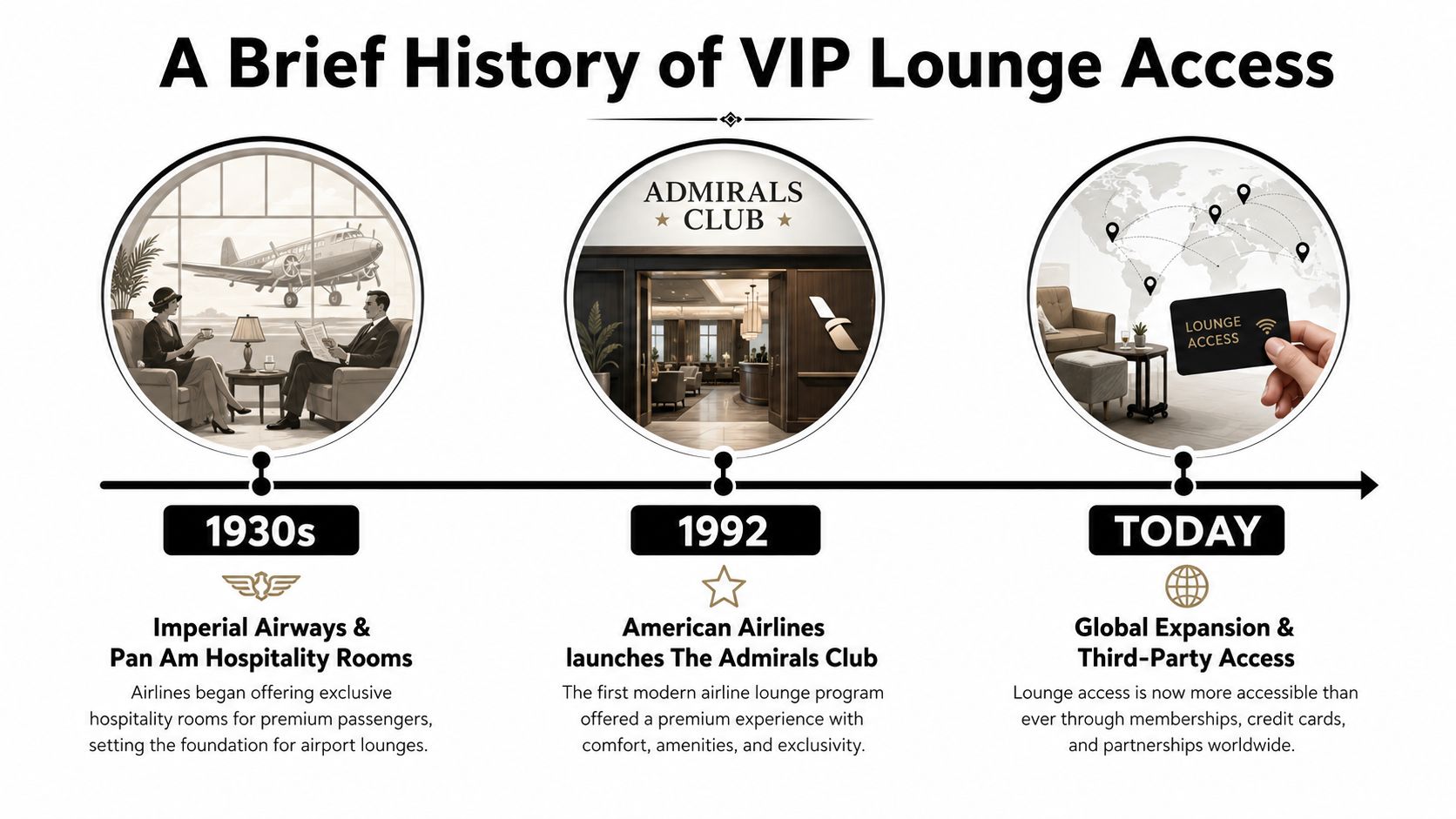
In the late 1930s, lounge access was a controlled relationship between an airline and a handpicked guest. American Airlines opened what is widely recognized as the first airline lounge at New York Municipal Airport, LaGuardia Field. Entry was by invitation, and guests were called “admirals”, giving the Admirals Club its name. (The history of the first airport lounge)
The model was simple. The airline chose the guests, managed the room, and defined the meaning of admission. A lounge functioned as a private extension of airline hospitality, not as a product travelers compared across cards, memberships, and terminals.
From invitation to commercialization
American Airlines formalized the paid model in 1967, introducing a USD 25 annual membership and a USD 250 lifetime membership. Lounge access became a purchasable travel benefit rather than a closed invitation. (The history of the first airport lounge)
Independent operators shifted control again. Travelers could use spaces serving multiple airlines, while membership networks and bank-linked programs widened access to premium leisure travelers, business travelers, and corporate users without airline elite status.
That expansion improved reach but weakened predictability. Ticket entitlements, paid visits, memberships, card benefits, and corporate arrangements now meet at the lounge door, each with separate rules. Cards and memberships can provide access, but they do not guarantee a quiet room, a suitable terminal, or admission for the entire party. VIP lounge access is therefore an orchestration problem. A concierge-led booking layer can check the route, terminal, timing, capacity, and guest requirements before arrival, turning a historical privilege into a more reliable part of the journey.
The Five Routes Into a VIP Lounge Today
A lounge pass is only useful when it works at the right terminal, at the right time, for the right party. Choose an access route according to certainty, network breadth, guest coverage, premium service, or operational control, then verify the operating details before departure.
How the main routes compare
| Access Route | Entry Certainty | Guest Policy | Premium Amenities | Best Fit |
|---|---|---|---|---|
| Private aviation and FBO terminals | Highest, with dedicated facilities | Usually arranged around the party | Private-terminal service and direct vehicle access | Charter clients, fractional flyers, and groups |
| Card-linked access | Moderate, subject to issuer and lounge controls | Varies sharply by card and spending conditions | Strong at proprietary card lounges, uneven elsewhere | Frequent cardholders using selected hubs |
| Airline elite status | High within the relevant airline network | Governed by status, cabin, and route rules | Often strongest in flagship airline lounges | Solo travelers loyal to one carrier |
| Paid single-visit entry | Variable, dependent on capacity | Usually paid separately or restricted | Basic lounge facilities are more common | Occasional travelers |
| Independent memberships and partnerships | Broad but inconsistent | Often fee-based or limited | Network breadth usually outweighs exclusivity | Leisure travelers visiting many airports |
Private aviation and FBO terminals deliver the most control. A dedicated facility reduces shared-lounge queues, and some operators can arrange direct vehicle transfer to the aircraft. The trade-off is practical: you need a suitable charter or fractional arrangement, and the option exists only at participating airports. Review HauteBlack's private aviation services within the full itinerary, not as a standalone lounge substitute.
Card-linked access through Amex Centurion, Capital One Venture X, and Chase Sapphire Reserve is convenient at selected hubs. It still depends on issuer terms, terminal location, guest rules, and capacity. Proprietary lounges can fill, while partner facilities may offer a different standard of seating and service. Check the exact lounge attached to your itinerary before relying on the card.
Airline elite status remains the strongest route for travelers who repeatedly fly one network. It aligns access with the ticket, cabin, and route, and can provide a more consistent standard in facilities such as Flagship First, The Concorde Room, or Singapore Airlines' Solitaire-linked experience. Guest access still follows the airline's conditions, so status does not automatically cover every companion.
Paid entry through LoungeKey or Plaza Premium suits a single trip without a long-term commitment. Admission may depend on available space, and guests usually require separate payment or approval. Independent memberships such as Priority Pass and Plaza Premium cover more airports, but the widest network can lead to shared rooms with limited control over seating and atmosphere.
Airport layout adds a separate operational risk. Travelers with mobility, sensory, or wayfinding needs should review practical airport accessibility challenges before choosing a lounge. The listed facility closest to the gate may still involve a difficult route, a terminal change, or insufficient transfer time.
Advisor verdict: Choose airline status for network loyalty, private terminals for maximum control, paid entry for occasional use, and card or membership access only after checking the specific airport, terminal, guest rules, and capacity conditions. A concierge should confirm those details and coordinate the route when a missed lounge would disrupt the arrival plan.
Why Reliability Is the New Luxury
A lounge can offer excellent food and still fail as a premium service if you can't enter or find a usable seat. J.D. Power reported that 46% of guests say their most-used lounge is usually moderately or severely crowded. Satisfaction falls from 833 to 589 when a lounge is severely crowded. (Forbes' coverage of the J.D. Power airport lounge findings)
Those figures clarify the value proposition. The luxury isn't the buffet. It's knowing that the room will absorb the pressure of a busy departure wave without forcing you into a queue, a shared table, or a noisy corridor.
How operators control the room
Lounge operators track the running difference between entries and exits and compare that figure with a comfort-capacity threshold, not just the maximum permitted by fire regulations. When the threshold approaches, staff can pause walk-ins or paid admissions before visible crowding becomes severe. (How airport lounges manage occupancy)
That process explains why an advertised entitlement may fail in practice. A membership gives you a route to request entry. It doesn't necessarily give you priority over committed airline guests, a reserved seat, or access during every departure bank.
Operators increasingly combine several controls:
- Timed entry windows reduce unpredictable arrivals.
- Reservation queues create a clearer order of access.
- Dynamic throttling limits non-essential admissions during pressure periods.
- Segmented spaces separate premium guests, quick-service users, and longer-stay travelers.
- Biometric corridors reduce document handling at the door.
Biometric programs are designed to validate facial identity and permit entry without repeatedly presenting a passport or boarding pass. One deployed airport program reported facial-recognition entry at five lounge access points, while other airport-biometrics systems are designed for throughput of up to 500 people per hour per gate. (Emirates facial-recognition travel coverage)
The strongest arrangements therefore combine three variables: access certainty, processing speed, and environment quality under load. If one fails, the room can feel ordinary no matter how impressive the amenities look online.
Choosing the Right Access Route for Your Travel Style
Start with your travel pattern, not the card brochure. A solo executive who flies repeatedly on one carrier needs a different solution from a family moving through several airports or an assistant coordinating a group itinerary.
Match the route to the traveler
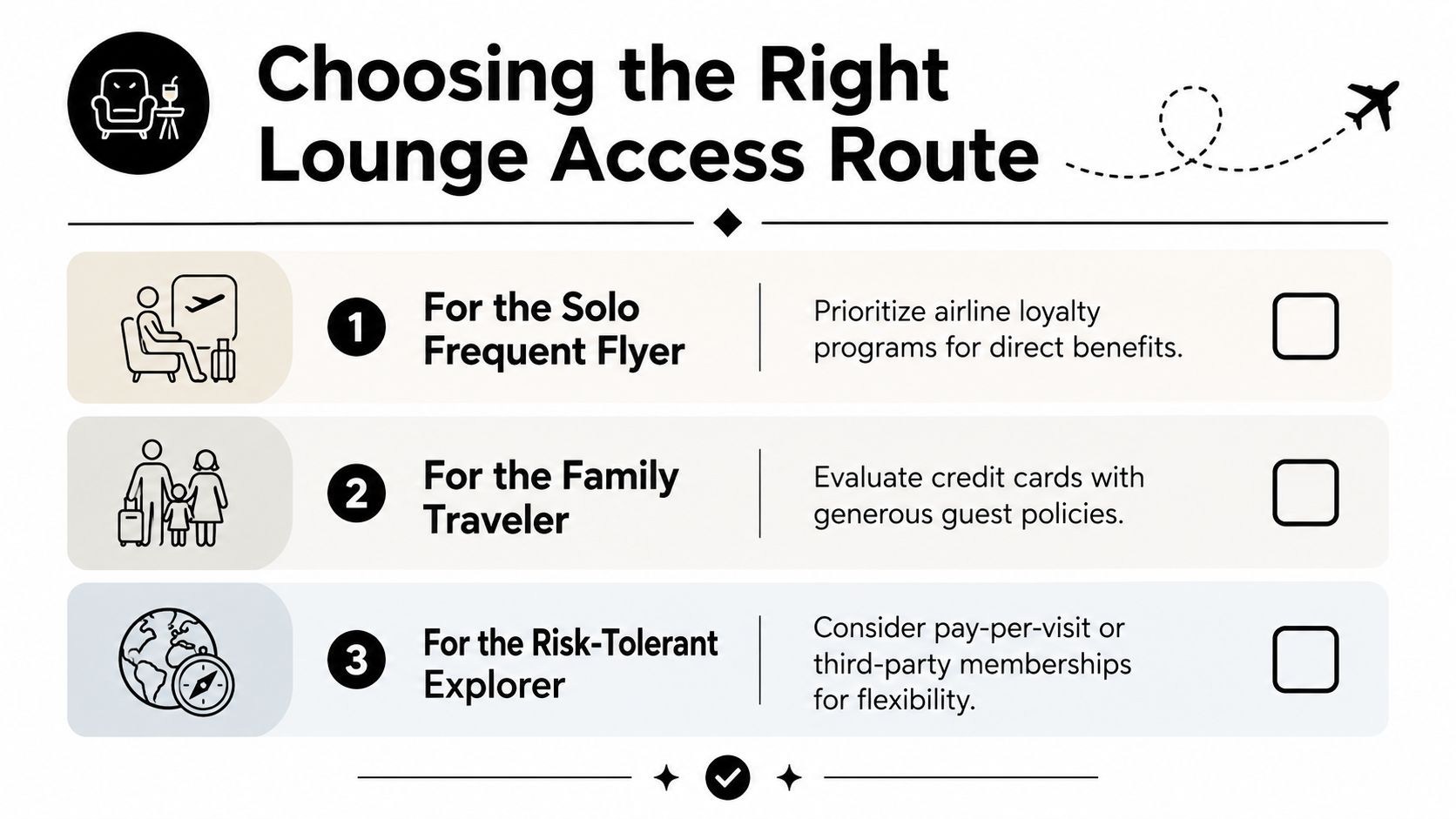
Solo frequent flyers should prioritize airline loyalty when their long-haul itineraries consistently use one network. Status can provide direct access to the carrier's own premium spaces and reduces the need to interpret several partner programs. It works best when the traveler's routes, cabin eligibility, and departure terminals remain predictable.
Families and multi-generational groups should study guest rules before paying an annual fee. A primary holder may have access while companions face separate charges, capacity restrictions, or age conditions. For a family, the relevant calculation is not “Is the card free?” It's “Can everyone enter the same room at the same time, without a last-minute exception?”
Infrequent travelers shouldn't chase status for its own sake. If you fly only occasionally, a paid visit or single-airline membership may be cleaner than maintaining a broad program you rarely use. Check the lounge's terminal location and same-day access conditions before purchase.
Corporate groups and simultaneous arrivals should consider private-terminal solutions or advisor-managed arrangements. Group travel creates more failure points because one denied guest can disrupt the entire departure plan.
Use a simple decision score
Rank each route against three questions:
1. Certainty: Can the provider confirm access for the exact date, terminal, and party?
2. Cost per use: Will the route remain sensible for your actual travel frequency?
3. Group coverage: Are spouses, children, assistants, or clients covered without unclear supplements?
Practical rule: If certainty ranks first, don't choose a route solely because it advertises unlimited access.
The same discipline applies to connected travel tools. If your itinerary crosses several countries, resolve troubleshooting eSIM across borders before departure, because a lounge reservation, driver message, or biometric instruction is only useful if you can receive it.
How a Luxury Travel Advisor Changes the Equation
Self-directed access ends at the point where the card, membership, or ticket meets the lounge rules. A luxury travel advisor adds a coordination layer around that entitlement. The advisor's value is not merely recommending a room with good reviews. It's arranging the conditions that make the room useful on the day you travel.
That can include checking whether a reservation slot is available at a flagship facility such as The Pier by Cathay Pacific or the Emirates First Class Lounge in Dubai, confirming the relevant terminal, and aligning the visit with the actual departure sequence. For a couple, the advisor confirms both travelers. For an executive traveling with an assistant or client, the advisor checks the entire party rather than assuming the primary traveler's access extends automatically.
What gets coordinated before departure
A properly managed booking can address:
- Reservation timing: The lounge visit fits the flight schedule and any entry window.
- Group seating: The request accounts for the number of travelers and the likely departure bank.
- Identity processing: Biometric or meet-and-greet instructions are activated before arrival where available.
- Ticket details: Booking classes, fare buckets, and frequent-flyer numbers are reviewed for missed airline benefits.
- Contingencies: Terminal changes, delays, and capacity restrictions receive an alternative plan.
Travelers often leave value unused inside their own booking. A frequent-flyer number may be missing, a booking class may affect recognition, or a partner benefit may apply only under a specific routing. Advisors can inspect those details as part of the wider itinerary instead of relying on the traveler to decode each program at the airport.
Private aviation introduces a separate operational advantage. When weather or air-traffic-control delays compress the schedule, direct communication with an FBO manager can help coordinate revised arrival timing, vehicle access, and apron movements. That is different from hoping a shared lounge remains open and available.
HauteBlack presents this work as part of a broader luxury travel service, including airport assistance and white-glove meet-and-greet support across a global airport network. Travelers evaluating the advisor model can also review what a Virtuoso travel agent is to understand how preferred relationships and itinerary management fit together.
The outcome is a shift from entitlement to orchestration. The advisor doesn't control every airport variable, but the advisor can verify more of them before you leave for the terminal.
Common Misconceptions About Lounge Access
Myth one, credit-card access is always cheapest
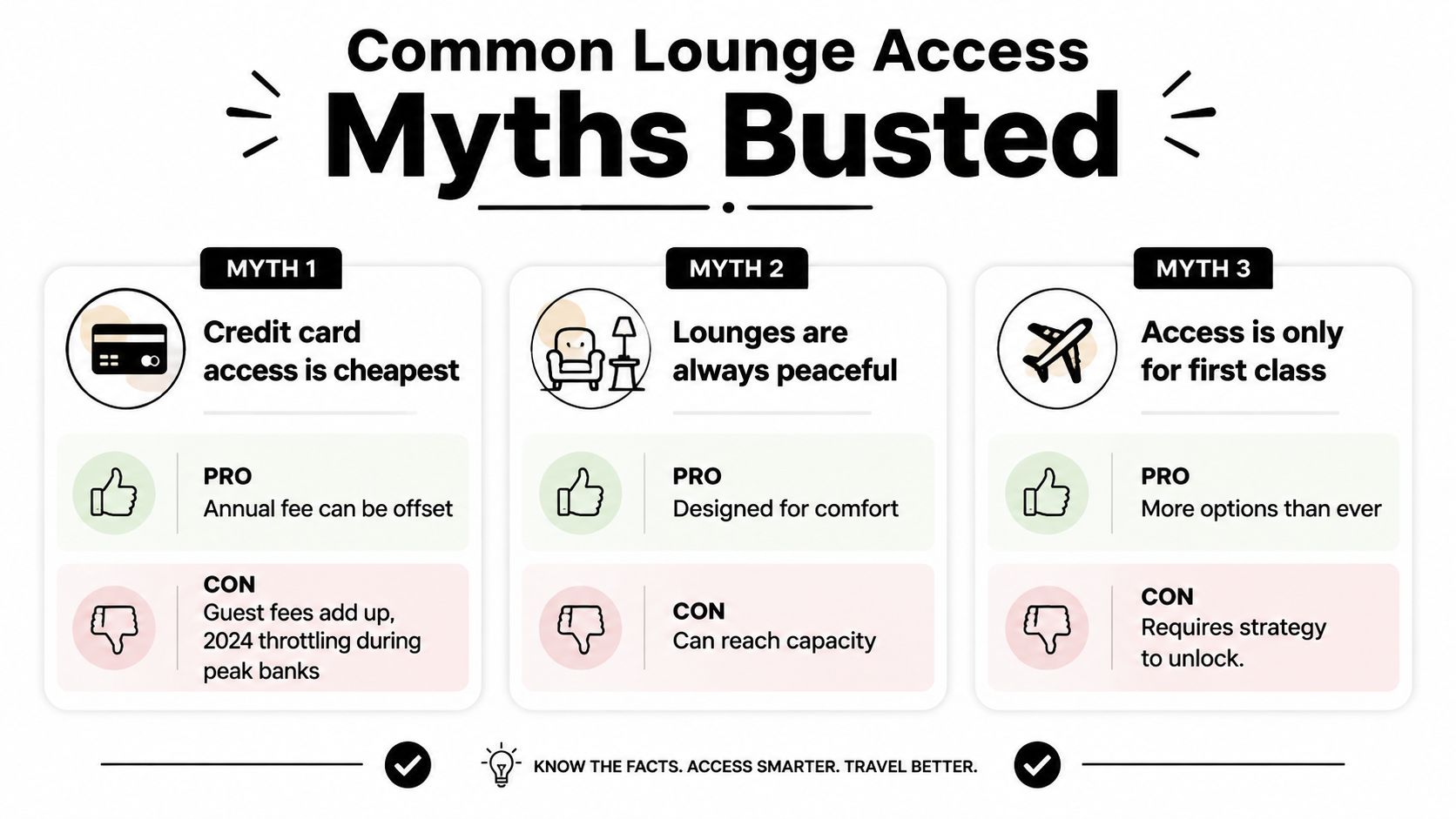
A card-linked benefit can be economical for a solo traveler who uses a compatible lounge regularly. It becomes less attractive when the traveler brings guests, encounters a capacity restriction, or discovers that a favored partner lounge isn't included. Recent program changes have included tighter guest rules, with some programs requiring USD 75,000 in annual spend for complimentary guests and others ending unlimited guest access. (Coverage of changing lounge guest policies)
The 2024 Priority Pass restaurant-credit cutbacks add another complication. A benefit that looks generous on an annual-fee summary may deliver less value when dining alternatives disappear or guest charges accumulate. Review the exact airport and party composition before calling card access inexpensive.
Myth two, airline status guarantees a peaceful room
Airline status can establish eligibility, but it doesn't eliminate crowding. A domestic First Class traveler or Gold-tier member may still be directed to a busy Admirals Club or a partner lounge with stricter rules. Status answers the question of whether you qualify. It doesn't answer whether the room has a quiet seat, available shower, or manageable noise level.
Myth three, one membership creates global consistency
Priority Pass, LoungeKey, and Plaza Premium networks overlap, but not perfectly. A membership may work at a major hub and fail at a secondary airport, or offer a lounge in one terminal while your flight departs from another. Conditions also vary between facilities, including opening hours, time limits, guest treatment, and whether entry is paused during peak periods.
The correction is simple. Check the actual lounge, terminal, party, and time before departure, then arrange a fallback when the journey matters.
The following video adds useful visual context to the lounge-access experience and its practical limitations:
What a Reliable Arrival Looks Like and What Comes Next
A reliable arrival is coordinated before the aircraft lands. Lounge access is confirmed, identity or biometric processing is ready where available, the meeting point is clear, and ground transport is staged for the next leg. The departure route is mapped in advance, whether it leads on foot to the gate, through an airside transfer, or directly to an FBO apron.
That coordination protects the value of the lounge. A quiet room gives you working time, family calm, or recovery between flights. A clear exit plan prevents document checks, terminal searches, and guest-eligibility questions from consuming the minutes you intended to save.
Build the arrival around the whole airport journey
A dependable plan links five decisions:
- Before arrival: Verify the terminal, entry conditions, guest names, and reservation timing.
- At the door: Use the fastest available identity and document process.
- Inside: Choose the space that fits work, rest, dining, or family needs.
- Before departure: Confirm gate distance, boarding time, and any escort or transfer service.
- After disruption: Rebook lounge and transport arrangements when delays alter the itinerary.
Pre-booking, segmented rooms, grab-and-go formats, and paid upgrades are changing how travelers secure access. Pre-booking is expanding to about 200 lounges globally, a sign that confirmed entry matters more than an open-ended membership promise.
Airline and private aviation partnerships will continue connecting premium ground handling with premium cabins. The practical priority remains the same: coordinate the arrival, lounge stay, departure route, and ground transfer as one itinerary.
A concierge booking layer addresses the gaps that cards and memberships leave behind. It checks the actual terminal, confirms the party, monitors timing, and adjusts the plan when a delay changes the connection. For the broader curb-to-seat experience, read HauteBlack's VIP Airport Concierge Services guide, which also covers related luxury travel planning.
At New York JFK, for example, a traveler connecting through a different terminal needs more than a lounge credential. The plan should confirm the correct facility, allow time for the terminal transfer, and stage the car at the appropriate arrivals area. HauteBlack coordinates VIP airport assistance, lounge access, meet-and-greet services, private aviation, and ground transport around the itinerary. Visit HauteBlack to arrange confirmed access and dependable movement through the airport.
Frequently Asked Questions
Explore Our Guides


Signature Experiences