Haute Black Journal
Te Anau Fiordland Lodge: The Ultimate Luxury Guide

Marlene Azeez
Director, HauteBlack
View all articles →
# Te Anau Fiordland Lodge: The Ultimate Luxury Guide
Published July 28, 2026 by Marlene Azeez
You've just pulled into Te Anau after a long drive, you're deciding whether to push on toward Milford Sound or settle into a base that fits a luxury itinerary, and the question is simple. Do you want convenience, or do you want the quiet, highly controlled kind of seclusion that makes a Fiordland trip feel deliberate?
Te Anau Fiordland Lodge sits at 472 Te Anau Milford Highway in Te Anau, right on the route to Milford Sound and squarely in the Fiordland gateway zone Fiordland Lodge venue listing. That address matters more than most hotel copy admits. It puts you in the setting, not in a town center pretending to be the setting. Te Anau itself sits on the eastern shore of Lake Te Anau, a broad body of water tied to the region's tourism identity Te Anau geography, and that backdrop is the whole point of choosing a lodge like this over a standard hotel.
I like this property for one kind of traveler, the one who values a small, controlled stay over easy walkable convenience. I do not like it for guests who want the flexibility of a bigger town base, casual dinner options, or the ability to improvise every part of the day. This is a 12-room lodge Orbitz listing, and that scale shapes everything, from service intensity to how quickly the property feels full, intimate, and slightly inflexible. If you've ever packed for a remote lodge and forgotten a few essentials, a practical resource like compact toothbrushes for hotels is the kind of small detail that saves annoyance later.
A Secluded Gateway to Fiordland National Park
Arriving at Te Anau Fiordland Lodge feels less like checking into a hotel and more like stepping into a controlled pause. The road does the work first, the lake and mountains take over second, and by the time you reach 472 Te Anau Milford Highway, the appeal is obvious. You are outside the town center, and that is the point.
What the location really gives you
The lodge's position on the Milford route is the luxury feature. Te Anau is the gateway to Fiordland National Park, and this base suits travelers who want early starts, scenic returns, and a quieter arrival after a long day on the road. You get efficient access for a Milford Sound run, then return to a property that feels removed from the day-trip churn.
The trade-off is direct. Staying here means giving up easy town convenience in exchange for privacy and a more deliberate Fiordland stay. That is a strong fit for couples, photographers, and travelers who prefer calm over foot traffic. It is a poor fit for guests who want to walk out for dinner and have several casual options at hand.
Practical rule: choose this lodge if your itinerary is built around Fiordland itself, not around Te Anau as a town.
Why the small scale matters
A lodge with 12 rooms Orbitz listing behaves differently from a conventional hotel. The atmosphere stays quiet, the service feels more personal, and the whole stay runs with tighter control. In a remote setting, that matters because there is no lobby crowd to disappear into and no city noise to blur the rough edges.
That small footprint also changes how you should book. Once the lodge fills, it fills in a practical sense, not just in marketing copy. There is less room for groups, less flexibility for last-minute multi-room requests, and more reason to treat the stay as part of the trip plan rather than a backup option.
Pack with that in mind. Remote lodges reward travelers who arrive prepared, and a few well-chosen essentials, including compact toothbrushes for hotels, save unnecessary friction when you are far from town. The right mindset is simple. Use the remoteness as part of the luxury, not as a compromise you tolerate. If convenience is the priority, stay closer to central Te Anau. If you want the property itself to feel like part of the Fiordland story, this location makes sense.
Accommodation Types and Standout Suites
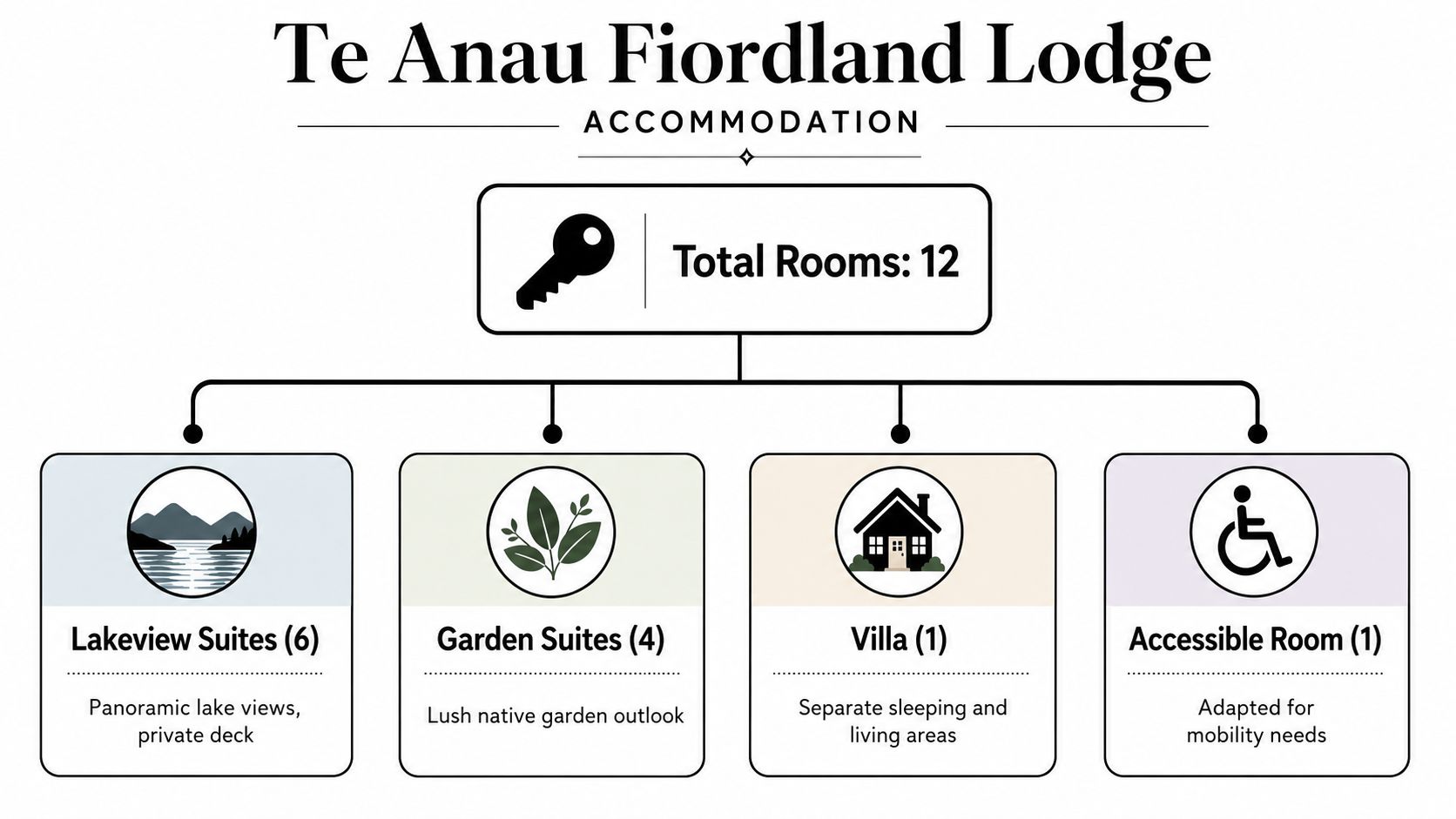
The room count is tiny, and that changes everything. A 12-room lodge does not operate like a standard hotel, so treat the mix as a set of practical trade-offs rather than a full range of interchangeable choices. Trip.com's listing even describes the lodge as having 5 rooms Trip.com listing, which only reinforces the point. Inventory is tight, the stay feels private, and you need to book with purpose.
How I'd rank the room types
The lake-facing suites are the clear pick for couples and for anyone who wants the setting to justify the premium. The value is not just the view, it is the way the room places you inside the Fiordland experience instead of framing it from a distance. For a romantic stay, that difference is real.
The garden-oriented rooms suit travelers who care more about quiet and privacy than a postcard outlook. They make sense if your days are spent on the road or out on excursions and you only need the room as a calm place to return to. I would also keep them on the shortlist for solo travelers who prefer atmosphere and function over paying for a view they will not use much.
The villa-style option works best for guests who want clear separation between sleeping and living space. That separation helps on longer stays, for travelers with more gear, and for anyone who dislikes a standard lodge-room setup. In a small property, that extra space feels more useful than it sounds on paper.
The accessible room should be secured early if mobility matters, because a small lodge cannot absorb special requirements the way a large hotel can. Ask before you commit, and do not assume a later switch will be easy.
Good booking behavior: request your preferred room type early, then confirm whether your stay depends on a lake view, mobility access, or a separate living area.
What to expect from a small inventory
A limited room count changes the rhythm of the stay. You are reserving a slice of the property's attention, not just a bed. That usually brings more personal service and less internal congestion, but it also means you need to be precise about what you want.
If you are traveling with other couples, a multi-room booking is not something to leave until the last minute. Plan ahead, especially in peak periods, because a lodge this small is built for intimacy rather than bulk inventory. The upside is straightforward. The downside is too. When you get the right room, the stay feels curated rather than just managed.
For travelers who care about presentation, the room choice should follow one rule. Pay for the view if the trip is about the setting. Skip the premium if your schedule is packed and the room will mainly be a place to sleep. That is the honest way to book this lodge.
Pack accordingly, too. Remote stays reward practical travelers, and the right accessories reduce friction when you are far from town. A good robe matters more than some might expect, so consult the best hotel robes buying guide before you pack. For broader trip planning, I also recommend using Haute Black dining coordination services as a model for arranging meals and timing in a remote itinerary.
Dining and Wellness at the Lodge
Breakfast at a place like this should be slow, and that's exactly how it should feel. You wake up, look out toward the lake and surrounding Fiordland terrain, and let the day begin without the pressure of a city schedule. The lodge's on-site dining setup, along with free breakfast and an on-site restaurant listed in booking materials, makes that easy Orbitz listing.
The right way to use the dining setup
This is not a property built around restaurant hopping. It's built around one high-touch dining rhythm that works because the lodge is small. That makes it especially useful for travelers who want a private, low-friction evening after a long drive or a full Milford day.
If you're planning special requests, remote-lodge realism matters. Supply chains are not as forgiving as they are in a city, so the right move is to communicate dietary needs early and keep the menu expectations sensible. A lodge of this size is much better at thoughtful execution than at improvisation on demand.
For a broader look at how I think about dining logistics in luxury travel, I'd point travelers to Haute Black dining services as one useful way to think about pre-arranged meal coordination when you're moving through a remote itinerary.
Sauna, quiet, and the value of staying put
The property's sauna is not a gimmick. In Fiordland, wellness is mostly about recovery and stillness, not about a sprawling spa agenda. A small-scale lodge can do this well because it does not overwhelm you with choices. You eat, you unwind, you reset.
The best evening here is simple. Early drink, unhurried dinner, then a short walk or quiet time before bed. If you're traveling as a couple, that rhythm is strong. If you're a family group, it gives tired people a place to decompress without needing another reservation or another drive into town.
I would not book this lodge for culinary variety. I would book it for a coherent, calm, well-paced evening that supports the rest of the itinerary. That is a very different value proposition, and it's the right one for many Fiordland trips.
Curated Experiences and Fiordland Adventures
The question is not whether you can book Fiordland experiences from Te Anau. You can. The question is whether the lodge adds enough value to justify having someone else arrange them. In a region this remote, that answer is often yes, but not always.
Where the lodge earns its keep
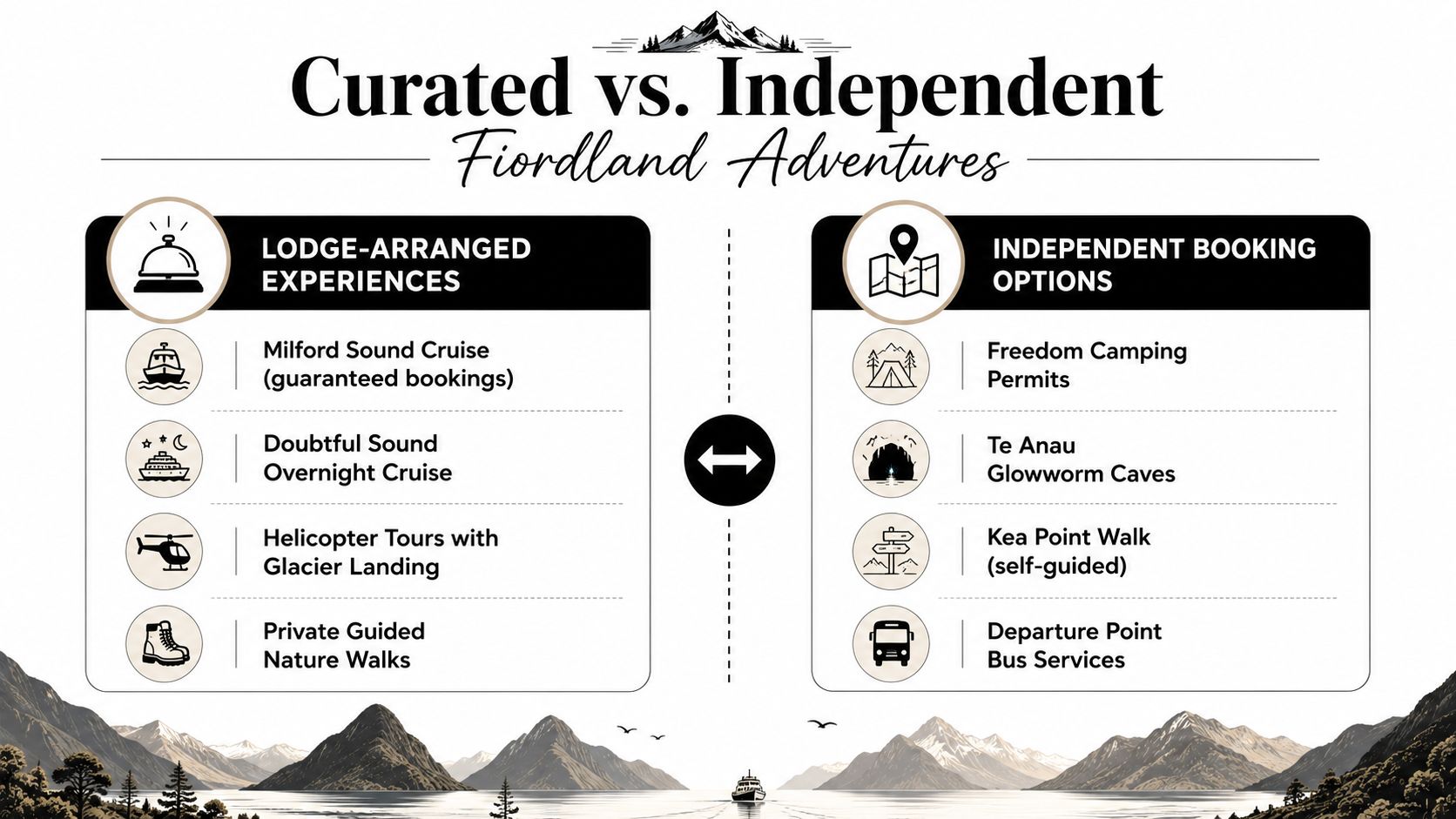
If you want a Milford Sound cruise, a Doubtful Sound overnight, a helicopter outing, or a private nature walk, lodge-arranged booking can save time and reduce friction. That matters most when availability is tight or when your day has to run on a fixed schedule. On a remote South Island trip, coordination is often the primary luxury, not the activity itself.
Independent bookings still make sense for lower-complexity plans. Self-guided walks, simple local stops, and flexible daytime activities can be easier to source on your own. For travelers who are comfortable managing timing, that's often the cleaner option.
For a richer activity-planning lens, I'd treat Haute Black experiences as one example of how a concierge-style layer can simplify multi-part Fiordland days without forcing you into a rigid package.
What I'd book through the lodge
I'd lean on the lodge or an advisor for anything with a hard departure time, a limited-capacity format, or multiple moving parts. That includes cruises, guided lake days, and air-based excursions. A remote base rewards good coordination, and that coordination is worth paying for when the trip is already expensive and timing-sensitive.
I would not overcomplicate short self-drive add-ons. Keep those independent unless you specifically want a fully arranged schedule. That keeps the lodge from becoming a middleman for things you could easily handle yourself.
For travelers who prefer private-arrival logistics, one possibility is arranging ground transport through a service like QR loyalty for quick-service, especially if your broader trip involves timed transfers and structured dining stops. It's not about gimmicks, it's about removing small layers of friction.
The best approach is blunt. Use the lodge for high-value coordination, not for every possible booking. That preserves flexibility and lets the property do what it's good at.
Logistics and Transfer Options
Getting to Te Anau Fiordland Lodge should be treated as part of the trip design, not as a background task. The property lists check-in from 2:00 PM to 10:00 PM and check-out by 10:00 AM Expedia listing, and that narrow window matters if you're flying in late, driving from Queenstown, or trying to depart early for Milford Sound.
How to arrive without stress
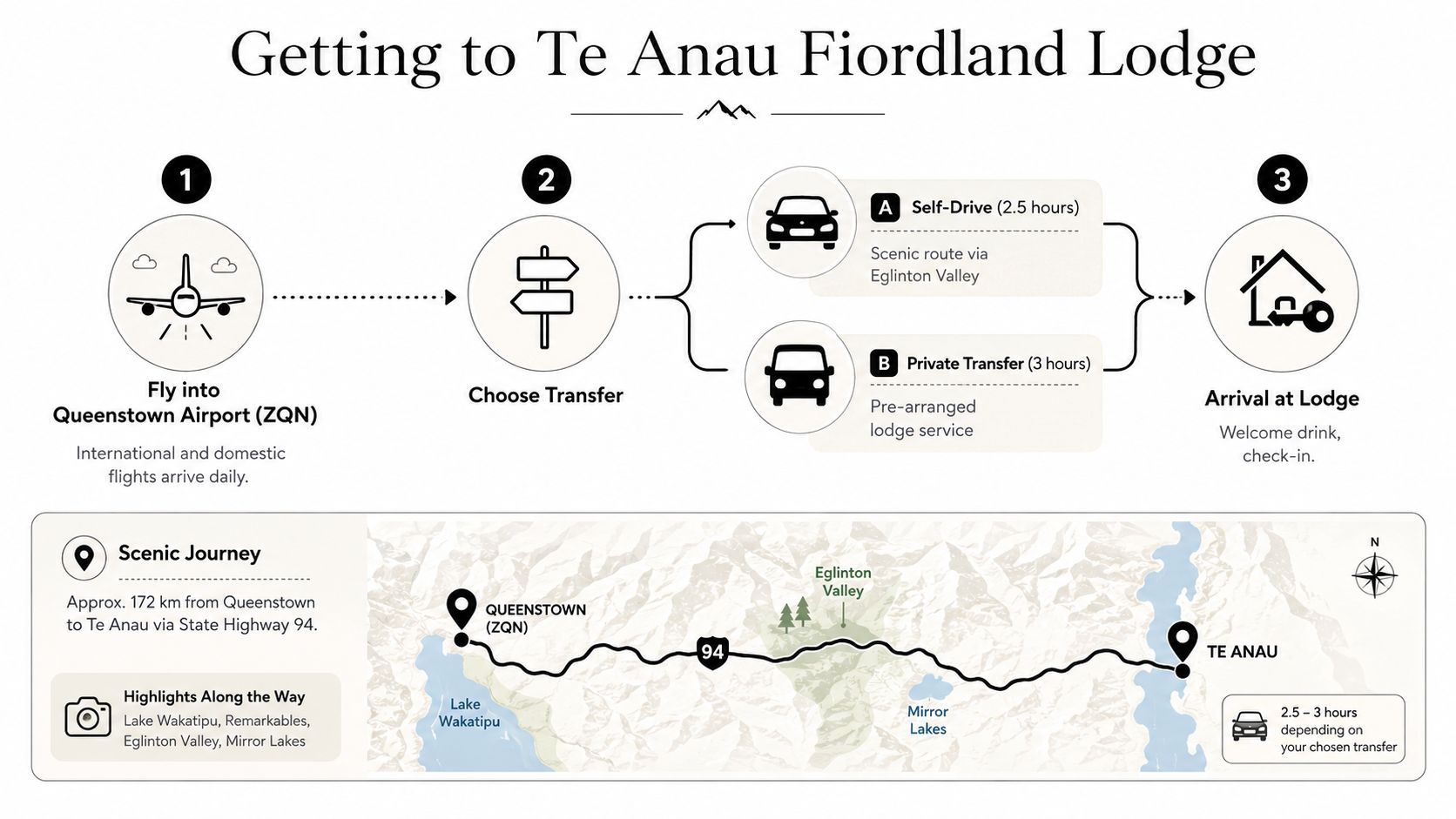
If you're self-driving, leave enough margin for a relaxed check-in and a grocery stop in Te Anau. The town is the last sensible place to handle errands before the Fiordland road takes over, and the broader Milford route is not where you want to be improvising. The lodge's free self-parking is useful here Orbitz listing, because it supports the self-drive model instead of pretending you don't need a car.
If you're landing at Queenstown Airport, a private transfer is cleaner than a rental if you're staying put for several nights. That's especially true for travelers who do not want to waste a luxury day on alpine driving logistics. A transfer turns the arrival into a handoff rather than a project, which is exactly how premium travel should feel.
For a broader look at that choice, the logic in private transfer services for luxury ground transport applies directly to this kind of Fiordland base.
My rule: if your stay is short and activity-heavy, book the transfer first and let the lodge be the destination, not the vehicle problem.
What the timetable means in practice
The 2 PM arrival window is workable, but it punishes sloppy planning. Late flights, slow lunch stops, and last-minute detours can all compress your day too much. The 10 AM departure is also strict enough that you should not plan a leisurely final morning unless your next stop is very close.
That is why I prefer a structure where you arrive earlier in the afternoon, settle in, then begin the next full day fresh. If you're heading to Milford Sound early the following morning, keep breakfast and departure logistics simple. If you're leaving the lodge to drive onward, do not leave the packing for after breakfast.
Central Te Anau hotels give you more casual flexibility, but they don't give you this same sense of escape. The lodge is more disciplined. For some travelers, that discipline is the luxury.
Seasonal Recommendations for Every Traveler
Fiordland changes the way the same lodge feels. That's why the right season depends less on the calendar and more on what you want the trip to do for you. Summer is the obvious high-demand period for hiking and long daylight. Autumn gives the surroundings a quieter, more reflective mood. Winter is for atmosphere and travelers who want the drama of a remote stay. Spring is for people who can tolerate uncertainty and like seeing the region wake up.
Choose the season by travel style
If you're a photographer, shoulder seasons can be more rewarding because the light feels sharper and the crowds ease off. If you're a hiker, summer is the natural fit, but the Fiordland setting still asks for flexibility because weather can shift. If you're planning a couple's escape, winter can be excellent precisely because the lodge feels more cocooned and intentional.
Families need a different filter. School schedules often push travel into busy periods, which means planning matters more and room availability tightens. In a small property, that matters immediately because there is no surplus inventory to smooth over a late decision.
Best mindset: book the season that matches your priority, not the one that looks prettiest in a brochure.
What to prioritize when you book
If your goal is seclusion, go when you're least likely to share the road and the fjord with every other traveler. If your goal is activity, choose the season that gives you the most daylight and the easiest trail access. If your goal is pure atmosphere, pick the time of year when you're most willing to lean into the weather instead of fighting it.
The lodge works in every season, but the experience changes. That's why I would never book it on autopilot. The setting is too specific for that.
Suggested Itineraries for Different Travel Styles
A good Fiordland itinerary should respect the lodge's check-in and check-out rhythm rather than fighting it. That means arrival day should feel light, full days should carry the heavy lifting, and departure day should be protected from unnecessary complexity. If you get that structure right, the stay feels elegant. If you don't, it feels rushed.
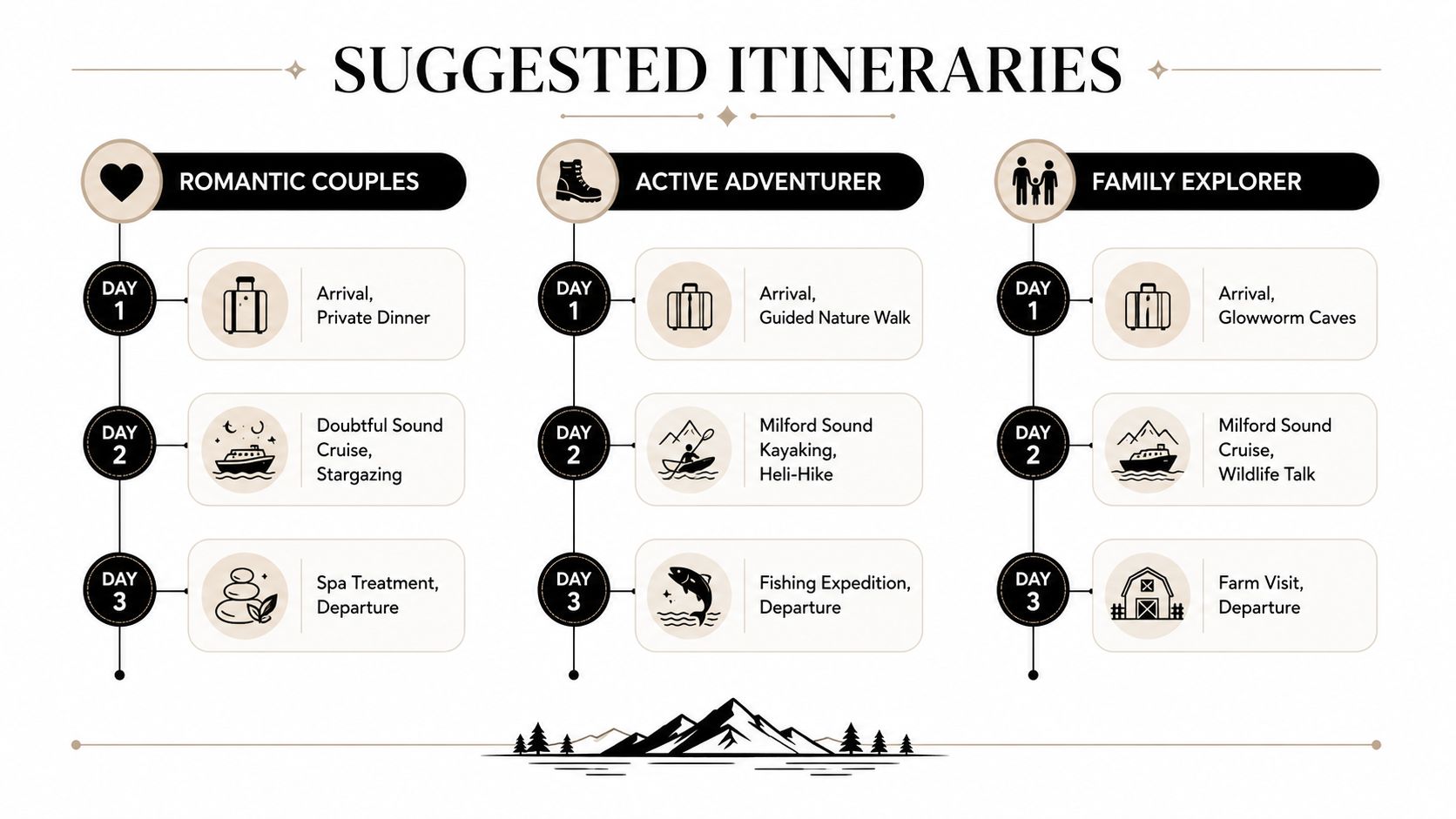
Romantic couples
For couples, I'd do a 3-night stay. Arrival day should be simple, check in, settle, and keep dinner on-property. The next day belongs to a long Fjordland outing, then back to the lodge for a quiet evening. Use the final full day for slower activities and late-afternoon downtime.
That structure works because the lodge itself is part of the romance. You do not need to pack every hour. You need one or two strong shared experiences and enough space for the property to feel like a retreat.
Active adventurers
For travelers who want to move, a 4-night stay makes more sense. Arrival day can absorb the travel fatigue, then the full days can alternate between a major Fiordland excursion and a local walk or guided outing. Don't force a massive day trip immediately after flying in, because Fiordland rewards people who start fresh.
I'd keep departure day clean and early. Active itineraries collapse when the last morning gets crowded, and this lodge's checkout window is too tight for that kind of improvisation.
Families
Families should prioritize pacing over ambition. Book a stay that leaves room for one anchor outing, one lighter day, and at least one slow morning at the lodge. A remote property works best for families when it reduces decision fatigue rather than amplifying it.
The strongest family itinerary is the one that doesn't try to imitate a couple's trip. Use the lodge as an anchor, not a race start.
VIP Booking Tips and Haute Black Value Adds
Book early if you want the room category you want, especially in the higher-demand periods when a small lodge inventory tightens fast. At this scale, last-minute flexibility is limited, so special requests need to be placed before the stay becomes a logistics problem. A dedicated advisor can handle that coordination more cleanly than a rushed direct booking.
Haute Black can be used as one booking channel that combines hotel placement, pre-arrival coordination, and access to preferred-partner style benefits where available. For this kind of remote stay, the value is not hype, it's cleaner handoff, fewer loose ends, and better timing around your transfer and activity schedule. If you're planning a broader New Zealand route, combine the lodge with other properties and keep the whole trip moving on one organized thread.
My advice: send room preferences, dietary notes, transfer timing, and activity priorities together. Fragmented requests create fragmented results.
If you want this Fiordland stay handled properly, use a luxury advisor who knows how to sequence the trip around the lodge's limited inventory and tight timing. That's the difference between a pretty booking and a smooth arrival.
If Te Anau Fiordland Lodge is on your shortlist, Haute Black can help you turn it into a clean, high-touch Fiordland itinerary instead of a pile of disconnected bookings. Visit Haute Black to plan the lodge, transfers, and onward New Zealand stays with one advisor who can keep the whole route moving.
Explore Our Guides


Signature Experiences


