Haute Black Journal
Members Events: Inside the World of Private VIP Access

Marlene Azeez
Director, HauteBlack
View all articles →
August 27, 2026
You've sat through the conference, accepted the “VIP” wristband, exchanged polite introductions, and left with little more than a badge scan and an expensive canapé. Your calendar is full, yet the rooms that promised access haven't produced a useful relationship, a meaningful invitation, or a reason to return.
That's the problem serious members events are designed to solve. The right gathering doesn't ask you to network harder. It gives you a better room, a clearer purpose, and access that would be difficult to arrange independently. HauteBlack's news page is a useful lens for understanding that shift, because its editorial calendar connects executive networking, destination expertise, cultural access, family travel, and retreat planning in one private-membership ecosystem.
Why Members Events Matter More Than Ever
The modern members event is a deliberate response to the excess of public programming. Large conferences can provide visibility, but visibility isn't the same as trust. A crowded lounge may contain impressive names, yet the setting often encourages quick exchanges rather than conversations that lead somewhere.
Private dinners, invitation-only retreats, and partner-led activations work differently. The host can shape the guest list, control the pace, and create a setting where people have enough context to speak candidly. That matters to executives, founders, investors, and creatives who already have access to events, but lack access to the right people in the right conditions.
Membership culture has a long history of using controlled access to create social and commercial value. London's private-club tradition emerged from 17th-century coffee houses, developed into formal clubs in the 18th century, and reached a Victorian peak of more than 400 clubs before falling to fewer than 40 today, as described in this historical overview of London's private members' clubs. Those clubs gave members a setting for elite socializing, politics, gambling, and business away from public scrutiny.
The event is now an engagement channel
Modern membership organizations treat events as more than occasional hospitality. Member Jungle reported 18,223 events held in 2025, a 34% year-over-year increase, alongside 179,466 event registrations and 15,638 event scans, in its membership management benchmark. The same source cites a 2024 survey in which nearly 90% of association respondents regarded events as their top member-engagement tool, while 86% ranked attendance as the leading engagement metric.
Those figures point to a practical truth. Events are where membership becomes tangible. A private club can promise access, but the member experiences that promise through a dinner, retreat, salon, or cultural invitation.
The rest of the HauteBlack news ecosystem makes the distinction clear. Its coverage of executive access sits alongside guides to Botswana's Chiefs Camp, elite children's travel activities, and executive retreat locations. That combination reflects how private event culture works now. Travel, networking, culture, and recognition aren't separate products. They're different doors into the same relationship network.
What Members Events Actually Are
A members event is a hosted experience whose guest list is filtered through membership, application, or partner invitation. It isn't a public event with a more expensive ticket. The distinction lies in who gets considered, who controls the room, and what happens after the gathering ends.
The format developed from the salon and private-club tradition, where social access depended on reputation and affiliation. London's formal clubs created spaces for repeated interaction among people who shared status, interests, or professional influence. Later private-club models adapted that logic for hospitality, design, dining, creative work, and travel.
Today's version has a more deliberate operating system.
The mechanics of a private room
A well-run members event usually includes:
- Vetted RSVPs: Hosts assess relevance, conduct, and fit rather than filling every available seat.
- Non-transferable invitations: The guest list remains intentional, which protects the experience from becoming a chain of casual substitutions.
- Curator oversight: Someone takes responsibility for the balance of professions, interests, personalities, and relationships in the room.
- Partner access layers: A private event may depend on a hotel, chef, gallery, sporting institution, estate, or cultural partner.
- Follow-up programming: The relationship continues through another introduction, a later dinner, a trip, or a more focused conversation.
Corporate hospitality often serves a sales agenda. Influencer events often serve reach and visibility. Members events should serve trust, relevance, and continuity. The host may have commercial relationships, but the guest experience works only when the room feels useful beyond a sponsor's objectives.
Practical rule: If the event would feel identical with a different guest list, it isn't curated enough.
The format matters because trust is scarce. High-net-worth individuals and senior operators don't need more invitations. They need environments where discretion is assumed, introductions carry context, and people can meet without performing for a public audience.
That's why the strongest members events feel less like attendance and more like access. A guest isn't merely present at a venue. They're recognized by the host, introduced with purpose, and given a credible reason to continue the relationship.
Signature Formats in Luxury Members Programming
Luxury programming falls into a handful of formats, and each format creates a different kind of value. The mistake is treating them as interchangeable. A chef's table is built for intimacy. A retreat is built for immersion. An executive salon is built for concentrated exchange.
Five formats with different outcomes
Private chef dinners typically use a single table or chef's counter, with a small, carefully matched group. The menu may connect to a region, a producer, or a hospitality partner, but the primary value is the sustained conversation. Members leave with stronger relationships, potential collaborations, or a direct introduction that would have been awkward to request in a larger room.
Invite-only retreats extend the experience across a villa, estate, or resort setting. Guests may combine working sessions with wellness, dining, or destination activities. A retreat earns its place on the calendar when it creates enough unhurried time for strategic conversations, trusted introductions, and travel access that isn't available through ordinary booking channels.
Launch and brand-immersion events include closed previews, atelier or factory visits, and founder conversations. Members don't just see a finished product. They learn how it was made, meet the people behind it, and may identify a partnership, acquisition, or client opportunity before the broader market sees it.
Cultural and arts access can involve after-hours museum visits, private gallery viewings, backstage access, or fashion-week-adjacent gatherings. The output is often social and creative rather than immediately commercial, but cultural fluency has value. Members build relationships through shared taste, not forced networking.
Executive networking formats include roundtables, salons, and partner-hosted discussions for senior operators. The best versions have a defined subject, a strong moderator, and enough guest context to prevent the discussion from becoming a sequence of personal pitches.
Venue selection supports every format. For a useful reference when assessing premium settings, the Auckland luxury event venue guide from Venue Finder NZ offers practical context on how location and venue character influence the guest experience.
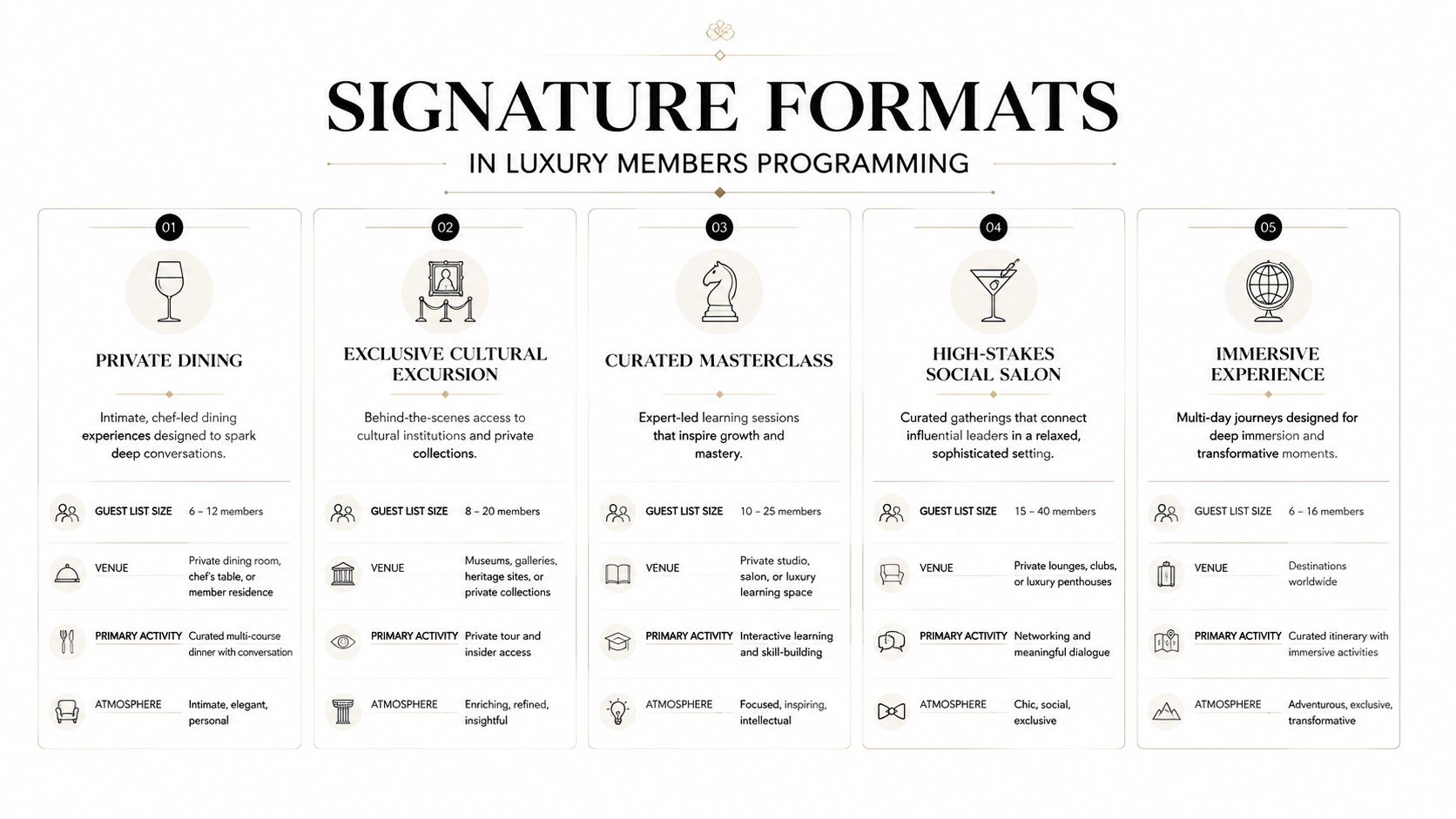
Format choice should follow the desired outcome. If you want a relationship to deepen, choose the dinner. If you want a strategic reset, choose the retreat. If you want early access to a new proposition, choose the immersion. If you want senior-level perspective, choose the salon.
Inside HauteBlack's Live Member Calendar
The HauteBlack news page shows how member programming can connect several forms of access without reducing them to generic luxury content. Its article “Executive Networking Events: The C-Suite Access Guide”, published on 2026-06-08 and updated on 2026-07-15, is explicitly focused on executive networking rather than broad travel inspiration. That framing matters because it treats the event as a route to senior-level access.
A culinary evening offers a different proof point. A private chef's-table experience with a Michelin-recognized culinary talent isn't valuable merely because the food is excellent. The guest receives proximity, recognition, and a conversation structure that makes introductions natural. A member can discuss hospitality, investment, media, or creative work without competing with a room full of strangers for attention.
Sporting access operates on another level. A members-only retreat tied to a major international sporting moment depends on partner relationships, hospitality infrastructure, and guest curation. Ticket availability alone doesn't create the experience. The value comes from what surrounds the event, who is present, and how smoothly the travel and hosting are handled.
Cultural programming broadens the network. A private gallery viewing or fashion-week-adjacent gathering gives members a shared point of reference, while the host can introduce guests according to genuine interests. The HauteBlack events calendar is the practical destination for discovering that type of programming.
The news page also shows how the editorial environment supports the event ecosystem. “Botswana Chiefs Camp: Ultimate Safari Guide 2026” was updated on 2026-06-23, while “10 Elite Kids Travel Activities for 2026” was updated on 2026-06-26. “7 Elite Executive Retreat Locations for 2026” was updated on 2026-07-13. These dated guides connect destination knowledge, family planning, and executive travel to the same wider promise: access that is planned with context rather than purchased as a standalone transaction.
How to Join, RSVP, and Gain the Right Access
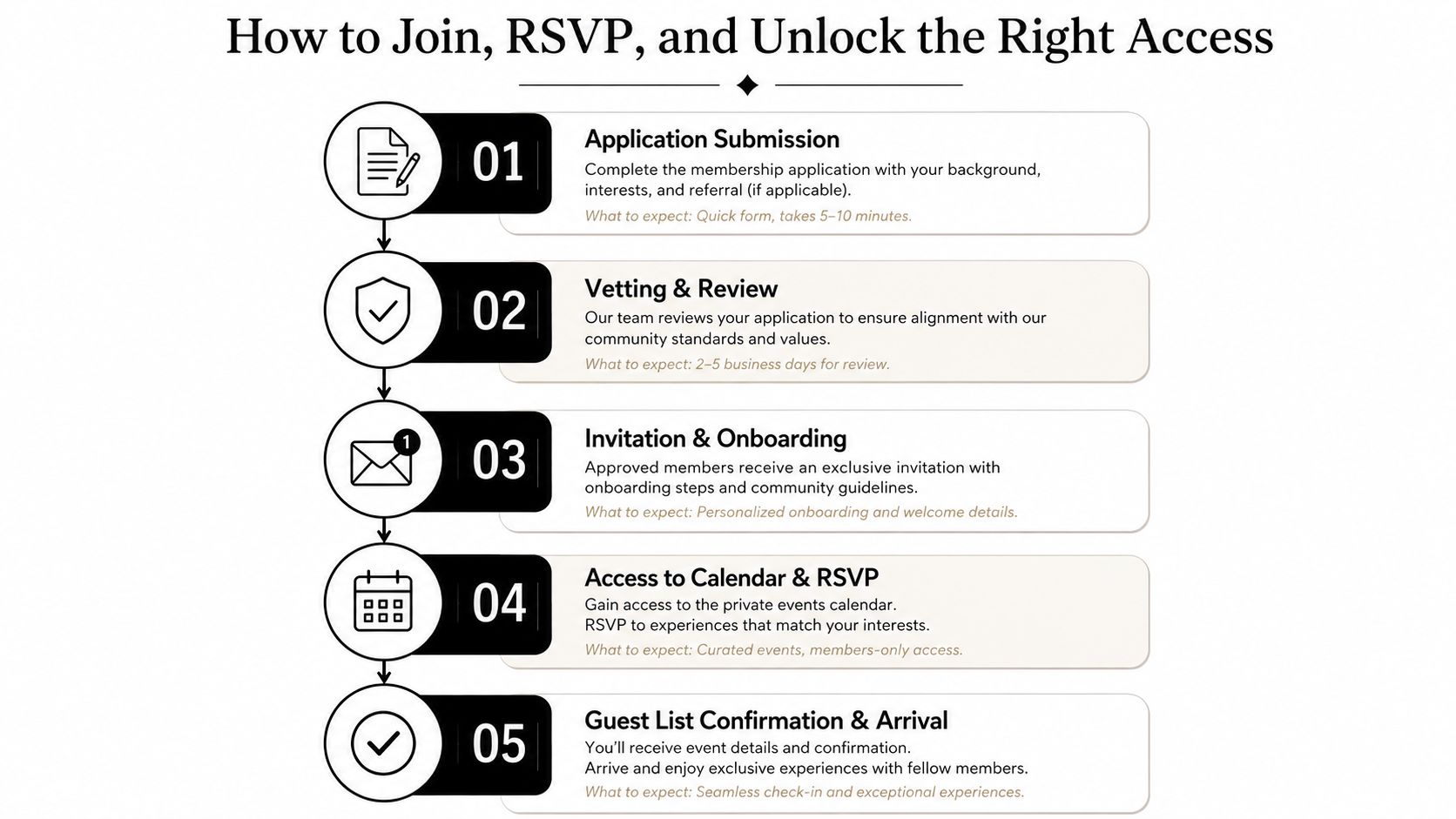
Private access follows a clear process. Treat each stage as part of your introduction to the club, because the information you provide determines which rooms, hosts, and programs are a sensible fit.
Start with the right profile
Submit an application. Explain what you do, where you spend time, and which relationships or experiences you want to pursue. A precise profile gives the curator enough context to place you well.
Expect vetting and review. Screening protects the quality of the membership community. Hosts assess credibility, conduct, relevance, and alignment with the programming.
Complete onboarding. Once invited, provide the details a concierge or event team needs to match you with suitable dinners, retreats, cultural experiences, and executive conversations.
Use the calendar strategically. Follow the curated news page, member communications, concierge outreach, and partner invitations. The HauteBlack membership page is the right starting point for understanding the application path and available access.
Confirm the guest list. Registration may not equal final approval. A limited-capacity event can require a second review, an attendance window, dress-code acknowledgment, or confirmation that a guest is permitted.
Reduce avoidable friction
Read every invitation carefully. Dress codes usually reflect the venue rather than the club's general style. Plus-one rules vary, and partner-only events can exclude otherwise eligible members. Plan geography early as well. A late confirmation can restrict flight and accommodation choices, especially when the event forms part of a larger travel schedule.
Respond quickly to waitlists, then explain your relevance. If cultural programming interests you, say so. A member who regularly attends gallery viewings should not present equal interest in every category. Specificity helps the team place you in rooms where you can contribute and gain useful access.
Higher access tiers may receive earlier notice, priority RSVP handling, or invitations connected to partner relationships. Availability and fit still determine the outcome. The strongest way to receive better invitations is to keep your profile clear, reply promptly, attend thoughtfully, and give the host useful context about your interests. That discipline turns a calendar listing into a well-matched opportunity.
Networking and Etiquette That Actually Work
Small rooms magnify behavior. At a public conference, an awkward introduction can disappear into the crowd. At a private dinner, the same moment may be remembered by the host, the member you approached, and the people seated nearby.
Preparation matters more than charisma. Review the guest information you're given, identify two or three priority conversations, and know why you're attending. Your objective might be a founder introduction, a creative collaboration, a travel connection, or a perspective on a particular market. Without that clarity, you'll drift toward whoever is closest.
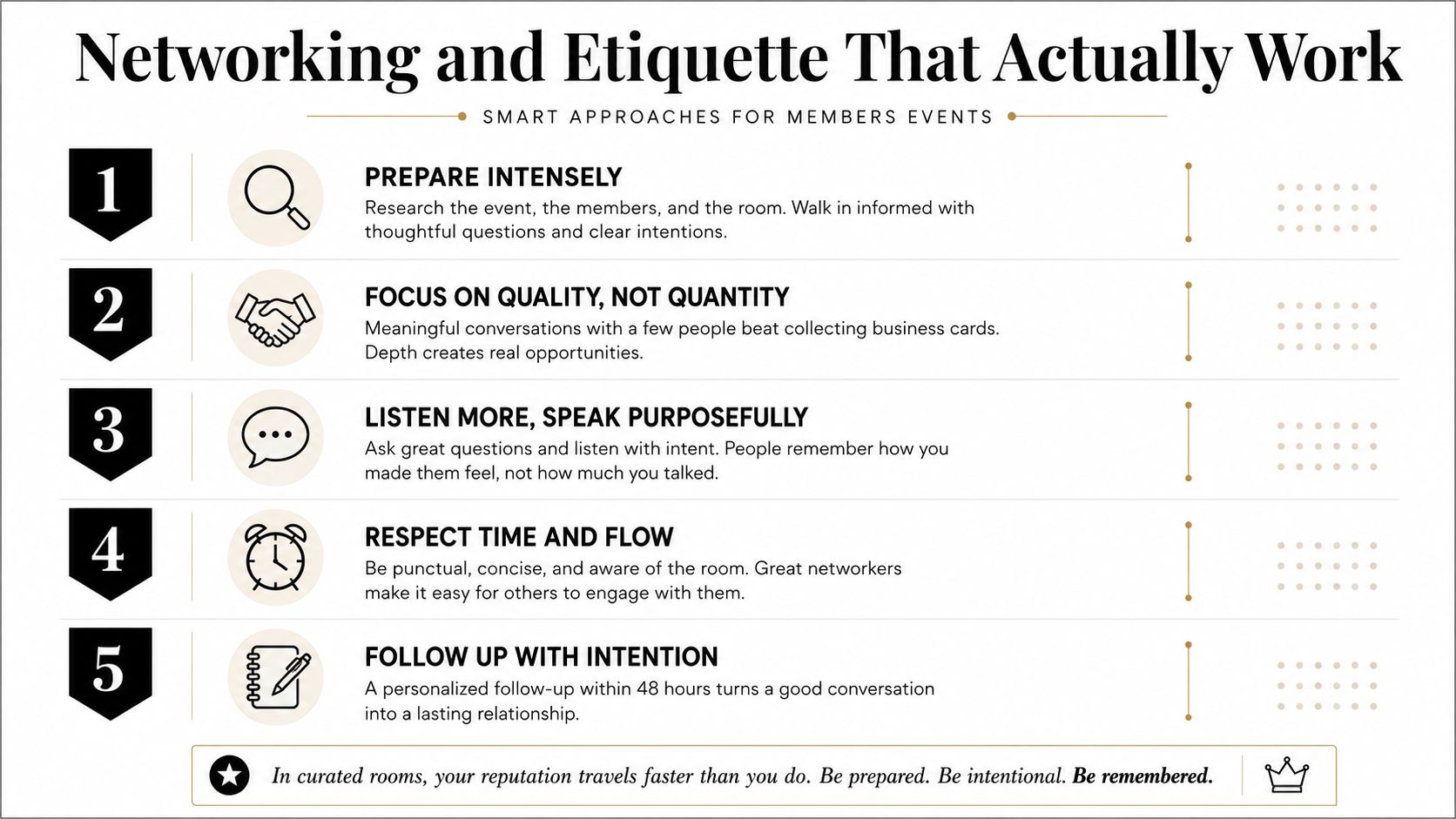
Five rules for a better evening
1. Prepare intensely. Learn enough about the people and subject to ask informed questions, but don't arrive with a rehearsed pitch.
2. Approach the host early. Thank the host, state who you'd value meeting, and let them decide whether an introduction makes sense.
3. Protect the conversation. Ask questions, listen for shared interests, and avoid turning every exchange into a business development call.
4. Exit cleanly. Say what you enjoyed, identify a reason to continue, and give the other person room to speak with someone else.
5. Follow up promptly. Send a specific note after the event that refers to the actual conversation and proposes a sensible next step.
The follow-up problem is larger than most attendees admit. An academic study of trade-show outcomes found that attendees typically followed up with only 20% to 30% of contacts made at the event, according to the study of attendee contact conversion. That makes the meaningful metric the number of relationships that survive the event, not the number of names collected.
The most valuable member is often the person who makes a relevant introduction without demanding immediate credit.
Avoid dominating circles, interrupting hosts, or treating the room like a sales floor. Introduce two people when you see a genuine connection. Keep sensitive information private. In a curated community, generosity and discretion create a stronger reputation than volume.
For more tactical guidance, HauteBlack's executive networking playbook provides a relevant companion to these rules.
Why Smaller, Curated Rooms Win
A crowded industry event may put 300 or more attendees in one venue, yet scale often produces badge exchanges, shallow follow-ups, and conversations chosen for convenience. Large gatherings still help with market scanning. They perform poorly when the goal is a relevant introduction that can develop into trust.
A curated room of 25 to 50 vetted peers creates better conditions. Guests encounter one another more than once, while the host can explain why an introduction matters. That continuity lets a professional conversation develop into personal rapport without forcing people to restart every few minutes.
The attendance data cited by MemberClicks found that 56% of members identify workload and time away from the office as barriers, 55% cite employer approval, and 49% cite cost of attendance, according to its event attendance analysis. Anyone asking for time, travel, or employer support needs a credible reason to attend. A focused guest list makes that promise easier to believe.
Density beats volume
Chef's-table dinners, private villa retreats, and partner-hosted salons limit capacity by design. The restriction protects the balance between host attention, relevant introductions, and time for real conversation.
A large room can produce many weak ties. A smaller room can produce fewer, stronger opportunities. If attendees continue with only a portion of their event contacts, collecting more names does not automatically create more value.
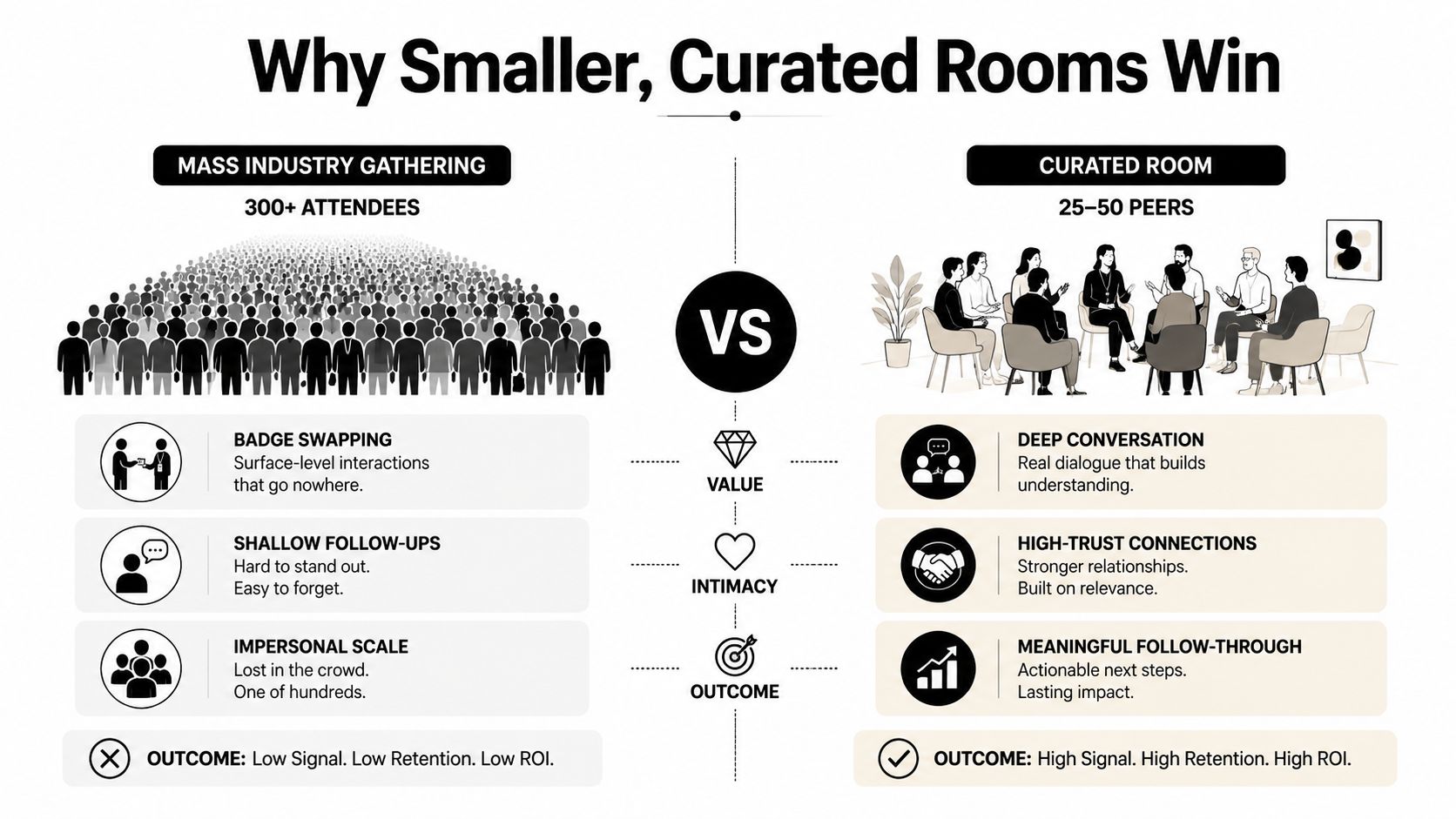
A useful visual summary of the difference appears below.
The same MemberClicks report shows association attendance remained 12.9% below 2019 levels in Q4 2024 and 3.7% below pre-pandemic levels by Q2 2025. People are assessing events more carefully, so programming must justify the journey through its guest list, setting, and access.
For executives, founders, and tastemakers, the valuable event is rarely the largest. It is the one where curated programming, including the live HauteBlack news page's travel, networking, and cultural access, supports the outcome you want.
Your First Step Into the Right Room
Members events earn their place when they deliver three things public programming often misses: access, recognition, and outcomes. Access means entering a room shaped by trusted hosts and partners. Recognition means being understood as more than a registration record. Outcomes mean leaving with a relationship, invitation, collaboration, or travel opportunity that continues beyond the evening.
The HauteBlack news page provides a practical starting point because it brings those strands together. Its editorial coverage ranges from executive networking and retreats to Botswana travel, family activities, and cultural experiences. That breadth doesn't make every event relevant to every member. It gives you enough context to choose the format that matches your priorities.
Start with the reason you're willing to leave home. If you want a sharper executive network, look for a salon or roundtable. If you want deeper personal connections, choose a dinner. If you want access that depends on place and timing, consider a retreat or partner activation.
Don't chase the busiest calendar. Choose the room where your presence can lead to a real conversation, and prepare to contribute before you arrive. The first invitation matters, but the reputation you build inside the room determines what comes next.
HauteBlack connects private members with curated dinners, cultural access, executive networking, bespoke travel, and invitation-led experiences. Visit HauteBlack to explore the membership world and identify the members event that deserves a place on your calendar.
Explore Our Guides


Signature Experiences