Haute Black Journal
How to Network at Events: An Executive's Playbook

Marlene Azeez
Director, HauteBlack
View all articles →
# How to Network at Events: An Executive's Playbook
July 2, 2026
Most networking advice is built for people who need exposure. Executives, founders, and serious investors need precision. “Work the room” is lazy advice when your reputation, time, and optionality matter more than volume.
That frustration is justified. 68% of senior executives say existing networking advice is too basic and irrelevant to strategic, high-value introductions, according to this LinkedIn post on executive networking gaps and AI-powered networks. And the stakes are real. In-person networking carries a 40% close rate for turning conversations into partnerships, while 75% of customers prefer face-to-face meetings to maintain trust, based on Apollo Technical networking statistics.
If you want to learn how to network at events at an elite level, stop thinking in terms of contacts. Think in terms of access, alignment, and alliance.
Beyond Business Cards Rethinking Your Approach
The amateur goal is to leave with a stack of business cards. The executive goal is to leave with one or two conversations that can change the next year of your business or personal life.
That's the first correction. Senior people shouldn't “talk to everyone.” They shouldn't stay too long in low-value circles. They shouldn't confuse visibility with relevance. A crowded room isn't an opportunity by default. Often, it's noise.
Why generic networking advice fails senior people
Most networking content assumes you need practice introducing yourself, asking what people do, and following up with a LinkedIn request. That's entry-level instruction. It breaks down the moment you're managing a brand, a fund, a board relationship, a family office, or a complex cap table.
At that level, every interaction carries signal. Who approached whom matters. Who made the introduction matters. The setting matters. Even your reason for attending matters.
Practical rule: Don't attend an event because it's prestigious. Attend because the room contains specific people, specific agendas, or specific adjacency to the relationships you want.
This is why alliance-building belongs inside leadership strategy. The same executive judgment used in hiring, investing, and partnership development should be used in social rooms. If you'd never pursue acquisitions by randomly talking to strangers, why would you build your strategic network that way?
For leaders shaping companies and culture, the discipline is similar to what's outlined in this executive guide to cultural transformation. The room is never just social. It's operational. It influences trust, internal momentum, and external positioning.
Replace contact collection with alliance curation
A useful contact knows your name. An ally understands your standards, your interests, and the kinds of opportunities worth bringing to you.
That means your filter must sharpen. Ask yourself:
- Strategic fit: Does this person operate in my world, or one move adjacent to it?
- Reputation quality: If I'm seen with this person repeatedly, does that strengthen my positioning?
- Reciprocal value: Can we help each other, or is this one-sided?
- Longevity: Is this someone I'd want in my circle a year from now?
If the answer is no, be courteous and move on.
Elite networking isn't warmer small talk. It's better judgment.
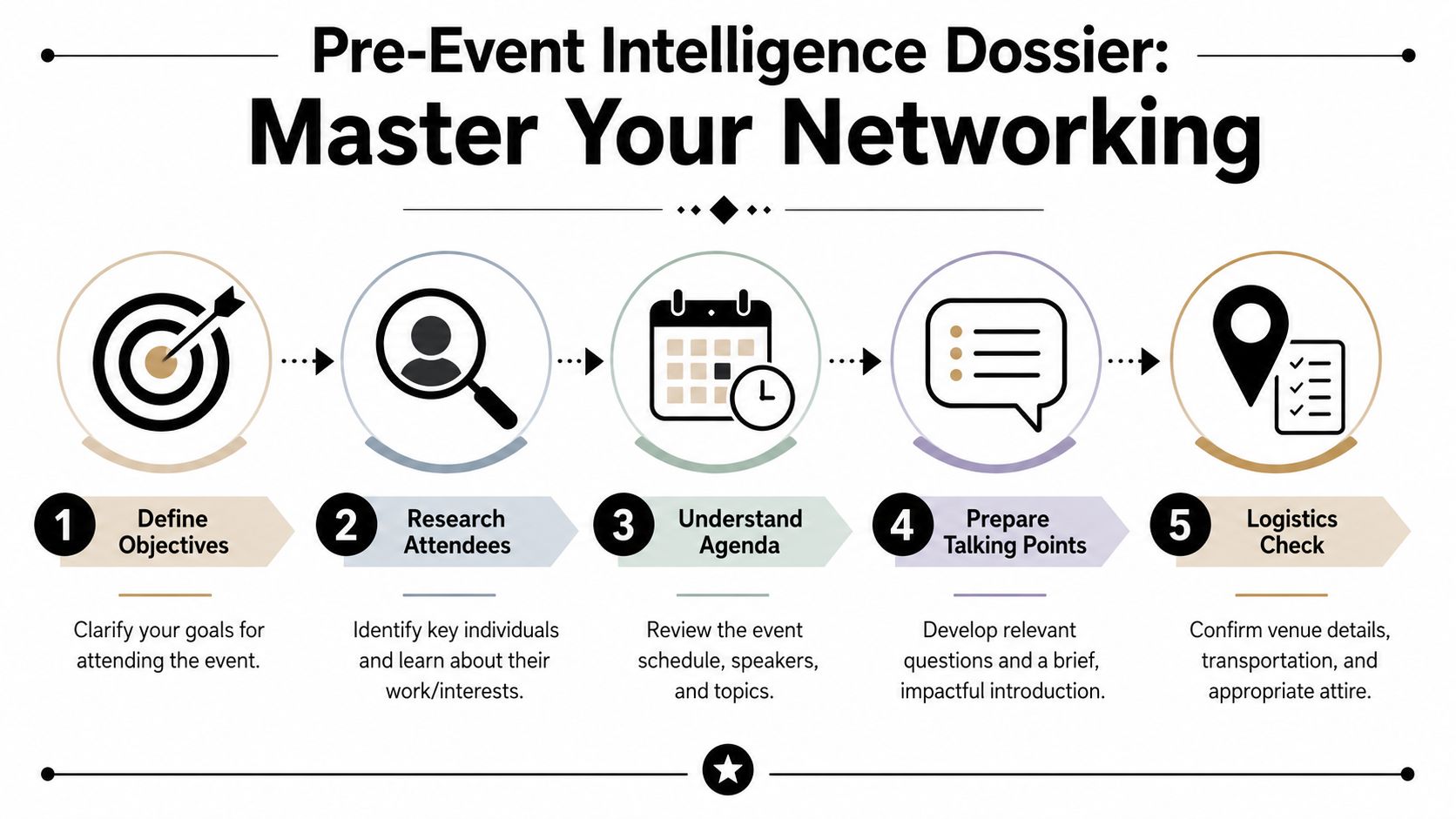
The Pre-Event Intelligence Dossier
The event starts days before you walk into the room. If you show up hoping to “see who's there,” you've already surrendered your advantage to people who prepared.
Build a shortlist, not a wish list
Start with names, not vibes. Identify the people worth meeting and rank them by strategic relevance. Your list should be short enough to remember without checking your phone every ten minutes.
Industry benchmarks show 52% of B2B event organizers consider structured matchmaking a key success factor, and activating matchmaking software 2 to 4 weeks before an event significantly boosts meeting arrangements, according to Converve's event matchmaking benchmarks. That matters because well-run events increasingly reward preparation, not spontaneity.
A sharper approach looks like this:
1. Pick your primary targets. These are the people you'd regret missing.
2. Identify your secondary layer. Useful connectors, gatekeepers, or adjacent operators.
3. Ignore the rest at first. You can always expand later if the room opens up.
If you move in executive circles regularly, this guide to executive networking events and C-suite access is a useful reference for distinguishing between rooms built for status theater and rooms built for trusted access.
Research for leverage
Don't just memorize titles. Learn what creates relevance.
You should know:
- Recent moves: investments, expansions, media appearances, board changes, product launches
- Context: who introduced them to the room, who they usually attend with, what communities they belong to
- Overlap: where your interests, portfolio, geography, philanthropy, or cultural priorities intersect
- Offer: one useful thing you can credibly contribute
Many accomplished people still fail at this. They prepare a polished self-introduction and nothing else. That's backwards. Your introduction matters less than your ability to make the conversation immediately useful.
Arrive with a point of view on the person, not just a point of view on yourself.
Use private access intelligently
Executive networking often happens in layers. The public event is just the outer shell. Key opportunities sit in pre-dinners, host circles, member salons, and private follow-on conversations.
That's where private memberships, trusted concierges, and curated communities become practical tools. They can surface attendee context, make warm introductions, and tell you which invitation list matters. One example is Haute Black, which operates a private membership world and AI-powered network connecting verified founders, executives, investors, athletes, and creators for introductions and roundtables. Used correctly, that kind of platform isn't about volume. It's about reducing randomness.
Set surgical objectives
Don't use weak goals like “meet interesting people.”
Use goals like these:
- Discuss a specific partnership possibility with one founder you've already identified.
- Assess chemistry with a potential investor or advisor.
- Earn an invitation into a more private room.
- Confirm whether a relationship deserves a second meeting.
A strong pre-event dossier should fit on one page. Names. priorities. context. your offer. your desired next step.
That's how to network at events when your calendar is full and your standards are high.
Navigating the Room with Quiet Confidence
The first minute matters. Not because everyone is judging you, but because the room starts assigning you a role immediately. Are you hunting for attention, or are you moving with intent?

Walk in slowly enough to read the room. Don't rush to the first familiar face. Don't cling to the bar. Don't bury yourself in your phone. The people with the most social fluency usually scan first, calibrate second, engage third.
Read formations before you enter
A networking room tells you a lot if you stop trying to perform confidence and start observing structure.
Open groups are easy to spot. Their stance leaves physical space. Closed groups angle inward and protect the conversation. If you're joining a circle, look for an actual opening in the formation and enter directly. “Hey, can I join you?” works better than a rehearsed interruption. If someone offers a handshake, match their pressure. That small mechanical detail is often overlooked, and it matters in professional settings, as noted in Hult's networking etiquette guidance.
There's another useful discipline in the room. Limit yourself to a small number of group engagements rather than pinballing everywhere. A practical method is to hit exactly three groups and leave each cleanly when it's time, using a line like, “I have a goal to meet some other folks tonight.” That approach comes from this networking advice video on event movement and exits.
Ask questions that cut through posture
Most event conversations die because both people are protecting their image. Titles. logos. broad claims. polished vagueness.
Skip that.
Instead of collecting business cards, go deeper with a disarming question like “What is something you recently spectacularly failed at?” That question, highlighted in Entrepreneur's perspective on deeper networking conversations, does something standard questions never do. It brings the person out from behind the role.
Good executives respond to candor. So do interesting investors. So do people who are tired of hearing the same transactional script all night.
A few useful alternatives:
- What are you paying unusual attention to right now?
- What problem keeps following you across deals or companies?
- What have you changed your mind about recently?
These questions signal discernment. They also make you memorable.
If you want rooms designed for this kind of exchange rather than broad, anonymous mingling, Haute Black events are built around intimate gatherings and curated introductions.
Here's a quick visual on executive presence in a room.
Spot the real connectors
The loudest person in the room usually isn't the most valuable. Watch for the person who speaks briefly, gets greeted by multiple circles, and never seems rushed. That's often the connector.
Approach them carefully. Don't pitch. Don't unload your résumé. Make one intelligent observation, ask one good question, and give them an easy way to place you in their mental map.
The best introduction is not “I'd love to pick your brain.” It's “I think we have one specific area of overlap, and I'd value your perspective on it.”
Quiet confidence is not about being reserved. It's about never looking socially needy.
The Art of a Meaningful Exchange
A polished introduction gets you noticed. A meaningful exchange gets you remembered by people who can open private rooms, shape deals, and extend trust.
At elite events, the objective is not chemistry for its own sake. It is relevance. You want the other person to leave with a clear sense of who you are, how you think, and where a future intersection makes sense.
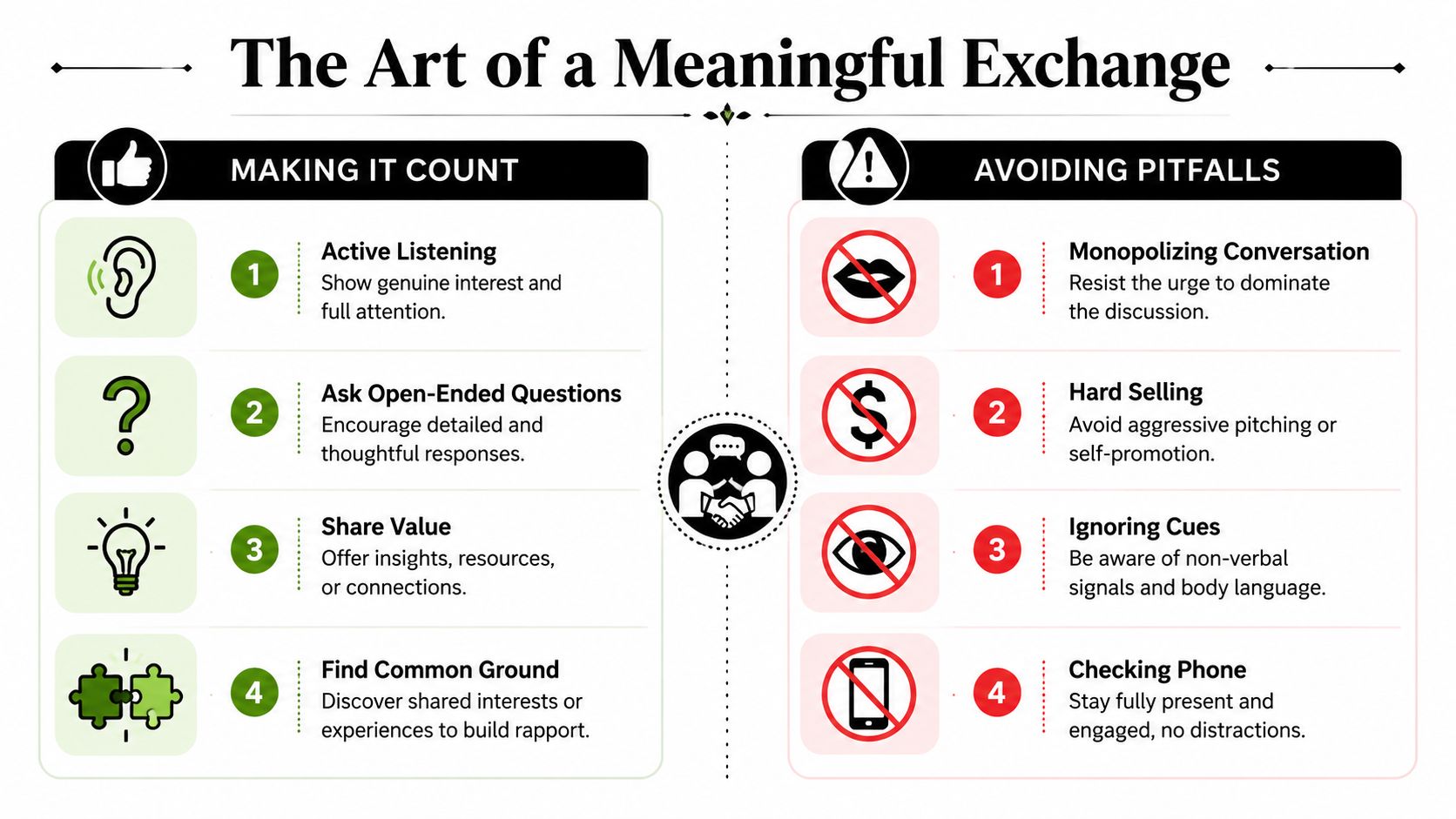
Long explanations ruin good conversations. So does treating every interaction like a pitch meeting. Discerning individuals hear enough positioning all week. What they respond to is precision, judgment, and restraint.
Use a simple standard. By the end of the exchange, the other person should have gained one of three things: a sharper frame for a problem, a useful perspective, or a credible reason to continue the conversation later. If none of that happened, you filled time.
State your thesis, not your biography
When someone asks what you do, answer with a point of view.
| Approach | Better phrasing |
|---|---|
| Broad description | “I invest across hospitality, media, and consumer brands where distribution is underpriced.” |
| Generic founder intro | “I build companies around high-trust access and private client relationships.” |
| Loose advisory claim | “I help leadership teams solve positioning problems when growth outpaces brand clarity.” |
That kind of answer does two things. It signals status without performing for it. It also gives high-caliber people an easy way to place you in their mental map.
If your world already includes private clubs, invitation-only dinners, family office circles, or curated member communities, use that context carefully. Mentioning the right environment can establish credibility fast, especially when the room values discretion and access. Haute Black Network for strategic relationship-building is one example of the kind of curated ecosystem where this approach matters.
If small talk is not your native mode, especially in international rooms, this guide to small talk for non-native professionals is useful because it focuses on opening lines that sound natural instead of rehearsed.
Good networking talk should feel like an intelligent first pass, not a full download.
Listen for the hidden brief
Senior operators, investors, and founders rarely announce their real need directly. They imply it. You will hear it in a casual comment about a new market, a difficult hire, a reputation concern, a stalled partnership, or a community they have not been able to access.
Your job is to catch the subtext.
A meaningful exchange usually has three parts:
- Tighten the issue. Ask a question that clarifies what matters.
- Contribute one sharp idea. One is enough if it is specific.
- Suggest a next step with control. Offer a continuation that matches the level of rapport.
Here is what that sounds like in practice. A founder mentions expansion into a new city. Instead of replying with your background, ask what kind of local trust they need first: customers, capital, operators, or cultural credibility. Their answer tells you whether to share an insight, offer an introduction, or mark the opportunity for later.
Then exit cleanly. “I've enjoyed this. I'd like to continue when we both have more room for it. I'll send the introduction or note I mentioned.”
That is how serious people build momentum. They leave the conversation open, clear, and worth revisiting.
The Discreet and Effective Follow-Up Protocol
Most networking value is lost after the event because people follow up like strangers, not like professionals. They send vague messages, ask for time too early, or disappear completely.
A strong follow-up is prompt, specific, and easy to answer. It also honors what transpired in the room. If the exchange was brief, don't write a long note. If the conversation was substantial, don't send a limp “great to meet you.”
Use a seven-touch mindset
For sustained networking success, it's useful to touch base with each new contact at least 7 times, including through LinkedIn actions such as sharing and liking posts to stay top of mind, according to this discussion on networking follow-through. That doesn't mean seven asks. It means seven relevant points of contact over time.
The first few touches should usually look like this:
- Deliver what you promised: article, introduction, note, contact, venue, idea.
- Add context: mention the exact topic you discussed so they can place you quickly.
- Keep it light: don't force a meeting before the relationship can carry one.
- Stay visible: thoughtful LinkedIn engagement works because it's ambient, not intrusive.
Your follow-up should answer one question immediately. Why is this message worth opening today?
Discreet Follow-Up Frameworks
| Scenario | Timing | Template Snippet | Objective |
|---|---|---|---|
| Brief but promising conversation | Within 48 hours | “Enjoyed our conversation about private market access. Sending the article I mentioned on brand-adjacent deal flow.” | Re-establish context and deliver value |
| Strong chemistry and clear overlap | Within 48 hours | “I left our conversation thinking there may be a sharper discussion to have around your expansion plans. Happy to continue over a brief call if useful.” | Open the door to a second conversation |
| You promised an introduction | As soon as possible | “You mentioned looking for someone with experience in that market. I know someone relevant and can connect you if helpful.” | Demonstrate reliability |
| VIP or very senior contact | Within a few days | “Appreciated your perspective on operator discipline. One point stayed with me, especially around timing and patience.” | Stay memorable without imposing |
| No immediate ask, but worth cultivating | Ongoing | “Saw this and thought of our discussion on cultural capital and consumer behavior.” | Build familiarity over time |
What not to do
Don't send generic LinkedIn requests with no message.
Don't write “let's grab coffee sometime” unless you're prepared to propose a real reason and an efficient format.
Don't follow up with a pitch deck unless they asked for it.
The best post-event operators understand pacing. Some relationships deserve a direct next step. Others need time, relevance, and repeated proof of judgment. If you want to know how to network at events without looking transactional, this understanding makes the distinction.
From Contacts to Alliances Building Your Circle
The people who get the most from elite rooms aren't the most extroverted. They're the most selective. They know which rooms matter, which conversations deserve energy, and which relationships are worth protecting.
That's the shift. Stop measuring networking by how many people you met. Measure it by the quality of access you earned, the trust you built, and the number of relationships that can survive beyond the event itself.
Build a circle that compounds
A serious network should do more than create introductions. It should sharpen judgment, widen opportunities, and provide private candor when public positioning won't.
Your circle should include different kinds of people:
- Allies who advocate for you in rooms you're not in
- Operators who understand execution, not just ideas
- Connectors who can place the right people together discreetly
- Peers who understand your level of pressure and ambition
That kind of circle is never built through random volume. It's built through disciplined preparation, thoughtful presence, and elegant follow-through.
Choose curated environments
Mass-market events reward stamina. Curated environments reward relevance.
That's why private memberships and trusted networks matter more as your profile rises. A better room narrows the field, improves signal, and increases the chance that a single conversation becomes an advisory relationship, an investment, a co-investment, a cultural collaboration, or a private friendship with real substance.
If your aim is to build a sharper, more valuable ecosystem around yourself, Haute Black Network reflects that model through verified introductions and private roundtables designed for high-trust relationships.
The point of networking isn't social accumulation. It's strategic intimacy with the right people.
Haute Black brings together bespoke travel, private membership access, intimate events, and a verified network for founders, executives, investors, athletes, and creators who value discretion and meaningful connection. Explore Haute Black if you want access to curated rooms where relationships can develop with context, trust, and purpose.
Explore Our Guides


Signature Experiences