Haute Black Journal
Executive Networking Events: The C-Suite Access Guide

Marlene Azeez
Director, HauteBlack
View all articles →
# Executive Networking Events: The C-Suite Access Guide
June 8, 2026
You arrive at a conference with a polished agenda, a stack of introductions to make, and a calendar blocked to the minute. By lunch, you've shaken hands with a dozen people, accepted a flood of LinkedIn requests, and learned almost nothing you can act on. The room is full, the conversation is pleasant, and the yield is weak.
That's the gap most senior leaders eventually recognize. Mass-market networking and executive relationship building are not the same activity. One is open access. The other is controlled access. One rewards visibility. The other rewards relevance, discretion, and trust.
At the top of the market, the best executive networking events are rarely loud, public, or easy to buy into. They tend to be curated dinners, closed-door roundtables, discreet salon conversations, and carefully filtered forums where everyone in the room has been screened for stature, fit, or usefulness. The unwritten rule is simple. The room itself is part of the value.
Beyond Business Cards and Small Talk
A crowded conference hall is designed for scale. Executive networking events are designed for consequence.
Most senior people don't need more random contacts. They need a sharper pipeline of qualified conversations. That means fewer introductions, better context, and a setting where people can speak candidly without performing for a room of strangers. When an event fails, it usually fails for the same reason. It confuses activity with access.
The continued importance of in-person executive relationship building isn't a matter of nostalgia. It is still tied to how business gets done. According to GoRemotely's networking statistics roundup, 95% of people think meetings in person are essential for maintaining long-term business connections, and 85% of executives, senior managers, and board members think networking is the key to success. That matters because top-tier opportunities still move through trusted human contact, not just public channels.
What low-yield events get wrong
Generic events usually overvalue volume. They fill the room, add a sponsor wall, circulate drinks, and hope chemistry does the rest. For executives, that model wastes the most expensive asset in the room, which is attention.
What works better is straightforward:
- Clear attendee logic: Each person should belong there for a reason.
- Context before contact: Introductions need background, not just name badges.
- A controlled social environment: Confidentiality changes the quality of conversation.
- Follow-through: The most important part often happens after the event ends.
Practical rule: If an event can't explain why the specific people in the room should meet each other, it isn't built for executives. It's built for headcount.
Why the best rooms feel smaller
Senior leaders don't attend premium events to “network.” They attend to pressure-test an acquisition thesis, compare notes with peers, find a discreet capital source, meet a potential board candidate, or deepen a relationship before a strategic move. The setting must support that purpose.
That is why the best executive networking events often feel calm, contained, and highly intentional. The room may be elegant, but elegance alone doesn't create value. The value comes from curation, pacing, and mutual trust. A room with fewer people and stronger alignment usually outperforms a ballroom full of weak-fit attendees.
What Defines an Executive Networking Event
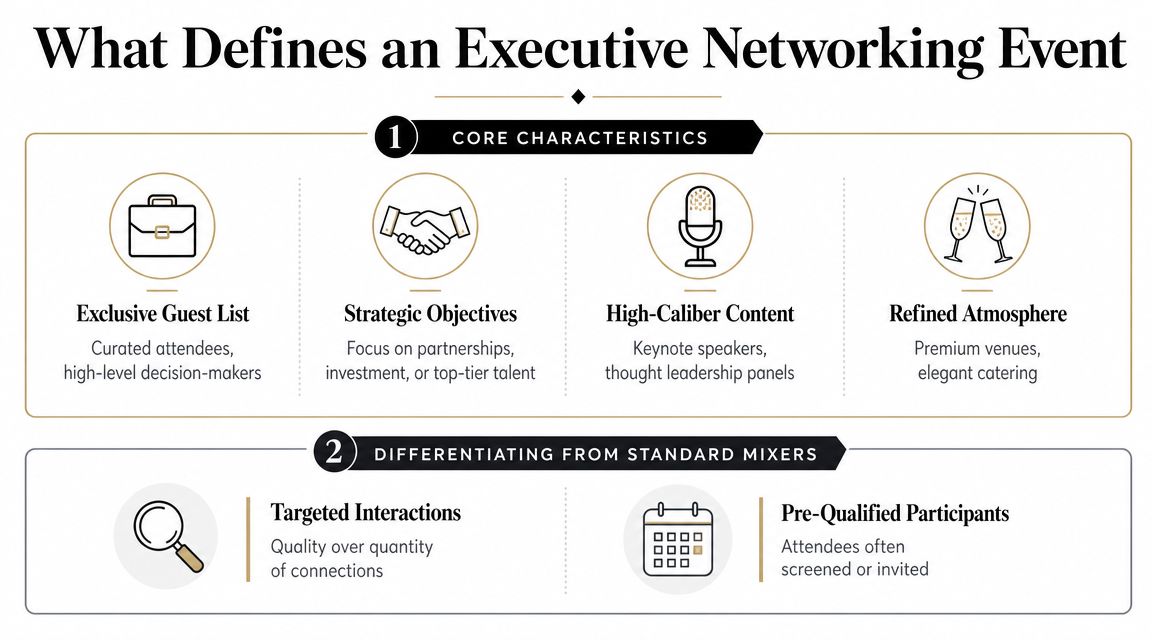
An executive event isn't defined by price, décor, or whether the champagne is poured properly. It's defined by the architecture behind the guest list.
At this level, organizers are not selling admission as much as constructing an environment. They verify who should be present, shape who should meet, and protect the tone of the room. That's why many of the most effective gatherings are semi-private or fully private, with attendance routed through referrals, host discretion, membership circles, or direct relationships.
The core components
A legitimate executive event usually includes four essential elements.
- Curation over open registration: Not everyone qualifies. Organizers screen for seniority, reputation, current role, and often strategic fit.
- Confidentiality by design: The strongest rooms reduce performative behavior. Guests speak more openly when they trust that a private dinner will remain private.
- A business reason to gather: The event has a commercial, strategic, advisory, or influence-building purpose.
- Structured introductions: Hosts don't leave outcomes to chance. They guide who meets whom and why.
That final point has become far more important because events now need to prove they were worth the effort. According to B2Match's guidance on event networking metrics, 26% of marketers dedicate 11% to 30% of their budget to events. That level of investment pushes serious organizers away from informal mixers and toward more structured, data-tracked experiences built around meaningful introductions.
Why polished venues are not enough
A luxury hotel ballroom can host a weak event just as easily as a strong one. Atmosphere matters, but atmosphere is not the product. The product is access to the right peer set under the right conditions.
That's also why many top-level gatherings avoid public overexposure. Excessive promotion attracts spectators, aspirants, and opportunists. The best hosts protect the ratio between genuine decision-makers and everyone else.
A good way to evaluate the quality of a room is to ask three questions:
1. Who curated the list?
2. What was the purpose of the invitation?
3. How will success be judged afterward?
If those answers are vague, the event probably is too.
For executives who value selective access over noise, Haute Black events reflect the type of environment where guest quality matters more than attendance volume.
The strongest rooms are not always the hardest to enter financially. They are the hardest to enter reputationally.
The Four Tiers of Executive Access
Not all executive networking events serve the same purpose. Some are built for candor. Some for visibility. Some for commercial filtering. The mistake is treating them as interchangeable.
The easiest way to understand the environment is to think in tiers of access and intimacy.

Tier one private roundtables
This is the highest-value format for many operators, investors, founders, and board-level leaders. The group is small. The topic is narrow. The expectation is contribution, not self-promotion.
These rooms work because they reward operating insight. If you can offer pattern recognition, candid experience, or useful judgment, you become memorable quickly. If you arrive with a rehearsed pitch, you become forgettable just as fast.
Tier two invite-only dinners
Dinner is where professional credibility becomes personal familiarity. It's less transactional than a meeting and more revealing than a panel.
The seating plan matters. The host matters. The pacing matters. You may not leave with a formal next step, but you will know who trusts whom, who is expanding into a market, who is considering a move, and who prefers discretion over publicity. That intelligence is often more useful than any stack of business cards.
If a dinner is well-hosted, the most important exchange may happen between courses, not during introductions.
Tier three industry summits
Summits sit in the middle. They offer more scale, more public positioning, and more obvious thought leadership value. They are useful when you want to signal expertise, track sector sentiment, or meet multiple relevant players in a compressed period.
They are less useful when your objective requires privacy. Public stages encourage polished narratives. Closed rooms surface real ones.
Tier four sponsor-driven forums
These events can be effective, but only when the sponsorship model doesn't overpower the guest logic. The best versions assemble buyers, capital sources, operators, and advisers around a clear vertical. The weakest versions feel like lead generation with table linen.
Here is the distinction at a glance.
| Executive Event Tiers Comparison | Primary Goal | Access Level | Key Outcome |
|---|---|---|---|
| Private roundtables | Peer exchange and strategic problem-solving | Highly restricted | Trusted insight and strong follow-up conversations |
| Invite-only dinners | Relationship depth and personal rapport | Restricted by host or referral | Durable trust and discreet introductions |
| Industry summits | Visibility and sector positioning | Selective but broader | Thought leadership and broad market access |
| Sponsor-driven forums | Targeted commercial conversation | Variable | Qualified meetings if attendee fit is strong |
Choosing the right tier
The right format depends on what you need.
- Need candor: Choose roundtables.
- Need trust: Choose dinners.
- Need visibility: Choose summits.
- Need targeted commercial access: Consider sponsor-led forums, but inspect the guest list carefully.
Executives often ask which tier has the best ROI. The better question is which tier matches the decision you're trying to influence.
How to Qualify for an Invitation
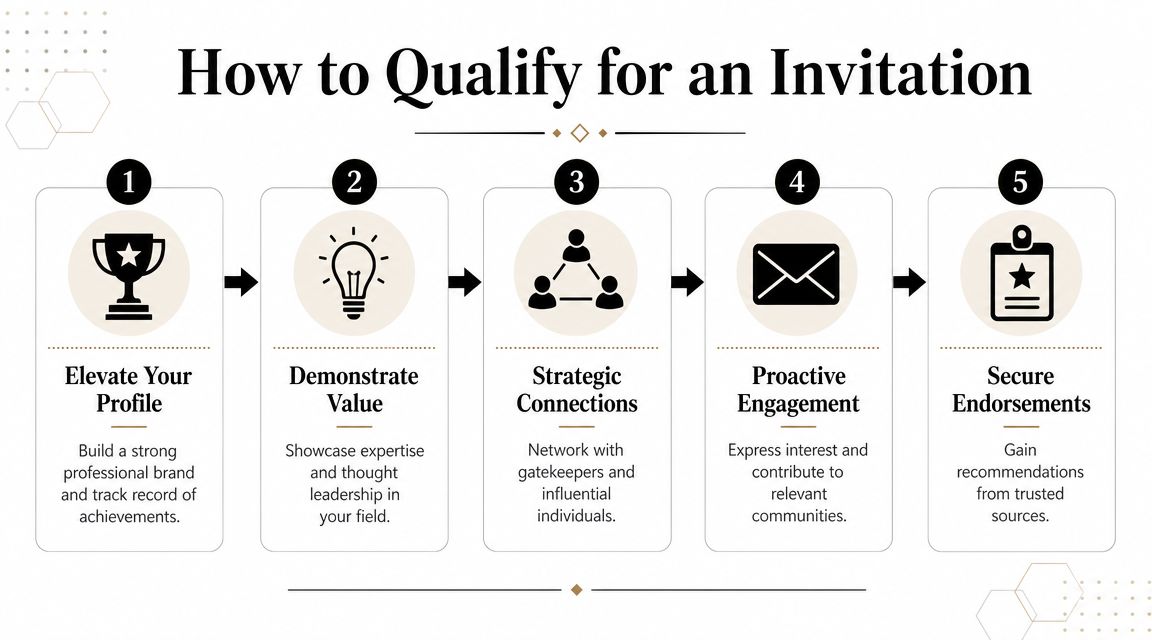
Access to elite rooms is rarely random. It's usually the result of a visible track record, trusted referrals, and repeated signals that you will add value to the room rather than extract from it.
That means the work starts long before the invitation appears.
Build a profile that earns review
Curators screen quickly. They look for role clarity, professional credibility, and evidence that others already take you seriously. Your digital footprint doesn't need to be loud, but it does need to be coherent.
A useful profile usually includes:
- A clear current role: Avoid vague titles that inflate stature but reduce trust.
- Visible expertise: Interviews, speaking appearances, board participation, published analysis, or serious commentary in your field.
- Signal of relevance: Market activity, investment thesis, operating scope, or domain authority.
Get known by the people who open doors
The best invitations often move through private connectors. These may be hosts, executive assistants, chiefs of staff, family office advisers, investor relations leaders, club managers, or trusted members already inside the circle.
Many executives go wrong. They try to chase the event instead of earning the endorsement. Hosts care less about your interest than your fit.
Use a deliberate approach:
1. Identify the curators. Don't just follow the visible brand. Find the people who shape lists.
2. Offer a reason to include you. That may be sector insight, deal relevance, investor perspective, operating experience, or peer value.
3. Respect the temperature of the relationship. Don't force intimacy where only familiarity exists.
4. Be easy to verify. A concise bio, current role, and mutual references matter.
5. Let others advocate for you. Third-party validation travels further than self-description.
A private network such as Haute Black membership reflects how many of these ecosystems operate. Access tends to follow trust, verification, and relevance rather than public availability.
A short briefing on executive presence can sharpen your approach before you pursue those introductions.
Behave like someone worth inviting back
Hosts notice more than pedigree. They notice conduct. Do you protect confidentiality? Do you dominate the room? Do you follow up intelligently? Do people feel sharpened by speaking with you, or merely handled?
Quiet advantage: The fastest way into better rooms is to leave the current room better than you found it.
The most effective attendees are easy to host. They arrive briefed, contribute without grandstanding, and understand that access is cumulative. One strong appearance often leads to the next.
Mastering Protocol and In-Room Etiquette
Once you're in the room, etiquette becomes strategy. Not the old version built around stiff formality. The modern version built around comfort, timing, respect, and restraint.
Senior people remember how you made the room feel. They remember whether you listened, whether you protected sensitive information, whether you monopolized the conversation, and whether your follow-up treated them like a person instead of a prospect.

Preparation changes the outcome
The best attendees don't improvise everything. They arrive with a briefing. Executive assistants and chiefs of staff can be decisive here.
A useful pre-event brief includes:
- Who matters most: Priority guests, relationship history, and potential sensitivities.
- Why each conversation matters: Board search, partnership, capital, hiring, market intelligence, or reputation.
- How to enter and exit gracefully: A concise opener and a clean reason to move on.
- What not to discuss: Pending deals, protected information, internal politics, or topics that belong in a later setting.
Appearance also carries signal value. In executive rooms, style should support confidence, not compete with it. If a client needs a practical reference before a formal dinner or private reception, this guide on how to elevate your formal look is useful because it focuses on polish without drifting into costume.
The new standard is psychological safety
Advanced event design now treats inclusion and comfort as part of the guest experience. According to Stova's guidance on inclusive networking experiences, modern formats increasingly use smart matchmaking to bypass attendee bias and quiet rooms for sensory breaks. That shift matters because executive presence is not about social aggression. It is about making others comfortable enough to engage authentically.
That has practical implications in the room:
- Don't trap people in conversation. Read body language and release cleanly.
- Don't assume everyone prefers a high-energy format. Some of the strongest operators in any room dislike crowded, performative mingling.
- Don't build rapport through exclusion. Gossip and insider signaling may feel knowing. They usually signal poor judgment.
- Don't overuse alcohol as social lubricant. Precision fades quickly.
Follow-up without killing the chemistry
A good follow-up is brief, specific, and anchored in the actual conversation. Reference the issue discussed, suggest the next move if one is warranted, and leave space if it isn't.
The worst follow-up is generic enthusiasm. The second worst is a sales deck sent too soon.
Good etiquette at this level is simple. Protect the room, respect the person, and never force the ask before the relationship can carry it.
The Haute Black Advantage VIP Access and Curation
Most executives don't struggle because they fail to attend enough events. They struggle because the best rooms are fragmented, private, and relationship-gated. Access depends on who trusts the host, who fits the room, and who can contribute meaningfully once inside.
That is where curation becomes more valuable than abundance. A strong private platform doesn't just collect names. It filters for compatibility, confidentiality, and timing. It creates conditions where a founder meets the right investor, an operator meets the right strategic partner, or a principal sits at a table that would never appear on a public calendar.
Why intelligent matchmaking matters
Modern executive platforms have moved beyond static guest lists. According to Brella's overview of networking tool features, structured matchmaking can analyze thousands of attendee data points and generate top matches in seconds, and success is often evaluated by the number of high-quality one-to-one meetings scheduled during the event. In practice, that means better pre-event routing and fewer accidental conversations that lead nowhere.
For high-level events, this matters because relevance is everything. A private investor doesn't want twenty introductions. They want two that fit their mandate. A founder entering a new market may need one local operator with trusted distribution access, not a room full of general business development chatter.
The advantage of a private ecosystem
A curated ecosystem can combine several elements that rarely coexist in public-facing events:
- Verified participants: The room stays credible because attendance is filtered.
- High-trust formats: Dinners, private salons, and closed roundtables protect candor.
- Cross-domain access: Founders, executives, investors, athletes, and creators can meet where interests overlap.
- Concierge orchestration: Travel, logistics, timing, and guest handling all support the quality of interaction.
This is the practical value of a platform that understands both hospitality and influence. The room isn't assembled for spectacle. It's assembled for outcomes.
For those who want a private ecosystem built around travel, introductions, and curated access, Haute Black services show how concierge infrastructure and intelligent matchmaking can support more meaningful executive encounters.
Conclusion From Attendee to Influencer
Many people still approach networking as a collection exercise. More contacts. More handshakes. More names in the phone. At the executive level, that model becomes inefficient very quickly.
Influence grows differently. It grows when the right people trust you in the right contexts. It grows when you're invited into smaller rooms, remembered for substance, and included in conversations before opportunities become public. That's why the strongest executive networking events don't optimize for crowd size. They optimize for judgment, confidentiality, and relationship durability.
The smartest reframing is to stop asking, “How many people did I meet?” and start asking better questions. Did this room improve my access? Did I meet someone I would trust with a strategic issue? Did the host curate intelligently? Did anyone leave wanting to continue the conversation in a more private setting?
That standard is more demanding. It's also more useful.
The best guidance on event ROI points in the same direction. The Small Business Expo's discussion of networking events emphasizes that the most valuable executive gatherings are built around small, confidential, high-trust interactions, where the return comes from qualified introductions and retained relationships rather than merely collecting contacts.
In the C-suite, presence alone isn't the win. Position is the win. The goal is not to be seen in the room. The goal is to become part of the circle that shapes what happens after the room clears.
For readers who want more than a calendar full of events, Haute Black offers a private world built around discreet access, curated introductions, and high-touch experiences where the right rooms effortlessly open.
Explore Our Guides


Signature Experiences


