Haute Black Journal
Luxury Travel Package to South Korea: A Bespoke Guide

Marlene Azeez
Director, HauteBlack
View all articles →

# Luxury Travel Package to South Korea: A Bespoke Guide
May 30, 2026
South Korea no longer belongs in the category of "interesting alternative" for luxury travelers. It has already reached scale. The country welcomed 16.37 million foreign visitors in 2024, reaching 94% of its 2019 peak and rising 48.4% year over year, according to South Korea tourism statistics. That's precisely why a generic package now underdelivers. Once a destination becomes this active, access, pacing, and insulation from friction matter far more than merely reserving a room and adding airport transfers.
A standard travel package to South Korea treats the country as a checklist. Seoul. Palace. Busan. Market. Maybe Jeju. A considered journey does the opposite. It edits hard, sequences experiences well, and protects the traveler from the dead time, crowded windows, and mediocre inclusions that make even expensive trips feel ordinary.
Beyond the Brochure: A New Standard for Korean Travel
In South Korea, luxury isn't excess. It's precision.
Most off-the-shelf itineraries still sell the country as a bundled circuit, as if the point were to move efficiently from landmark to landmark. That approach misses what makes Korea compelling for a discerning traveler. Seoul changes personality by district and even by hour. Busan can read as polished and coastal or raw and kinetic depending on where you stay and how you move. Jeju can feel restorative or touristic. The same country can deliver private design culture, temple stillness, serious contemporary dining, and highly choreographed urban glamour. A brochure package can't hold all of that well.
The better approach starts with intent. Is the trip built around art, architecture, food, wellness, fashion, heritage, or a private celebration? Once that answer is clear, every logistical choice gets sharper. Hotel selection changes. Ground movement changes. Guide selection changes. Even the right arrival time changes.
For travelers planning your 2026 trip to Seoul, broad destination overviews are useful at the inspiration stage. But once the goal shifts from "seeing Korea" to experiencing it elegantly, the package has to become more like a private commission than a prebuilt product.
South Korea is now too dynamic, too visible, and too in-demand to leave to a commodity itinerary.
A proper travel package to South Korea should feel invisible when it works. Doors open. Tables are ready. Transit is pre-decided. The trip flows with confidence, not effort.
The Anatomy of a Luxury Korean Journey
A luxury package isn't defined by a suite category alone. It's defined by who is solving problems before you see them.
Statista identifies sustained growth in South Korea's package holidays market, which supports the appeal of bundled itineraries for travelers who want one entity managing the journey end to end, as noted in its package holiday outlook for South Korea. In the premium segment, that logic still holds. It just needs to be enhanced considerably beyond flights, hotels, and a driver with a printed sign.
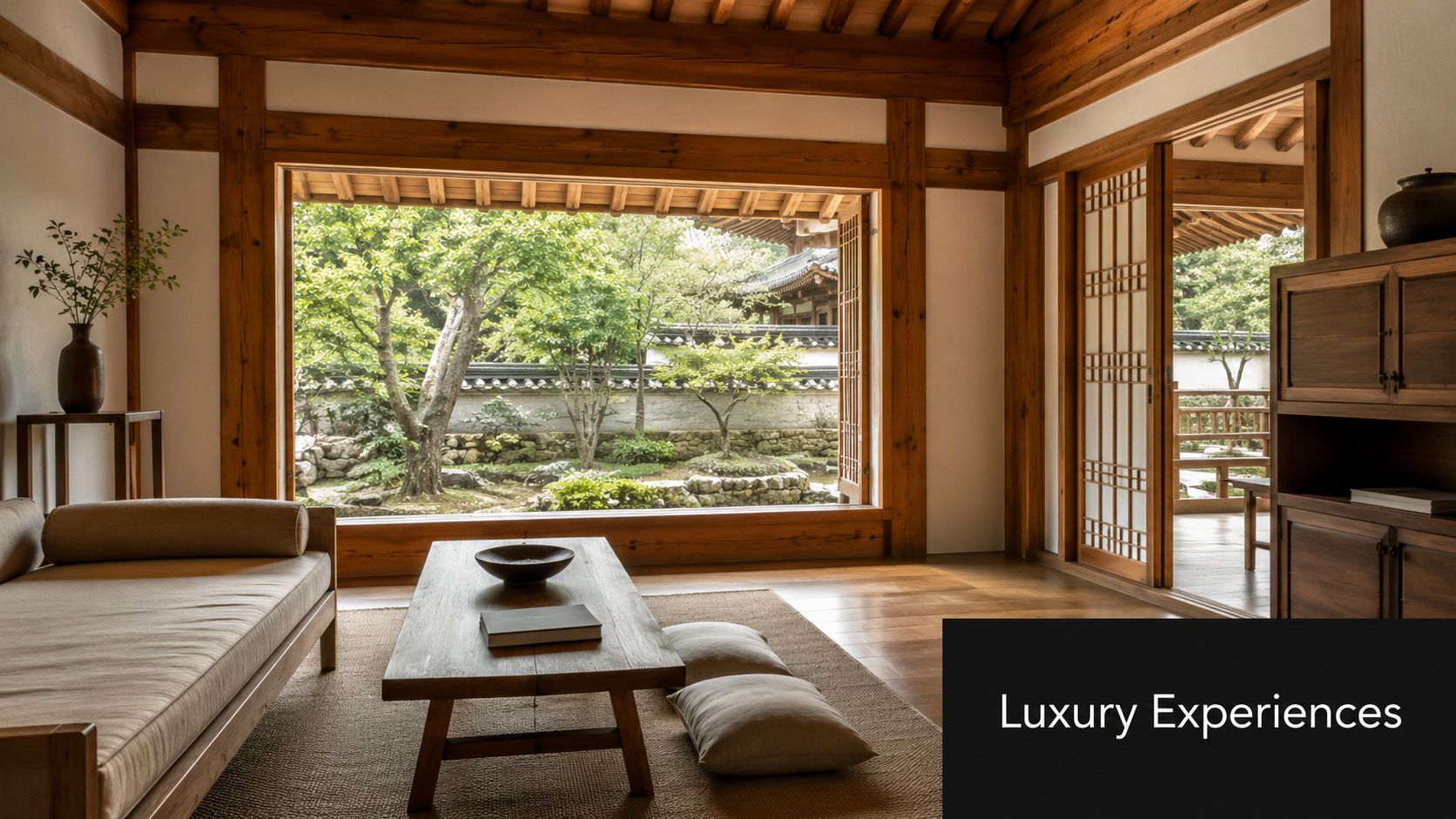
What belongs in the package
A serious Korean itinerary usually needs these layers working together:
- A lead trip designer who shapes the pacing before anything is booked. This person decides whether a hanok stay is best as a contrast piece, not a gimmick, and whether a district like Gangnam or a more heritage-forward base will better suit the traveler.
- In-country concierge coverage for the inevitable changes. Dinner runs long. A gallery invitation appears. Weather shifts. The itinerary must flex without collapsing.
- Private guides with subject expertise, not generic escorts. Korea rewards specialists. A historian transforms a palace visit. A culinary guide changes a market entirely.
- Pre-confirmed transport architecture so the traveler never negotiates cars, station flows, or airport handoffs in real time.
- Reservation strategy across dining, cultural access, and room allocation. In luxury travel, what's confirmed matters more than what's theoretically available.
What often looks premium but isn't
Many expensive packages still fail on the unglamorous details. They may include a respected hotel but use weak room categories, awkward transfer timing, or pooled experiences that interrupt privacy. They may advertise "free time" where the traveler requires a curated handoff: shopping support, a fashion fixer, a bilingual art liaison, or a driver on standby.
A refined package should answer practical questions before you ask them:
| Element | Weak package | Strong package |
|---|---|---|
| Arrival | Standard transfer | Coordinated meet, swift handoff, calm arrival flow |
| Dining | Suggestions only | Confirmed tables matched to taste and mood |
| Guiding | General city guide | Subject-matter expert for culture, food, or design |
| Flexibility | Rigid daily schedule | Elegant adjustments without re-planning stress |
Practical rule: If a package can't explain who handles changes once you're on the ground, it isn't luxury. It's inventory stitched together.
The best travel package to South Korea feels intentional from the first airport greeting to the final departure car. Not ornate. Not noisy. Just exact.
Designing Your Bespoke South Korean Itinerary
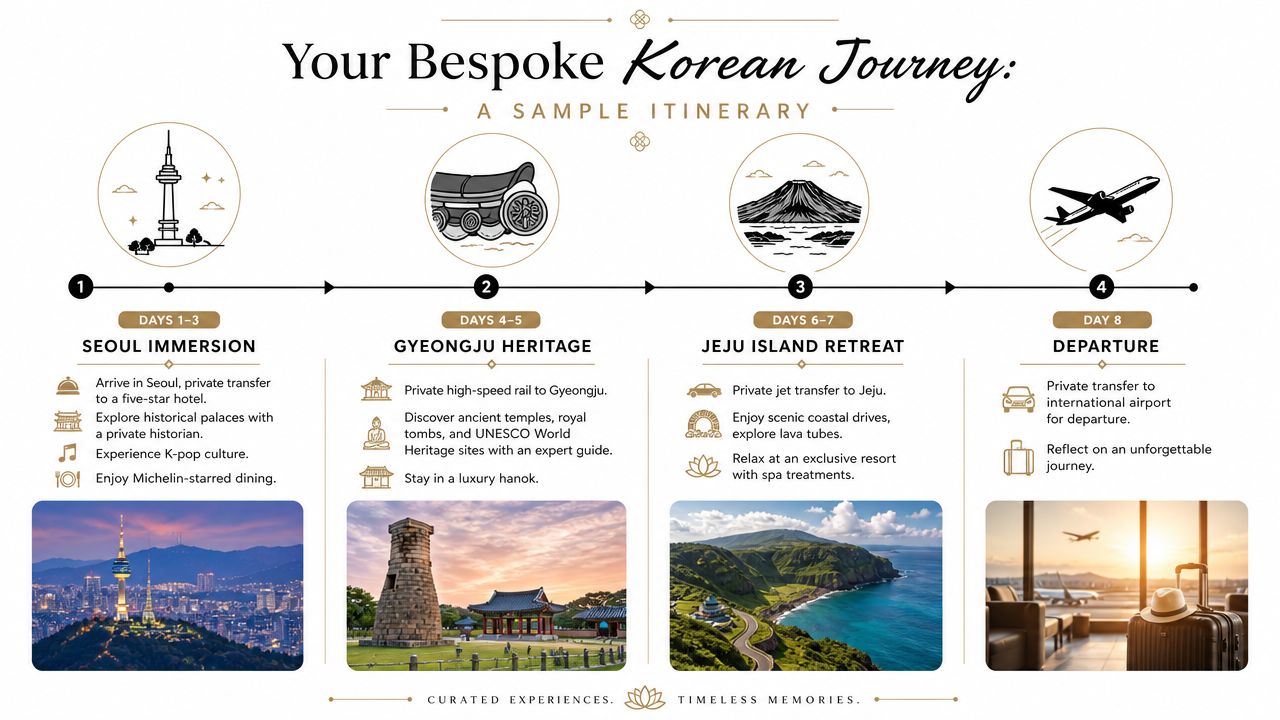
A memorable Korean journey works best when it moves from intensity to texture, then to release. Seoul gives you force and contrast. Gyeongju gives you depth. Jeju gives you air.
That sequence works because each stop corrects the energy of the previous one. You don't want eight days of urban velocity. You also don't want to flatten Korea into only serene heritage and scenic natural environments. The country's appeal lies in its tension between polish and tradition, speed and ritual, hypermodern life and old forms still taken seriously.
To see how that rhythm comes together, this sample route shows the bones of a well-paced private journey.
Seoul for contrast and private access
Seoul should open the trip because it establishes range immediately. Done well, the city never feels like one note. Morning can belong to courtly architecture and quiet compounds. Afternoon can shift into private showroom appointments, contemporary art, or a guide-led walk through a neighborhood where fashion, coffee, and design all matter.
The strongest Seoul itineraries don't overschedule landmarks. They create curated contrasts:
- Historic Seoul in expert company with a private historian who can connect dynastic architecture to modern Korean identity.
- A design-forward afternoon in galleries, ateliers, or appointment-based retail spaces where the traveler sees taste, not just trend.
- A dining arc that moves from refined tasting menus to highly specific local specialties chosen for quality, not novelty.
A lot of generic packages overplay visibility and underplay access. Seoul rewards insider curation. A palace with context lands harder than three palaces without it. A meaningful reservation in the right room of the right restaurant changes the entire emotional register of an evening.
For readers interested in how tailor-made routes are structured at a higher level, this look at customized package tours captures the difference between templated travel and a journey built around individual priorities.
Gyeongju for heritage without performance
Gyeongju works beautifully in the middle of a luxury itinerary because it recalibrates the traveler. The pace eases. The visual field opens. History isn't trapped behind museum glass. It is embedded in the environment.
I prefer restraint over theatricality. You don't need an overloaded schedule. You need room to absorb site, silence, and proportion. A private guide with deep historical fluency matters far more than a long attraction list.
A good Gyeongju stay often includes:
- A luxury hanok night that feels serene rather than staged.
- Temple and tomb-site touring with enough interpretation to make the setting legible.
- Evening pacing that allows for quiet walks, refined dining, and an early reset before the next move.
Gyeongju is often where sophisticated travelers stop trying to "cover Korea" and start actually feeling it.
Jeju for decompression and elemental beauty
Jeju belongs at the end for one reason. It lets the trip exhale.
The island can be mishandled if treated as a sightseeing annex. It works better as a controlled retreat with selective exploration. Scenic drives, lava formations, ocean-facing quiet, and spa recovery all fit naturally here. So do private tastings, slower lunches, and low-interruption mornings.
The key is editing. Jeju doesn't need to be busy to feel valuable. It needs to be beautifully paced.
| Stop | Best role in the itinerary | What to avoid |
|---|---|---|
| Seoul | Opening impact, urban culture, dining, style | Too many landmarks in one day |
| Gyeongju | Historical depth, stillness, architectural memory | Treating it like a rushed day trip |
| Jeju | Retreat, nature, privacy, recovery | Filling every hour with excursions |
A bespoke travel package to South Korea should create emotional progression, not just geographic movement. That's the difference between a trip you remember and one you merely completed.
Securing Exclusive Cultural and Culinary Access
South Korea is one of the rare destinations where culture and cuisine shouldn't be split into separate planning tracks. They feed each other. A meal explains a region. A market explains social rhythm. A formal tea, temple setting, hanbok fitting, or craft encounter gives context to what appears later at the table.
That matters because visitors aren't coming only to sightsee. The U.S. International Trade Administration notes that 60% of tourists cited food or gourmet experiences as a primary reason for choosing Korea in 2023, and visitors stay 7.8 days on average, as shown in its South Korea travel and tourism guide. In practical terms, that's enough time to build a journey around appetite, ritual, and place rather than squeezing in one or two "special meals."
Culinary access that changes the trip
The difference between ordinary and exceptional culinary planning isn't solely booking a difficult table. It's building a food narrative across the stay.
That can include:
- Chef-led encounters where the traveler sees ingredient selection, technique, and plating philosophy rather than just the dining room.
- Market visits with interpretation, especially when a specialist can decode products, etiquette, and regional distinctions.
- Private dining moments that fit the traveler's style, whether that means polished formality or a deeply local setup executed with care.
- Temple or heritage-linked meals that place food inside a wider cultural frame.
The mistake many itineraries make is confusing abundance with refinement. Five restaurant reservations do not equal a strong culinary journey. One weak room, one poor seating, or one generic recommendation can dull the entire tone.
Cultural access worth arranging in advance
Korean culture rewards preparation. The best experiences often require quiet coordination before arrival.
Consider the difference between these two approaches:
| Generic inclusion | High-level version |
|---|---|
| Palace visit | Palace visit with a private historian or cultural interpreter |
| Hanbok rental | Private fitting with design sensibility and proper styling |
| Tea ceremony | Intimate setting with context, etiquette, and conversation |
| Craft shopping | Introduced access to ateliers or makers with serious work |
A premium itinerary should also understand mood. Some travelers want formality and ceremonial polish. Others want contemporary Korea through architecture, fashion, and art patronage. Both can be authentic. Both need the right host.
The most valuable access in Korea isn't always the hardest reservation. It's the person who can turn a closed-looking world into a comfortable one.
When culture and cuisine are planned together, the trip stops feeling like a sequence of nice experiences. It becomes legible. You begin to understand the country through taste, aesthetics, etiquette, and setting all at once.
Mastering Seamless Travel Logistics to Korea
Luxury travel in South Korea is won or lost in transitions.
Anyone can reserve a beautiful hotel. Fewer planners know how to eliminate the friction between arrival hall, city transfer, station platform, rail timing, hotel check-in, luggage handling, and dinner seating. For high-net-worth travelers, that connective tissue is where quality announces itself.
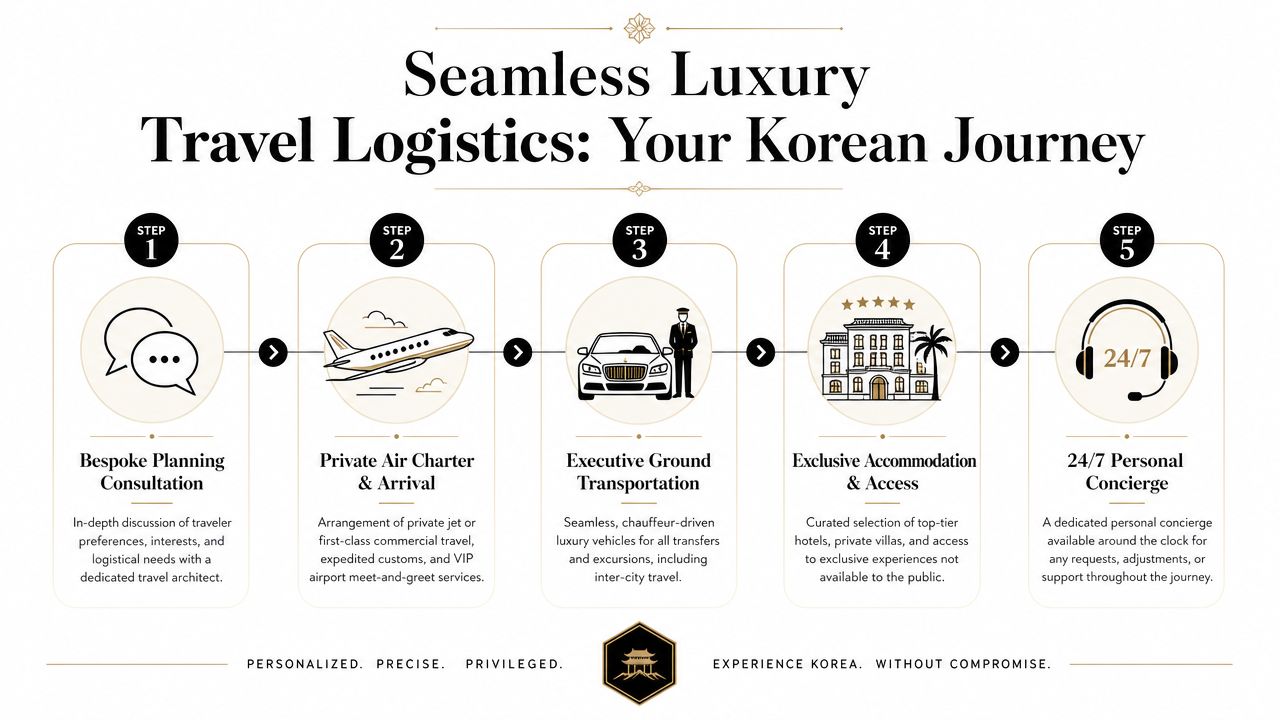
Why rail often beats the road
For multi-city itineraries, I strongly favor rail over chauffeured road transfers on the Seoul-Busan axis unless the client has a specific privacy or routing reason to avoid stations. The reason is simple. The KTX from Seoul to Busan takes just over 2 hours and costs about 59,800 KRW, while slower trains or buses take roughly 4 to 6 hours and cost about 28,000 KRW, according to this breakdown of South Korea transport costs.
For luxury planning, that isn't a budget discussion. It's a time-value discussion. Saving several hours on a transfer day protects the lunch, the spa appointment, the fitting, or the sunset cruise that would otherwise be compromised.
Air strategy and on-ground control
Private aviation can make sense for select Korea journeys, especially when the traveler is pairing Seoul with Jeju or integrating Korea into a wider regional schedule. Travelers evaluating ownership alternatives, cards, and access structures often benefit from reviewing top private aviation investment models before deciding how they want to fly.
On the ground, the hierarchy should be clear:
- Airport arrival first. Fast, managed handoff matters more than a flashy car waiting outside.
- Vehicle standard second. The car should suit the route and luggage profile, not just the photo.
- Coordinator oversight always. Someone should be watching timing, route changes, and service handoffs throughout.
For travelers comparing commercial premium cabins and private flying as part of a broader 2026 strategy, this guide to private jet luxury travel in 2026 is a useful companion read.
Operational standard: Never force a guest to make a logistics decision on the day of travel if that decision could have been made calmly in advance.
A proper travel package to South Korea should make movement feel elegant, even when the route is complex. Especially when it is.
Understanding Seasonal Timing and Investment Value
The best time to visit South Korea depends less on weather in the abstract and more on what kind of atmosphere the traveler wants to inhabit.
Spring brings softness and visual romance. Summer can work well for coastal emphasis and resort time. Autumn has a richly composed look that suits heritage routes and city walking. Winter strips things back in a way some travelers love. Korea becomes quieter, cleaner, and more architectural.
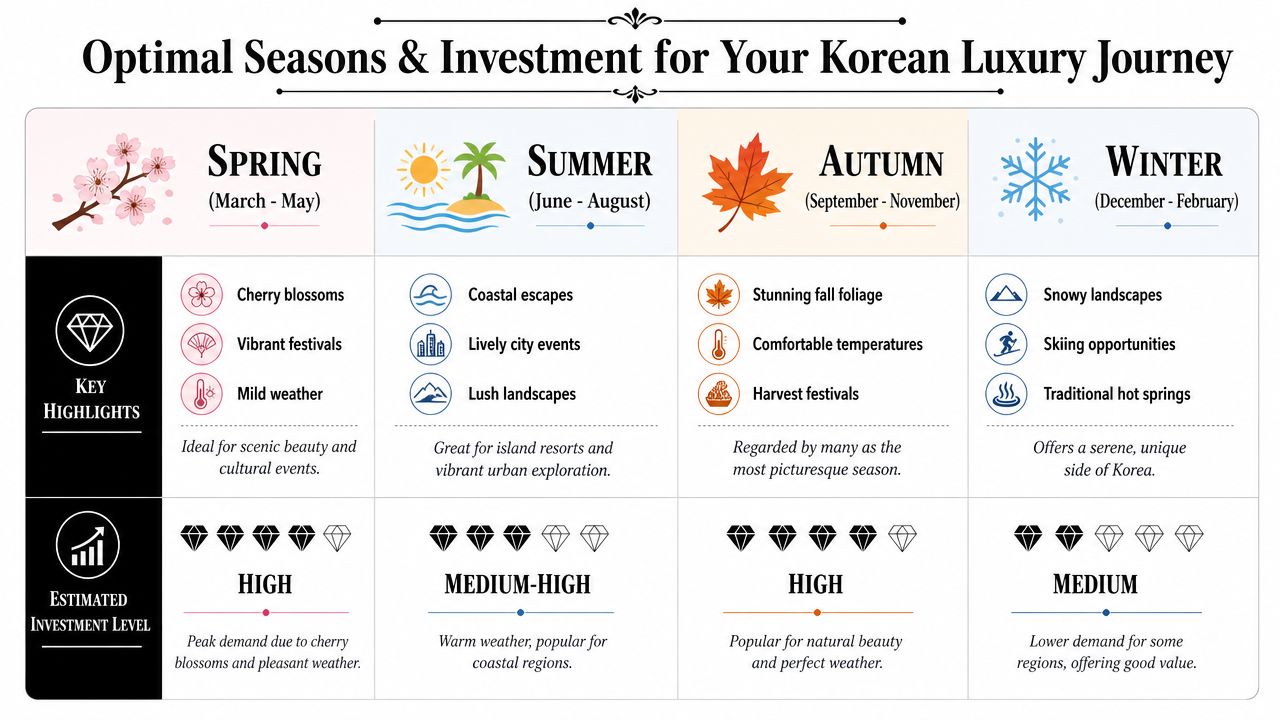
What the season changes
Seasonality affects more than scenery. It changes the trip's social texture.
| Season | Best for | Planning implication |
|---|---|---|
| Spring | Blossoms, polished city energy, classic first visit | Reserve premium rooms and top dining early |
| Summer | Jeju, Busan, coastal mood, resort rhythm | Focus on cooling, pacing, and privacy |
| Autumn | Foliage, architectural touring, elegant walking days | Strong for multi-city cultural itineraries |
| Winter | Minimalist beauty, wellness, festive urban scenes | Best with warm interiors and slower cadence |
I generally advise clients to choose season based on emotional preference, not internet consensus. The "best" month on paper may be wrong for someone who dislikes crowds, wants deep dining access, or values restorative downtime more than peak visual spectacle.
Price is not the same as value
This matters even more in Korea because many advertised packages still obscure what's included. One itinerary may include a specific mix of hotel nights, meals, and transport, while another offers a different inclusion structure entirely, making direct comparison difficult, as shown in this example of South Korea package inclusions and pricing variation.
That's why discerning buyers shouldn't ask only, "What does it cost?" They should ask:
- Which room category is being held
- Whether transfers are private throughout
- How many meals are included
- Who the guides are and what they specialize in
- What level of flexibility exists once the trip begins
The teaser price on a marketplace package tells you very little. In a bespoke travel package to South Korea, value comes from coherence, access, timing, and confidence in execution.
A transparent planner should be able to explain the investment in plain language. Not with vague luxury vocabulary. With specifics.
The Unmatched Benefits of Booking with HauteBlack
For travelers who want South Korea handled at the highest level, the advantage isn't just that arrangements get made. It's that the right relationships shape the outcome.
HauteBlack sits in a rare position because it combines bespoke travel design with the wider reach of Haute Living's network. That means a Korean journey can be built with sharper hotel recognition, more thoughtful VIP treatment, and access that goes beyond standard preferred-rate booking channels. Through its Virtuoso affiliation and preferred partner relationships, travelers may receive upgrades when available, property-specific benefits, and a more recognized arrival profile at leading hotels.
That matters in a destination where details decide whether a trip feels smooth or improvised. A strong advisor can shape suite strategy, reserve around difficult dining windows, coordinate private transfers and air support, and adapt quickly once the traveler is in motion. For members, the value compounds further through dedicated advisory support and waived planning fees.
Travelers considering what elite concierge support should include can review this overview of luxury travel concierge services. It clarifies the difference between simple booking help and full-spectrum lifestyle travel management.
For the client, the effect is simple. Less explanation. Less repetition. More recognition. More access. Better judgment at every decision point.
If you want a travel package to South Korea that feels privately designed rather than publicly sold, HauteBlack is built for that standard. From VIP hotel recognition and private aviation support to tailor-made cultural access and end-to-end concierge execution, HauteBlack creates Korean journeys with the discretion, precision, and insider advantage that exceptional travel requires.
Explore Our Guides


Signature Experiences


