Haute Black Journal
Luxury Travel Advisor Guide to Better Trips

Marlene Azeez
Director, HauteBlack
View all articles →

Choosing a luxury travel advisor for upgrades alone is the wrong starting point. A better room is welcome, but it won't rescue an itinerary built around an impossible connection or a family suite that doesn't accommodate your children. Start with a more useful question: Who will help you make sound decisions, and who will take responsibility when the arrangements need to change?
Why Luxury Travel Demands More Than Reservations
Consider a hypothetical family arriving overseas before an important celebration. Their hotel looks exceptional, the restaurant is booked, and a driver is waiting. Then their flight changes, the driver's instructions still show the original arrival, and the hotel reveals that connecting rooms were requested rather than confirmed.
None of those problems comes from choosing an inexpensive service. Each comes from a gap between services. The family doesn't need another reservation. They need someone who understands how changing an arrival affects check-in, transport, dinner, and tired travelers.
The connections matter as much as the components
An expensive itinerary can still be poorly designed. A remote villa may offer privacy but require more driving than a grandparent can comfortably manage. A celebrated restaurant may be unsuitable for a child's dietary needs. An early departure may undermine the restful anniversary evening that motivated the trip.
The useful distinction is between purchasing impressive components and designing a workable journey. The latter starts with constraints, not photographs.
- Time: Does the schedule allow for arrival formalities, recovery, and realistic travel between commitments?
- Suitability: Will the accommodation work for the people traveling, not just look attractive?
- Accountability: Who checks that separate suppliers are acting on the same information?
Luxury, understood this way, is less about accumulating extras than avoiding preventable friction. Travelers can still choose adventurous routes, ambitious schedules, or secluded properties. They should understand what those choices require.
Practical rule: Judge an itinerary by its weakest connection, not its most beautiful reservation.
An advisor shouldn't replace the traveler's judgment. Their job is to make the consequences clear enough that the traveler can choose confidently, without becoming the project manager for every detail.
What a Luxury Travel Advisor Actually Does
A luxury travel advisor works much like a private architect. You describe how you want to live during the journey. The advisor translates that ambition into a design that suppliers can execute. You remain the decision-maker, while they test whether the proposed arrangements fit together.
Suppose you're planning a honeymoon across Italy and France. You want privacy, memorable meals, and time by the water, but you dislike frequent packing. A useful advisor doesn't begin by presenting a long hotel list. They first establish what you're willing to trade: fewer destinations for longer stays, central locations for seclusion, or spontaneity for access that requires advance arrangements.

From preferences to an executable plan
The work connects several responsibilities:
- Destination judgment: Explain which locations suit your interests, season, and preferred pace, including reasons to reject appealing alternatives.
- Itinerary design: Arrange stays and activities in a sensible sequence, with room for rest and personal time.
- Supplier coordination: Translate your requirements into specific instructions for hotels, drivers, guides, and restaurants.
- Representation: Speak to those suppliers on your behalf when a request needs clarification or an arrangement falls short.
The discovery process should capture more than favorite hotel brands. Room and bed requirements, mobility needs, dietary restrictions, privacy expectations, celebration goals, and acceptable compromises all belong in the planning conversation.
For the honeymoon example, “romantic” isn't a sufficient instruction. Does it mean quiet breakfasts, discreet service, a lively dining scene, or uninterrupted time together? Those answers can lead to very different recommendations.
Advice and concierge work overlap, but aren't identical
A concierge request might concern a particular dinner or transfer. Advisory work also asks whether that arrangement belongs in the journey at all. For a destination-specific introduction to concierge terminology, Uptown Rent A Car's Dubai travel concierge explained provides a useful companion resource.
When reviewing HauteBlack's travel services, apply the same distinction between an individual arrangement and responsibility for the whole itinerary. Ask what happens before booking, while you're traveling, and after you return.
A post-trip conversation matters because it can turn an observation into a better future decision. “We loved the property but disliked the isolation” is more useful than recording that you enjoyed a luxury hotel.
What Makes Advisor Value Worth Paying For
The clearest reason to pay for advice is better judgment under constraints. In a survey of affluent travelers, 84% said a trusted advisor was more valuable than unlimited internet research, according to the Preferred Hotels & Resorts luxury travel report coverage. The practical question is what the advisor does with that trust.
Consider an executive combining business commitments with a family holiday across several countries. The most prestigious hotel may be the wrong choice if it creates difficult transfers or separates the executive from the family during limited free time. Good advice makes that conflict visible before anyone commits.
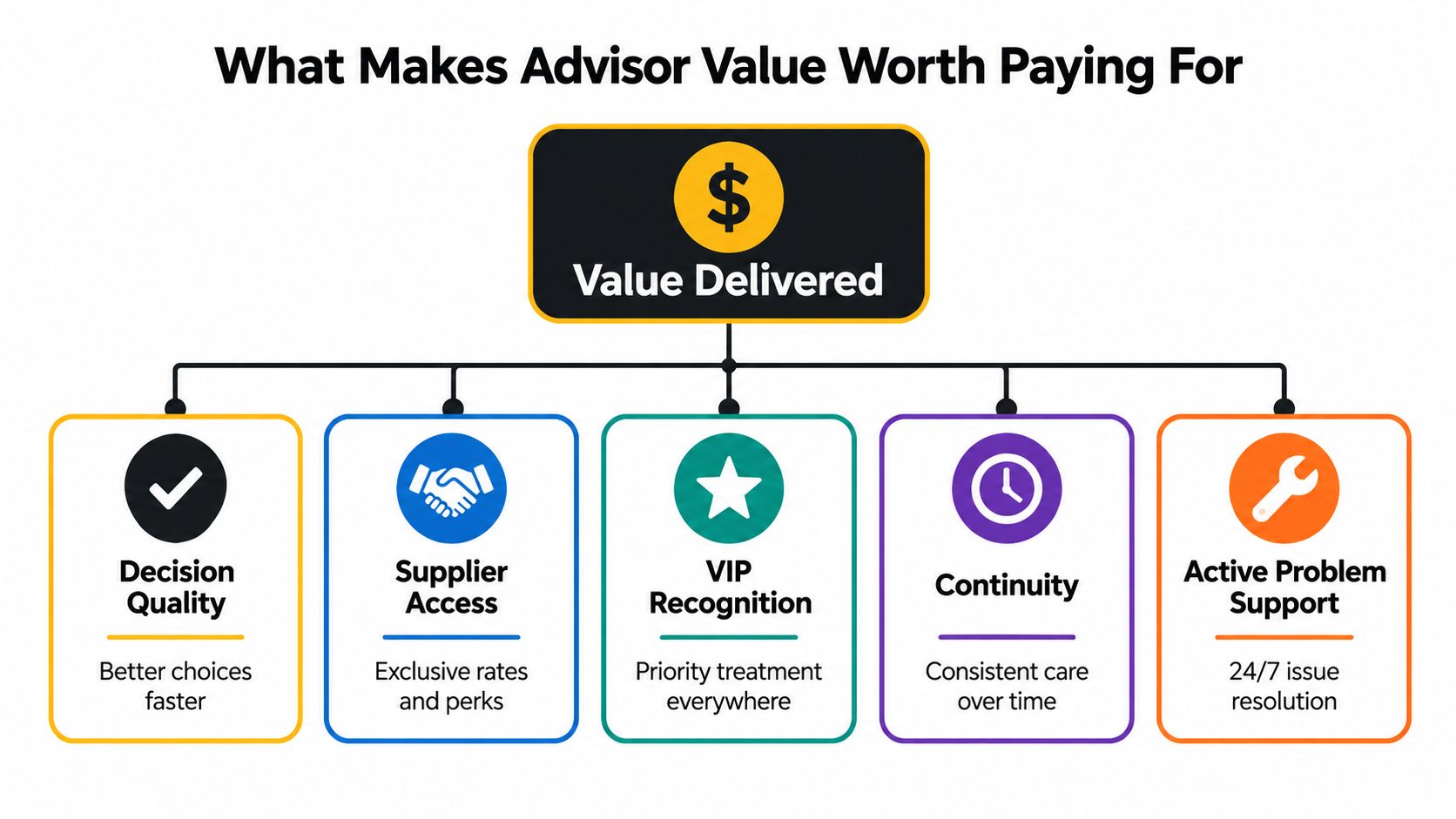
Separate the benefits you can see from the work you can't
Decision quality means receiving a defensible shortlist rather than a catalogue. The advisor should explain why an option fits and what you're giving up by choosing it.
Supplier access concerns relationships and available arrangements. VIP recognition concerns how a supplier prepares for your stay. Neither should be confused with a guarantee that every request will be fulfilled. When reviewing Virtuoso-related benefits, ask which terms apply to the particular reservation, rather than assuming a program description settles every detail.
Continuity is different again. It means someone can carry your priorities across separate arrangements and understand why a seemingly minor change matters.
Luxury service is continuity, not merely a visible perk.
Information isn't the same as intervention
An advisor who forwards an airline cancellation notice provides information. An advisor who contacts affected suppliers, develops alternative routing, and obtains your approval for revised costs performs active disruption work. You need to know which service you're buying.
This distinction reflects a consequential concern: 75% of surveyed luxury travelers ranked safety and security as their top concern, while 65% identified peace of mind as an advisor's greatest benefit, according to Virtuoso luxury travel findings reported by Travel Weekly Australia.
No advisor can prevent every cancellation, weather event, or emergency. Their value lies in preparation and an agreed response process. Ask who monitors developments, who contacts suppliers, what happens outside office hours, and what spending or rebooking authority requires your approval.
The infographic summarizes categories of value, not contractual promises. Around-the-clock availability, priority treatment, and particular benefits should always be verified in writing.
How HauteBlack Extends the Advisor Role
A traveler booking a hotel, a traveler designing a complex holiday, and a member coordinating travel alongside private events may need different kinds of support. Comparing those needs is more useful than assuming every business calling itself an advisor offers the same service.
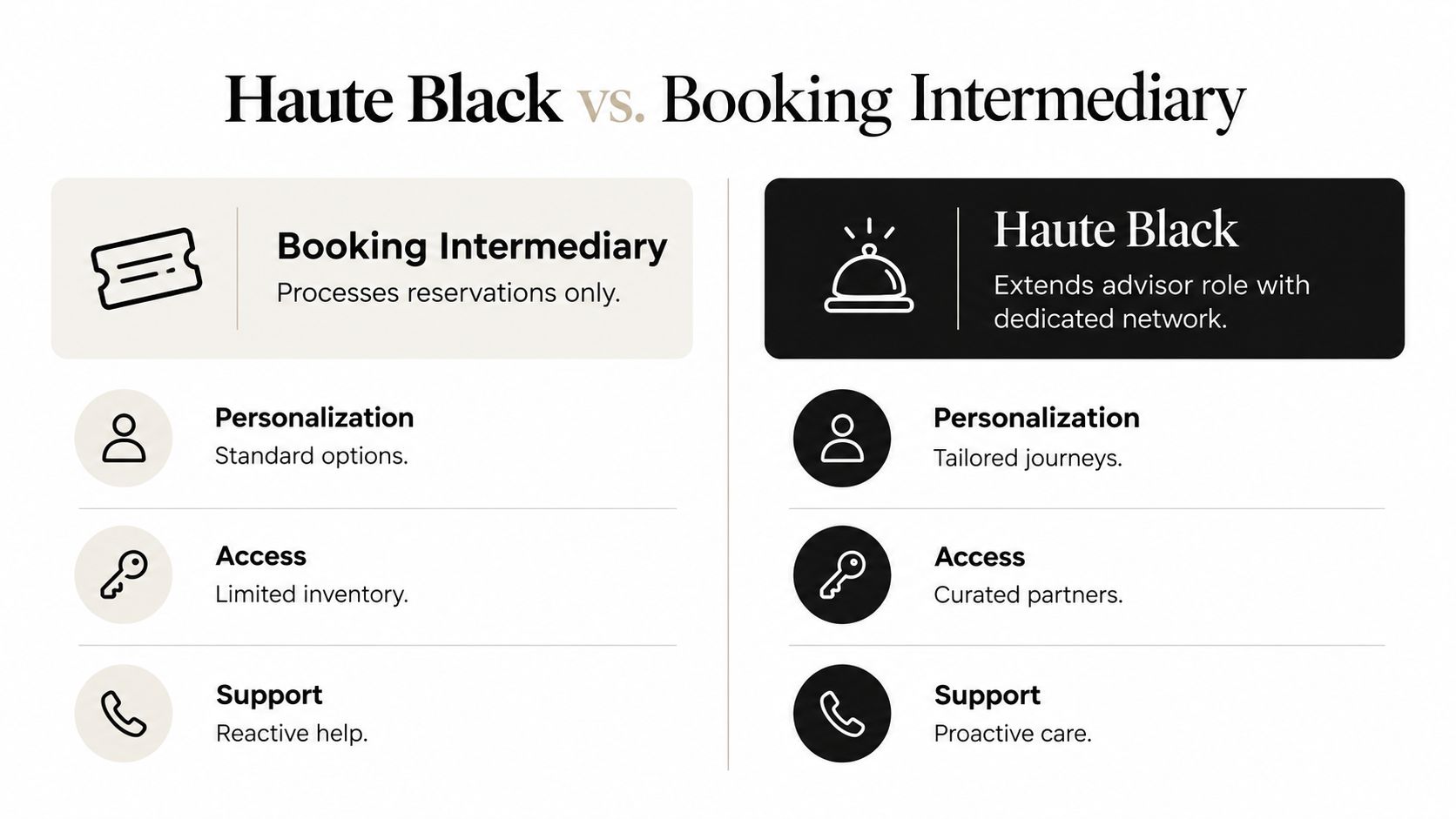
A reservation-focused intermediary might suit someone who has already selected the property and dates. An independent luxury travel advisor may take responsibility for wider planning and supplier coordination. A broader membership model adds another question: does the traveler want an ongoing relationship extending beyond individual journeys?
A broader service scope
HauteBlack describes a network spanning more than 120 countries, with bespoke itineraries, VIP recognition, private aviation through Haute Jets, first-class and helicopter transfers, villas and estates, concierge dining, sporting events, and curated upgrades in its overview of luxury journeys and travel services.
The significance isn't the length of that service list. It's the possibility of coordinating related needs through a shared planning relationship. For an executive assistant arranging a business arrival followed by a family retreat, transport choices should reflect luggage, privacy requirements, accommodation access, and the executive's commitments.
The company also states that it has preferred relationships with more than 500 luxury properties, naming Four Seasons, Aman, Rosewood, St. Regis, Mandarin Oriental, 1 Hotels, Wynn, and Belmond, and says advisors contact properties directly before client arrivals in its guide to planning a journey around the world.
Reach is useful only when applied to your requirements
A Virtuoso affiliation or preferred relationship is a starting point for questions, not a substitute for booking-specific confirmation. Whether you're considering a named partner or a Ritz-Carlton stay, ask which relationship applies, what benefits are documented, and which requests remain subject to availability.
Compare the models through a concrete request: a private arrival, a suitable family residence, a significant dinner, and attendance at a sporting event. Who designs the sequence? Who checks access conditions? Who owns the handoffs?
- An intermediary: Establish whether its responsibility ends with the reservations it processes.
- An independent advisor: Confirm the breadth of coordination and any services handled by outside specialists.
- A membership provider: Determine what the ongoing relationship adds beyond trip planning.
The comparison diagram describes contrasting service models. It shouldn't be read as proof that every intermediary is reactive or every membership arrangement includes proactive monitoring. The engagement terms should settle those questions.
Choose an Advisor by the Decisions They Make
Begin with the journey's difficulty, not the advisor's destination photographs. Identify where your trip could become hard to manage: separate arrival cities, restricted schedules, family requirements, sensitive personal information, or suppliers whose arrangements depend on one another.
Then ask prospective advisors to discuss a real planning conflict. If you want a remote retreat and easy access to city dinners, do they explain the compromise? An advisor who respectfully challenges an unsuitable request may offer more useful judgment than one who agrees with everything.
Compare Three Models of Luxury Travel Support
These are evaluation prompts, not universal descriptions. Independent businesses and individual service agreements vary.
| Decision Criterion | Booking Intermediary | Independent Luxury Travel Advisor | HauteBlack |
|---|---|---|---|
| Planning depth | Confirm whether advice extends beyond transactions | Request a sample planning approach | Assess bespoke itinerary scope |
| Ongoing access | Check contact arrangements after booking | Establish continuity between trips | Compare trip-based and membership access |
| Supplier relationships | Ask who communicates special requirements | Request relevant relationship examples | Ask which preferred relationships apply |
| VIP recognition | Verify what the reservation includes | Separate confirmed benefits from requests | Obtain booking-specific benefit terms |
| Coordination | Identify responsibilities between suppliers | Agree ownership of itinerary handoffs | Confirm responsibility across selected services |
| Broader services | Check the limits of the engagement | Identify specialist partners | Evaluate travel alongside wider arrangements |
Request evidence rather than reassurance
A useful proposal explains why the advisor excluded an attractive alternative. Perhaps its location would consume too much of your limited free time, or its accommodation couldn't meet a defining family requirement.
- Relevant experience: Ask for an anonymized example involving comparable constraints, not the same destination.
- Communication quality: Look for direct answers, clearly recorded decisions, and a realistic contact process.
- Operational discipline: Request an explanation of reconfirmation, documentation review, and contingency ownership.
- References: Where available and appropriate, ask about clients with similar planning needs, without expecting disclosure of private details.
Selection test: Ask what the advisor would advise against booking, and why.
Finally, assess personal fit. Some travelers want detailed comparisons; others want a recommendation with the reasoning summarized. An executive assistant may need written approvals and clear spending boundaries. A couple may prefer collaborative conversations. The advisor should be able to explain how their working style accommodates yours without promising unlimited availability or undefined service.
Questions to Ask Before Choosing an Advisor
A consultation should reveal how the advisor thinks. Give them a genuine outline of your journey, including the awkward parts, and listen for precise follow-up questions. A polished answer about exclusive access tells you little if the advisor hasn't understood who is traveling.
Test destination judgment and discovery
- Suitability: “What about this destination might make it wrong for us?”
- Preference discovery: “What would you need to know before recommending accommodation?”
- Trade-offs: “If we keep this event in the schedule, what should we remove?”
- Relevant experience: “Can you describe an anonymized planning problem similar to ours and explain your approach?”
Strong answers distinguish personal taste from practical constraints. For a multigenerational family, the advisor should notice differing mobility and rest needs. For honeymooners, they should clarify what privacy and celebration mean to the couple.
Establish verification and authority
- Supplier preparation: “Which room features and access requirements will you confirm directly, and how will you document the answers?”
- Sequencing: “Where do you see the most vulnerable handoff in this proposed journey?”
- Travel documents: “Who checks passport, visa, and entry requirements, and what remains our responsibility?”
- Benefits: “Which inclusions are confirmed, which are requests, and which depend on availability?”
- Disruption response: “Who handles an urgent problem outside normal hours, and through which contact channel?”
- Rebooking authority: “What can you change without further approval, and how will additional costs be authorized?”
Listen for named responsibilities and a practical process, not promises that nothing will go wrong. An executive assistant should also ask how the advisor handles decisions when the principal is unreachable.
Ask how sensitive information is handled
“Who can access our traveler profiles, documents, and itinerary?” is a more revealing question than “Is everything confidential?” Follow it with questions about secure transmission, supplier disclosure, retention, and correcting outdated information.
Ask what will be reconfirmed before departure and what documentation you'll receive. A strong answer makes the boundary between advisor responsibility and traveler responsibility understandable. If that boundary remains vague during the consultation, resolve it before paying or authorizing bookings.
Decide When Membership Becomes Worthwhile
Membership and bespoke planning solve different problems. An individual trip requires an engagement with a defined scope. An ongoing relationship may suit someone who wants travel preferences and decision-making arrangements carried across repeated journeys.
HauteBlack states that non-members can book signature journeys and tailor-made trips, while membership includes a dedicated advisor and waived planning fees, as explained in its guide to luxury travel planning fees. You don't need to assume annual membership is necessary to obtain personalized planning.

Compare the relationship, not just the fee waiver
HauteBlack reports that membership starts at $10,000 annually and includes waived planning fees, direct access to directors, and entry to more than 75 exclusive members-only events, according to its luxury travel membership guide.
Those terms create several separate considerations:
- Travel pattern: Would you use the relationship repeatedly, or mainly for an isolated complex holiday?
- Senior access: When would access to directors be useful, and how does it operate?
- Event relevance: Do the cultural, culinary, and networking opportunities match your interests and availability?
- Fee scope: Which planning services are covered, and which expenses or specialist services remain separate?
- Relationship expectations: What continuity, privacy arrangements, and communication commitments are documented?
Avoid an imaginary savings calculation
A planning-fee waiver isn't evidence that membership will save every traveler money. Compare written trip-based proposals with the actual membership terms, including services you would genuinely use. Don't assign financial value to events you wouldn't attend or benefits that aren't confirmed.
Review the current membership options and ask for clarification before committing. Membership becomes more compelling when the broader relationship fits an established travel pattern and the additional entitlements matter independently. For a single milestone journey, a clearly scoped bespoke engagement may be the more proportionate choice.
Build a Relationship Before You Book
Match the support to the task. A straightforward stay that you've confidently selected may need little advice. A complicated one-off journey may justify bespoke planning without an annual commitment.
Repeated travel can make an ongoing advisor relationship useful. Membership deserves consideration when the wider cultural, event, and relationship benefits are relevant to your life, rather than attractive in the abstract.
Buying access opens a door. Buying continuity means knowing who will help when the door you planned to use is closed.
Bring a real journey to the first conversation
Prepare your likely dates, traveler needs, fixed commitments, and unresolved choices. Ask the advisor to identify a difficult trade-off, explain how they would prepare suppliers, and describe their response if a critical arrangement failed.
You don't need a complete itinerary during that conversation. You need evidence of careful listening, sound reasoning, and a service boundary you understand. Choose the relationship that helps you make better decisions and assigns clear responsibility, not the proposal with the longest list of perks.
HauteBlack offers bespoke itinerary planning, VIP recognition, and coordinated travel arrangements, with both individual-trip and membership access. Visit HauteBlack with a real journey in mind, and ask which service structure fits your planning needs, travel frequency, and expectations for ongoing support.
Explore Our Guides


Signature Experiences


