Haute Black Journal
Luxury Resort Amenities: The 2026 Insider Guide

Marlene Azeez
Director, HauteBlack
View all articles →
You've arrived after a long flight, the resort looks immaculate, and yet the first hour feels oddly ordinary. The room is beautiful, the pool is photogenic, and the welcome drink is perfectly chilled, but nobody has asked how you want the day to unfold. That's the difference between a resort with luxury resort amenities and a resort that knows how to use them.
At the top of the market, amenities are no longer a checklist of visible indulgences. They're the systems that protect your time, preserve your privacy, improve your health, and remove decisions from the trip. The public website may advertise the spa, villa pool, and fine-dining restaurant. The valuable question is what happens before arrival, between treatments, at dinner with children, and when plans change.
The Moment a Resort Reveals Its True Tier
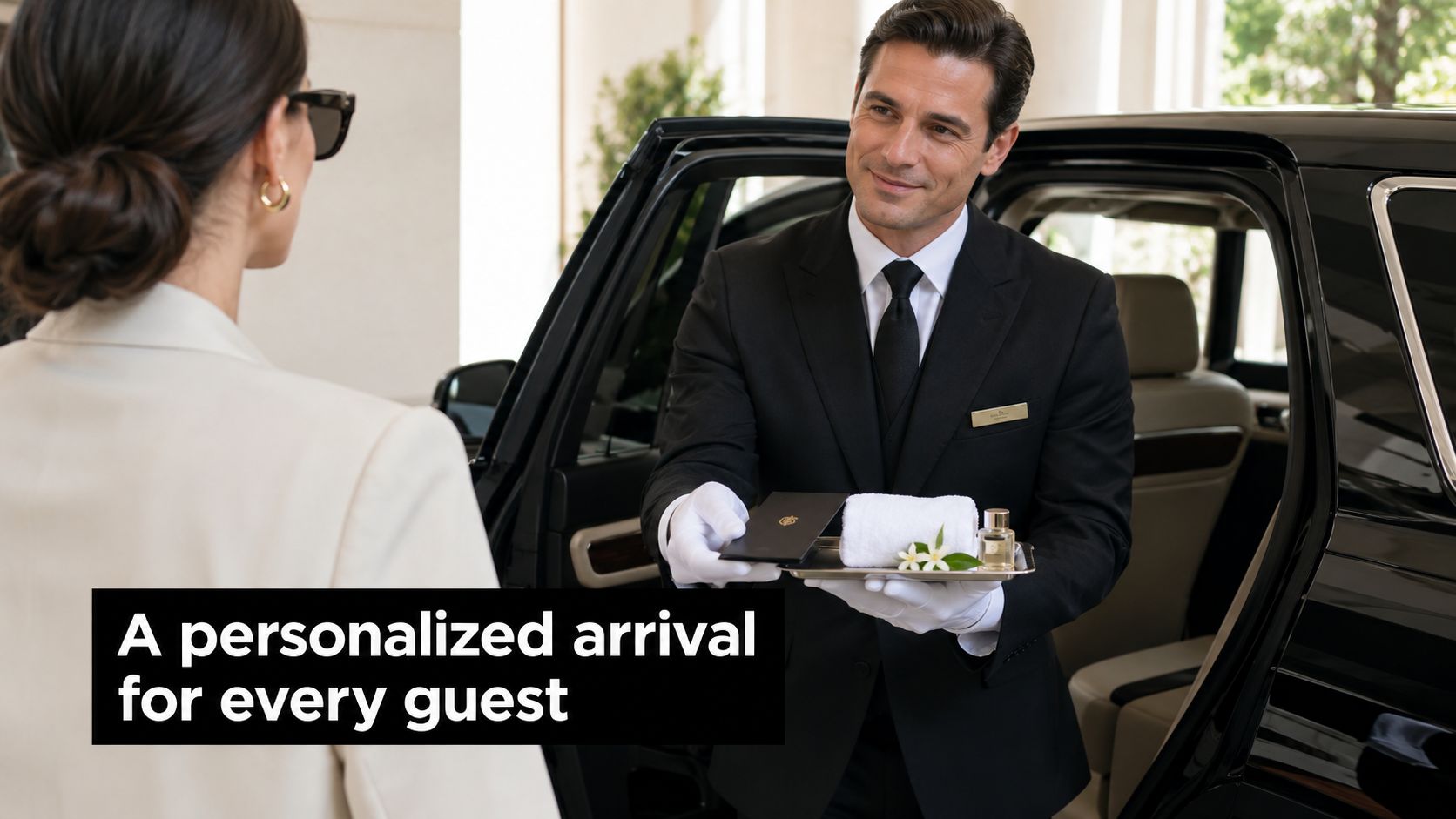
The private transfer turns beneath a discreet porte-cochère. Before the engine stops, a butler is already walking toward the vehicle, greeting you by name. A chilled towel carries a light neroli fragrance. Your suite key is in hand, your preferred sparkling water is waiting, and nobody asks you to repeat a passport detail or explain where your luggage should go.
That moment tells you more than the marble in the lobby. Luxury appears in the handover from tarmac to villa, when transport, arrival, recognition, luggage, and room access operate as one continuous experience.
Seamlessness is the real differentiator
The physical product has become easier to imitate. A dramatic suite, an infinity pool, a private beach, and a well-designed spa now appear across many top-tier brochures. What separates an Aman from a Rosewood or Six Senses is less often the footprint of the room than the ecosystem wrapped around it.
A resort's true tier reveals itself through small operational decisions:
- Recognition: Staff know who you are and what matters to you without making the welcome theatrical.
- Continuity: The preferences shared with reservations reach the villa, spa, restaurants, and transfer team.
- Discretion: Staff solve personal requests without turning them into visible transactions.
- Anticipation: The resort handles likely friction before you need to mention it.
Advisor's rule: If the resort can only describe an amenity as a facility, ask who operates it and how it changes your day.
This is why the gap between marketed amenities and delivered amenities matters. “Butler service” might mean a dedicated professional who coordinates your wardrobe, dining, and family logistics. It might also mean a concierge who answers a phone. “Wellness” might mean a treatment room and a small gym, or it might mean diagnostics, recovery, nutrition, and a schedule designed around your goals.
The brochure tells you what exists. The arrival tells you how intelligently it works.
What Luxury Resort Amenities Actually Mean Today
The category has evolved in clear stages. In America, the modern branded-amenity concept didn't exist in 1776, when even upscale lodging focused on privacy, food, and bedding rather than a branded collection of guest facilities. The grand-hotel era began in the 1820s, introducing private rooms with locks, indoor plumbing, bellhops, and free soap, while electricity and in-room telephones later became part of maturing luxury standards. These milestones are documented in the history of luxury amenities in American hotels.
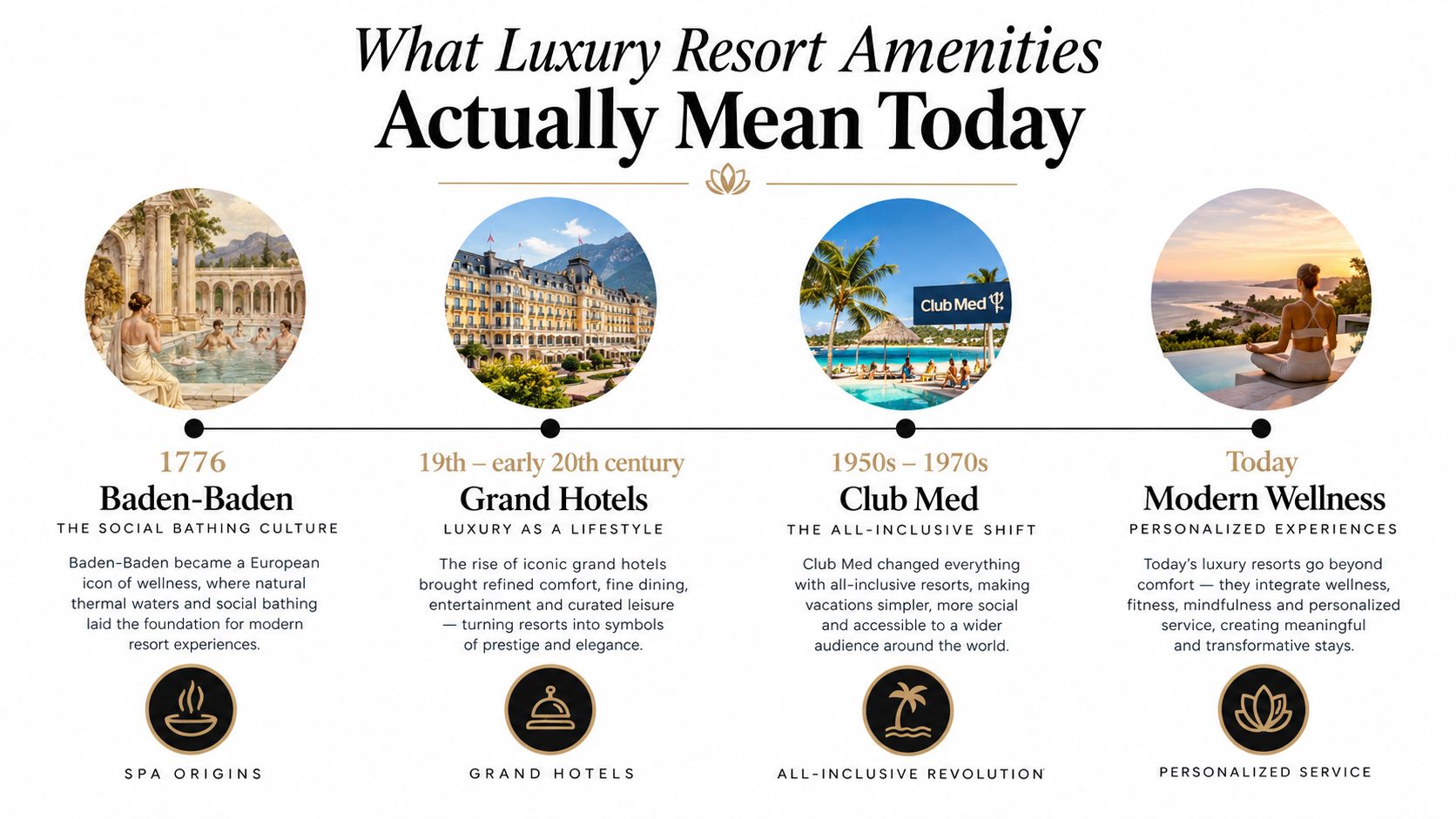
The lesson is straightforward. Amenities have always reflected what affluent guests wanted to avoid or enjoy next. Locks created privacy. Plumbing created convenience. Telephones created access. Today, personal service, wellness programming, integrated technology, and curated logistics perform the same function at a more refined level.
Three tiers, three different promises
Standard luxury amenities include the expected spa, attractive pool, fine dining, fitness center, quality bedding, and attentive concierge. They establish credibility, but they rarely determine whether a repeat guest returns.
Aspirational amenities create a stronger emotional reason to book. Think private plunge pools, club floors, exceptional villas, overwater accommodation, destination restaurants, and well-designed family facilities. These features influence the choice between comparable properties.
Ultra-luxury amenities are outcome-oriented. A dedicated team captures preferences before arrival, arranges private logistics, adjusts the room to the guest, programs the wellness experience, and manages family or business requirements without repeated prompting. The guest isn't buying more objects. They're buying time, privacy, and certainty.
That's the working definition I use: a luxury resort amenity is valuable when it changes how the guest spends the day, not merely how the resort photographs.
The Six Categories That Define a Modern Luxury Stay
A resort brochure becomes easier to assess once you sort amenities by delivered guest value, not by the amount of space or marketing attention they receive. For repeat guests, wellness and service usually outrank decorative design. A beautiful pool is pleasant. A capable team that arranges an early treatment, a private lunch, and a child's activity without friction is useful every day.
The six categories
| Rank | Category | What It Includes | Guest Value | Brand Leaders |
|---|---|---|---|---|
| 1 | Personal service | Butlers, concierges, dedicated staff, preference management | Saves time and protects privacy | Aman, Rosewood, Four Seasons |
| 2 | Wellness and spa | Treatment rooms, thermal facilities, recovery, structured programming | Supports energy, sleep, and routine | Aman, Six Senses, SHA Wellness |
| 3 | Accommodation tier | Villas, residences, private compounds, plunge pools | Creates space, separation, and control | Four Seasons, Rosewood, Cheval Blanc |
| 4 | Arrival and transfer | Chauffeured vehicles, private terminals, fast-track logistics | Removes travel friction | Four Seasons, Aman, Rosewood |
| 5 | Culinary | Chef-led restaurants, in-villa dining, beverage programs | Adds pleasure and convenience without leaving the property | Aman, Bvlgari, Rosewood |
| 6 | Family and multigenerational | Kids' clubs, teen programming, nannies, family villas | Lets different generations travel well together | Four Seasons, One&Only, Soneva |
The ranking changes with the traveler. A couple celebrating an anniversary may place dining above family programming. A wellness devotee will put treatment depth first. A multigenerational group may value accommodation configuration and childcare more than a signature restaurant.
How to read the brochure
Start with the accommodation category. A private compound with separate entrances and outdoor living can transform a family stay more effectively than a larger hotel room. Then examine the service architecture. Does the resort assign one person who owns the stay, or does every request move through a different desk?
Look for depth in wellness, not just the word “spa.” Ask whether the property offers movement, recovery, sleep, nutrition, and consultations. For arrival, find out whether the resort manages the full transfer chain or only recommends a car service.
The most expensive amenity isn't automatically the most valuable one. The right amenity is the one that removes the problem you would otherwise spend your holiday solving.
Private Butlers, Villas, and the Service Standard Above Five Stars
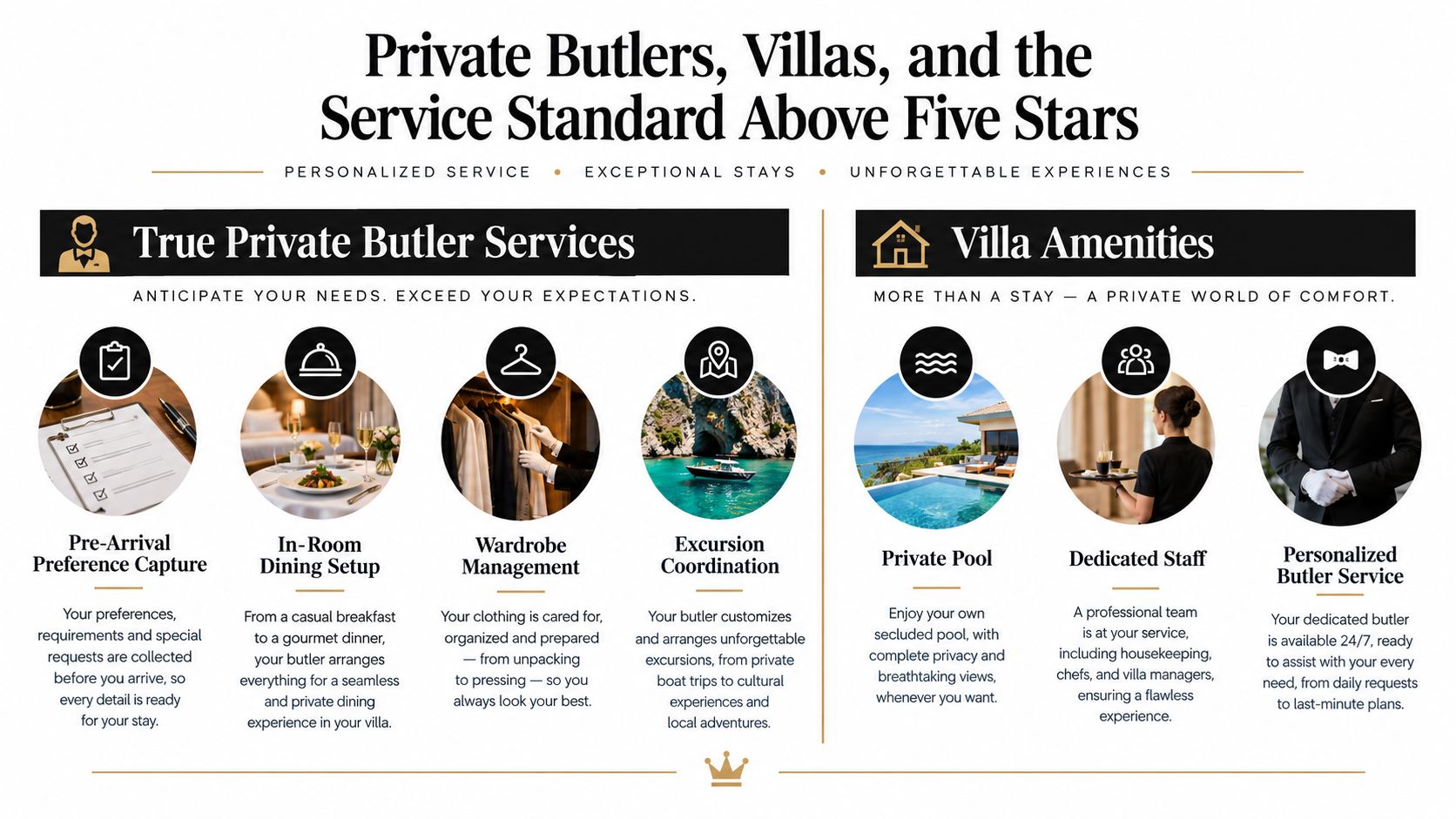
A genuine private butler doesn't just relay requests. That's a glorified concierge with a more elegant title. A real butler owns the guest experience inside the accommodation, often coordinating with the wider resort while protecting the guest from unnecessary decisions.
What a proper butler handles
Before arrival, the butler should help capture preferences around bedding, beverages, dining times, wardrobe needs, celebrations, children, and privacy. During the stay, the role can include in-room dining coordination, packing and unpacking, garment preparation, excursion timing, and discreet management of personal logistics.
The test is continuity. If you tell one person that your child needs an early dinner, the information should reach the restaurant and activity team without you repeating it. If you ask for a room refresh while at breakfast, the request should be resolved without a chain of calls.
Branded programs associated with Aman, Bulgari, Rosewood, Four Seasons, and Cheval Blanc can differ substantially by property, so the label alone proves nothing. Ask about training, availability, communication method, and whether the same professional remains responsible throughout the stay. Direct WhatsApp or app communication is useful, but responsiveness and judgment matter more than the channel.
Villas are an operating model
Villa categories include beachfront, overwater, residential, and private-estate accommodation. The meaningful distinction is not merely the pool or the square footage. It's whether the villa has a separate arrival path, genuine privacy, dedicated staff, and a service pattern suited to the number of people staying there.
A staffed Caribbean villa typically includes a private chef, butler, and dedicated 24/7 concierge, according to HauteBlack's Caribbean villa guide. The same guide cites a Four Seasons Nevis villa fact sheet stating that villas can provide access to resort amenities while costing 30% to 50% less than equivalent resort rooms for the same group size.
Before booking, ask these questions:
- Who is assigned: Is there a named butler or only a shared service desk?
- What happens pre-arrival: Does the team capture preferences before the journey?
- How does communication work: Can you reach the assigned person directly?
- What does the villa include: Is the staff package clear, and are resort facilities accessible?
- What is the privacy design: Are entrances, pools, and service routes fully separate?
For a practical view of how concierge support can add value before and during a stay, consult this guide to luxury travel concierge services.
Why Wellness Has Become the Most Important Amenity Category
Wellness has moved from a pleasant hotel department to a serious commercial asset. In CBRE's 2024 hotel spa sample, spa revenue averaged $6,061 per available room, rising to $6,539 in resort locations and $9,847 at luxury hotels. Spa revenue represented 4.2% of total revenue at luxury hotels, compared with 3.5% at resort properties and 3.4% across the full sample, as reported in CBRE's analysis of hotel spa departments.
HVS found that luxury hotels averaged 13 spa treatment rooms, compared with 12 at upper-upscale hotels, while luxury spa revenue per occupied room averaged $40, compared with $18 for upper-upscale hotels. That investment changes the guest experience. Operators have a financial reason to build deeper treatment capacity, recruit resident practitioners, and keep guests engaged beyond a single massage.
The spa building is only the beginning
The old model centered on facials, massage, and a quiet relaxation lounge. The modern model combines movement, recovery, sleep, nutrition, and mental performance. Properties such as Clinique La Prairie, Longevity Hub by Clinique La Prairie, SHA Wellness, Lanserhof, Aman, and Six Senses represent different approaches to that wider proposition.
| Brand or Property | Signature Wellness Concept | Medical Integration | Programming Depth |
|---|---|---|---|
| Clinique La Prairie | Longevity and cellular-focused wellness | High | Structured, consultation-led |
| Longevity Hub by Clinique La Prairie | Integrated longevity experiences | High | Diagnostics, treatments, and lifestyle |
| SHA Wellness | Preventive health and wellbeing | High | Multi-day programs |
| Lanserhof | Medical wellness and recovery | High | Intensive and individualized |
| Aman | Quiet, highly personalized restoration | Selective | Flexible and retreat-oriented |
| Six Senses | Holistic wellness connected to place | Selective | Broad daily programming |
The financial case also explains why wellness now influences room design and food and beverage. Resorts can support earlier breakfast, sleep-friendly rooms, hydration rituals, movement spaces, recovery menus, and schedules that don't force guests into a treatment room to benefit from the philosophy. For operators evaluating this category, a plan for funding a wellness center can help connect clinical ambitions with practical capital planning.
A serious wellness resort should answer four questions clearly: Who assesses the guest, what happens after assessment, which practitioners are on site, and how does the plan fit around dining and excursions? For a curated view of wellness-led travel, explore HauteBlack's wellness travel collection.
Dining, Family, and Arrival Perks Across the Major Brands
No single luxury group wins every amenity category. The right choice depends on whether you care most about chef-led dining, children's independence, or the ability to arrive without a long public transfer.
| Amenity Category | Leading Brand or Brands | Signature Offering | Why It Stands Out |
|---|---|---|---|
| Dining | Aman, Cheval Blanc, Rosewood | Chef-led restaurants, private dining, in-villa service | Turns the resort into a complete culinary destination |
| Family | Four Seasons, Rosewood, One&Only, Soneva | Kids' clubs, family villas, nanny support | Gives each generation a workable rhythm |
| Arrival | Aman, Four Seasons, Rosewood | Chauffeured transfers and coordinated arrival logistics | Makes the journey feel private from the start |
| Beverage and provisioning | Aman, Bvlgari, Rosewood | Curated bars, local products, tailored in-room setup | Adds convenience without sacrificing quality |
| Place-based cuisine | Property-specific | Estate-to-table sourcing and regional menus | Gives the stay a stronger sense of destination |
Dining is about flexibility, not just a famous name
A Michelin-starred restaurant is valuable, but it isn't the only measure. I look for a resort that can deliver a serious dinner, an elegant poolside lunch, a private meal in the villa, and a child-friendly option without making any of those experiences feel secondary. Aman, Cheval Blanc, Rosewood, Mandarin Oriental, and Bvlgari each approach culinary identity differently, so the property matters as much as the parent brand.
Ingredient quality is part of that assessment. For clients who care about sourcing and Italian pantry staples, a specialist such as IFM Gourmet Food Store's Italian gourmet ingredients in Dubai illustrates the level of detail that should carry through to a private villa menu.
Families need design, not just supervision
Four Seasons generally performs strongly for families because its service culture can accommodate different ages without making the resort feel like a children's facility. Rosewood and One&Only can suit families who want a more polished atmosphere, while Soneva often appeals to travelers seeking imaginative programming and a stronger connection to nature.
Arrival is equally decisive. A seaplane transfer may be romantic, but it can be tiring with young children or complicated luggage. A private aviation partnership, fast-track customs arrangement, chauffeured Rolls-Royce or Bentley, and a staff member who owns the handover can matter more than the transfer vehicle itself.
How to Match the Right Property to the Right Traveler
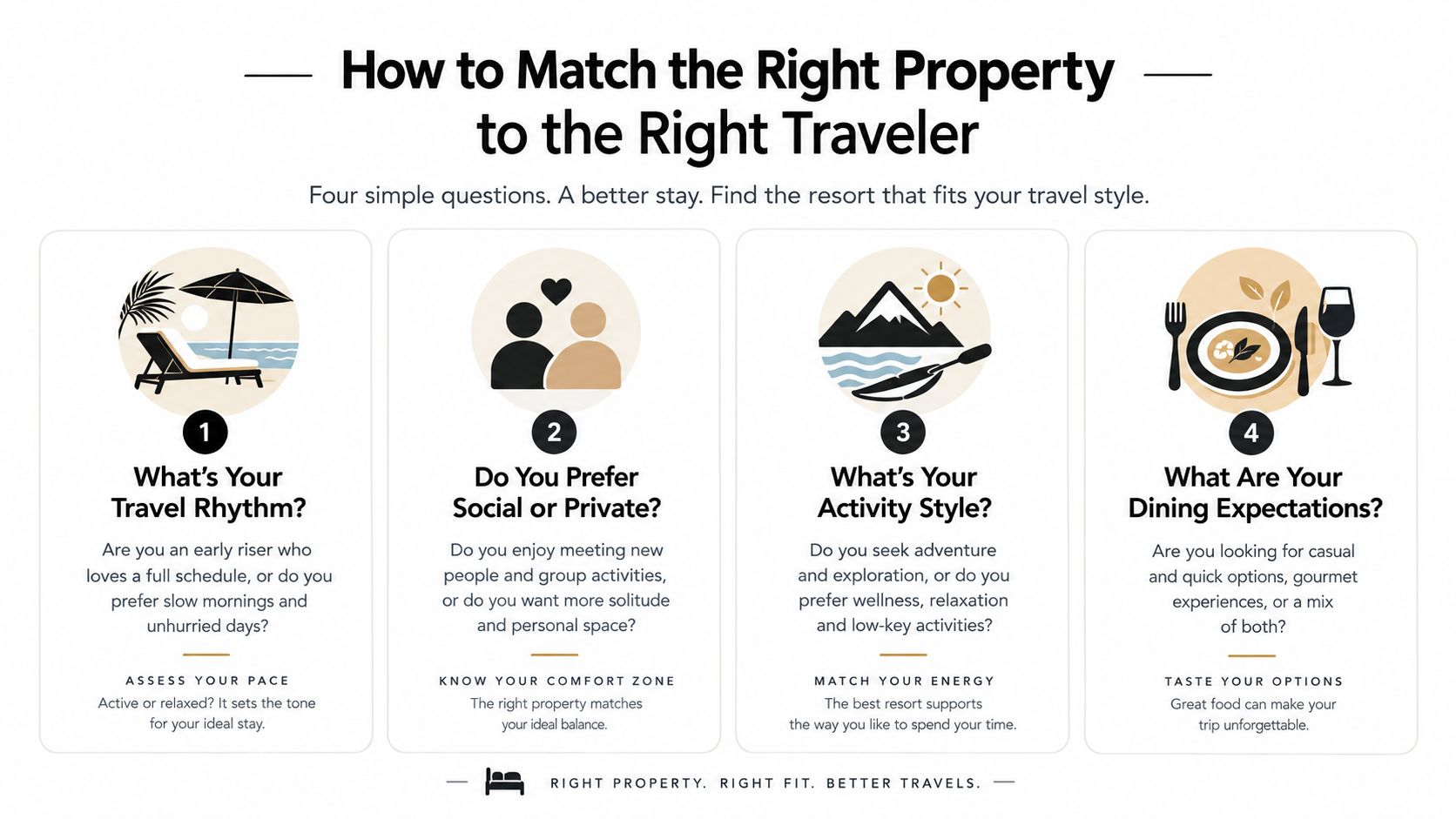
An advisor starts with four questions:
1. How do you travel? Do you want a full itinerary, or room to improvise?
2. How private are you? Do you prefer a discreet villa or a lively resort with restaurant energy?
3. What does wellness mean to you? Recovery, longevity, fitness, sleep, or simply a good massage?
4. Who is traveling? A couple, young children, teenagers, grandparents, or several generations?
For a milestone celebrator, choose a property with a memorable arrival, strong private dining, exceptional villas, and staff who can orchestrate surprises discreetly. A villa-only retreat may be too quiet if the couple wants restaurant buzz and a social atmosphere.
For a multigenerational family, prioritize accommodation configuration, childcare, teen programming, flexible dining, and easy transfers. An adults-only flag removes a property from the shortlist immediately, regardless of how impressive the spa may be.
For a wellness devotee, assess practitioner access, consultation depth, daily programming, recovery facilities, and the quality of the food philosophy. A private island can be perfect for concentration, but its logistics may outweigh the romance if the traveler wants frequent off-property exploration.
The red flag is a mismatch between the resort's strongest amenity and the traveler's actual behavior. A spectacular pool won't compensate for poor family logistics. A celebrated medical program won't satisfy someone who wants spontaneous dinners and cultural excursions. Match the operating rhythm, not the Instagram image.
How to Actually Secure the VIP Benefits You See in the Brochure
The benefits that matter most often move through advisor channels rather than the public booking path. Virtuoso, Aman Club, Belmond Bellini, Four Seasons Preferred Partner, and direct advisor negotiations can support upgrades, preferred placement, arrival recognition, flexible benefits, and property-specific credits when available.
An advisor also works the upgrade pipeline. Room categories may be released close to arrival, sometimes between 72 and 24 hours before check-in, so flexibility can matter. Midweek arrivals may create better placement opportunities, while a credit is not the same as a confirmed benefit. A credit gives spending value. A confirmed upgrade, early arrival, late departure, or named welcome gives operational certainty.
For travelers combining resort wellness with clinical planning, an advanced diagnostics concierge can be a useful complement to ordinary spa booking. The broader role of an advisor is outlined in what a luxury travel advisor does.
A booked-and-forgotten reservation gets the brochure. A worked reservation gets the suite, the early check-in, and the butler who already knows the children by name.
HauteBlack arranges bespoke resort stays with VIP recognition, preferred-partner benefits, private villas, transfers, and 24/7 concierge support where available. If you want luxury resort amenities matched to the way you travel, visit HauteBlack and begin with a conversation about your next journey.
Explore Our Guides


Signature Experiences


