Haute Black Journal
Luxury Golfing Trips to Scotland: VIP Tours & St Andrews

Marlene Azeez
Director, HauteBlack
View all articles →

# Luxury Golfing Trips to Scotland: VIP Tours & St Andrews
July 14, 2026
The first time a client arrives at St Andrews before dawn, the mood changes before the first tee shot. The car door opens to cold salt air, the town is quiet, and the course feels less like a reservation and more like an audience with history.
The Ultimate Pilgrimage to the Home of Golf
A memorable Scotland golf trip starts long before the first tee time. For the clients I advise, the brief is rarely just “get us on the Old Course.” It is to make the week feel composed from the moment the aircraft door opens to the final dinner, with every detail handled discreetly and correctly.
That standard changes the shape of the trip.
A well-run journey is built around timing, discretion, and recovery. Arrival windows are planned around traffic patterns and daylight, not just flight schedules. Clubs are waiting where they need to be. Waterproofs are selected for coastal wind and sideways rain, not whatever a weather app suggested three days earlier. If a guest wants to play 36 holes, the lunch pacing, caddie strength, treatment booking, and evening dining all need to support that decision.
What proper planning actually changes
The difference is not cosmetic. It is operational.
On ordinary golfing trips to Scotland, guests lose energy to preventable friction. A transfer runs long. A lunch reservation is too public. A baggage delay leaves someone borrowing outerwear from the pro shop. A party arrives at a historic club without understanding jacket rules, mobile phone etiquette, or how quickly a draw can harden in an afternoon wind.
Handled properly, the trip feels calm because the pressure has already been absorbed. Tee times are only one part of the work. The stronger service sits around them. The right caddie pairing for temperament, not just handicap. A driver who knows whether the group wants silence after a difficult round or a detour for a proper whisky stop. A hotel team briefed on preferred pillows, early breakfast, garment pressing, and a private room for a post-round debrief.
Luxury in Scotland is certainty.
It also requires restraint. Scotland does not reward a packed schedule built by someone chasing logos. The best journeys leave room for weather calls, a second lunch, an unplanned walk through town, or a late evening in a clubhouse room that cannot be replicated anywhere else. I often advise clients to play one fewer round than they think they should. The trip usually improves.
Scotland still stands apart because the experience extends beyond access to famous courses. At the top end, what matters is who can secure the right accommodations during peak weeks, who can arrange privacy without making it feel staged, and who understands which details deserve attention. Some clients want a full house taken privately with security and household staff integrated into the plan. Others want a low-profile stay with excellent pressing, fast club turnaround, and dinners that never feel performative. Those are very different briefs, and Scotland can satisfy both if the trip is built with care.
The point is straightforward. Golf is the reason to come, but the legendary trips are defined by everything surrounding the round.
Choosing Your Pilgrimage Core Regions and Their Courses
The smartest golfing trips to Scotland begin with region choice, not a wish list of famous names. Clients often say they want “the best courses,” but that's rarely their actual brief. Most are deciding between three different atmospheres: historic gravity, Highland solitude, or Open Championship pedigree.
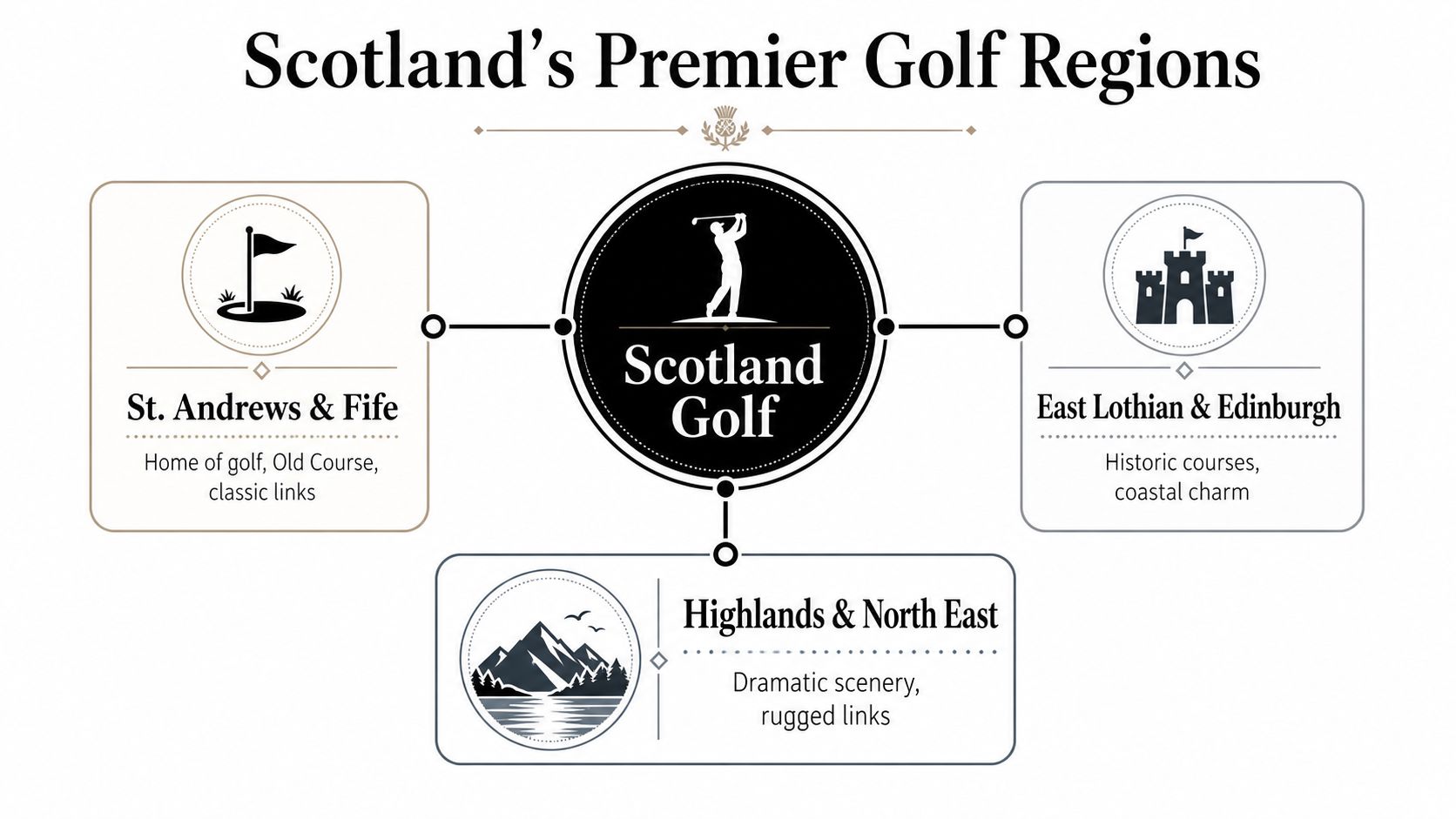
St Andrews and the Kingdom of Fife
This is the canonical pilgrimage. Fife suits the traveler who wants golf embedded in daily life, where a short drive can lead to another course of consequence and where the entire trip carries a sense of lineage.
The trophy course is obvious. The Old Course remains the most symbolically powerful tee time in golf. Not because it's the most dramatic land in Scotland, but because no other walk carries the same weight from first tee to eighteenth green.
The insider's choice in this region is often Elie or Crail, depending on a client's temperament. Elie has personality and a memorable sense of place. Crail offers a more intimate, old-world texture that seasoned golfers often appreciate after the scale and scrutiny of St Andrews. Neither feels like a consolation prize.
Who should choose Fife
| Traveler profile | Why Fife fits |
|---|---|
| First-time Scotland pilgrim | You get the emotional center of Scottish golf |
| Collectors of iconic rounds | The concentration of marquee names is hard to match |
| Clients traveling with non-golfers | The town setting gives the trip cultural range beyond the course |
Fife is also efficient. You can build days that feel full without becoming exhausting, and that matters more than travelers expect. A week of great courses can still fail if every round is wrapped in logistics.
The Highlands
The Highlands are for clients who don't need spectacle announced to them. The natural setting is broader, the roads quieter, and the golf feels less observed. Here, the journey becomes soulful.
The trophy course is Royal Dornoch. It has that rare combination of purity, grandeur, and understatement. Many experienced players finish the round convinced they've just seen the most complete course on the trip.
The insider's choice is Brora, and not only because of its golf. Brora carries a kind of cultivated simplicity that wealthy travelers often crave after too much polished sameness elsewhere. It feels local in the best sense. It also opens an interesting strategic angle on repeat play and club access, which I'll come back to later.
The Highlands reward clients who care less about being seen and more about how a place feels at ground level.
The Highland trade-off
The Highlands ask for commitment. Distances can be longer. Weather can turn quickly. Dinner options need to be chosen with intention, not left to chance. But the return is huge. The rounds breathe. The land stays with you.
For travelers who've already done the obvious circuits in England, France, or the American private-club world, the Highlands often become the part they talk about most once they're home.
Ayrshire and the West
Ayrshire is about championship pedigree, muscular links golf, and a stronger sense of sporting examination. This region suits the player who wants the trip to feel competitive, not just beautiful.
The trophy course is Royal Troon, a venue with unmistakable Open identity. The golf asks direct questions and doesn't flatter anyone. That's part of the draw.
The insider's choice is Western Gailes. It tends to resonate with golfers who know enough not to chase brand names alone. The course has rhythm, seriousness, and a more clubby, less theatrical atmosphere than some marquee venues.
Why clients choose the West
- They want Open rota credibility. Ayrshire delivers rounds with unmistakable championship lineage.
- They prefer sterner golf. The test is often more explicit here than in softer resort environments.
- They enjoy pairing golf with urban convenience. Access from Glasgow can make arrivals and departures more efficient.
There's also a style difference. Fife feels historical. The Highlands feel elemental. Ayrshire feels competitive.
That's why “best region” is the wrong question. The right question is what kind of memory the client wants to create.
Crafting the Perfect Itinerary Two Bespoke Journeys
A strong itinerary doesn't just stack famous courses. It controls tempo. It places difficult rounds on the right days, builds in recovery, and treats transfers as part of the experience rather than interruptions.
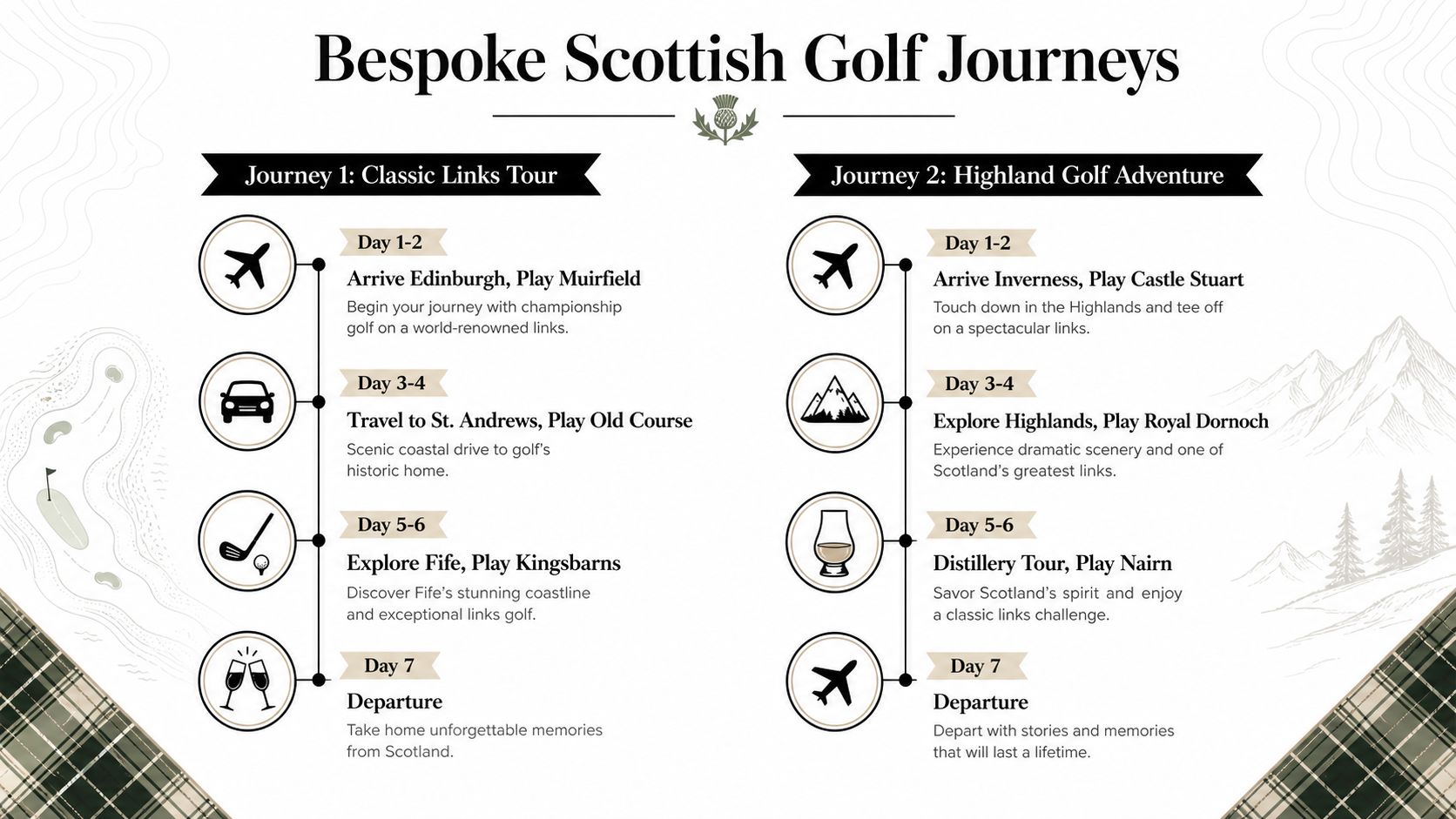
The Open Champion's Tour
This journey suits the golfer who wants consequence every day. The schedule is assertive, but not careless.
Day one begins with arrival into Edinburgh, a private transfer, light recovery, and a formal dinner rather than immediate golf. The first mistake many planners make is forcing a round too soon after travel. Fatigue can spoil a championship course.
Day two is for Muirfield. It's best placed early, when the client is fresh and still sharp enough to appreciate the discipline the course demands. Lunch should be unhurried. The afternoon remains open for rest or a coastal drive.
A useful outside resource for broader timing ideas is this guide on planning your 2025 golf trip, particularly for travelers comparing Scotland with other major golf destinations before committing to dates and group structure.
Day three shifts toward Fife. The transfer should include a scenic stop and a late check-in rather than trying to squeeze in an extra half-round. Preserve energy for what follows.
Here's a visual sense of the rhythm these itineraries can take on the ground.
Day four is the anchor day. The Old Course belongs in the morning if possible, followed by a private lunch and a soft afternoon. Clients often think they'll want another activity right away. They usually don't. The round itself carries enough emotional weight.
Why this route works
The strength of this itinerary is sequencing. It doesn't place the most anticipated round at the end, where fatigue, weather, or accumulated delays can compromise it. It also respects the social component. Muirfield and St Andrews aren't interchangeable rounds. They carry different codes and should be approached with different energy.
Day five can take one of two forms. A purist version heads to Carnoustie for a sterner examination. A more balanced version chooses Kingsbarns for visual drama and a slightly more expansive feel. The right answer depends on the client's appetite for severity.
Day six leaves room for either a replay request, a curated local experience, or a private cultural day. Smart itineraries always carry elasticity. Clients often discover mid-trip that they'd rather deepen one region than keep moving.
Day seven is departure, ideally after a calm breakfast and with no early-morning rush to settle storage, clubs, or transport details.
The best seven-day schedule in Scotland never feels packed, even when it is. That's because the complexity is hidden.
The Highland Mystique
This second journey is shorter, quieter, and often more memorable for repeat visitors. It trades density for atmosphere.
A five-day structure that breathes
1. Arrival in Inverness
Land, settle, and avoid the impulse to over-schedule. A Highland trip should begin with decompression. Dinner matters more than forcing an extra activity.
2. Castle Stuart or a similar opening round
This first round should reintroduce the golfer to links conditions without the pressure attached to a “bucket-list” tee time. It sets tone and touch.
3. Royal Dornoch day
Build the whole day around the round. Leave margin before and after. Lunch should be close, and the evening should stay local.
4. Brora and private whisky access
The trip's identity is defined by Brora in the morning. A private distillery visit later, ideally with a host who can speak to cask selection rather than delivering a generic visitor script.
5. A final round, then departure
The final day should feel conclusive, not frantic. A shorter transfer window helps preserve that feeling.
What makes the Highland version different
This journey is more about texture than accumulation. The roads, villages, and private encounters matter as much as the scorecard. It's ideal for couples, small groups, or clients who've already had the marquee Scottish trip and now want something with more point of view.
Practical design principles
- Keep hotel changes limited. Constant unpacking erodes the calm that makes a Highland trip special.
- Pair one demanding round with one atmospheric round. Back-to-back examinations can flatten the trip's mood.
- Treat whisky, dining, and scenery as core programming. They aren't filler between golf rounds.
The hidden discipline in bespoke golfing trips to Scotland is restraint. Most luxury travelers can afford to add more. The true skill is knowing when not to.
Beyond the Links Exclusive Accommodations and Experiences
Where a client sleeps in Scotland changes the entire tone of the golf. A poor accommodation strategy can make a distinguished itinerary feel transactional. The right one can make even a difficult weather day feel coveted.
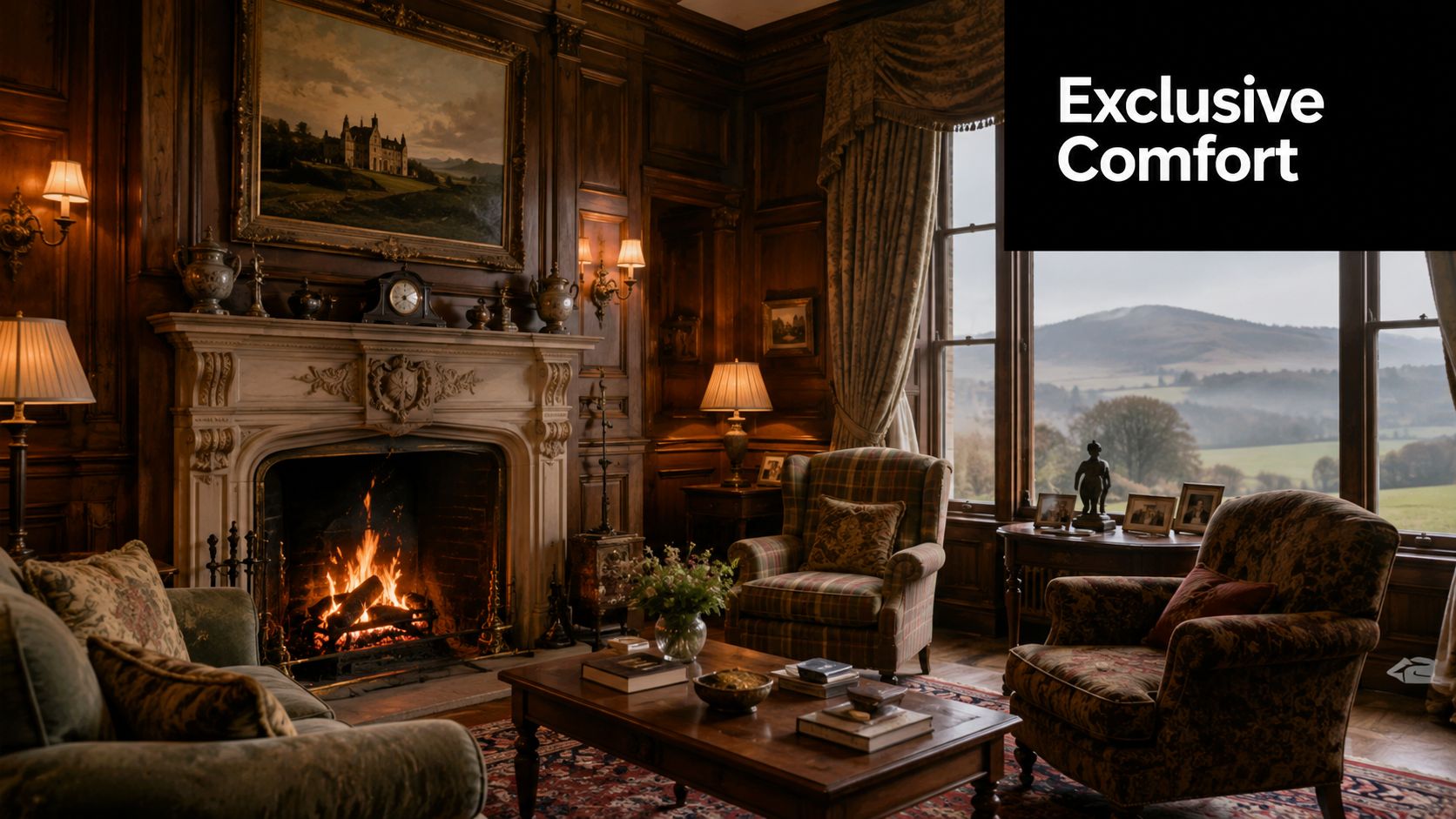
Private estate or grand hotel
These are not interchangeable choices. They produce completely different experiences.
A private-use estate is the right answer for a principal who values seclusion, staff continuity, and the freedom to shape each day without crossing paths with other guests. This format works particularly well for family travel, small corporate circles, and groups that want dinners, tastings, and post-round gatherings under one roof.
A partnered five-star hotel works better when the client wants polished service infrastructure, a renowned spa, established concierge operations, and the energy that comes from staying somewhere iconic. Certain trips benefit from that sense of place and visibility.
A quick comparison
| Stay style | Best for | Main advantage |
|---|---|---|
| Exclusive-use estate | Families, principals, close groups | Privacy and control |
| Iconic hotel | Couples, first-time luxury visitors, mixed-interest groups | Service depth and ease |
The error is choosing based on prestige alone. The right decision depends on the social architecture of the trip. Who's traveling, how much privacy is needed, and whether evenings should feel intimate or grand.
The evening program matters
Golfers remember the rounds first. They remember the evenings longer.
That's why after-golf planning can't be generic. In Scotland, that might mean a private dining room with a chef-led tasting menu, a castle visit arranged around access rather than public hours, or a distillery appointment shaped for serious collectors rather than tourism traffic.
For travelers who want the cultural side of the country to be as well handled as the golf, a useful starting point is a clear Scotland whiskey regions map. It helps frame whether a trip should lean toward Speyside-style depth, Highland breadth, or a route that keeps whisky secondary to golf.
A memorable Scottish golf trip doesn't end at the eighteenth green. It changes register.
Why lodging should sit near the center of the plan
I often advise clients to think of accommodation as operational infrastructure, not decoration. If the property is in the wrong place, every day starts earlier than it should. If service is thin, every small request becomes a conversation. If there's no privacy, the client never fully settles.
The strongest itineraries build golf around the right base. They also leave room for non-golf experiences that justify staying longer than a pure tee-time chase would suggest. That might be a late lunch after the round, a cellar tasting, or a custom program drawn from a broader portfolio of curated luxury experiences.
A great room in Scotland does more than look good in photographs. It absorbs weather risk, protects the mood of the trip, and gives the entire journey a center of gravity.
Navigating the Logistics The Art of Seamless Travel
A Scottish golf journey can feel effortless to the client and tightly engineered behind the scenes. That is the standard worth aiming for.
Scotland rewards early decisions. It is less forgiving when key rounds, preferred suites, caddie requests, and transport are left to chance. The difference between a good itinerary and a properly run one usually appears in the margins. Arrival times that respect fatigue. Course pairings that suit the wind. A driver who understands club timetables and where bags should already be waiting.
Booking horizons and eligibility
For marquee courses, timing is not a detail. It is the framework. Scotland Tourism's golf guidance notes that peak-summer access to Open rota venues such as the Old Course often requires planning well over a year ahead, and it also outlines handicap requirements that can affect eligibility at clubs including St Andrews and Carnoustie.
That should be verified early, before dinner reservations, helicopter options, or celebratory assumptions start building around a round that may not be confirmed.
What to confirm first
- Priority courses. Identify the rounds that justify the trip and build the routing around them.
- Handicap documentation. Have it current, accessible, and accepted by the relevant clubs.
- Deposit tolerance. Some clients value flexibility. Others prefer to secure scarce access early and accept stricter terms.
Seasonality and movement
June and July bring long light and strong course conditions, but they also bring pressure on every supporting element. Hotel inventory tightens. Caddies become harder to secure. Road transfers take longer than clients expect, especially when the itinerary tries to cover too much geography.
September can be a more refined choice. The atmosphere is calmer, service teams are less stretched, and the trip often feels more private. The compromise is weather volatility, which is manageable if transport, layering, and backup timings have been handled properly.
I usually advise clients to treat transport as part of the service standard, not an afterthought. A dedicated luxury ground transportation plan in Scotland protects pace, privacy, and club handling in a way ad hoc car bookings rarely do.
The transport hierarchy
The right movement strategy depends on distance, privacy expectations, and how much schedule compression the client can tolerate.
- Chauffeured vehicle suits Fife, Ayrshire, and many Highlands routes where consistency, discretion, and easy club handling matter more than saving a small amount of time.
- Helicopter transfer earns its place on itineraries with difficult cross-country routing, very limited time, or clients who prefer to avoid long road segments altogether.
- Private aviation into the region works best for multi-country programs or family offices operating to fixed schedules.
The essential skill is restraint. The best-run trip does not advertise its logistics. It removes friction, protects energy, and keeps every day focused on the golf rather than the machinery around it.
The Insider's Edge VIP Access and Etiquette
Access in Scotland is rarely just about money. It's about timing, club literacy, and knowing which levers are worth pulling.

Membership strategy and reciprocal value
One of the most overlooked tools in the premium market is the intelligent use of club membership. Not broad status collecting. Specific, tactical membership where it changes access economics and on-the-ground treatment.
A good example is Brora. A membership there was listed at £372 in 2024, and that can be recouped in three high-season rounds at £125 per round, while also opening reciprocal discounts at other clubs, as discussed in this MyGolfSpy forum thread on Scotland golf-trip hacks.
That matters because elite travel content often focuses only on packaged tours or marquee booking windows. Seasoned players know that private advantage sometimes comes from quieter structures.
Etiquette is part of access
Scottish club culture is welcoming when approached correctly. It can feel colder when a guest behaves as though a famous booking automatically confers fluency.
The caddie is not just a bag carrier. On the right course, that person acts as local strategist, pace manager, historian, and translator of terrain. Clients who understand this have better rounds and better days.
Three habits that elevate the experience
- Arrive composed, not hurried. Rushed arrivals signal poor planning and often lead to sloppy early holes.
- Dress for the club, not the camera. Scottish golf still respects discretion over performance styling.
- Use the clubhouse properly. Know when to linger, when to keep things quiet, and when the room expects formality.
The client who belongs in Scotland is the client who doesn't need to announce that he belongs there.
Quiet preparation creates visible ease
This is also where broader travel judgment helps. Travelers moving by private aviation often understand the value of reducing friction before arrival, especially when they're connecting a golf journey with other high-value commitments. That same logic applies on the ground and in the club environment, much like the broader principles outlined in this private jet luxury travel guide for 2026.
The most successful Scottish golf travelers don't just secure hard tee times. They move through the trip with the right level of confidence, courtesy, and preparedness. That's what turns access into acceptance.
Budgeting for a Legacy Golf Experience
One client arrived in Scotland with a simple brief. He wanted St Andrews, a west coast test, rooms that felt private rather than performative, and no dead time. By the end of planning, the tee times were only one line in a much larger operating plan. The budget sat in the layers around the golf. The right suite inventory during peak weeks, the right vehicle and driver pairing, caddies who fit the personalities in the group, dining reserved for late finishes, and enough flexibility to absorb weather without compromising the marquee rounds.
That is the correct way to price a legacy trip.
As noted earlier, international golf visitors to Scotland spend at a level that places these journeys well above ordinary leisure travel. The useful question is not the nightly average. It is what the spend buys. At this level, clients are paying for access, privacy, timing, and judgment. They are also paying to avoid preventable mistakes, which is often where an expensive trip starts to feel cheap.
What a premium package can look like
For a public benchmark, a premium Scottish Highlands golf package for June 2026 is listed at £5,495 for shared accommodation or £6,795 for single occupancy, with a 50% non-refundable deposit at booking and the balance due 90 days before travel, according to UK Golf Guy's Scottish Highlands June 2026 package details.
Use that figure as a floor, not a ceiling. It prices a polished packaged trip. It does not account for the requests that UHNW travelers usually make once the brief becomes specific. Private use transfers instead of pooled movement. Signature suites instead of standard rooms. A lighter touch at check-in. Better spacing between rounds. Last-minute dining changes handled without fuss. On the right trip, those details matter more than the difference between one green fee and another.
Where the real value sits
A well-built budget answers three practical questions:
| Consideration | The better question |
|---|---|
| Price | Did the spend secure the right access and remove friction from the trip? |
| Pace | Did the itinerary protect energy for the courses that matter most? |
| Privacy | Did the client move through Scotland comfortably, discreetly, and without unnecessary exposure? |
Experienced planning earns its fee. A cheaper hotel twenty minutes farther out can cost the group an hour of useful day once breakfast timing, traffic, bag handling, and club arrival are factored in. The wrong room category can turn a restorative stop into a compromised one. Shared transport that looks efficient on paper can become the weak point if one round runs long and the rest of the day starts slipping.
I advise clients to budget for the trip they want to remember, not the one that looks tidy in a spreadsheet.
The best golfing trips to Scotland stay with people because every moving part felt well judged. The golf carries the story. The invisible work around it determines whether the story is merely good, or family-archive good.
Haute Black designs that level of journey with the discretion, relationships, and operational control UHNW travelers expect. If you're ready to plan a Scottish golf experience that goes far beyond tee times, start the conversation with Haute Black.
Explore Our Guides


Signature Experiences


