Haute Black Journal
Luxury France Barge Trip: Private Charters & VIP Access

Marlene Azeez
Director, HauteBlack
View all articles →
# Luxury France Barge Trip: Private Charters & VIP Access
May 16, 2026
A france barge trip is one of the most overrated ideas in luxury travel for the wrong client, and one of the best for the right one.
The mistake is obvious. Affluent travelers often group barges with river cruises, then book on that assumption and end up with the wrong experience entirely. A barge holiday is quieter, smaller, more private, and far less performative. It suits travelers who care more about atmosphere, access, and time well spent with their own party than about choice, buzz, or constant activity.
That is the definitive decision point.
If you want a sociable ship with multiple lounges, bigger cabins, and a stronger sense of motion and variety, book a river cruise. If you want total control over the week, private charter usually wins. If you like the barge format but do not need the whole vessel, a hotel barge cabin can be an excellent buy. And if your idea of French slow luxury centers on grand hotels, Michelin dining, and day trips by car, a barge may be the wrong format.
For the right traveler, it is highly appealing. For the wrong traveler, it is an expensive mismatch.
The Unveiling of True Slow Luxury
A france barge trip is either one of the smartest luxury decisions you can make in France or a very expensive category error. The difference comes down to what you value once you strip away the romance of the brochure.
It works like a floating private house with staff, not a cruise product with fewer passengers. That distinction matters because the experience is built around atmosphere, pacing, and personal attention, not variety for its own sake.
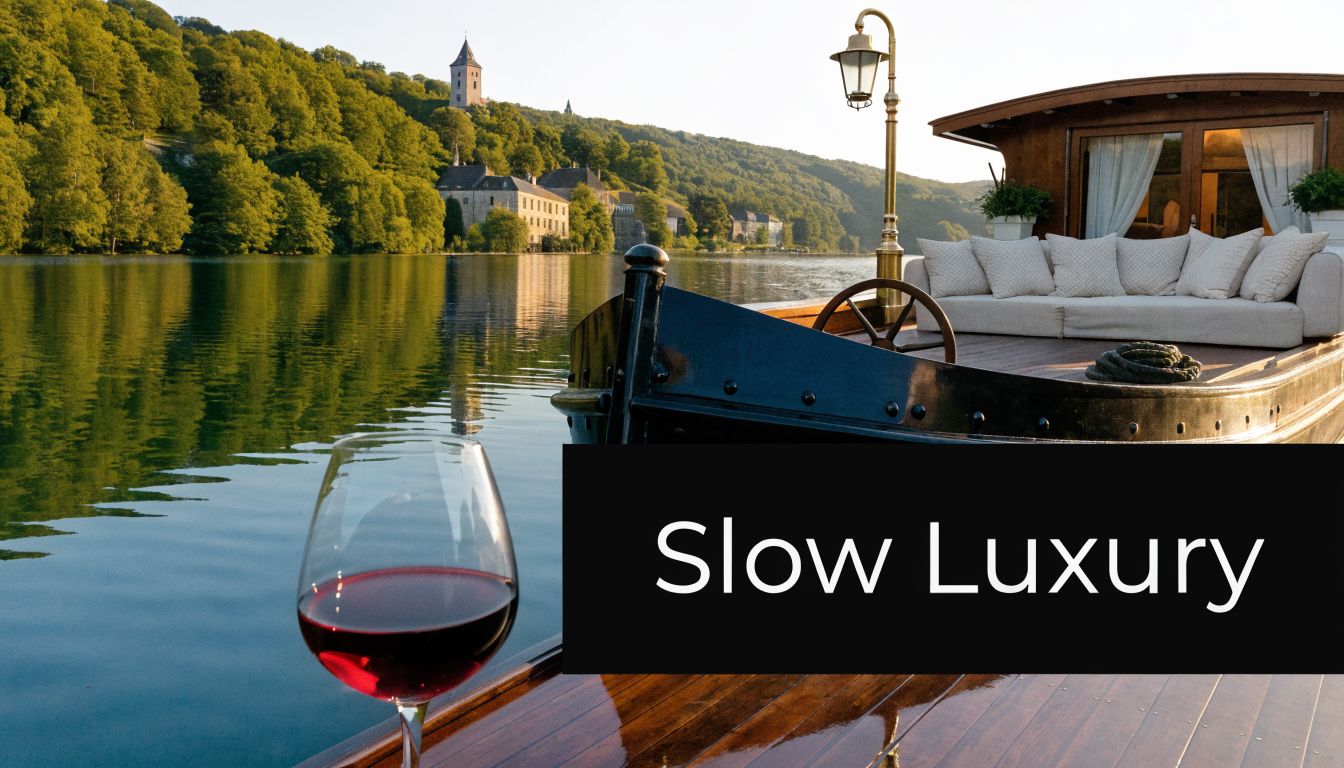
Once you understand that, the category becomes much easier to judge properly. A barge does not compete with a palace hotel on grandeur. It does not compete with a river ship on scale. It wins on intimacy, control, and the rare luxury of having your days shaped around your party instead of around a larger operation.
That is real slow luxury.
What luxury actually looks like on a barge
On a good barge, luxury shows up in quieter ways. The crew knows how you take your coffee by the second morning. Lunch feels tied to where you are, not copied from a standard route. Excursions are chosen because they suit the group, not because they fill a timetable. Even silence has value. You are not paying for constant stimulation. You are paying for the absence of it.
The best barges deliver three things especially well:
- Privacy: The social atmosphere stays contained and civil. You are not sharing the week with a crowd.
- Regional depth: One stretch of France reveals itself properly, through food, producers, villages, and daily life.
- Access: Small boats reach settings that feel rural, local, and completely removed from high-volume tourism.
This is also where many affluent travelers get the choice wrong. If your version of luxury depends on a dramatic spa, multiple dining venues, or a different scene every evening, a barge will feel too narrow. If your version of luxury is a beautifully run week with no friction, no noise, and no wasted motion, it is hard to beat.
The right client does not book a barge for more options. They book it for better use of time.
Who should book one, and who should not
A france barge trip suits travelers who care about the quality of the week as a whole. Couples do well here, especially if they want privacy without the formality of a grand hotel. Multi-generational families can do very well too, but usually on private charter, where the boat becomes their own space and the pace can be adjusted around the group. Friends who enjoy long meals, good wine, and understated service often love it.
It is a weaker fit for travelers who need spectacle or spontaneity in the urban sense. If your ideal France trip means shopping in Paris, hopping between starred restaurants, and changing plans at 5 p.m., stay on land. If you want the slow-luxury version of France but with more architectural drama and more freedom each day, a staffed villa or a top countryside hotel may suit you better.
That is the genuine benchmark. A barge is not automatically the most refined option. It is the most refined option for a specific kind of traveler, especially one deciding between a private charter and a cabin-based hotel barge, and willing to choose depth over breadth.
Understanding the Rhythm of Canal Life
The pace on a france barge trip is not a concession. It's the whole point. France Today notes that the country has nearly 1,000 miles of navigable waterways, many of them built centuries ago to transport wine and goods, and a typical hotel-barge cruise usually lasts seven days and six nights. These itineraries often cover only 10 to 20 miles per day at about 3 to 6 miles per hour, which is why the experience feels immersive rather than transactional, as described in France Today's hotel barge guide.
That's the first adjustment I ask clients to make. Stop judging the trip by mileage. Judge it by texture.
A day on the canal should feel spacious
The best barge days have a rhythm that land travelers rarely get in France. You don't spend the day packing, checking out, driving, and checking in again. You stay put, and the scenery changes around you.
A strong day usually has a simple structure:
1. Morning cruising with coffee, breakfast, and open countryside.
2. A cultural or culinary stop that feels rooted in the region.
3. A relaxed afternoon for cycling, walking, tasting, or doing nothing.
4. An unhurried evening where dinner feels like part of the destination, not a stop between activities.
That rhythm is why barging works so well for people who are overstimulated by conventional luxury travel. No transfers every few hours. No endless repacking. No pressure to optimize every slot on the schedule.
The operational reality matters
Canals impose their own discipline. Barges are slow, and locks control the flow of the day. Frommer's notes that most boats travel only about 4 to 7 mph, that planners should build around no more than 5 hours of boating per day, and that lock transits can take 30 to 60 minutes depending on traffic, as explained in Frommer's guide to barge trips in France.
That has two consequences for luxury travelers.
First, experienced planners don't try to "cover ground." They choose short segments with high-value stops. Second, your enjoyment depends on accepting that the canal sets the tempo. Clients who fight that usually end up frustrated. Clients who lean into it often come back saying it was the first trip in years that actually felt restful.
Practical rule: If your instinct is to maximize distance, a barge is the wrong vehicle.
Why the history matters
These waterways weren't built for modern tourism. They were built for commerce. That gives a france barge trip a sense of continuity that many polished luxury experiences lack.
You aren't floating through an invented scenic route. You're moving through old working corridors that now connect vineyards, villages, market towns, and regional food cultures. That historical backbone gives the trip credibility. It feels lived-in, not staged.
And that's why the best barge journeys don't rush. The point isn't to arrive. The point is to inhabit a region that rewards slowness.
Private Charter Versus Hotel Barge Cabin
This is the decision that determines whether the trip feels magical or mildly irritating. Typically, the region is the initial focus. I think that's backwards. Choose the booking model before you obsess over the route.
On luxury barges, small scale is the structural advantage. Barges often carry only 6 to 12 passengers, and that intimacy supports high-touch service and access to narrow, shallow canals and villages larger vessels can't reach, as noted by Road Scholar's barge cruise overview. That same small scale is why the difference between taking one cabin and chartering the whole vessel is enormous.
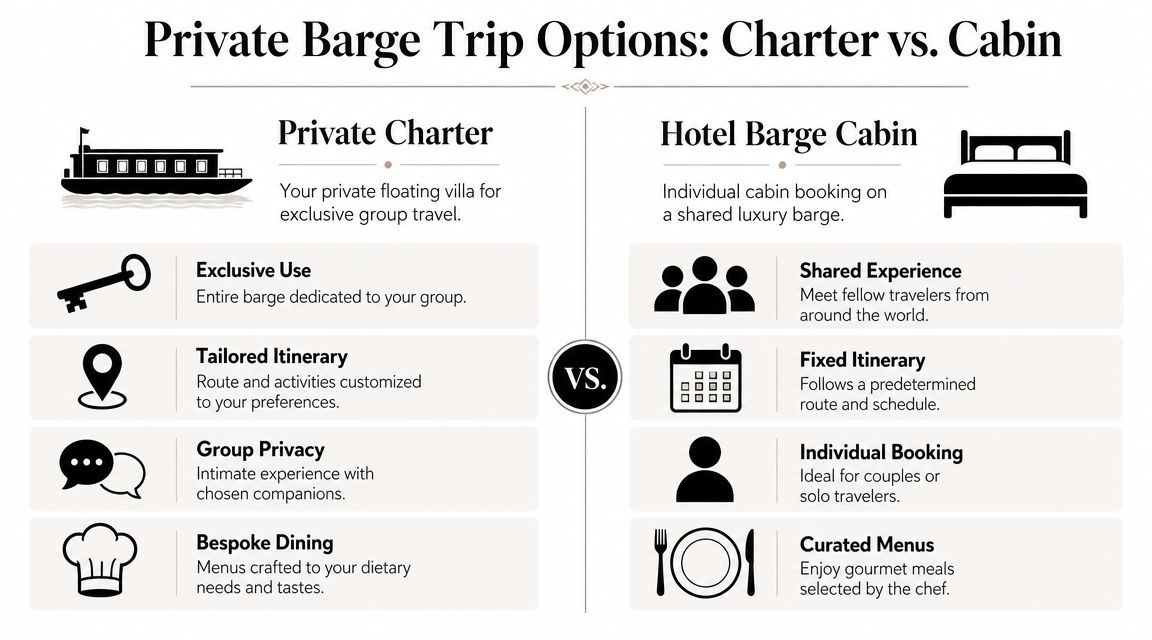
The simplest comparison
Think of it this way. A hotel barge cabin is like booking a suite in a very small boutique hotel. A private charter is like taking over the entire property.
| Decision point | Private charter | Hotel barge cabin |
|---|---|---|
| Privacy | Full control of the environment | Shared with other guests |
| Dining | Easier to shape around your group | More communal and preset |
| Excursions | Better for private pacing | Usually aligned with group rhythm |
| Social dynamic | Ideal if you want only your people | Ideal if you enjoy meeting others |
| Best for | Families, friends, executive groups | Couples, solos, easygoing pairs |
When a cabin is the better choice
A shared hotel barge cabin is often the right move for a couple that wants the atmosphere of a luxury barge without the responsibility of filling the vessel. It also works for travelers who enjoy conversation and don't mind communal dining.
Choose a cabin if:
- You don't need full control: You're happy to follow the established flow.
- You enjoy social travel: The right fellow guests can enhance the week.
- You're buying the format, not the takeover: You want the barge experience without the burden of a full charter decision.
A cabin booking can feel polished, convivial, and easy. But it only works if you don't mind sharing the social space.
When a private charter is worth it
A private charter is the superior option when privacy is the point of the trip. That includes honeymoons with a full buyout, milestone birthdays, family gatherings, and board-level retreats where discretion matters.
Choose a charter if:
- Your group wants control of meal timing
- You need privacy for conversations or family dynamics
- You have strong preferences on excursions and pacing
- You don't want the chemistry of the week to depend on strangers
The smaller the vessel, the more dramatic the difference between "shared" and "private."
Here is my blunt recommendation. If you're even slightly concerned about privacy, don't split the difference. Charter the barge. The whole allure of this format is intimacy. Sharing that intimacy with unknown guests can either feel charming or intrusive. There isn't much middle ground.
The real question isn't romance versus family
People often frame this choice as couples versus groups. That's too simplistic. The core issue is control.
A couple who values seclusion may be happier with a full buyout than with the best shared departure. A family that doesn't fill the boat comfortably may be better off in a villa. An executive group that needs confidentiality should never gamble on a cabin arrangement.
Book the model that matches your tolerance for shared space. Everything else comes second.
Navigating France's Signature Barge Regions
Region matters, but not in the way glossy brochures suggest. You are not choosing a backdrop. You are choosing a mood, a food culture, and a social temperature for the week.
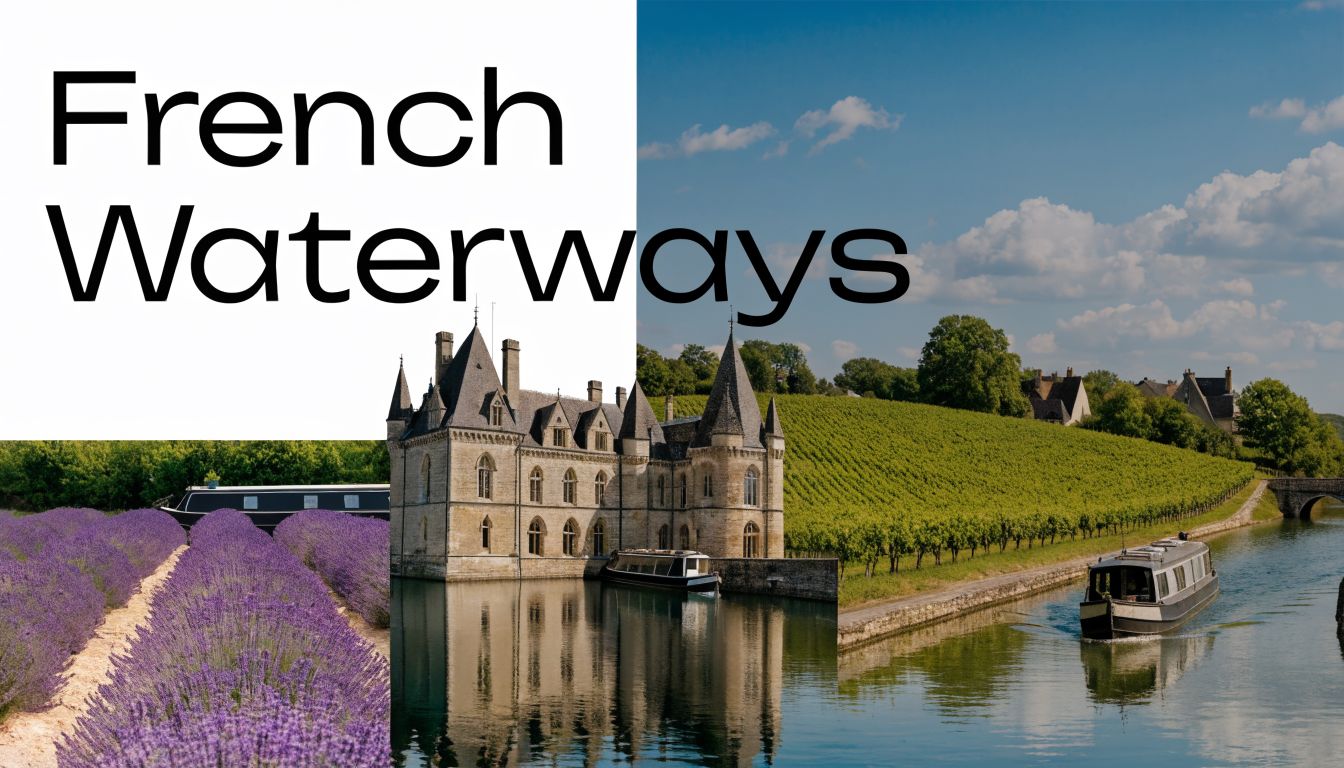
Burgundy for serious eaters and wine collectors
If your ideal trip revolves around lunches that turn into tastings and village markets that turn into purchases, choose Burgundy. This is the most natural fit for travelers who care about terroir, cellar visits, and the quiet prestige of classic French countryside.
Burgundy works especially well for:
- Collectors who want a wine-centered week
- Couples who prefer understatement over spectacle
- Hosts planning a small celebratory charter
For travelers comparing broader wine-focused options in France, Haute Black's Bordeaux experience guide is a useful complement to a barge itinerary conversation.
Canal du Midi for history and atmosphere
The Canal du Midi suits travelers who want historic substance with a warmer, more southern tone. This route appeals to guests who like engineering history, old stone villages, and a slower, sunlit rhythm.
The charm here is less aristocratic and more textured. It feels storied and grounded. If Burgundy is refined, the Midi is atmospheric.
Loire Valley for romance and château lovers
The Loire is for travelers who want visual romance. This is the region for clients who light up at the idea of fairytale silhouettes, formal gardens, and a softer sense of grandeur.
It tends to attract:
- honeymooners
- anniversary travelers
- guests who want cultural polish without urban intensity
A Loire barge week can feel cinematic if that's what you're after.
Bordeaux for polished hedonists
Bordeaux is for the traveler whose priorities are clear. Wine, architecture, and effortless indulgence. A france barge trip in this sphere works well for people who want a sharper gastronomic identity and a touch more swagger in the overall experience.
This short film captures the allure of French waterways better than most brochures do.
Alsace and Provence for travelers who already know what they like
Alsace is ideal for clients who want a distinct regional personality. The architecture, cuisine, and cultural feel are noticeably different from central France, which gives the trip a stronger sense of place.
Provence draws a different client entirely. This is the route for someone who wants color, light, local produce, and a more sensual countryside atmosphere. If your French fantasy includes markets, warm stone, and painterly scenery, Provence is a strong fit.
Pick your barge region the same way you'd pick a villa location. By lifestyle fit, not by checklist sightseeing.
My direct advice on choosing a region
If you're torn, don't overcomplicate it.
- Choose Burgundy if wine and food sit at the center of the trip.
- Choose the Canal du Midi if historical texture matters most.
- Choose the Loire if you're booking for romance.
- Choose Bordeaux if you want a more indulgent, wine-driven mood.
- Choose Alsace if regional character is the draw.
- Choose Provence if visual beauty and lifestyle matter more than monuments.
There is no universal "best" france barge trip region. There is only the region that fits how you want to live for a week.
Crafting Your Perfect Barge Itinerary
A weak barge itinerary tries to do too much. A strong one protects the pace and builds around the people onboard.
Affluent travelers often get it wrong, asking which route is best before asking whether the vessel fits the group. That is backwards. A common planning gap is underestimating how much vessel size shapes the entire trip. Many luxury barges are tiny. European Waterways' profile of L'Art de Vivre highlights an 8-passenger vessel, which is exactly why group composition can matter more than destination for a charter decision.
For couples and honeymooners
Couples should avoid overprogramming. The best romantic barge itineraries leave room for long lunches, impromptu deck time, and excursions that don't feel like obligations.
Prioritize:
- A compact route with beautiful moorings rather than many stops
- One or two standout private visits instead of daily over-scheduling
- A region with natural mood, not just famous names
If your ideal honeymoon includes constant scene changes and a wider dining circuit, this may not be the right product. But if you want seclusion and a setting that lowers the volume of daily life, it is hard to beat.
For families
Families need honesty more than aspiration. A barge can be superb for the right family and frustrating for the wrong one.
A good family fit usually means:
1. The group size works comfortably with the vessel.
2. The ages and energy levels are compatible with slow travel.
3. The family wants shared time rather than parallel activity.
A poor fit is a multigenerational group that expects unlimited flexibility, lots of independent movement, and enough cabins to absorb family politics. In that case, a villa often wins.
For travelers balancing wine, food, and regional personality across France, this guide to wine travel in Bordeaux and Burgundy helps sharpen the itinerary conversation.
For executive retreats
A france barge trip can work brilliantly for a leadership group, but only if the brief is clear. This is not the setting for a packed agenda. It is ideal for private discussion, relationship-building, and discreet entertaining.
The best executive itineraries usually include:
- Short cruising segments that preserve mental space
- High-quality off-boat moments with relevance to the group
- A full charter, because shared departures make no sense for confidential travel
If the retreat needs privacy, don't compromise on cabin count. Either the whole group fits the vessel well, or you choose another format.
Build around the canal, not against it
Locks, narrow waterways, and gentle speeds reward disciplined planning. The best itineraries don't treat slow movement as an obstacle. They use it as editorial control.
That means fewer transfers, fewer forced highlights, and more emphasis on experiences with memory value. A private tasting. A market visit with context. A lunch that doesn't need to end quickly. A village that would never appear on a mass-market route.
That is what separates a refined france barge trip from an expensive novelty. The point isn't to say you've cruised a canal. The point is to design a week that only makes sense on one.
The Haute Black Difference with Bespoke Service
At the top end of the market, the barge itself is only the platform. The difference between a good trip and a memorable one comes from what happens around it.
The strongest bespoke barge journeys are curated with precision before anyone steps onboard. Menus reflect actual guest preferences rather than generic luxury assumptions. Excursions are selected for access and relevance, not because they appear in the brochure. Transfers are designed to preserve the mood of the trip instead of interrupting it.
What bespoke planning should actually include
For a france barge trip, high-level planning should cover the elements that shape daily comfort and social tone.
- Pre-arrival design: guest preferences, dietary expectations, wine priorities, and pacing style
- Arrival choreography: whether the transition into the trip feels smooth, discreet, and on-brand for the traveler
- Private access ashore: tastings, visits, and cultural moments that don't feel like standard tourism
- Onboard atmosphere: from cellar stocking to meal timing to how formal or relaxed the service should feel
Many supposedly luxury bookings fall short right here, as they reserve inventory but don't shape the experience.
The upgrades that matter
Not every add-on improves a barge trip. Some just make it busier. The best enhancements are the ones that remove friction or increase exclusivity.
The right examples include private aviation support, helicopter transfers when geography supports it, customized pre- and post-stays, discreet ground logistics, or special access that would be difficult to arrange independently. The wrong examples are generic activity add-ons that compete with the calm of the canal.
A useful benchmark is whether the addition deepens the trip's central promise. If it improves privacy, continuity, or access, it belongs. If it disrupts the rhythm, skip it.
For a broader look at how customized journeys are constructed, Haute Black's perspective on customized package tours gives a useful reference point.
Why relationships matter more than features
Luxury travelers often ask about inclusions. That's not the decisive issue at this level. Relationships are.
Preferred partner status, direct hotel ties, aviation coordination, and genuine destination contacts matter because they provide flexibility when plans shift and improve the quality of moments that don't show up on a rate sheet. Anyone can book a barge. Far fewer people can shape the surrounding itinerary so the whole experience feels coherent from airport to final night.
The product isn't the vessel alone. It's the precision of everything wrapped around it.
If you're spending at this level, that's the standard you should expect.
Final Details for Planning Your Journey
A france barge trip usually operates from early April through late October, as noted earlier from France Today, so timing is less about "good versus bad" and more about what atmosphere you want. Spring feels fresh and green. Summer brings the fullest sense of outdoor living. Early autumn suits travelers who want a softer, more reflective tone.
Pack for relaxed elegance, not formal display. Soft layers, easy daywear, practical shoes for towpaths and village walks, and one or two polished evening looks are usually enough. Overpacking is pointless on a vessel built around ease.
The final decision test
French Waterways makes an important point in its overview of barging in France. A barge trip is not always the superior luxury option. If you care most about Michelin dining variety or complete itinerary flexibility, a land-based villa may serve you better. If you care about privacy, scenic intimacy, and access to villages larger vessels can't reach, a barge is difficult to top.
Use that as your filter.
- Choose a barge if you want privacy, slowness, and countryside immersion.
- Choose a villa if your group needs space, range, and fluid logistics.
- Choose another format entirely if movement and variety matter more than atmosphere.
The best barge trips are decisive. They work because the traveler wants exactly what the format offers, and nothing else.
If a france barge trip sounds like your kind of luxury, Haute Black can help design it properly. The right vessel, the right region, the right charter model, and the right pre- and post-trip access make all the difference. For travelers who want a discreet, fully customized French waterway journey with VIP handling from start to finish, it's worth starting the conversation early.