Haute Black Journal
Luxury All Inclusive Family Vacations: 2026 Guide

Marlene Azeez
Director, HauteBlack
View all articles →

Published August 19, 2026 by Marlene Azeez
The most popular advice about luxury all inclusive family vacations is also the least useful: choose the resort with the longest amenity list. That approach confuses quantity with quality. A water park, multiple restaurants, kids' clubs, and a premium room can still produce a standardized holiday if the resort can't manage privacy, pacing, dietary needs, and the competing expectations of parents, children, and grandparents.
The right question is more demanding. Can this property remove friction without making your family feel processed? High-end all-inclusive resorts can do that exceptionally well, but private villas and bespoke itineraries often do it better for families who value seclusion, cultural depth, or complete control. The decision depends less on the resort's marketing language than on your family's ages, energy levels, preferred rhythm, and tolerance for shared facilities.
Redefining Luxury All Inclusive for Affluent Families
All-inclusive no longer automatically means a crowded buffet, a fixed entertainment schedule, and identical rooms facing a busy pool. The category now spans everything from large family resorts with extensive programming to highly personalized properties offering suites, villas, private dining, concierge support, and dedicated service. The phrase luxury all-inclusive describes a spectrum, not a single operating model.
The market data supports treating this format as a serious luxury category rather than a niche convenience product. Families account for 36.8% of total all-inclusive resort bookings, generate about $24.83 billion in revenue, and have reported year-over-year growth of 7.9%, according to Market Intelo's all-inclusive resort market report. The same report places luxury all-inclusive resorts at 38.5% of the total market, valued at $25.95 billion in 2025. Those figures indicate that premium bundled travel has become a substantial part of the broader resort economy.
Predictability is the modern luxury
Affluent families aren't buying an all-inclusive package because they can't afford to pay separately. They're buying it because separate decisions create unnecessary work. Parents don't want to debate every lunch, activity, transfer, and evening reservation while supervising children. Grandparents don't want to negotiate logistics at every turn. Teenagers want choice without requiring a private driver and a separate itinerary for every afternoon.
Independent family-travel research found that affluent households spent about $1,500 per person per trip, with an average household size of 3.9 and 4.1 trips per year, translating to more than $23,000 annually on family travel, as reported by Hotels Magazine. The same research found that hotels were the leading accommodation choice at 60%, while 43% of respondents said their child had stayed with them at a five-star hotel or resort. Luxury resort travel is already familiar territory for this audience. All-inclusive pricing adds control to that established preference.
The service spectrum matters
At one end, a resort may include meals and drinks but charge extra for premium restaurants, special excursions, upgraded transfers, and childcare. At the other, a villa-style property can coordinate private meals, age-specific activities, butler support, and discreet transportation within one ecosystem.
The distinction is important for families hiring additional childcare. A resort kids' club can be useful, but it isn't a substitute for one-to-one support during flights, airport transitions, dinners, or long excursion days. Families who need that continuity may benefit from private holiday nanny staffing alongside the resort's own programming.
Advisor's view: The best all-inclusive stay feels effortless because the resort has anticipated your family's needs. It should not feel effortless because the resort has reduced your choices.
All-inclusive resorts in Mexico and the Dominican Republic had reached about 77% occupancy recovery versus 2019 on a March 2022 trailing-12-month basis, according to JLL's Americas all-inclusive resort sector outlook. The format's appeal rests on more than recovery. Bundled pricing, on-property amenities, and synchronized services reduce booking friction for families and make the entire trip easier to manage.
What Separates Luxury All Inclusive from Standard Packages
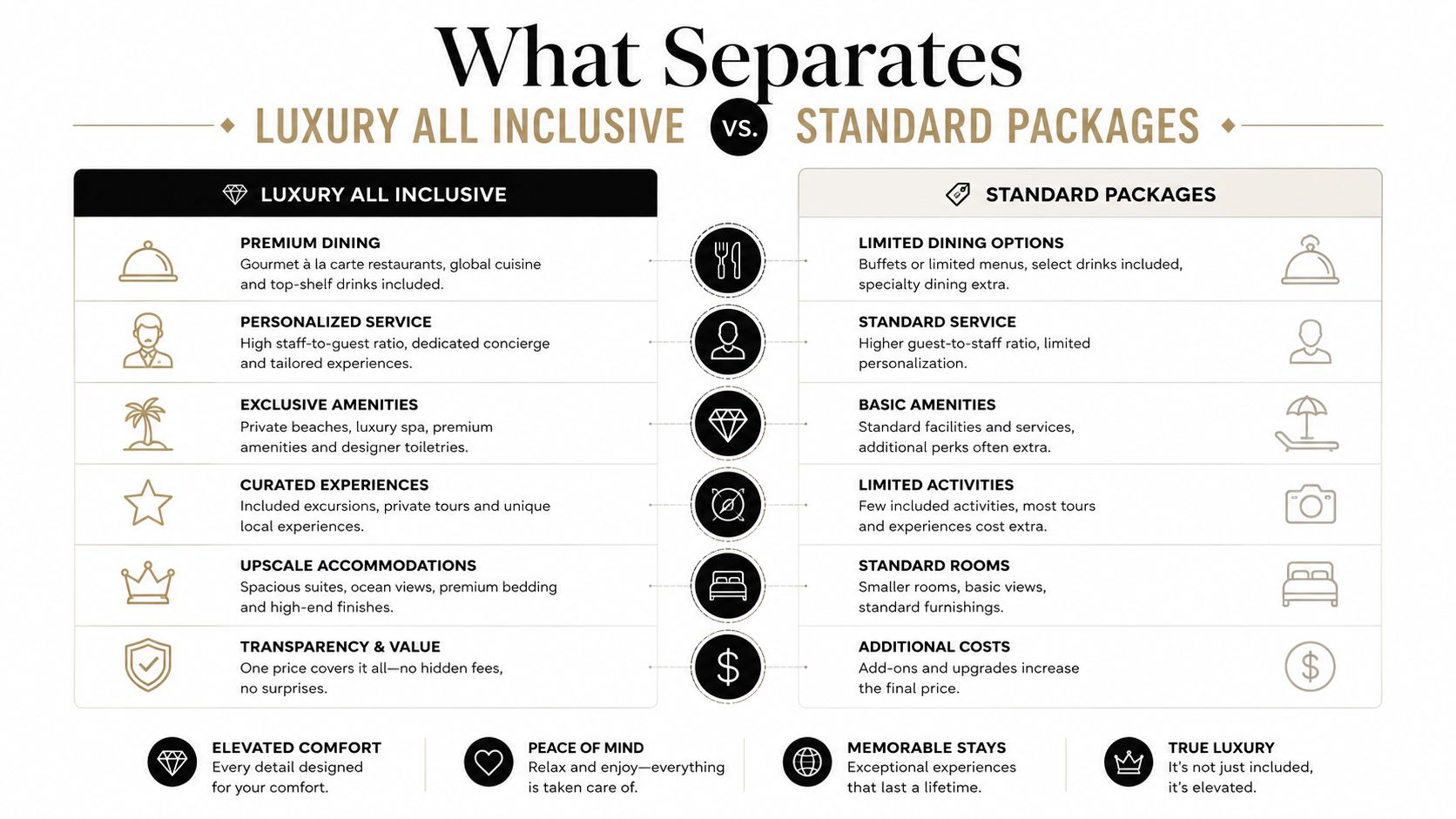
A luxury label means little until you examine what the package delivers. Start with the room. A standard room with two beds may be perfectly adequate for a short family break, but it doesn't provide the privacy or decompression space that makes a premium trip feel premium. Suites, connected rooms, villas, and separate sleeping areas are more valuable than a decorative upgrade because they solve a daily family problem.
Look for a layout that gives parents and children genuine separation. A villa with a private pool may be useful for early risers and younger children, while a suite with a second bedroom can work better for families with older children. Confirm the bedding, maximum occupancy, bathroom configuration, balcony access, and distance from noisy facilities before paying for the category.
Dining reveals the truth quickly
Luxury dining isn't defined by the number of restaurants printed in the brochure. It's defined by execution, flexibility, and access. A credible property should offer multiple à la carte venues, thoughtful children's choices, room service that arrives at useful times, and staff who can handle allergies without turning every meal into an administrative exercise.
Ask whether premium restaurants are included for every guest or restricted to a club category. Ask whether reservations are required, whether private dining carries a surcharge, and whether the resort can serve a quiet early dinner for young children without making parents feel rushed. A large buffet can be convenient, but it shouldn't be the only dependable option.
Service must operate before you ask
Dedicated butlers, a family concierge, and proactive restaurant coordination can justify a premium when they remove real friction. Service should cover airport arrival, room setup, children's equipment, activity reservations, dietary requests, and special celebrations. A named contact who understands the family's schedule is more useful than a generic app full of promotional offers.
Exclusive facilities also deserve scrutiny. A private beach area, adults-only pool, shaded family cabanas, a well-run spa, and a properly staffed kids' club can materially improve the stay. The resort should explain age bands, activity styles, staff qualifications, supervision procedures, and whether children can move in and out of programming without rigid scheduling.
Red flags deserve a direct answer
A property probably isn't delivering luxury value if it hides fees, restricts restaurant access, charges for ordinary family necessities, or promotes facilities that are consistently overcrowded. Review the inclusions document rather than relying on the room rate. Check transfer terms, premium alcohol policies, water sports, childcare, Wi-Fi, excursion access, and cancellation conditions.
| Area | Luxury standard | Warning sign |
|---|---|---|
| Accommodation | Suite or villa layouts with usable privacy | A larger room with the same single-room configuration |
| Dining | Several reliable à la carte choices and flexible service | Buffet dependence or frequent access restrictions |
| Family support | Proactive concierge and age-appropriate programming | A kids' club treated as the entire family strategy |
| Facilities | Space, shade, quiet zones, and well-maintained amenities | Chair competition and crowded shared areas |
| Pricing | Clear inclusions and transparent supplements | Multiple charges revealed after booking |
A high rate doesn't guarantee high-touch service. The package earns its luxury status through access, discretion, and operational competence.
When All Inclusive Makes Sense for Your Family
All-inclusive works best when your family wants a reliable base with enough choice to keep everyone occupied. It's particularly effective for parents with young children who value predictable costs, short distances, familiar meal options, and supervised programming. It also suits multi-generational groups because grandparents can rest while parents take children to activities, then everyone can reunite for a shared meal without coordinating transportation across town.
Convenience has become a central reason families choose the model. Recent survey data identifies convenience as the top driver at 92%, while reporting on family-travel preferences emphasizes on-site activities, kid-focused programming, and eco-friendly options. The same research identifies more shared on-site activities as the largest unmet need, followed by distinctive children's experiences and luxury, according to the Family Travel Association survey report.
Choose the resort when structure helps
A resort is a strong fit if:
- Your children have different energy levels: One child can attend a club while another swims, naps, or joins a family activity.
- Your group includes grandparents: On-site dining, elevators, accessible paths, and short transfers reduce physical demands.
- You want simple international travel: A single property, coordinated transfers, and a known service team reduce the number of moving parts.
- You prefer flexible togetherness: Family members can separate during the day and reconnect without rebuilding the itinerary.
The format also makes sense for a first international trip with children. You can introduce new food, water sports, excursions, and cultural experiences without asking the family to change hotels every few nights.
Know when to leave the resort model
A private villa is usually better for families who prioritize quiet, space, and control over programming. It can suit teenagers who want independence, adults who dislike shared pools, and groups that need a flexible dining schedule. A staffed estate can also provide more consistent privacy than a large resort, particularly when several generations travel together.
A bespoke multi-stop itinerary is the better choice when cultural immersion matters more than operational simplicity. Families who want to spend time in several cities, use private guides, or build the trip around art, food, sport, or nature may find a single resort restrictive. Boutique hotels can provide a stronger sense of place, though they often require more planning for meals, transfers, and children's activities.
For destination inspiration and a broader comparison of family travel styles, review Haute Black's family travel guidance. The key is to match the format to the family, not force the family to adapt to the format.
Selection Criteria for Luxury Family Resorts
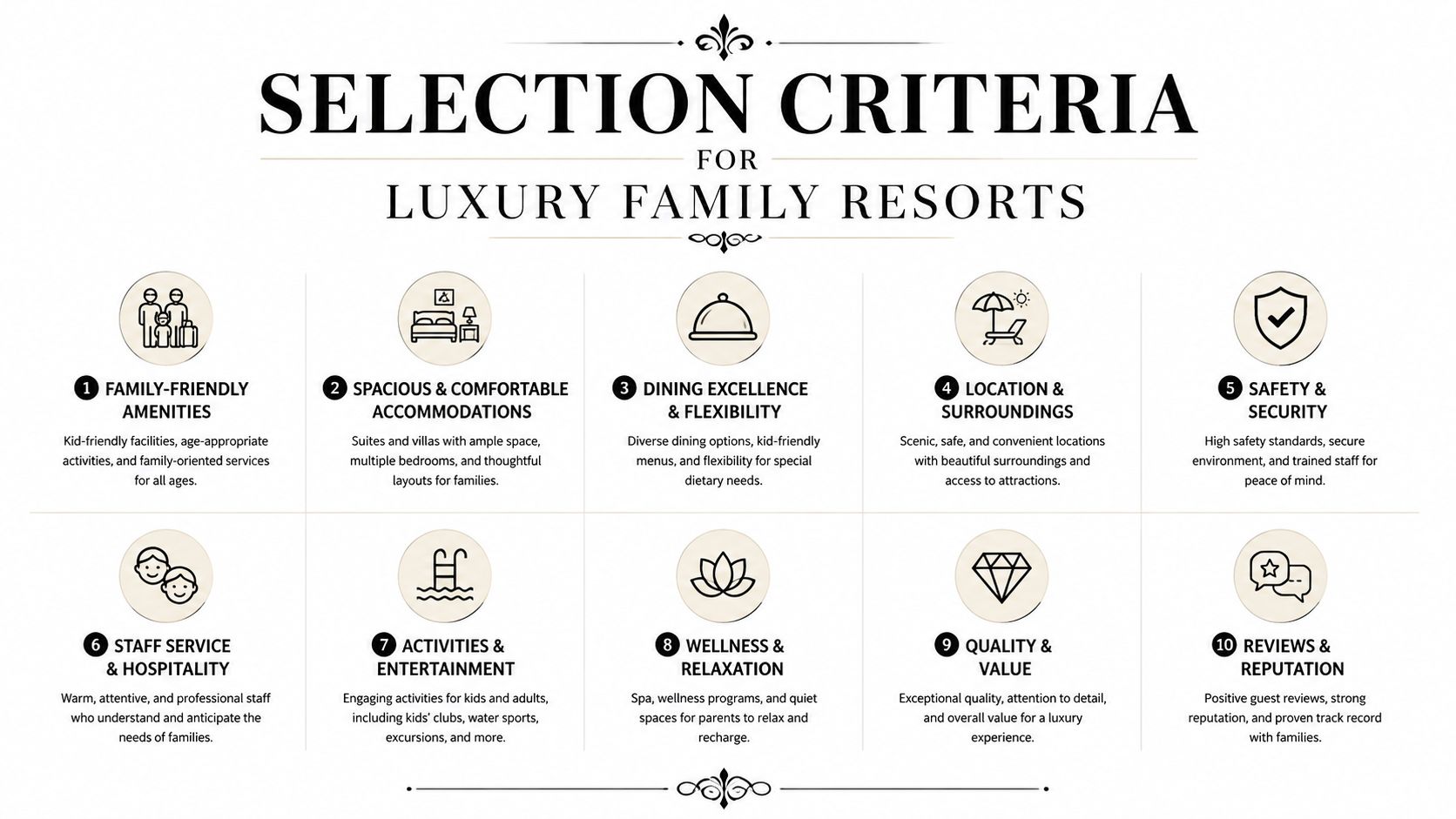
Evaluate the property in a fixed order. Begin with the family's physical and emotional space, then examine programming, food, access, and recognition. A resort may offer impressive amenities, but if it can't provide quiet sleeping arrangements or a practical plan for different age groups, the headline features won't save the trip.
Start with privacy and room logistics
Request the floor plan, not just the room description. Confirm whether children sleep in a separate room, whether the villa has internal doors, whether bathrooms serve each sleeping area, and whether outdoor space is private. Ask for locations away from evening entertainment, service corridors, loading areas, and high-traffic pool decks.
Privacy also includes adult breathing room. An adults-only pool or lounge can give parents and grandparents a quiet interval, while a private pool lets families choose their own rhythm without competing for chairs or shade.
Test the children's program
Don't accept “kids' club” as a complete answer. Ask which ages share a group, what happens for toddlers, how the program handles children who don't want to participate, and whether older children have activities beyond crafts and pool time. For teenagers, look for water sports, supervised adventure, creative spaces, and places where they can socialize without being treated like small children.
Educational or locally grounded activities can make the resort feel less insulated. A cooking session, conservation experience, guided water activity, or cultural outing gives children a reason to engage with the destination rather than just consume the property.
The following video can help families think through the practical differences between resort categories and service models.
Examine dining and destination access
Ask whether the kitchen can accommodate allergies, whether private dining is available, and how much advance notice special menus require. Then ask how the resort arranges off-property experiences. A private guide, discreet vehicle, child-sized equipment, and a departure time suited to your family are worth more than a generic group excursion.
Families comparing resort travel with larger private-home options may also find a luxury rentals Orlando FL guide useful when evaluating villa space, location, and service expectations.
Confirm VIP handling in writing
Your advisor should document airport transfers, room preferences, celebration details, dining requests, childcare needs, mobility considerations, and priority reservations. Ask who owns the request after booking. A property that promises a dedicated concierge but can't explain the communication process isn't ready to manage a complex family stay.
Sample Itineraries and Multi Generational Scenarios
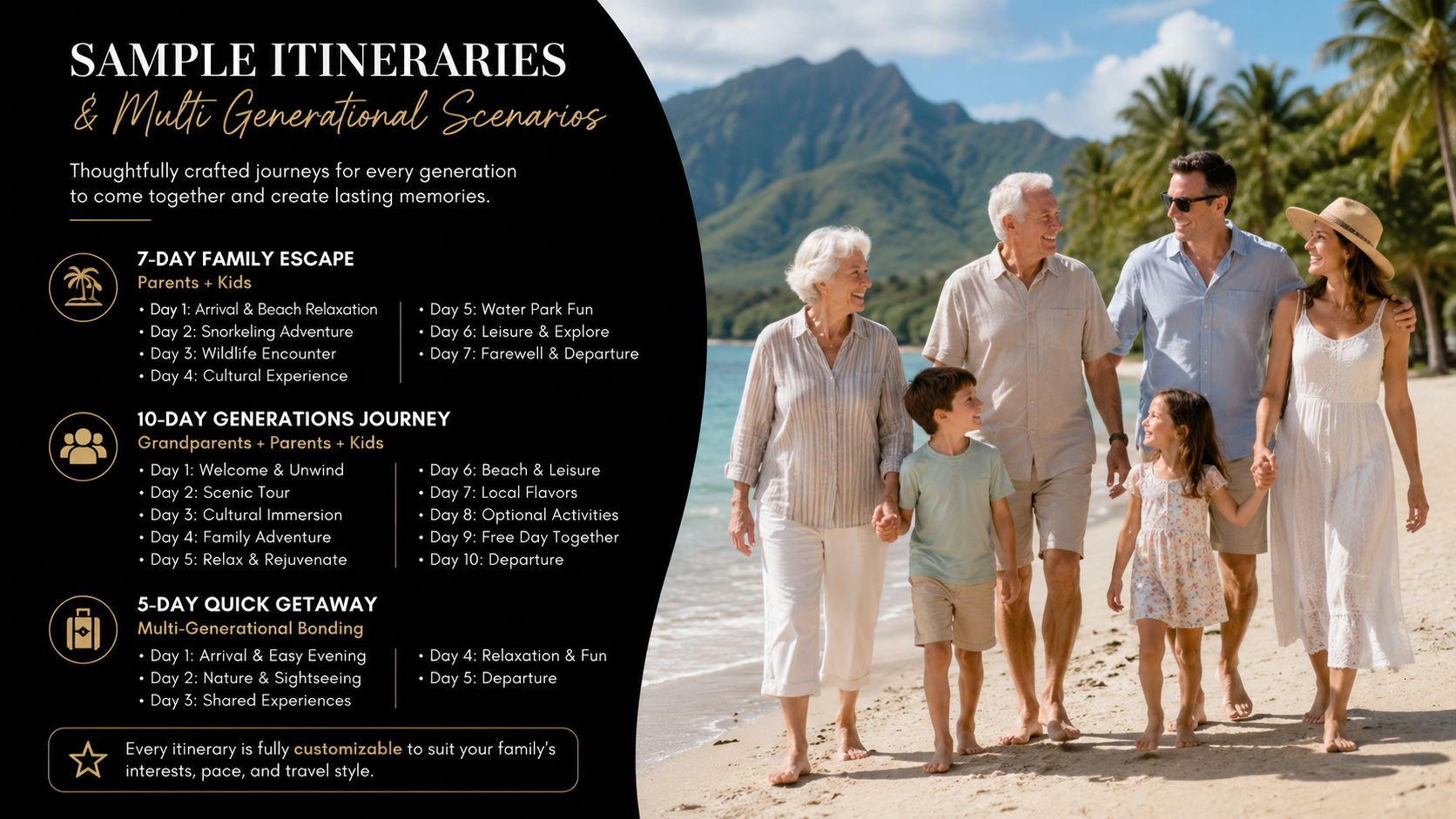
Luxury all-inclusive travel works best when it gives families structure without forcing constant togetherness. The property should make separation easy, keep logistics contained, and offer enough privacy for each generation. Use these scenarios to test whether a resort can deliver that balance.
Young children need short transitions
Families with toddlers should keep the schedule compact. Start with breakfast near the room, then use the kids' club or a private nanny for a short morning period. Parents can take a quiet swim or spa treatment while grandparents enjoy the beach. Meet for lunch in a shaded setting.
Keep the afternoon simple. Choose family beach time, a gentle pool activity, or a brief nature experience, then return to the suite before the children become overtired. A private or semi-private early dinner is more practical than a long formal meal. Adults can alternate bedtime duty and enjoy a later dinner or quiet drink.
The resort earns its fee by reducing coordination. You are paying for the freedom to divide the day without arranging separate transportation for every family member.
Teenagers need autonomy with guardrails
Teenagers usually need choice more than a packed entertainment schedule. Build the morning around an active excursion, water sport, or guided adventure. Give them a defined area for independent time, with clear meeting points and an agreed return time.
Parents can choose a long lunch or spa visit while teenagers use the resort's activities. Keep dinner flexible, with one planned family meal and other evenings open. A club level, lounge, or dedicated concierge can secure reservations while allowing different groups to follow different timetables.
Your advisor should confirm whether the property supports independence safely. A long activity list does not compensate for poor supervision, inconvenient distances, or a weak environment for teenagers.
Three generations need opt-out flexibility
For grandparents, parents, children, and extended relatives, reserve a suite or villa configuration that gives each household a private retreat. Plan one shared anchor each day, such as a private boat outing, family cooking experience, sunset meal, or beach gathering. Leave the remaining hours optional.
Grandparents may join breakfast and an early excursion, then return to rest. Parents can take younger children to the pool while older relatives use the spa. Teenagers can skip a group dinner without making the evening feel unsuccessful.
Research cited by Market Intelo says 52% of family vacationers include extended family members, such as grandparents, aunts, or cousins. The practical lesson is clear: choose a property that supports shared experiences without demanding constant togetherness. If the family needs distinct kitchens, larger living areas, or a fully private daily schedule, a villa or bespoke itinerary may serve them better than an all-inclusive resort.
The Value of Booking Through a Virtuoso Advisor
Where you book matters almost as much as where you stay. A luxury travel advisor with preferred partner relationships can often attach benefits to a reservation that aren't visible through a public booking channel. The value comes from advocacy, recognition, and problem-solving, not from sending you a link to the resort's website.
For affluent families, preferred partner access can translate into complimentary room upgrades when available, resort credits, flexible benefits, priority handling, and a more considered arrival. Those benefits vary by property and booking terms, so your advisor should explain exactly what applies before you commit. At hotels and resorts associated with brands such as Four Seasons, Aman, Rosewood, Belmond, and Ritz-Carlton, relationship-based recognition can shape the experience from the first interaction.
Direct booking isn't always the strongest route
Booking direct may appear simpler, especially when a family already knows the destination. It can also be appropriate for a straightforward stay where no special handling is required. But a direct reservation generally leaves the family responsible for coordinating the room category, transfers, dining, celebrations, children's equipment, and any recovery when something goes wrong.
Online platforms can widen the search, but they rarely understand the family's internal dynamics. They won't know that one grandparent needs a room near the elevator, that a teenager should not be placed beside a children's activity zone, or that parents want a private dinner on the first evening after a long journey.
Ask what the advisor actually contributes
A credible advisor should compare properties rather than push a predetermined resort. They should explain occupancy rules, realistic service levels, room locations, supplement policies, and the difference between included and paid experiences. They should also remain involved after booking, especially when flights change, weather disrupts an excursion, or the resort fails to deliver a promised arrangement.
Read Haute Black's guide to what a Virtuoso travel agent is before choosing an advisor. The important distinction is whether the advisor has the relationships and operating discipline to make a multi-generational trip feel coherent.
Booking test: If the advisor can't tell you what happens when the preferred room, restaurant, or transfer isn't available, you haven't yet seen the value of the relationship.
High Touch Add Ons That Enhance Family Travel
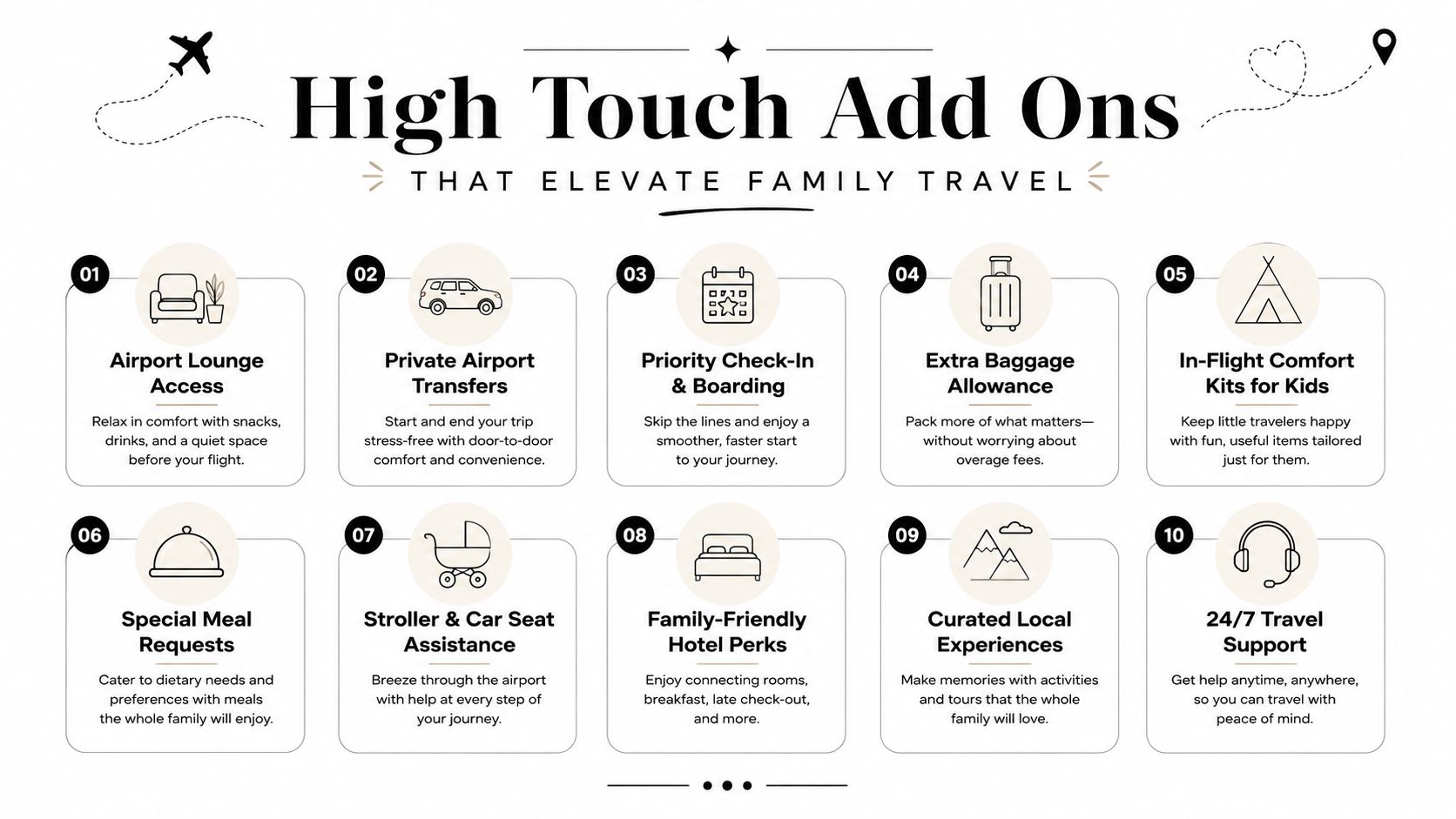
The right add-on removes a specific source of friction. Private aviation can shorten a difficult journey, but it is poor value when the problem is an uncoordinated ground transfer. A villa upgrade can provide privacy, while a private chef may matter more than another resort restaurant for a birthday or family celebration.
Build the services around one operating plan. The arrival should suit the accommodation, the accommodation should support the family's daily rhythm, and the concierge should coordinate dining, excursions, childcare, and special occasions accordingly.
Prioritize the first and last mile
Families often remember airport logistics more vividly than a beautifully designed lobby. Arrange a private transfer with enough room for luggage, car seats, mobility equipment, and tired children. For European journeys connecting air travel with a cruise, a dedicated service such as Heathrow to cruise port transfers removes an unnecessary handoff between airport and port.
Helicopter transfers suit routes where geography creates a long drive, provided the luggage rules, weather contingencies, and ground arrangements are clear. Private aviation earns its cost when it solves a real itinerary problem. It adds little when it merely signals status on an otherwise ordinary route.
Spend on privacy and competent coordination
For a multi-generational group, a private villa or larger suite may be the most useful upgrade. Children can sleep without restricting adult conversation, while grandparents can rest without following the group's schedule. Pair the accommodation with a dedicated concierge who handles restaurant reservations, excursion timing, dietary requests, airport arrangements, and childcare communication.
A private chef can create a stronger occasion than another included dinner. Review Haute Black's guide to villas with private chefs before deciding whether an in-resort meal or private culinary service better fits the family.
Advisor's rule: Buy the service that protects your family's time and privacy. Skip an upgrade that only adds another logo, lounge, or decorative feature.
Haute Black arranges bespoke family journeys, private villas and estates, private aviation, helicopter and first-class transfers, and concierge support for dining and transport. Visit Haute Black to compare a high-end all-inclusive with a staffed villa or tailor-made itinerary, then choose the format that fits your family instead of accepting a package that only looks luxurious.
Frequently Asked Questions
Explore Our Guides

Signature Experiences


