Haute Black Journal
Jicaro Island Lodge: Nicaragua's Top Eco-Luxury Retreat

Marlene Azeez
Director, HauteBlack
View all articles →
# Jicaro Island Lodge: Nicaragua's Top Eco-Luxury Retreat
June 7, 2026
The approach reveals itself on arrival. You leave the mainland, the noise drops away, and within minutes Jicaro Island Lodge stops feeling like a hotel booking and starts feeling like a controlled retreat designed for people who value privacy over spectacle.
That distinction matters. Many travelers say they want eco-luxury, but what they seek in practice is a conventional resort with softer branding. Jicaro is different.
The Essence of Jicaro An Unspoiled Sanctuary
Jicaro Island Lodge works best for travelers who understand that small scale changes everything. This is a nine-casita private-island retreat that can host up to 21 guests and can also be reserved as a full buyout, with the property recommending booking that option up to six months in advance, according to the Jicaro Island Lodge FAQ. That's not just a capacity detail. It defines the entire rhythm of the stay.
What eco-luxury means here
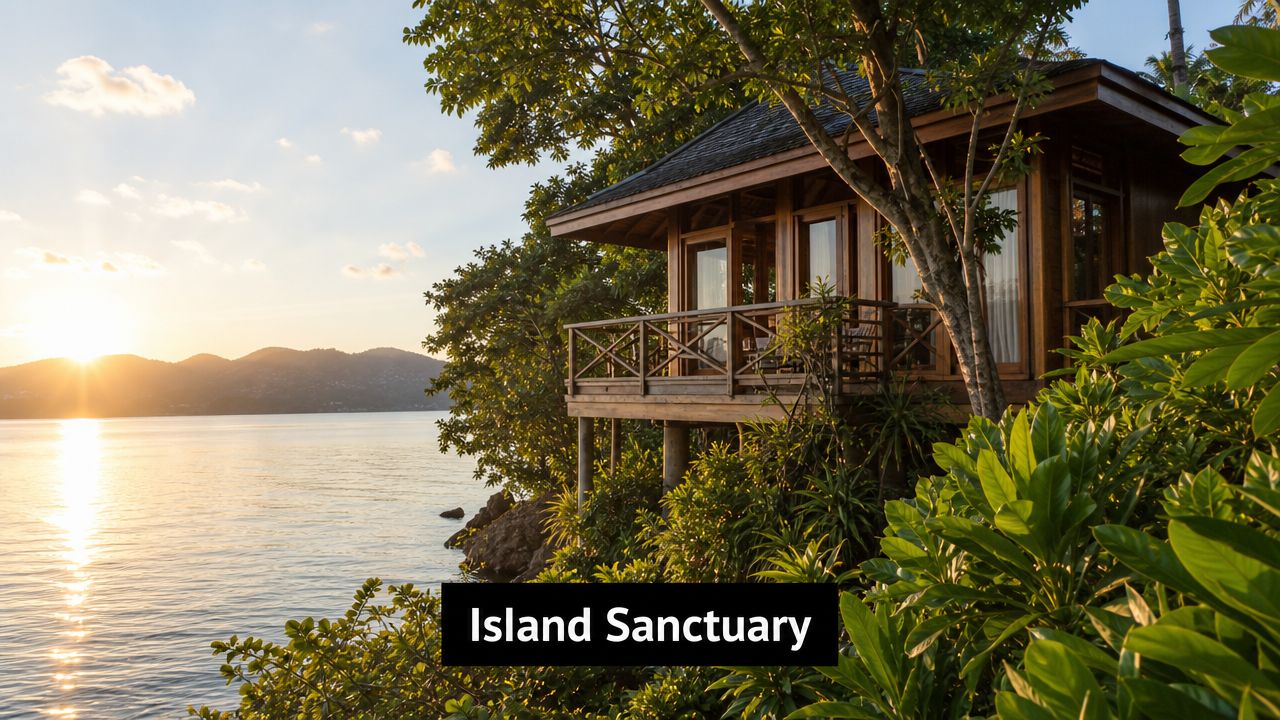
At Jicaro, eco-luxury isn't expressed through a giant spa circuit, a long list of restaurants, or a packed activity board. It shows up in a quieter way. The island setting, the modest inventory, and the lodge's emphasis on sustainability create a stay that feels edited rather than expansive.
That's the first trade-off to understand. If your benchmark is a larger island resort with endless outlets and constant stimulation, Jicaro may feel intentionally restrained. If your benchmark is seclusion, silence, and service that adapts quickly because very few people are on property, it's unusually compelling.
The service model helps explain why. The lodge maintains a full-time staff of 17 for a maximum of 21 guests, creating an operational ratio of roughly 0.81 staff per guest at full occupancy, as outlined in Jicaro's rates and inclusions. In practical terms, that supports fast response, flexible pacing, and a more personal cadence than most resorts can deliver.
Practical rule: Jicaro isn't the place to choose if you want anonymity inside a busy luxury ecosystem. It's the place to choose if you want staff to quickly understand your preferences without the resort ever feeling crowded.
The real appeal for private travelers
The lodge sits near Granada's Isletas de Granada and is accessed by boat from the mainland, which adds a psychological layer that many properties can't replicate. Even before you settle into your casita, there's a sense of crossing into a more protected environment.
For discerning travelers comparing island stays, this is closer to a private residence model than to a classic resort model. It's especially well suited to couples, small celebratory groups, and families who want controlled privacy without taking on the burden of staffing a fully standalone villa.
A useful comparison point appears in this broader guide to private island resorts. Jicaro belongs in that conversation, but with an eco-minded, low-density personality that's more intimate than theatrical.
What works and what doesn't
What works:
- Privacy by design: Very limited inventory reduces foot traffic, noise, and the feeling of sharing the experience with many other travelers.
- Service without over-formality: A small guest count allows the team to adjust timing and flow naturally.
- A stronger sense of place: The lake setting and island separation make the destination itself part of the experience.
What doesn't, for some travelers:
- No big-resort variety: Travelers who need multiple venues and constant choice may find the experience too pared back.
- A more naturalistic setting: Eco-luxury here means closeness to the environment, not insulation from it.
- Limited spontaneity for peak dates: Inventory is tight, so last-minute luxury planning is riskier here than at larger properties.
Jicaro's character comes from those trade-offs. It isn't trying to be everything. That restraint is exactly why the right guest tends to love it.
Accommodations and Lakeside Dining
The stay revolves around two things. First, how well your casita lets you live with the lake rather than merely look at it. Second, whether dining feels personal enough to justify an all-inclusive format. At Jicaro, both are handled with more intention than scale.
How to choose the right casita mindset
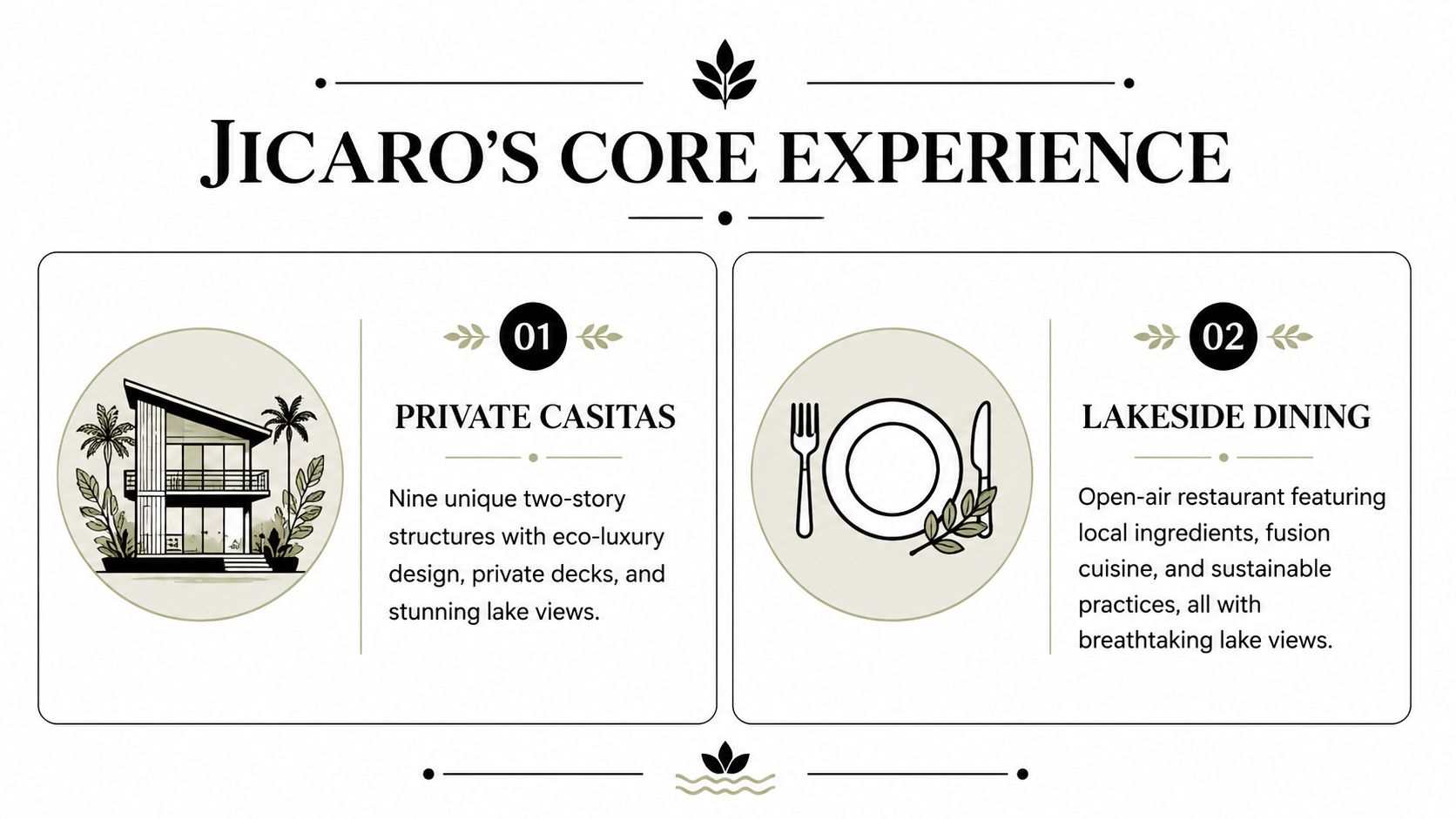
Jicaro Island Lodge has only nine private two-story casitas and can accommodate a maximum of 21 guests, which is why it's particularly attractive for travelers considering a whole-island takeover. The property itself recommends booking full private buyouts up to six months in advance, according to the lodge FAQ.
That two-story layout matters. A freestanding structure creates more acoustic and visual separation than a conventional suite block, and each casita includes a lake-facing terrace or deck. The result is a stay that feels more residential than hotel-like.
For clients weighing this property, I usually frame the casitas this way:
| Consideration | What Jicaro does well | Possible compromise |
|---|---|---|
| Privacy | Freestanding accommodation feels secluded | You won't have the sprawl of a large villa estate |
| Connection to setting | Decks and open outlooks keep the lake present all day | Travelers wanting a sealed, urban-luxury environment may prefer a different style |
| Exclusivity | Very few keys on island changes the atmosphere immediately | Choice is limited if you're booking close in |
Living well in a small-footprint retreat
Jicaro's casitas work best when you use them properly. Don't treat them as a place to sleep between excursions. Spend time on the deck. Let the property's slower cadence shape the day. This is one of those stays where the room itself is part of the reason to come.
That's also why some guests misread it. Travelers accustomed to oversized suites sometimes focus on what isn't there. The better lens is how well the space supports quiet, privacy, and a sense of remove.
The luxury at Jicaro comes from how little interruption the setting allows, not from how much hardware the room can display.
For travelers who are passionate about food as part of the trip, it also helps to think of the lodge's culinary offering as an integrated part of the stay rather than a separate revenue center. That all-inclusive structure changes the tone of meals for the better.
Dining with fewer decisions and better flow
The published rate structure is thorough by luxury standards. One authoritative hotel guide notes rates at $995 per casita per night and $1,503 per casita per night for holiday season, with 17% government tax included, while another listing notes $993.12 per night with a 15% tax included. Across channels and dates, the property remains around the $1,000-per-night level and includes all meals, roundtrip boat transfer, and use of kayaks, SUP boards, and yoga equipment, as outlined in this Jicaro Island Lodge guide.
That matters because all-inclusive at this level can remove friction rather than flatten the experience. You're not signing checks after each meal. You're not debating whether to stay in or head out. The island encourages you to settle into it.
Dining tends to work best for guests who want:
- A cohesive stay: Meals feel like part of the retreat, not a separate transaction.
- A scenic setting: Open-air dining by the lake adds atmosphere without needing theatrics.
- Ease over excess: The value is in thoughtful execution, not endless venue rotation.
Travelers who build trips around marquee dining scenes in major cities may still want to pair Jicaro with time elsewhere. But if the goal is relaxed, well-paced, lakeside meals with minimal decision fatigue, the format suits the property perfectly. For clients who prioritize culinary planning across a wider journey, Haute Black's perspective on luxury dining experiences is also useful when building a larger Nicaragua or Central America itinerary around this stay.
Signature Experiences and Wellness
Days at Jicaro can go one of two ways. You can let the island reduce your pace, or you can use it as a quiet base for movement, exploration, and return. The strongest itineraries usually combine both.
The island itself is part of the program
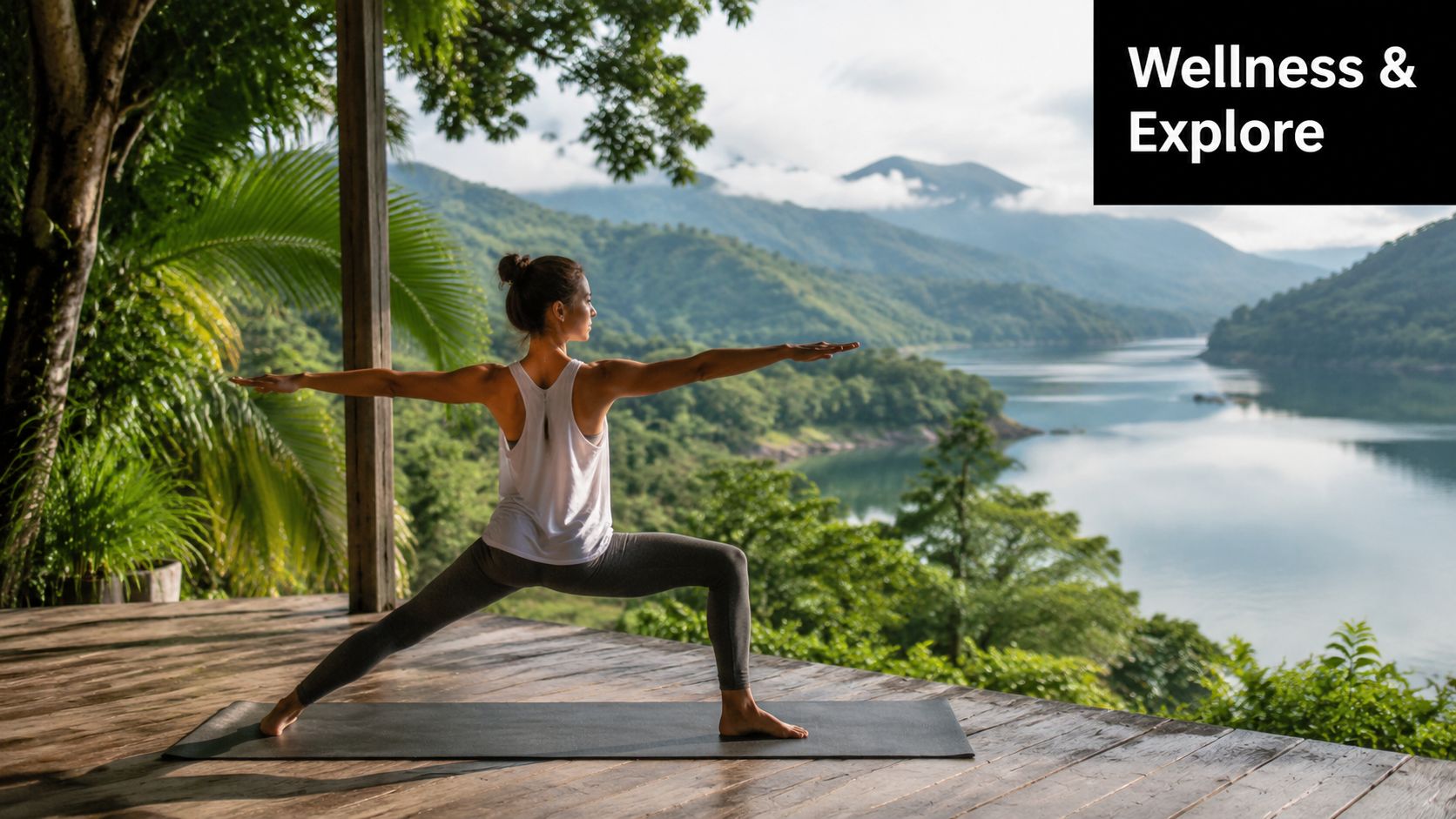
The included use of kayaks, SUP boards, and yoga equipment shapes the experience in a practical way because it invites guests to do simple things well. Morning movement on deck. A paddle through the isletas. Time off your phone. An unhurried lunch back on property.
That sounds modest on paper. In practice, it's often exactly what over-scheduled travelers need.
The wellness side of Jicaro is strongest when treated as atmosphere rather than agenda. The property doesn't need a giant wellness complex to create restorative value. The combination of low guest density, water views, and a quieter service rhythm does much of the work.
For travelers who build honeymoons around privacy and pacing rather than nonstop activity, I sometimes compare planning style rather than destination style. A resource like Max's Luxury Rides honeymoon offers is useful as an example of how transport, romance, and timing can be layered thoughtfully into a couple's trip. The same logic applies here. The sequence matters as much as the location.
Best paired experiences
Jicaro shines when guests mix soft-activity mornings with more structured outings later. The lodge can feel contemplative if you stay entirely on island. That's perfect for some travelers, but not all.
The best pattern is usually a blend such as:
- Early movement: Yoga or a quiet paddle before breakfast
- A half-day excursion: Granada or a nature-focused outing
- A slow return: Lunch, rest, and a late afternoon by the water
- An easy evening: Dinner without needing to re-enter a city rhythm
Here's a closer look at the property in motion:
Off-island exploration works best in moderation
Jicaro also serves travelers who want a base with range. Granada adds cultural texture. Nature excursions add contrast. Adventure elements can absolutely be woven in. But the property is most effective when those pieces don't overpower the island itself.
Book Jicaro if you want to come back to calm after each outing. If you expect the lodge itself to behave like a full-scale adventure resort, you're using the wrong lens.
That's why I like it for clients who want one elegant, low-noise address and a flexible menu of experiences around it. The island remains the anchor, and the excursions stay selective.
For travelers who place wellness at the center of the trip, the broader editorial lens on wellness-focused travel fits Jicaro well. The property's appeal isn't flashy wellness. It's environmental calm, personal space, and a schedule that doesn't demand performance.
Sample Bespoke Itineraries
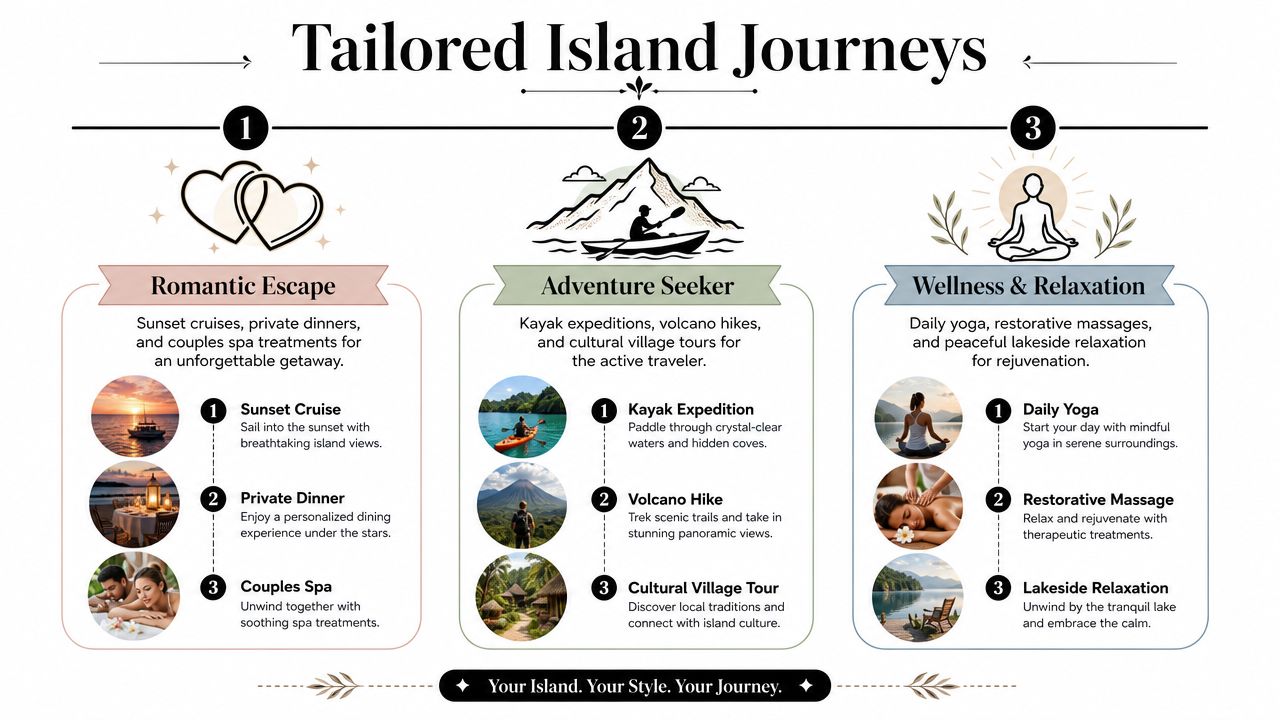
The easiest way to understand Jicaro is to see how differently it can serve different travelers. The property rewards customization, but not every guest should use the island the same way.
Romantic escape
Day one should stay simple. Arrive, settle into the casita, and resist the urge to over-program the first afternoon. This is a property where couples benefit from slowing down immediately rather than treating arrival as transit between activities.
Day two is where Jicaro often proves itself. A quiet morning, time on the water, and an unhurried meal can feel more intimate than a heavily staged romantic setup. The privacy comes from the island's scale, not from orchestrated theatrics.
Day three can hold one well-chosen outing, then an early return. Couples who spend every day off property often miss the core strength of the stay.
Family adventure
Jicaro works for families who travel well in calm environments and don't need a kids' club to validate the trip. The island encourages shared time and low-friction activity, which can be more valuable than heavily programmed entertainment.
A sensible family pattern looks like this:
- Arrival day: Keep children close to the room and let them adjust to the boat-access rhythm and the novelty of island life.
- Middle day: Use the included water equipment for supervised activity and keep the schedule flexible.
- Exploration day: Add one off-island excursion with a clear beginning and end, then return before fatigue sets in.
The caveat is straightforward. Families seeking nonstop facilities and broad child-specific programming may be happier elsewhere. Families that value togetherness, calm water-based activity, and a contained setting often do very well here.
Adventure seeker's journey
Jicaro can also support a more active traveler, but the itinerary needs discipline. The mistake is booking every possible excursion and reducing the island to a bed between transfers.
A stronger approach:
1. Use the first full day for the island itself. Paddle, orient, reset.
2. Place your most demanding outing next. That keeps the body fresh and gives the trip a centerpiece.
3. Reserve the final stretch for decompression. Jicaro is at its best when it has room to restore you after effort.
The best Jicaro itinerary always leaves empty space. This property needs some breathing room to justify its character.
Across all three styles, the same rule holds. Build around the island, not just around Nicaragua. Jicaro isn't the backdrop. It's the reason the itinerary feels cohesive.
Practical Logistics and Insider Booking Tips
Jicaro is easy to reach once the sequence is understood. The mistake is assuming “private island” means cumbersome access. In reality, the logistics are fairly straightforward, but timing still matters because the property's intimacy leaves less room for sloppy planning.
Arrival chain and what the rate covers
One authoritative hotel guide notes that the all-inclusive rate can range from $995 to over $1,500 per night depending on season, and that it includes all meals, a roundtrip boat transfer from the Port of Asese, plus use of kayaks and SUP boards. The same guide states that the port is a 15-minute boat ride from the island and just over an hour's drive from Managua International Airport, as outlined in this hotel overview of Jicaro Island Lodge.
That access pattern makes Jicaro workable for travelers who want seclusion without committing to a remote expedition. You fly into Managua, continue by road, then finish by boat. The transitions are simple enough, but each handoff should be confirmed in advance so the arrival feels smooth rather than improvised.
Booking windows that matter
Because inventory is so limited, date strategy matters more here than at larger resorts. The lodge's own booking rules are a good signal of demand patterns. According to the Jicaro Island Lodge FAQ, wildlife-season reservations are due 30 days before check-in, high-season reservations 60 days before check-in, and holiday-season reservations 90 days before check-in, with a 25% confirmation deposit due 120 days before check-in.
For practical planning, I'd use these rules as a baseline:
- Holiday travel: Don't treat this as a last-minute booking.
- Buyouts and milestone trips: Start earlier than you think you need to.
- Couples with fixed dates: Lock in promptly if the trip depends on a specific season.
Insider advice that improves the stay
The smartest questions to ask before confirming aren't always about price. They're about fit.
Use this checklist:
- Casita preference: Ask which accommodations best match your priorities, whether that's privacy, easiest access, or preferred outlook.
- Pacing of excursions: Decide in advance whether the trip is primarily restorative or exploratory.
- Dining rhythm: If you have strong food preferences or timing habits, raise them early so the small team can shape the stay around them.
- Transfer tolerance: If anyone in your party dislikes fragmented travel days, plan buffers so road and boat connections don't feel rushed.
I also recommend reading outside the destination category now and then. Pieces focused on operations can be surprisingly useful because they sharpen your eye for how a property delivers service, not just how it markets it. This look at hotel operational insights for trade partners is one example of the kind of material that helps travelers and advisors think more critically about guest flow, staffing, and service design.
Jicaro rewards that kind of planning. It's not difficult to book. It's a place where precision noticeably improves the result.
Elevating Your Stay with Haute Black
A property like Jicaro Island Lodge exposes the difference between making a reservation and shaping a journey. On paper, the stay can look straightforward. Small island. all-inclusive structure. easy transfer chain. In practice, the outcome depends on how well each surrounding detail is handled.
That matters more with intimate properties than with giant resorts. Large hotels can absorb imperfect planning. A low-density retreat cannot. If your arrival lands awkwardly, if your pre- and post-stay rhythm is off, or if your travel style doesn't match the island's pace, the experience can feel diminished.
Why curation matters more at Jicaro
Jicaro is best booked for a reason, not just because it looks beautiful in photos. The advisor's job is to determine whether the island should be a honeymoon anchor, a decompression stop after a more active circuit, a discreet family retreat, or a full private celebration.
Each version changes the trip design.
A good planner will usually focus on:
- Sequence: Whether Jicaro should open the trip, close it, or sit in the middle
- Energy management: How much activity belongs around such a tranquil base
- Privacy priorities: Whether the guest needs a standard stay or should consider a full-island approach
- Ground handling: How to make airport, road, and boat transitions feel polished from the first touchpoint
The value of personalization before arrival
The luxury world talks constantly about personalization, but the useful version isn't cosmetic. It's operational. Preference capture matters only if it changes what happens on the ground.
That's why I pay more attention to execution frameworks than to generic promises. This perspective on superior guest experience personalization is helpful because it underlines a point many travelers miss. Personalization works when details are translated into service behavior, timing, and guest recognition.
At a place like Jicaro, that can mean simple but meaningful differences:
- meal pacing that suits your habits
- excursion planning that doesn't fracture the stay
- room placement aligned with how you travel
- transfer timing that protects the island's calm rather than undermining it
What discerning travelers should expect
The right support around Jicaro usually improves three parts of the trip.
First, fit. Not every luxury traveler wants eco-luxury in its truest form. A strong advisor will say that plainly and redirect if needed.
Second, flow. Jicaro often performs best as one component in a wider itinerary, especially when paired with another destination that offers a different texture.
Third, friction reduction. The less mental energy you spend on confirmations, timing, and transitions, the more the island can do what it does well.
Jicaro delivers best when the guest arrives already aligned with the property's logic. Privacy over spectacle. rhythm over volume. setting over display.
This is the true standard to apply. If the travel design respects the island's nature, Jicaro can feel exceptionally refined. If it's booked with generic luxury assumptions, the guest may miss what makes it special.
For travelers who understand that distinction, the lodge can be one of the most satisfying stays in the region because it offers something increasingly rare. Quiet, space, and service that feels proportionate to the setting.
If you'd like a Jicaro Island Lodge journey built around privacy, smooth transfers, and the right pre- and post-stay pairing, Haute Black can design the trip with the precision this kind of property deserves.
Explore Our Guides


Signature Experiences