Haute Black Journal
Honeymoon Travel Planner Guide to Bespoke Romantic Escapes

Marlene Azeez
Director, HauteBlack
View all articles →

You've got a wedding deposit deadline approaching, a half-built inspiration board, and two very different ideas of what “the perfect honeymoon” means. One of you wants a quiet villa and no schedule. The other wants cities, restaurants, and a day trip that begins before breakfast. Meanwhile, family members are offering destination suggestions, and the wedding budget has already claimed more than its share.
That's when a honeymoon travel planner earns their place. The job isn't to turn a destination wish list into a stack of reservations. It's to make the important decisions in the right order, so the trip fits your energy, privacy needs, time off, and real budget. The difference between a memorable journey and a beautiful itinerary that leaves you exhausted is usually the planning, not the number of upgrades.
The Wedding Ends and the Journey Planning Begins
A couple can spend months choosing a venue and still approach the wedding without agreeing on where to go afterward. One partner has saved beach villas; the other wants Italy. Family recommendations add to the options, while a deposit deadline can pressure the couple to commit before they have settled what matters most.

Start with the shape of the trip, not a hotel shortlist. Agree on how much rest you want, what you hope to remember, how much travel you can tolerate, and what spending still feels comfortable after the wedding. A planner turns those choices into a practical framework, setting the pace and cost priorities before individual bookings make the itinerary harder to change.
The honeymoon has also changed in purpose over time. The custom grew from the early-19th-century British bridal tour, when newlyweds visited relatives who could not attend the wedding, into a private holiday for the couple. As rail, steamship, and hotel networks expanded during the Belle Époque, honeymoon travel became part of modern leisure tourism. That history helps explain why privacy and milestone spending remain closely tied to the trip (history of the honeymoon).
If you are marrying in wine country, review weddings at Kunde Winery for venue-specific event guidance. Keep those arrangements separate from honeymoon decisions, and ask your travel advisor to structure the journey that begins after the celebration. That division gives wedding logistics and travel planning clear owners rather than leaving both in the same crowded conversation.
The first major choice is how to build the trip around your shared priorities. Set the destination, pace, and spending boundaries together before paying for separate pieces. A planner's value starts with that structure, which helps prevent attractive bookings from turning into a journey that does not fit either of you.
What a Honeymoon Travel Planner Actually Does
Think of a planner as the director of a private production. You're the only audience, but someone still has to make sure the setting, schedule, people, and transitions work together. A booking agent may secure a room and a flight; a skilled honeymoon travel planner designs the entire experience and stays accountable for how its parts connect.
Design before booking
First comes destination and timing strategy. The planner asks what you want to feel on the trip, how much time you have, what your budget needs to cover, and which compromises either partner can accept. That conversation determines whether a single resort, a cultural circuit, or a safari-and-beach combination makes sense.
Then comes supplier curation. The advisor recommends hotels, guides, transport providers, and experiences that fit your priorities. This isn't a catalogue exercise. A beautiful property can still be the wrong choice if transfers consume too much of your holiday, its atmosphere doesn't match your privacy expectations, or its room category won't deliver what the photos imply.
Coordinate the journey, not just the reservations
Once you've approved the direction, the planner handles the practical structure: transfers, arrival timing, hotel changes, reservations, and coordination with suppliers. They should also prepare for disruption, whether that means a missed connection, a delayed arrival, or an experience that needs to move because of weather.
Before departure, ask what you'll receive. A useful planning package should include a day-by-day itinerary, key supplier and emergency contacts, a contingency plan, and a financial reconciliation showing what's booked, what's included, and what remains payable. A concierge can help during a stay, but may not have designed or coordinated the full trip.
The boundary matters. A travel planner typically manages the journey, not the wedding ceremony, legal officiating, or event production. If you're eloping, clarify who handles the ceremony and who owns the broader travel plan, including accommodation, ground transport, dining, and any private aviation.
Bespoke Experiences, Upgrades, and Privacy as an Operational Choice
A honeymoon planner should shape how the trip works, not just secure a room upgrade. The value is access, sequencing, and discretion: getting a request to the right person, timing arrivals to avoid unnecessary exposure, and building a schedule that doesn't turn each day into a logistics exercise.
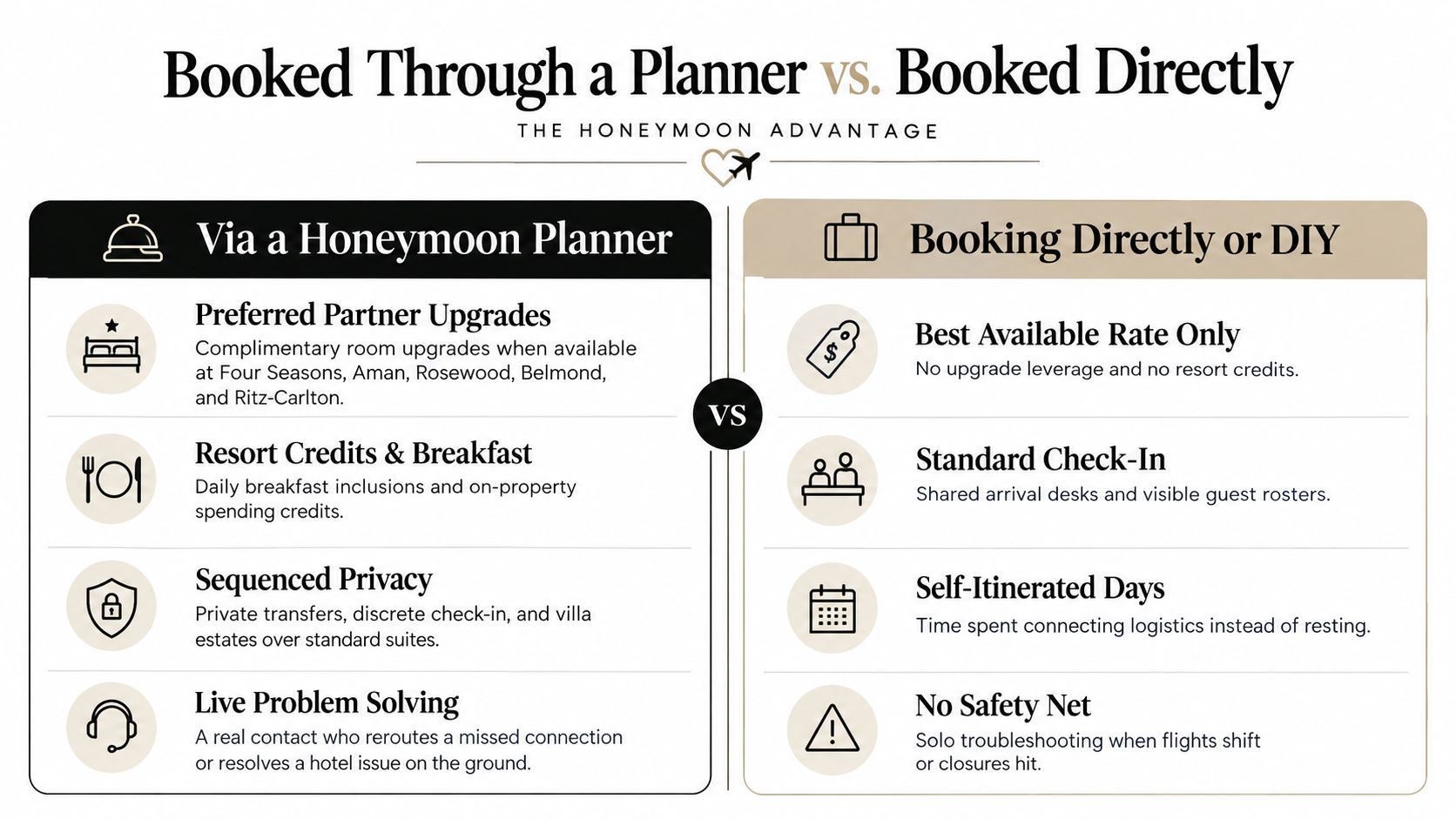
An established agency relationship may provide preferred-partner benefits at properties such as Four Seasons, Aman, Rosewood, Belmond, and Ritz-Carlton. Depending on the property and availability, benefits may include a complimentary upgrade, daily breakfast, resort credit, or other flexible offers. None is guaranteed, so confirm what applies to your booking before you commit. HauteBlack's Four Seasons preferred partner benefits show how a property relationship can affect the terms of a stay.
Privacy is an operational choice
For couples who want discretion, privacy needs to be built into the itinerary, not left as a vague request. A private car changes the arrival experience. A villa estate may create more separation than a standard suite. A discreet check-in, carefully timed arrival, or private guide can also reduce time spent in crowded spaces.
Ask the planner to address these specific markers:
- Arrival: Can the hotel arrange a discreet check-in and private transfer?
- Accommodation: How does the villa or suite sit apart from neighbouring rooms and public areas?
- Dining and excursions: Can bookings be timed to avoid the busiest periods?
- Information handling: Who receives your travel details, and how are special requests shared?
A coastal outing closer to home needs the same operational thinking. Before adding a day on the water, review a private boat charter San Diego and confirm how departure logistics, privacy, and the pace of the outing fit your plans.
Membership-tier planning can also differ from a one-off booking. A continuing advisor relationship gives the planner room to coordinate preferences across suppliers and bookings, while a single reservation may cover only that stay. Ask what support continues after booking, who handles requests with the property, and what the service includes before paying a deposit. Put the four privacy markers in writing, then have the planner confirm which ones the selected property can deliver.
Three Romantic Itineraries That Actually Work
Three trip styles can all be luxurious, but they ask different things of you. Choose by energy and appetite for movement, not by which destination photographs best.
| Itinerary | Pace and privacy | Best fit |
|---|---|---|
| Beach and villa | One base, long stretches of downtime, private accommodation | Couples recovering from wedding intensity |
| Cultural circuit | Several distinct places, with travel between bases | Couples who want art, food, and local texture |
| Safari and beach | A carefully coordinated change of setting | Couples who want wildlife and quiet coastal recovery |
A beach-and-villa escape should resist the urge to fill every day. One property for a week or more can make privacy and rest the main features rather than rewards you squeeze in between excursions. Choose a single anchor experience, such as a private boat day or a special dinner, then leave space around it. If wine country is part of a nearby or domestic honeymoon, a guide to the top Sonoma wineries to visit can help you consider which visits deserve a place on the schedule.
For a cultural circuit, Italy is a good test of whether an itinerary has been designed or accumulated. HauteBlack's Italy itinerary guidance recommends no more than three primary bases for a 7–10-day trip, connected by rail or private transfer, with major travel legs kept to roughly 2.5–3 hours or less. That structure makes room for meals and unplanned discovery instead of turning each morning into a checkout.
A safari-and-beach combination needs more than a lodge shortlist. Start with the wedding date, departure window, preferred safari intensity, beach preference, and an honest budget range. HauteBlack's Africa safari honeymoon planning guide sets out a process built around a 30-minute consultation and a curated shortlist of three lodge combinations within ten business days.
The right draft itinerary should make it obvious why each stop is there. If you can't explain what a transfer, hotel change, or excursion adds to the experience, question whether it belongs.
How the Honeymoon Budget Really Breaks Down
A couple can spend more on a shorter trip and still get better value if the budget protects the parts they care about most. The Knot's 2024 Real Weddings Study reports that 69% of couples took a honeymoon, with an average trip spend of $5,300. Domestic trips averaged $3,400, while international trips averaged $6,800 (The Knot's 2024 Real Weddings Study). These figures describe broad spending, not the cost of a bespoke luxury itinerary.
Build the budget around the choices that affect comfort and logistics:
- Flights: Weigh a direct route against the added cost of a premium cabin.
- Accommodation: Set a priority for room size, a view, or greater privacy.
- Dining: Allow for meals beyond the hotel package and any planned celebrations.
- Experiences: Decide which outings justify a private guide or reserved access.
- Transfers: Include travel between the airport and hotels, and between properties.
- Protection and incidentals: Budget for insurance, communications, gratuities, and contingency cash.
A planner's job is to structure the trip around your priorities, not make a high-cost itinerary inexpensive. If dining matters more than room size, choose a smaller suite in a stronger location. If the wedding leaves you tired, put the money toward a direct flight or private transfer rather than another hotel change. Those decisions shape the pace as much as the destination does.
Budget rule: Approve the full trip cost and its assumptions before authorizing nonrefundable bookings. Confirm what is included, what you will pay locally, and the financial terms for changing plans.
For an international itinerary, require a proposal that lists each transfer, accommodation, experience, and known fee. A one-off booking may show a room rate; a planner should show how the pieces fit, where costs can shift, and what trade-offs protect your budget. A clear total matters, but so does knowing what it buys.
How to Choose the Right Planner for Your Honeymoon
Don't choose a planner on the strength of an attractive social feed. Choose someone who can explain how they'll design and operate the journey you want. Before the consultation, agree with your partner on the destination possibilities, travel style, privacy expectations, and budget range you're comfortable sharing.
Then ask the candidate these five questions:
1. Which hotel relationships matter for this trip? Ask whether they have preferred-partner status at your target properties and what benefits may apply to your exact booking.
2. Who is your contact at the hotel? The planner should be able to explain how they communicate with the property, not just how they search room inventory.
3. What will the proposal include? Look for a coherent itinerary, named accommodation options, transfer logic, and clear pricing.
4. How do your fees work? Ask whether planning fees are separate, credited, or waived under particular arrangements. Get the answer in writing.
5. Who helps if something goes wrong while we're travelling? Clarify whether you can reach the advisor directly and who manages urgent changes.
Compare proposals on the same terms. Line up accommodation category, meal inclusions, transfers, cancellation rules, payment schedule, and the advisor's on-trip support. A lower price may reflect a different room, fewer transfers, or less assistance, not better value.
Be wary of a planner who can't identify a meaningful contact at the hotel, passes after-sales issues to an unnamed third party, or won't provide cancellation terms in writing. Those gaps matter more when flights shift or a property changes its arrangements.
The embedded video offers another perspective as you prepare to compare planner relationships:
How Membership Services Like HauteBlack Change the Planner Relationship
A couple returning from their honeymoon may already be thinking about their next trip, a private dinner, or introductions through a trusted network. That is where a membership planner differs from a booking agent: the relationship can continue after the wedding, shaping how travel and related services fit into the couple's wider lives.
HauteBlack's membership service pairs a dedicated advisor and waived planning fees with supplier relationships Haute Living has developed over two decades. Members also have access to intimate chef dinners, cultural evenings, and an AI-powered network connecting verified founders, executives, investors, athletes, and creators. For newlyweds whose professional and social lives continue after the celebration, those introductions and events give the network a purpose beyond travel.
The practical value is continuity. An advisor who learns your preferences over time can help plan future trips around how you travel, while the membership includes experiences beyond itineraries. That can suit couples who expect to use curated introductions, private events, and travel support throughout the year. It is less compelling if you need a straightforward, one-time booking and have no interest in the wider offering.
Non-members can still book signature journeys and tailor-made trips. The choice is therefore between paying for help with a specific honeymoon and joining a service intended to support travel and other needs over time.
Be direct in your first consultation: ask what membership changes for your honeymoon, which benefits apply to your plans, and what you are likely to use after the trip. Choose the ongoing relationship only if its broader services justify the commitment.
Common Honeymoon Planning Mistakes Worth Avoiding
Your flight lands late, the weather turns, and the afternoon excursion no longer sounds appealing. A tightly packed itinerary gives you little room to adjust. The honeymoon itinerary literature describes relaxation as a major reason couples travel after wedding stress and fatigue. Keep the schedule selective: plan a few meaningful experiences, then protect time to rest and enjoy the hotel.
A prestigious destination is not automatically the right choice. As noted earlier, couples choose both domestic and international honeymoons. Compare the full door-to-door effort, time away from work, access to medical care, and the kind of trip you want before committing to a long journey. A honeymoon planner should shape that decision around your priorities, not sell you distance as a measure of value.
Booking each component yourself can lower an individual cost, but it also puts the coordination on you. You are responsible for checking connections, aligning suppliers, handling changes, and finding help when a plan breaks down. A planner's value is structural: the right person designs the pace, builds in workable transitions, and takes charge when logistics change. Decide whether that responsibility is worth keeping before assuming DIY is cheaper.
A honeymoon shouldn't feel like a relay. Leave time to sleep, arrive, and enjoy where you are.
Don't let welcome amenities distract from health and contingency planning. The World Health Organization advises consulting a travel-medicine professional early, since health requirements depend on the destination and itinerary. It also recommends medical insurance covering accident, sickness, and medical repatriation (WHO travel-medicine guidance). Ask who handles supplier changes and what support is available if your plans are disrupted.
Aim for a few exceptional bases, experiences worth remembering, and unstructured time together. Choose a planner who can manage the whole journey and respond when a missed rail connection between Florence and Positano disrupts the schedule. A one-off booking may suit a simple trip; a closer planner relationship earns its place when pacing, privacy, and changes need active coordination.
HauteBlack offers bespoke honeymoon itineraries, a dedicated advisor through its membership service, and custom journeys for non-members. Share your priorities and budget with HauteBlack to discuss the pace, privacy, and support your trip requires.
Explore Our Guides


Signature Experiences


