Haute Black Journal
Greece Vacation Planning: A Luxury Travel Guide

Marlene Azeez
Director, HauteBlack
View all articles →

Greece looks simple from a distance. Pick an island, book a suite, add a yacht day, done. That approach is now the fast way to overpay, lose days in transit, and spend your trip negotiating around crowds.
The numbers tell the story. Greece recorded 36.0 million international tourist arrivals excluding cruise passengers in 2024, and 40.7 million including cruise passengers, while tourism receipts reached €20.6 billion excluding cruises and €21.7 billion including cruise revenue according to the 2024 INSETE tourism bulletin. That is not a sleepy island playground. It is a scaled, high-pressure travel market that rewards disciplined planning and punishes improvisation.
The second surprise is that demand keeps rising while spend per visitor is getting softer. Greece set record tourism performance in 2025, and early 2026 kept growing, yet average expenditure per trip fell in May 2026 and June receipts rose only modestly, as summarized by Euronews travel reporting on Greece's tourism market. For luxury travelers, that creates an opening. The edge isn't choosing the loudest island. It's choosing the right transfer architecture, season window, and booking lead time before everyone else reaches for the same premium inventory.
Why Greece Planning Now Demands More Strategy Than Ever
Greece is no longer a simple luxury buy. It is a crowded, high-demand travel market where more visitors are competing for the same premium rooms, boats, drivers, and dinner tables, even as spend per visitor has started to soften. That combination changes how you should plan.
Demand is high, premium inventory is tighter
As noted earlier, Greece posted very strong arrival and revenue figures in 2024. The headline for luxury travelers is straightforward. More people are entering the system, and the best parts of that system do not expand much in July and August. The number of waterfront suites stays fixed. The best villa stock stays limited. The strongest skippers, drivers, and restaurant tables get claimed first.
This is why expensive mistakes in Greece rarely start at the hotel. They start in the routing. A glamorous island pair can still produce a clumsy trip if it requires awkward ferry timing, exposed port transfers, or a flight connection that burns half a day on each move.
Practical rule: Your route matters more than your wishlist.
Where the operational advantage sits
Well-built Greece trips are usually less ambitious on paper and better on the ground. Keep the geography tight. Reduce handoffs. Pay for the room category that protects privacy and the transfer plan that protects time.
I would rather see a client book one strong cluster with excellent suites, prearranged boat days, and confirmed dining than chase four famous stops and spend the trip repacking. That is how premium budgets get diluted in Greece. Not through one big splurge, but through repeated logistical friction that adds cost without improving the experience.
Planning tools can help early, before an advisor or executive assistant starts holding inventory. If you are comparing timing, routing, and destination fit, this AI vacation planner blog is a useful starting point for organizing options before you commit deposits.
What luxury means in Greece now
Luxury here is operational control.
- Privacy that holds up in peak season: the right suite, villa, or boat setup keeps day traffic and neighboring noise from taking over the trip.
- A route with margin: one weather issue or ferry adjustment should not collapse the itinerary.
- Fewer transfers: every extra port, driver handoff, or check-in steals time from the part you are paying for.
- Better timing: late May, June, September, and early October often deliver a stronger ratio of service, availability, and atmosphere than high summer.
The clients who get the best Greece are rarely the ones who try to see the most. They are the ones who book early, edit hard, and treat transfer architecture as a budget decision, not an afterthought.
Choosing the Right Islands and Regions
Greece rewards selection, not accumulation. The right region choice protects your budget from hidden transfer waste, inflated peak-season pricing, and hotel nights that exist only to connect one famous stop to another.
Start with a geographic family and stay disciplined. Premium travelers do best when the route matches the trip brief, the transfer burden, and the time of year, rather than chasing island name recognition.
Four clusters that make sense in practice
| Cluster | Best For | Transfer Reality | Watch-Out |
|---|---|---|---|
| Cyclades | Design-led hotels, honeymoon energy, yacht days, iconic views | Best when kept inside one tight island grouping | Wind, crowded ports, expensive short stays, sold-out summer routes |
| Ionian | Villas, motor yachts, family privacy, easier boating rhythm | Better for villa-and-boat trips than fast island hopping | Less of the whitewashed postcard look if that is the brief |
| Saronic | Short luxury escapes from Athens, low-friction weekends, polished harbor towns | Efficient from Athens and easy to pair with a city stay | Limited if you want the classic Cycladic visual identity |
| Dodecanese plus Crete | History, food depth, larger-island flexibility, longer stays | Strong for slower trips with fewer hotel changes | Distances can consume full days if you stack too many stops |
The Cyclades still justify premium rates, but only in edited combinations
The Cyclades are where many high-budget Greece trips either shine or start leaking value. Mykonos and Santorini remain strong if the client wants visual impact, polished hotels, and a social scene with real density. They disappoint when used as mandatory boxes to tick in peak season without a clear plan for arrivals, departures, and down time.
Santorini earns its rates for caldera-view stays and a short, high-impact visit. Mykonos works best for travelers who want beach clubs, nightlife, and high service levels, then know when to stop adding reservations. Both islands become expensive fast when paired with too many follow-on stops.
That is why experienced travelers often redirect part of the budget to Antiparos, Folegandros, Milos, or Sifnos. These islands often return more calm, better pacing, and stronger hotel value once the headline names have delivered their effect.
If you are staying on Santorini and want independent movement away from hotel transfers, this guide to Santorini vehicle rentals from local suppliers is useful for understanding your ground options before arrival.
For broader regional context, HauteBlack's Greece destination guide for high-touch travelers shows the style of island and mainland combinations that suit a premium brief.
The Ionian is the smarter privacy buy
The Ionian suits families, villa clients, and travelers who care more about private sea days than being seen. Corfu, Paxos, and Zakynthos can produce a better use of budget than the Cyclades because the trip architecture is simpler. One villa base, one boat plan, fewer hotel swaps.
The mood is softer and more old-world. The terrain is greener. The pacing is easier. For clients who want Greece without the performative pressure of the headline islands, this region is often the better answer.
Pairings that return value, and pairings that do not
Some combinations consistently work:
- Mykonos plus Paros or Naxos for social energy followed by a calmer second act
- Santorini plus Folegandros or Milos for visual drama followed by decompression
- Corfu plus Paxos for privacy, boating, and low-friction family time
- Hydra or Spetses plus Athens for a short, polished trip with minimal transfer drag
Other pairings cost more than they return. Santorini plus Corfu is the classic example. It sounds glamorous, but for many travelers it creates extra flight coordination, more waiting, and less time in the places they are paying to enjoy.
Keep Greece inside one regional logic. That is how you protect the trip from turning into a sequence of expensive handoffs.
Two Bespoke 10-Day Itineraries Worth Building
These are templates, not doctrine. What matters is the logic. Each sequence protects recovery time, limits fragile transfers, and leaves room for the things that determine trip quality, namely dinner timing, sea conditions, and sleep.
Itinerary one, the Cyclades hotel and yacht arc
This route is for couples, founders, or executives who want Greece to feel cinematic without becoming chaotic. A close cousin of this approach appears in HauteBlack's Athens and Cyclades journey, which follows the same broad principle of pairing the capital with a tightly edited island sequence.
1. Day 1, Athens arrival
Land in Athens and stay one night only. Book a city palace-style hotel, keep dinner local, and sleep. Don't force sightseeing on an intercontinental arrival day unless the client handles jet lag unusually well.
2. Day 2, onward to Mykonos
Transfer early and settle in for three nights. Mykonos works best at the front of the trip while energy is high. Use day one for beach settling, not social overcommitment.
3. Day 3, Mykonos properly used
Hold a beach club reservation for lunch, lock dinner in advance, and leave the late afternoon unscripted. This island repays selectivity. Too many bookings turn it into a parade of vehicles and hostess desks.
4. Day 4, yacht or controlled leisure day
If weather is clean, use a private day boat. If not, lean into spa, shopping, and a lower-tempo dinner. Don't pretend every sea day must happen because the brief said “yacht.”
5. Day 5, move to Folegandros
Go by private yacht if sea state allows and the budget supports it. Spend two nights. The point is decompression.
6. Day 6, Folegandros at low speed
Long lunch, no agenda-heavy touring, sunset drinks, one excellent dinner. That's enough.
7. Day 7, onward to Milos
Shift to Milos for two nights. Milos works because it adds texture and boating without the full theater of Santorini or Mykonos.
8. Day 8, Milos sea day
Private boat time pays off. Build around coves and lunch, not a maximalist route.
9. Day 9, return to Athens
Take the cleanest transfer back and sleep in Athens before departure.
10. Day 10, international departure
Leave from Athens with margin, not from an island under pressure.
Where this breaks
The Cyclades sequence can fail in three places.
- Wind exposure: yacht legs may need redesign.
- Overtight same-day connections: one late arrival can ripple through the entire plan.
- Late dining requests: premium tables don't like indecision in summer.
Don't place your international departure on the same day as a ferry arrival into Athens. That's not bold. It's sloppy.
Itinerary two, the Ionian villa and charter plan
This one suits multigenerational families or travelers who want space and consistency over scene.
Day 1 is Athens overnight.
Days 2 to 4 go to Corfu, ideally in a hilltop estate or polished resort base.
Days 5 to 7 move into a motor yacht rhythm through Paxos and Antipaxos with overnights that preserve privacy.
Days 8 and 9 return to villa time on the western coast for recovery.
Day 10 routes back through Athens and home.
The charm here is that the trip feels expansive without constant repacking. The risk is different from the Cyclades. It isn't crowd pressure as much as balancing villa logistics, docking rhythm, and making sure everyone in the group wants the same pace.
Pre-book the things people forget:
- Dinner sequencing: not every night needs to be “the big one.”
- Spa windows: prime slots vanish fast on high-occupancy weeks.
- Boat provisioning: dietary notes must be handed off early, not as the crew casts off.
Getting Around Without Losing the Day
Transport is where luxury Greece itineraries either become effortless or absurd. The wrong mode doesn't just slow you down. It fractures the day.
The transport rule that matters
Greece's ferry system is highly seasonal. Peak service generally runs from May through September, shoulder periods in April and October are thinner, and winter timetables may reduce routes to essential island links or suspend some crossings entirely, as outlined in this overview of Greek ferry seasonality and route dynamics. For multi-island trips, that means one geographic cluster and limited ferry legs is the sane play.
Transfer modes compared for luxury Greece itineraries
| Mode | Best use case | Time saved vs ferry | Privacy level | Weather risk |
|---|---|---|---|---|
| Private jet | International arrival, domestic repositioning into primary gateways | High on longer domestic repositioning | Very high | Low to moderate |
| Helicopter | Short premium hops, villa-to-yacht shortcuts, hard-to-connect routes | Very high on select island legs | Very high | Moderate |
| Scheduled flight | Efficient city-to-island movement when airport pairs are strong | Moderate to high | Low | Low to moderate |
| Chartered yacht | Scenic inter-island movement with leisure built into the transfer | Depends on route | Very high | Moderate to high |
| High-speed ferry | Practical shared transport on major summer routes | Baseline | Low | Moderate to high |
Ground handling matters too. On a well-run trip, a pre-positioned driver can outperform a short flight once you factor baggage handling, waiting, and transfer friction. That's especially true around Athens and for villa corridors. If you're structuring those land moves carefully, HauteBlack's ground transportation services show the kind of dedicated transfer support that fits executive-style travel planning.
When each mode actually wins
Use private jets when the client's real priority is control, not speed. They work best into gateways that support a clean arrival-to-transfer chain.
Use helicopters selectively. They are excellent for shaving off weak surface connections, but they are not a magic wand for every island combination.
Use scheduled flights when they simplify the architecture. There is no medal for chartering every leg.
Use yachts when the transfer itself is part of the experience. If it's just transport, a yacht can become an expensive ferry with staff.
Use ferries sparingly and intelligently. On major routes they remain useful, but they should support the itinerary, not define it.
Booking Timeline and Lead-Time Reality
Most bad Greece trips are booked too late and then dressed up with expensive fixes. A premium room category doesn't rescue poor timing.
The booking clock starts early
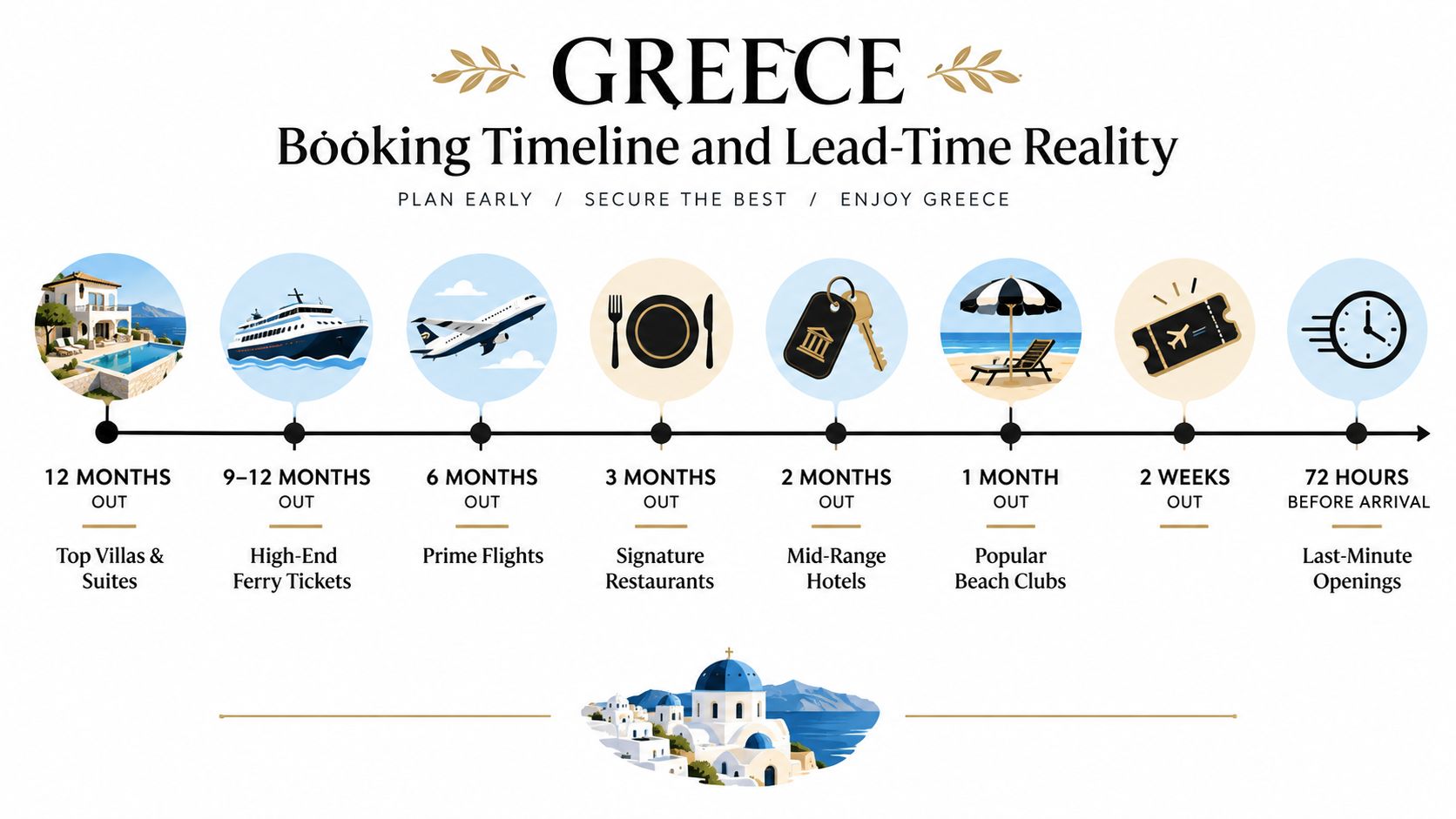
A serious Greece trip should start 9 to 12 months out if the travel window is peak summer and the brief includes top villas, marquee suites, or private yacht inventory. You are not just reserving lodging. You are protecting a chain of finite assets that all have to line up.
What to book and when
| Item | Ideal timing | Why it tightens early |
|---|---|---|
| Top villas and signature suites | 9 to 12 months out | Limited inventory and high repeat-client demand |
| Private yachts for prime summer weeks | By January for July travel | The strongest boats and crew calendars go first |
| Flights with ideal timings | Several months out | Cleaner schedules disappear before bargain seats do |
| Signature restaurants | 8 to 12 weeks out | The right tables vanish before the date itself feels close |
| Ferries, especially with vehicles or premium cabins | As soon as schedules open | The best inventory is not endless |
| Beach clubs and spa slots | Closer in, but not casually | Peak-day timing matters more than people think |
The EA checklist that saves the trip
Run these actions in sequence:
- At 30 days: confirm passports, names on tickets, transfer manifests, dietary handoff, and villa staffing notes.
- At 7 days: recheck ferry e-tickets, marina timing, weather-sensitive activities, and airport meet points.
- At 72 hours: reconfirm dining, beach setups, and any charter adjustments.
One more point. Popular summer ferry crossings to Santorini, Mykonos, Paros, and Naxos can sell out weeks ahead, and planning guidance recommends avoiding same-day onward flights after a ferry while keeping at least a 24-hour buffer before an international departure from Athens, according to this Greece ferry planning guide.
Where to Stay and What to Look For
In Greece, the room is never just the room. Your stay decision determines privacy, staff quality, dining flexibility, transport friction, and how much of the destination you feel.
Hotel versus villa is a management choice
Choose a flagship hotel when the client wants service consistency, easier dining access, and polished daily rhythm. This works well for couples, short stays, and travelers who value recognition and structured support.
Choose a private villa when the client wants space, control, and group flexibility. Villas usually outperform hotels for families, friend groups, and anyone who doesn't want to split across multiple room categories.
The mistake is assuming a villa is automatically more luxurious. Some are magnificent. Some are beautifully photographed houses with weak staff and no operational depth.
What to verify before paying
Use this checklist:
- Exclusivity: confirm whether the full property is private or if outdoor areas are effectively shared.
- Staffing reality: ask who is on call and at what hours.
- Infrastructure: verify generator backup and water reliability.
- Beach access: “private beach” language is often softer than it sounds.
- Concierge power: can the property secure boats and tables, or does it send recommendations?
- Arrival flow: find out how bags, vehicles, and check-in are handled in practice.
A gorgeous villa with weak logistics feels cheaper than it cost.
Recognition matters, but only when it's real
Chain and branded hotels can provide useful recognition when booked through the right channel. That may mean upgrades when available, priority for hold requests, or stronger pre-arrival note handling. An independent villa can match that standard, but only if the booking agency or local manager has enough authority to solve problems once you're in-country.
That is why I care less about the brochure and more about who answers the phone when the wind changes, the chef is delayed, or the client wants a different boat by noon.
Insider Access and Concierge Advantage
In Greece, the premium difference isn't the headline rate. It's the relationship behind it.
By 2025, tourist accommodation arrivals reached 38.2 million and overnight stays hit 156.3 million, while June 2026 alone recorded 5.58 million arrivals and 24.06 million overnight stays in tourist accommodation, according to GTP coverage of ELSTAT tourism accommodation data. In a market moving that much volume, the best room category in theory means little if no one can protect the rest of the trip.

What a serious fixer actually does
A credible on-the-ground operator can hold the trip together when inventory is tight or plans shift. That usually means:
- Table access: securing peak-night reservations that don't show online.
- Experience control: arranging cultural access, boat substitutions, or cleaner timing windows.
- Real-time rerouting: changing transport or day plans when closures, wind, or crowd density force a pivot.
Hotel concierge teams are useful, but they are loyal to one property first. Their influence often weakens once the request moves off-property or onto another island.
When to use a broader advisor network
For a single-island hotel stay, a strong hotel team may be enough. For a multi-stop Greece itinerary with villas, boats, and inter-island movement, broader coordination earns its margin quickly. One option in that category is HauteBlack's news page, where the company's Greece and Europe travel coverage appears alongside current luxury destination content and reflects an actively maintained editorial window into the kinds of trips and markets it plans around.
Two ways to vet credibility without handing over your full budget immediately:
- Ask for problem-solving examples: not glossy sample itineraries, but how they handle disruption.
- Test their reach with one hard request: a specific restaurant, vessel, or access window tells you more than a sales call does.
A concierge relationship should reduce decision fatigue, not create another layer of it.
HauteBlack plans Greece the way it should be planned now: around route logic, room access, transfer control, and the relationships that keep a crowded market feeling private. If you want a Greece itinerary that protects time instead of wasting it, visit HauteBlack and start with a trip architecture built for how the country works.
Explore Our Guides


Signature Experiences