Haute Black Journal
Gorilla Tours in Rwanda: Your 2026 Guide

Marlene Azeez
Director, HauteBlack
View all articles →

Published August 19, 2026 by Marlene Azeez
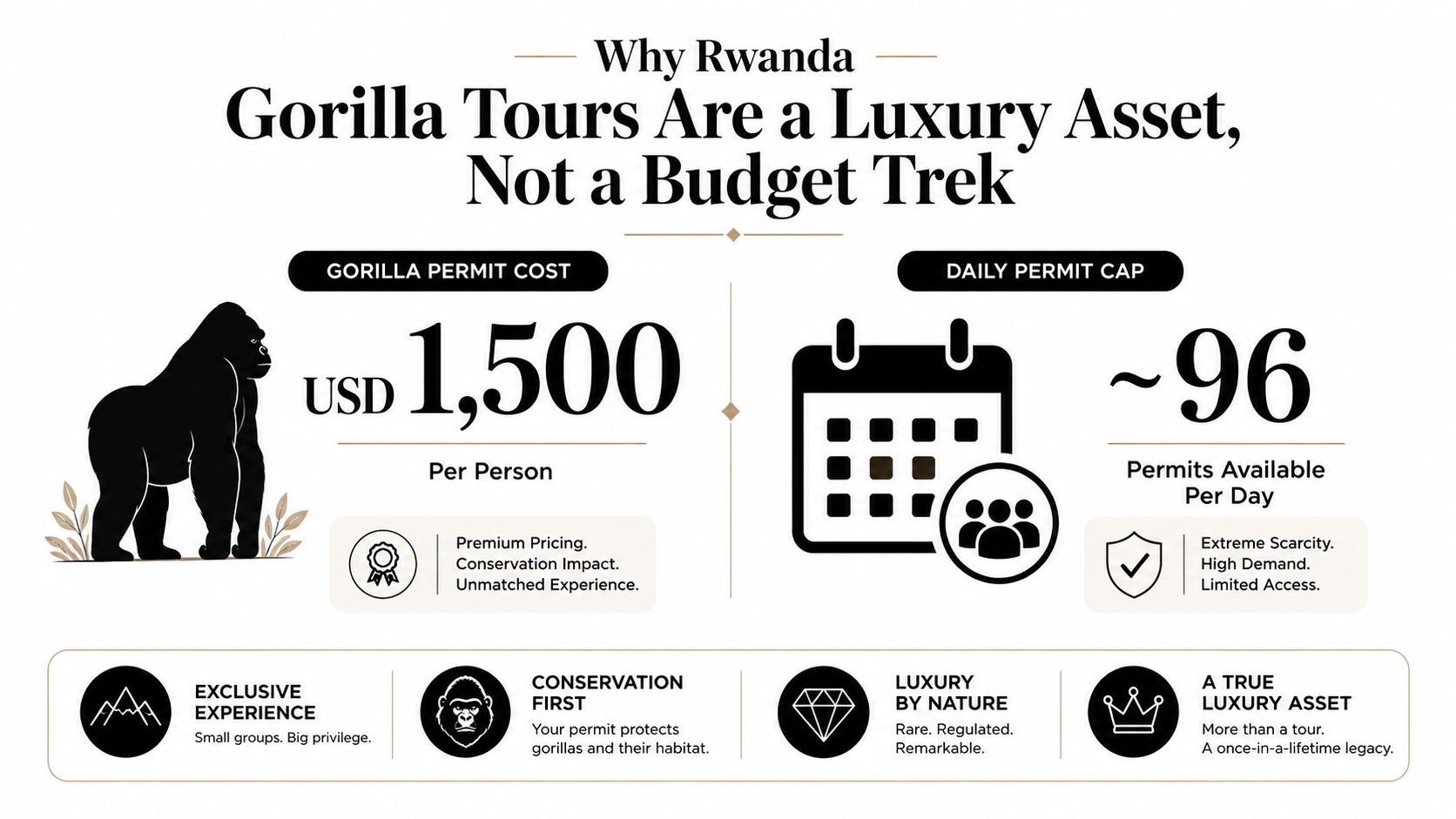
A Volcanoes National Park gorilla permit costs USD 1,500 per person, and only 96 permits are typically released per day, so timing and booking strategy matter more than hotel choice. Rwanda's gorilla tours justify that premium when you value low-friction access, tightly controlled encounters, and a polished itinerary rather than the lowest possible permit price.
That scarcity is the point. Rwanda has built gorilla trekking around limited access, conservation financing, and premium service, not spontaneous wildlife viewing. In 2019, gorilla tourism generated about US$107.3 million, approximately 21.5% of total tourism revenues, while gorilla permits contributed about US$24 million. The World Bank's Rwanda tourism assessment also records the shift from a broader tourism model toward high-value, low-volume travel.
For a honeymooner, executive, or family planning around school holidays, the permit is only the first decision. The work is coordinating availability, lodge location, transfers, pacing, and backup plans so the experience feels effortless.
Why Rwanda Gorilla Tours Are a Luxury Asset, Not a Budget Trek
The USD 1,500 permit and roughly 96-permit daily ceiling define Rwanda's product. You're not buying an ordinary park admission. You're buying a controlled place in a conservation-led operating system where access is deliberately restricted and every visitor is assigned within a managed framework.
Rwanda's government increased the permit price from US$750 to US$1,500 in 2017, and by 2018 the country had sold 15,132 mountain gorilla permits worth US$19.2 million, according to the World Bank tourism and conservation analysis. That pricing decision made the positioning clear. Rwanda would rather earn more from carefully managed visits than chase volume.
Scarcity changes the booking question
Open-access safaris let you spend the day searching across a broad area. Gorilla trekking works differently. You have a specific permit date, a designated habituated family, a regulated observation period, and a strict visitor limit. Groups are limited to 8 visitors per gorilla family per day, with a one-hour encounter window and a required distance of roughly 7 to 10 meters, as outlined in the Rwanda gorilla trekking regulations.
That structure makes access engineering more important than novelty. A strong luxury operator secures the right permit date, places you near the briefing point, assigns an appropriate vehicle and guide, and builds enough flexibility around the trek to protect the rest of your itinerary.
The US$1,500 permit is the floor, not the ceiling. Your actual experience depends on the lodge, vehicle privacy, porter support, transfer design, meals, guide quality, and whether you add helicopter or private aviation services. I recommend treating the permit like a scarce asset and the accommodation like the supporting infrastructure around it. The lodge should serve the trek, not distract from it. See why Haute Black for the kind of high-touch travel planning that prioritizes those details.
What the Trekking Day Looks Like
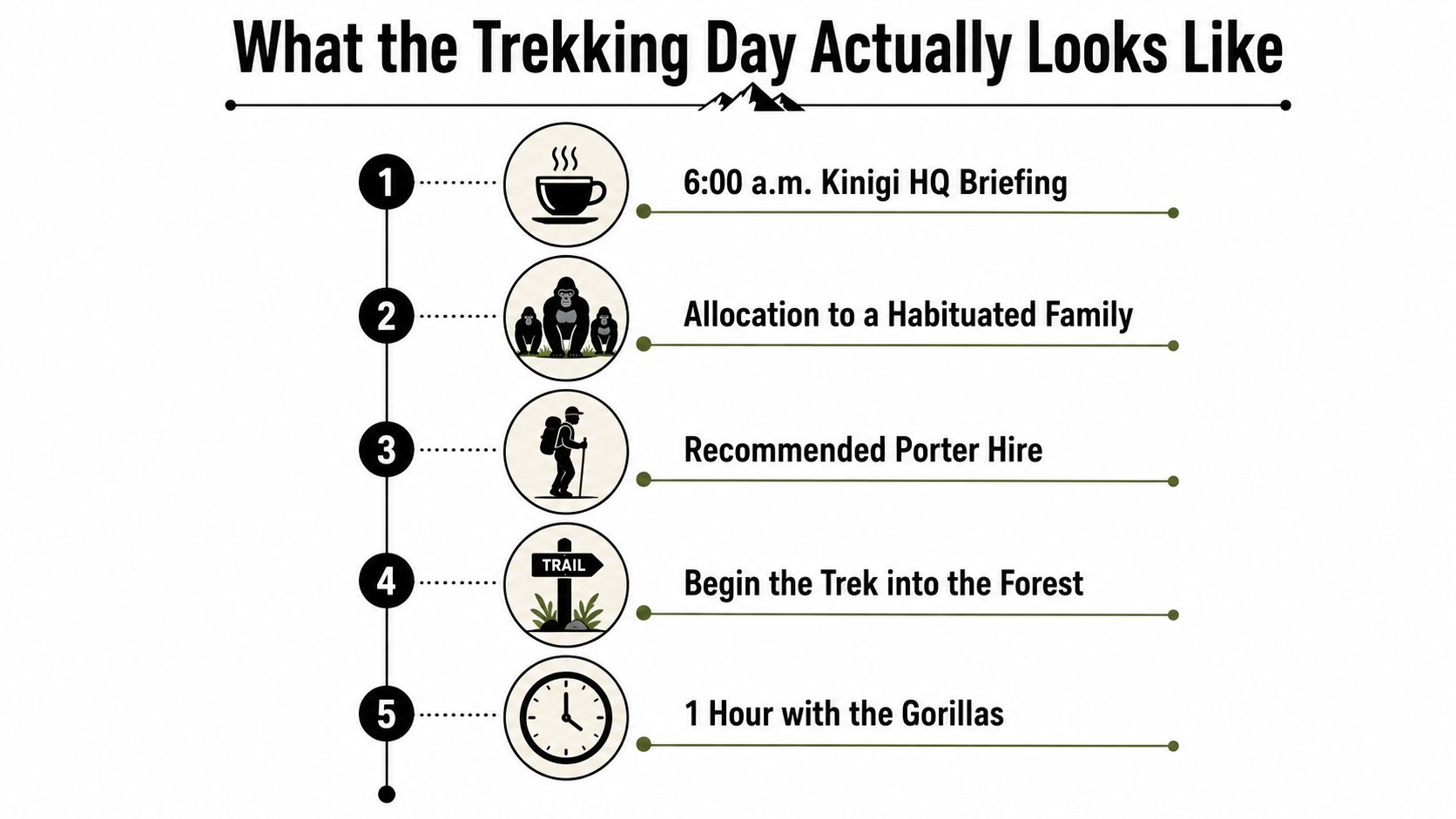
A well-run trekking day begins early. Arrive at Kinigi headquarters around 6:00 a.m. for the briefing, registration, and family allocation. The team explains park procedures, introduces the guides, and confirms which habituated gorilla family you will track.
The allocation shapes the day because each family moves through different terrain. Your guide can set expectations, but no reputable advisor should promise an effortless walk. The hike may last 30 minutes to 6 hours, crossing lava-plain edges, bamboo zones, and steep forest. Hire a porter even if you are fit. A porter carries your daypack, steadies you on difficult ground, and reduces physical strain without taking away from the experience.
What the encounter actually involves
Once trackers locate the family, you receive one hour to observe the gorillas. Keep roughly 7 to 10 meters away, avoid eating, drinking, or smoking nearby, and do not trek if you are ill. These rules limit disease transmission and behavioral stress, so treat them as operating requirements.
Photography rewards preparation more than expensive equipment. You may stand on uneven ground, work through foliage, and adjust to low or changing light. Bring a camera you can operate quickly, keep your movements calm, and follow the guide rather than pursuing a better angle. Patience produces stronger images than proximity.
The minimum trekker age is 15 years old, and fitness matters more than luxury marketing suggests. Wet trails become slick, while damp clothing adds weight. Drier conditions generally make walking and photography easier, although the forest remains unpredictable. After the descent, expect a certificate presentation and a transfer back to the lodge.
Reserve the rest of the day for recovery. A late lunch, massage, or quiet meal suits the trek far better than another demanding activity.
For a visual sense of the experience, watch this short field video before finalizing your expectations.
Permits, Pricing, and the Full Cost of a Luxury Trip
The USD 1,500 per person permit is only the first line of a Rwanda gorilla trip. Build the budget around access, then price the services that determine privacy, comfort, and control over the day.
The Volcanoes National Park fee guidance confirms the standard permit price and notes discounted categories for East African residents and Rwandan citizens. Permit revenue supports conservation work, including anti-poaching patrols, veterinary intervention, and ecological monitoring. The permit functions as both an access fee and a direct conservation contribution, which matters when comparing Rwanda's premium pricing with lower-cost alternatives.
Build the cost stack in the right order
1. Permit: Secure the date before confirming a romantic suite, family villa, or executive schedule. A beautiful room cannot compensate for an unavailable trek date.
2. Private transport: A private 4x4 gives you control over departure time, luggage, camera equipment, and post-trek pacing. Shared vehicles reduce flexibility, so they are the wrong place to economize on a short luxury itinerary.
3. Guide and porter support: A dedicated guide improves communication and pacing. Porter hire is a practical choice for altitude, wet trails, and travelers carrying camera equipment or day bags.
4. Lodge selection: Bisate Lodge, One&Only Gorilla's Nest, and Singita Kwitonda occupy different positions within the luxury market. Compare the room, drive time to briefing, privacy, dining rhythm, wellness facilities, and the lodge's ability to manage special diets or family logistics.
5. Aviation: Helicopter transfers and private charter services can reduce road time and protect a compressed schedule. They suit executives, honeymooners with limited leave, and travelers connecting Rwanda with another premium destination.
| Cost Component | Budget Tier | Luxury Tier | Notes |
|---|---|---|---|
| Gorilla permit | Standard access fee | Standard access fee | Secure the permit before building the rest of the itinerary. |
| Ground transport | Shared or scheduled transfer | Private 4x4 with dedicated driver | Private transport protects timing and comfort. |
| Guiding | Shared guiding structure | Dedicated guide and porter coordination | Useful for precise pacing and personal assistance. |
| Accommodation | Comfortable local lodge | Bisate Lodge, One&Only Gorilla's Nest, or Singita Kwitonda | Location and service matter as much as room design. |
| Air transfer | Road transfer | Helicopter or private charter option | Useful when the itinerary is time-sensitive. |
| Add-ons | Limited extras | Wellness, private dining, additional wildlife activities | Confirm inclusions before comparing proposals. |
I will not quote an all-in price band because lodge rates, charter availability, and room categories change by date. Request an itemized proposal showing the permit, room, vehicle, guide, porter, transfers, taxes, and cancellation terms. An advisor can substitute a lodge, adjust the vehicle plan, and manage the planning workload. The permit date remains the hard constraint.
Rwanda Versus Uganda for Affluent Travelers
Rwanda suits travelers who value time efficiency, road simplicity, and concentrated luxury lodging. Uganda suits travelers building a longer national safari, especially when a lower permit cost matters more than shorter transfers and a compact route.
The difference comes down to trip structure and priority. Rwanda supports a polished short-format journey from Kigali to Volcanoes National Park. Uganda's Bwindi and Mgahinga options fit better when gorilla trekking sits inside a wider country itinerary. The trek itself is only part of the decision. Each route shapes the time, energy, and accommodation choices available around it.
| Factor | Rwanda, Volcanoes | Uganda, Bwindi or Mgahinga |
|---|---|---|
| Arrival logic | Strong fit for a short Kigali-based itinerary | Better within a wider Uganda route |
| Access style | More concentrated park approach and luxury planning | Longer overland routing can be part of the adventure |
| Lodge choice | Strong concentration of premium properties near briefing areas | Lodge selection varies by sector and route |
| Permit strategy | Premium pricing with tightly managed availability | Lower permit positioning, but total logistics still matter |
| Best traveler profile | Honeymooners, executives, first-time luxury visitors | Travelers combining gorillas with a classic Uganda circuit |
Uganda's permit is USD 800. That gap is meaningful, but it does not determine the trip's real value on its own. Longer road movements, sector selection, lodge quality, and charter requirements can reduce the apparent saving. Compare the complete routing and service level, not the permit line alone.
Rwanda works best for a limited travel window, a high-touch lodge close to the park, or a pairing with Kigali, the Masai Mara, or the Seychelles. Uganda earns the recommendation when gorilla trekking is one chapter in a substantial Uganda journey and you accept more overland movement for a broader safari route. For honeymooners and executives, I would choose Rwanda. For travelers prioritizing a deeper Uganda circuit, I would choose Uganda.
When to Go for the Best Weather, Sightings, and Privacy
Your travel window sets the balance between trail conditions, photography, demand, and privacy. June and September are my first choices for ultra-high-net-worth travelers. They typically offer manageable trails and useful photography conditions, and I would reserve them earliest for a honeymoon or executive schedule.
Three practical travel windows
- Dry season, mid-December to February and June to September: Choose these months for more predictable trails and photography. Demand is higher, so coordinate the permit and preferred lodge early.
- Shoulder months, March, October, and November: These dates can feel quieter and provide softer light, with a greater chance of rain. They suit travelers who value privacy and can accept a less predictable walking day.
- Green season, April and May: Lush vegetation and softer lodge pricing appeal to flexible travelers. Expect muddy trails, and pair these dates with a strong lodge program and a realistic pace.
For June through September, book 12 to 18 months ahead. For shoulder-season travel, allow 4 to 6 months. These are planning recommendations, not guarantees, and permit inventory can change quickly. Rwanda's official guidance recommends advance booking through the Irembo government platform.
Privacy requires more than choosing a rainy month
A quieter calendar does not guarantee a private encounter. Family allocation, lodge position, guide quality, and willingness to travel outside popular dates all shape the day. Treat privacy as a planning priority, not a weather benefit.
Secure the permit first. Then build the accommodation and transfer plan around it. For honeymooners, I would prioritize June or September and a lodge close to the briefing area. For executives with fixed calendars, shoulder months can work, provided the itinerary allows for rain and slower trail conditions.
Packing, Health, and the Park's Operating Rules
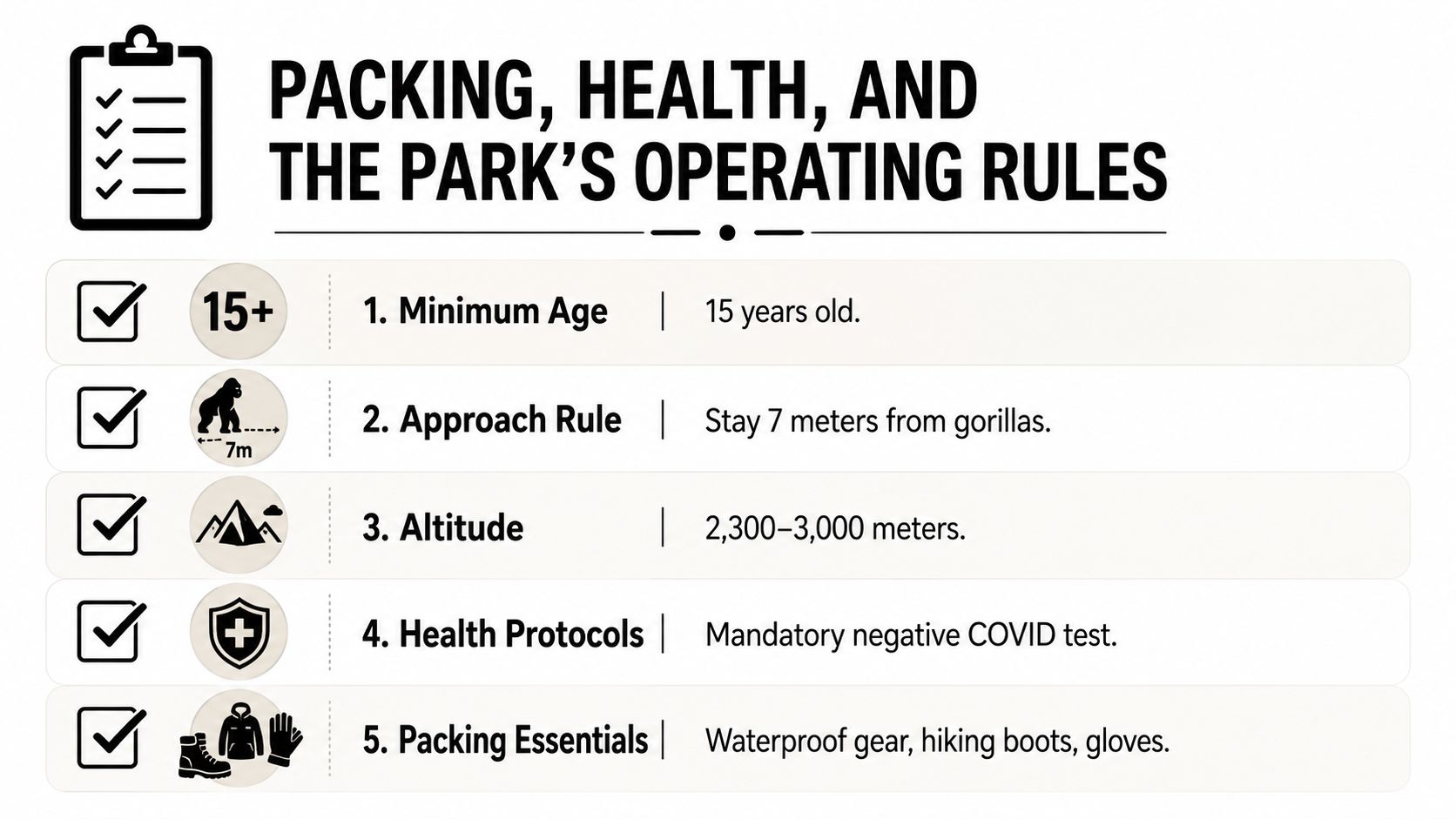
Gorilla trekking rewards practical preparation. The park limits visitors to 8 per gorilla family per day, requires trekkers to be at least 15 years old, and expects visitors to maintain roughly 7 to 10 meters from the gorillas. Visitors must also avoid eating, drinking, smoking, or entering the trek while ill, as detailed in the park's visitor operating guidance.
Pack for vegetation and changing ground
Wear waterproof hiking boots with ankle support, layered clothing, and a waterproof shell. Add gloves for nettles and rough vegetation, gaiters for wet grass and mud, and a compact daypack with a rain cover. Keep camera equipment protected and carry only what you'll use, because unnecessary weight becomes irritating on a long climb.
The park's operating rules matter more than polished lodge surroundings. Don't rely on a high-end hotel to compensate for poor footwear or an unsuitable jacket. Your guide can help with pacing, but you need to arrive ready for uneven, damp terrain.
Handle health planning early
Discuss vaccinations, malaria prevention, altitude, and travel insurance with a qualified medical professional before departure. Confirm the current entry and health requirements with your airline, Rwanda's official authorities, and your advisor because protocols can change.
For families transferring through airports, also confirm the vehicle's child restraint arrangements before arrival. Guidance on child seat legal requirements for airport cars is a useful reference when organizing transfers for younger travelers, even though the gorilla trek itself has a minimum age requirement.
Sample Luxury Itineraries for Honeymoons, Families, and Executives
A Rwanda luxury itinerary starts with the gorilla permit date, not the hotel. The permit controls the trip's fixed point, while the surrounding schedule should protect rest, weather flexibility, and experiences beyond Volcanoes National Park. That capacity-managed structure is what gives the journey its value. You are paying for access to a tightly controlled encounter, then building the logistics around it.
Honeymoon architecture
A 7-night Kigali and Volcanoes itinerary gives couples time for romance without compressing every day. Start in Kigali, continue to Bisate Lodge, and pair a private gorilla permit slot with a couples' golden monkey experience. Ask the lodge to arrange private dining, spa time, and a recovery afternoon after the trek.
Keep the day after the gorilla encounter deliberately light. Couples should have time to return, shower, eat, and enjoy the property before another transfer or scheduled activity. That buffer matters more than adding one more excursion.
Multi-generational family design
Families need a broader route and stronger operational planning. Add a Nyungwe Forest extension, use a private vehicle for the journey toward Volcanoes, and secure two gorilla permits so adults and eligible children can be coordinated thoughtfully. Keep chimpanzee tracking available as a flexible alternative if weather or family energy changes.
Connecting rooms are only one part of the arrangement. Confirm meal timing, luggage handling, vehicle capacity, walking support, and the age eligibility of every participant. Protect grandparents with sensible pacing, while giving younger travelers enough independence and variety to keep the trip enjoyable.
Executive express
An executive schedule can work in 4 nights with 3 compressed days, provided the aviation plan is secured early. Use a Kigali helicopter transfer to Volcanoes, schedule one gorilla permit, and place the traveler at Bisate or One&Only Gorilla's Nest on the night before departure.
For a short business trip, helicopter timing can justify its cost by protecting working hours and reducing road exposure. For a longer stay, a private 4x4 remains the more flexible choice. For a broader view of how to structure bespoke luxury journeys in Rwanda, the destination works best when the permit, lodge, and aviation plan are treated as one booking.
| Itinerary | Duration | Lodging | Permits | Cost Band (USD) | Best For |
|---|---|---|---|---|---|
| Honeymoon | 7 nights | Kigali hotel and Bisate Lodge | Private gorilla permit slot and golden monkey activity | Quote by travel date and room category | Couples seeking romance and depth |
| Multi-generational family | Flexible extended journey | Kigali, Nyungwe, and Volcanoes properties | Two gorilla permits with chimpanzee backup | Quote by family size and vehicle plan | Families balancing comfort and flexibility |
| Executive express | 4 nights | Bisate or One&Only Gorilla's Nest | One gorilla permit | Quote by helicopter and schedule | Time-sensitive executives |
Rwanda also pairs naturally with the Masai Mara or the Seychelles through Kigali. Fix the gorilla permit date first, then use private aviation and buffered connections to reduce the risk of turning a short luxury journey into airport delays.
Logistics, Charters, and How Haute Black Books the Trip
The operational plan determines whether Rwanda gorilla tours feel smooth. Kigali International Airport is a practical East African gateway for arrivals from London, Doha, Dubai, and Brussels, giving advisors a clean starting point for a Volcanoes itinerary.
Helicopter transfers from Kigali to Volcanoes suit executives whose calendars cannot absorb a long road transfer. The service protects working hours and reduces road exposure. For longer stays, a chauffeured 4x4 is the better choice because it offers luggage space, flexibility, and an easier transition into the mountains. I recommend the helicopter for schedule control, not for appearance.
The booking sequence protects the trip
A disciplined advisor books in this order:
- Permit hold: Secure the preferred trekking date first, particularly for peak June through September and December travel.
- Lodge confirmation: Match the room and property to that date, allowing for briefing access and recovery time.
- Charter planning: Confirm helicopter or private aviation availability around the fixed trekking schedule.
- Final manifest: Recheck names, passport details, dietary requirements, health documentation, vehicle needs, and transfer timing before departure.
Insurance should address medical assistance and trip interruption. Confirm yellow fever certificate requirements, visa procedures, and passport validity with the relevant authorities before travel. US, UK, and Schengen passport holders should verify the current visa-on-arrival process instead of relying on an old itinerary file.
Service recovery separates a carefully managed trip from a merely expensive one. Request early check-in where possible, room upgrades when available, resort benefits, a private briefing arrangement, and one named contact for the journey. These measures cannot influence the gorilla family's behavior, but they can keep delays and changes from disrupting the rest of the itinerary.
Clients extending private aviation beyond the Volcanoes transfer can include Haute Jets in the routing plan. Secure the scarce permit first, position the traveler close to the trekking area, and build every movement around that fixed date.
Haute Black designs bespoke Rwanda gorilla journeys around permit availability, private transfers, preferred luxury lodges, and each traveler's priorities, whether a honeymoon, family expedition, or executive escape. Visit Haute Black to begin planning a Rwanda itinerary where access, timing, and service receive the same attention as the destination itself.
Frequently Asked Questions
Explore Our Guides
Signature Experiences