Haute Black Journal
Golfing Trips to Scotland: Unforgettable Luxury in 2026

Marlene Azeez
Director, HauteBlack
View all articles →

# Golfing Trips to Scotland: Unforgettable Luxury in 2026
July 22, 2026
You've already made the first smart move. You're not looking for a generic golf holiday, you're trying to build a Scotland trip that works for a demanding group, with elite golf, proper hotels, real food, and enough non-golf depth to keep everyone engaged. That's the difference between a good trip and a trip people talk about for years.
Scotland rewards travelers who plan with intent. The iconic fairways are famous for a reason, but the best golfing trips to Scotland are won or lost on routing, lead times, and how intelligently you layer the rest of the journey around the golf. Get those decisions right, and Scotland becomes far more than a bucket-list round. It becomes the standard by which you judge every future golf escape.
The Allure of Scotland for Luxury Golfers
The moment matters. A private jet lands, the doors open, and you step into air that feels cooler, saltier, and somehow older than the rest of Europe. By the time you're rolling toward dew-drenched fairways, the trip already has a different energy, because Scotland doesn't sell golf as a commodity. It sells provenance, weather, ritual, and access.
That's why affluent golfers keep coming back. The draw isn't just the quality of the courses, it's the fact that the setting feels irreplaceable. St Andrews carries the weight of history. The Highlands deliver scale and silence. Even the transfer days feel like part of the experience when the route is planned properly.
Why Scotland still beats the obvious alternatives
Most destinations can give you one thing well. Scotland gives you several at once, if you know how to stitch them together. You can play world-famous links in the morning, have a serious whisky lunch, check into a proper country house by late afternoon, and finish with a dining room that deserves the booking.
That combination is why Scotland remains the benchmark for luxury golf. It's not because every moment is easy. It isn't. It's because the friction is part of the appeal, and the right advisor can remove that friction without diluting the trip. The result is a journey that feels exclusive without feeling staged.
Practical rule: in Scotland, prestige alone is never enough. If the routing is weak, the trip will feel disjointed, no matter how famous the courses are.
What a high-end Scotland trip should include
A serious itinerary should do more than tick off famous tees. It should link course access, regional logic, and non-golf luxury into one coherent move. That means pairing golf with castles, spa time, private dining, and at least one stretch where non-golfers feel just as looked after as the players.
For UHNW travelers, that balance is everything. Couples don't want a golf-only tour. Multigenerational groups don't want everyone separated into separate experiences. The best golfing trips to Scotland solve that problem by giving the golfers a first-rate schedule while the others enjoy equally polished alternatives.
That's the lens for the rest of this guide. Use it to think less about isolated courses and more about how the whole trip feels in motion.
Understanding Scottish Golf Tourism Trends
The numbers explain why Scotland's golf market behaves the way it does. The 2016 Scotland Golf Visitor Survey estimated golf tourism and events at £286 million per year, supporting 4,700 jobs and generating £154 million in GVA (Scottish Enterprise). That is not niche leisure. That is a serious tourism engine built around premium, multi-day travel.
The survey also showed a 30% increase, or £66 million growth, versus the 2009 baseline of £220 million (Scottish Enterprise). That growth matters because it tells you the market has matured. Golf visitors are not just arriving for one round and leaving. They're staying longer, spending more, and expecting a more polished experience around the course.
Who is coming, and how long they stay
The survey found that 47% of Scotland's golfing visitors came from overseas, with North America accounting for 30% of all overnight golfing visitors and Europe 14% (Scottish Enterprise). That visitor mix tells you where the demand pressure comes from. The most coveted tee times are being chased by international travelers who often build Scotland into a once-in-a-lifetime trip.
Average stay length is just as revealing. Overnight golfing visitors stayed 6.79 nights on average, while overseas visitors stayed 10.21 nights (Scottish Enterprise). Those aren't throwaway weekend numbers. They support itineraries that move thoughtfully across regions, with time for non-golf experiences, recovery, and weather buffers.
Scotland works best as a multi-night luxury circuit, not a point-to-point tee-time hunt.
Why this matters for bespoke planning
If you're designing a premium golf trip, you should treat that longer-stay pattern as a signal, not just a statistic. It tells you that Scotland is best approached as a layered travel product. You can combine St Andrews with the Highlands and Edinburgh, but only if you avoid dead time and respect the geography.
It also explains why affluent travelers should stop thinking in terms of "how many courses can we fit in?" The smarter question is, "How do we make each night matter?" That's where private dining, spa appointments, distillery access, and heritage stays become part of the golf strategy rather than decorative extras.
For luxury travelers, Scotland's scale is the opportunity. The longer the trip, the easier it becomes to absorb the country properly. The mistake is trying to compress it.
Choosing Regions and Championship Courses
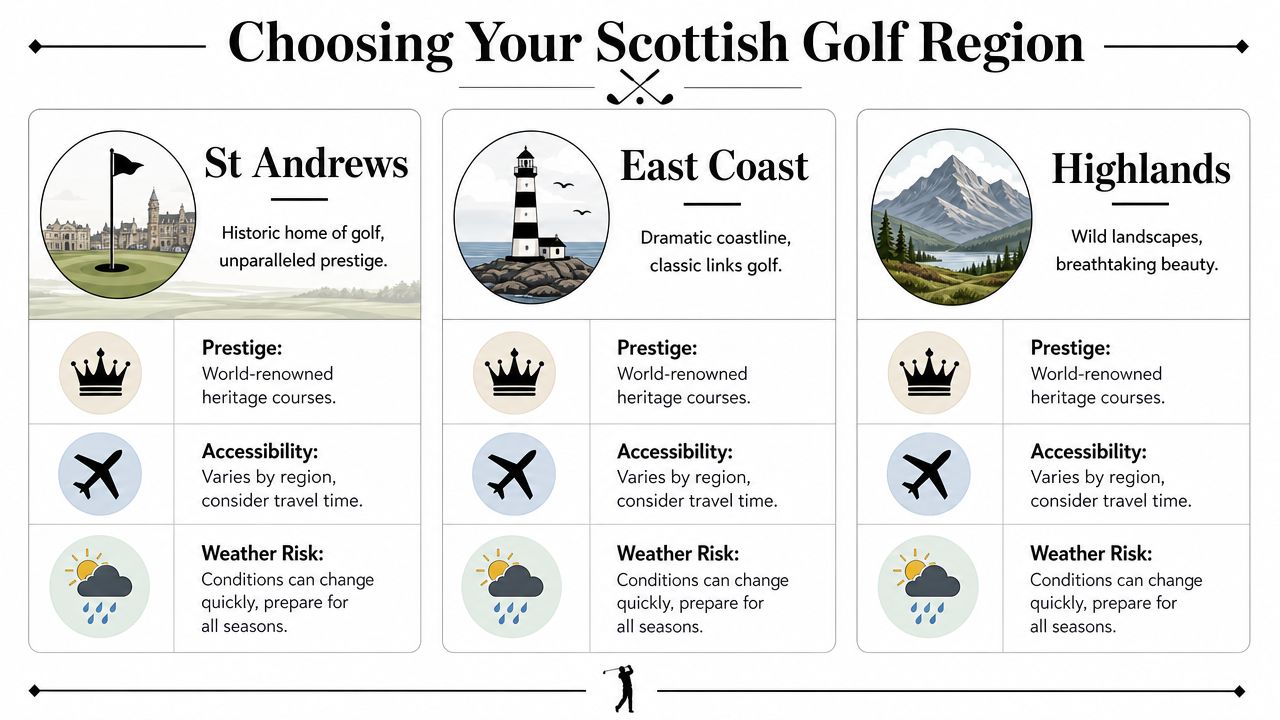
The right region depends on what you're protecting most, prestige, convenience, or flexibility. If the trip is built around one signature round, St Andrews is still the anchor. If you want a more varied and usually more forgiving base, the East Coast gives you strong links options with better routing logic. If you want atmosphere, scale, and fewer crowds, the Highlands are the better play.
St Andrews, when the trip has to feel definitive
St Andrews is the one most clients fixate on first, and for good reason. It has unmatched golf heritage and the kind of cultural gravity that makes the trip feel complete. But it is also the least forgiving place to build around if you are late to the game, because demand for iconic tee times is so constrained that bookings often require 12 to 18 months lead time, especially at St Andrews and championship coastal links.
That scarcity changes the whole planning game. If you want the Old Course, treat it as the trip's center of gravity and build everything else around it. Don't tack it on as an afterthought. The region works best when the rest of the itinerary supports the emotional lift of being there.
East Coast, when routing and access matter
The East Coast is the practical counterweight. You still get serious golf, but the region is easier to move through and easier to pair with luxury hotels, restaurants, and private transfers. For travelers who want a clean blend of golf and broader Scotland without overcommitting to a single marquee tee time, this is the smartest backbone.
It's also the region I'd choose when the group has mixed expectations. Serious players get quality golf. Non-golfers get a less punishing travel rhythm. That matters more than often recognized.
Highlands, when you want drama and breathing room
The Highlands are for clients who care about setting as much as scorecard. You're dealing with more open space, bigger vistas, and a stronger sense of escape. That makes them ideal for a trip that includes castles, whisky, and countryside stays.
The trade-off is weather volatility and more complex transfers. That's not a reason to avoid the region. It's a reason to respect it. Build the itinerary with more margin, and the Highlands become a gift instead of a headache.
If your group is mixed, put the most committed golfers in the most famous region, then use the Highlands for the restorative part of the trip.
Crafting Multi-Day Luxury Itineraries
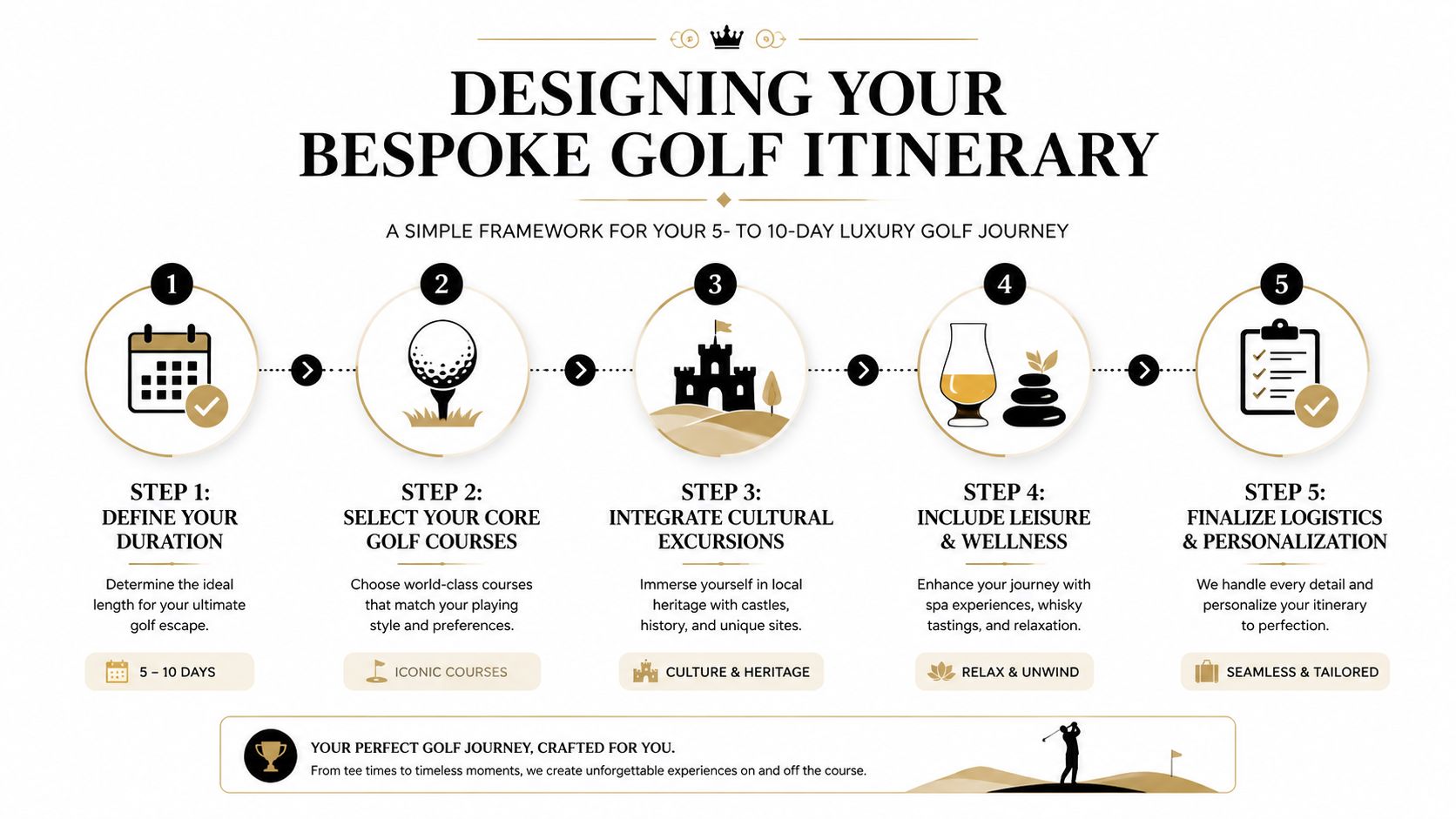
A good Scotland golf itinerary is built like a private residence, not a hotel corridor. You want flow, privacy, and rooms that serve different moods. Start by deciding whether the trip is a 5-day sprint, a 7-day balanced journey, or a 10-day full circuit. That single decision determines whether the itinerary feels spacious or overcrowded.
Build the trip around one anchor, not six headline names
The biggest mistake is overfilling the schedule with famous courses just because they're available on paper. Pick one anchor region, then add the rest only if the transfers make sense. A 7-day trip might use St Andrews as the opening statement, then move north toward Aberdeen and the Highlands, with a buffer day built in for weather or rest.
The point is not to cram. The point is to make every day feel deliberate.
Keep the non-golfers genuinely engaged
Most guides under-serve families and non-golfers. That's a mistake. A proper trip should use castle stays, Michelin-starred dinners, and whisky experiences to satisfy everyone in the party, not just the golfers. If you do that well, the non-golfers stop feeling like they're waiting around and start feeling like they're on a parallel luxury itinerary.
You can also use technology to tighten the process. For travelers who want faster itinerary mockups and smarter calendar handling, AI-powered trip planning can be a useful first-pass tool before a human advisor refines the route and final reservations.
Finalize the details that make the trip feel finished
The last step is often underestimated. Lock transfer timing, dining windows, caddie arrangements, and backup indoor plans. Then make sure the golf days are spaced so the group doesn't feel rushed.
The best bespoke golf trips feel calm on the surface because someone else solved the friction before the client ever arrived.
Private Villas and Five-Star Hotel Partnerships
If you're traveling with a spouse, children, friends, or a private entourage, villas often outperform standard hotel inventory. You get more control, more privacy, and usually a better recovery environment after long golf days. The right estate also makes a golf trip feel like a house party with a professional support team attached.
That matters because luxury golf travel is rarely just about sleeping well. It's about having room for private breakfasts, club storage, bespoke dinners, and late-night debriefs without feeling compressed. A villa with a private chef, chauffeur access, and spa therapists on call can do things a hotel sometimes can't, even when the hotel is excellent.
Why preferred hotel brands still matter
The right five-star partner changes the mood of the whole trip. Four Seasons, Aman, Rosewood, Belmond, and Ritz-Carlton all understand the value of discretion, and the best properties know how to translate that into golf travel. Think complimentary upgrades when available, resort credits, better room placement, and introductions to caddies or local golf staff who can smooth over small but important details.
That kind of recognition is what separates polished travel from generic luxury. You're not buying a bed. You're buying smoother access, better timing, and a staff that understands exactly why your group is there.
Pair the property to the route
Use hotels strategically. A heritage property near St Andrews works well when the trip needs formal polish. A retreat-style property in the Highlands is better when the itinerary leans into rest and scenery. If the schedule includes couples who care more about dining and spa time than scorecards, the hotel choice matters as much as the golf list.
Villa stays are best when the group is large enough to value separation and shared space at the same time. That's where a private chef, a dedicated driver, and a strong housekeeping team become part of the experience instead of background convenience. In a good villa, the days start on your terms, not the property's.
What the best setups feel like in practice
In strong trip design, the accommodation doesn't sit outside the golf. It supports it. Breakfast is timed around tee times. The driver knows when to wait and when to return. The chef can pivot from a formal dinner to a casual post-round meal without drama.
The little surprises matter, too. An exclusive clubhouse reception. A private tasting after a round. A room that's been upgraded before arrival. Those touches don't happen by accident. They happen because someone with the right relationships built the booking carefully.
For a closer look at how villa placement can shape a golf itinerary, see Haute Black's private villas service.
Travel Logistics and VIP Concierge Services
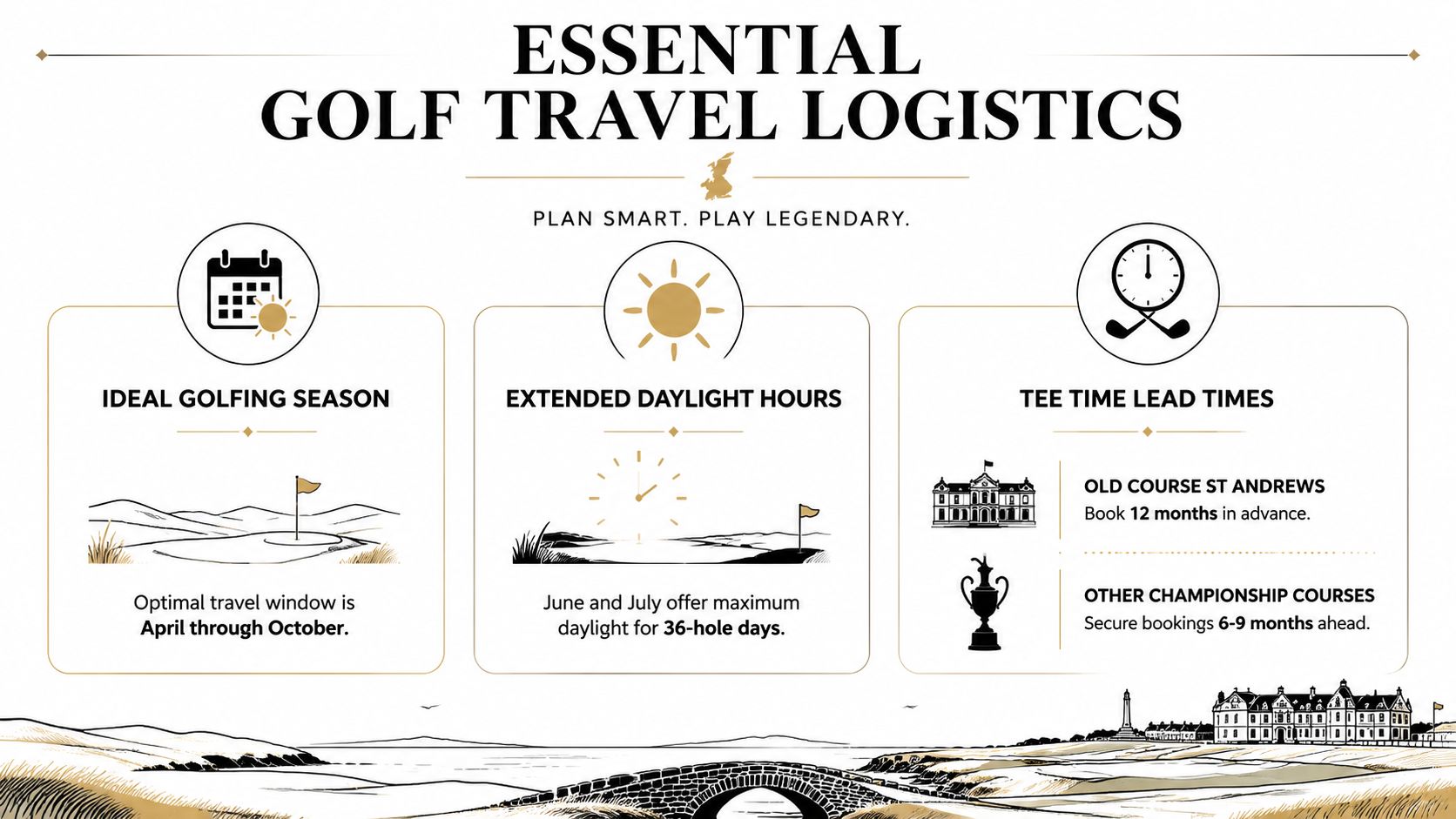
Scotland is easiest to enjoy when you respect its calendar. The main season runs roughly April through October, with May through September as peak, according to Scottish tourism guidance (Scotland Tourism). June and July bring the long daylight that makes 36-hole days realistic, and near midsummer the Highlands can stay light until past 10pm (Scotland Tourism). That flexibility is useful, but it also demands discipline in how you stack your days.
Book the golf before you book the fantasy
If the tee sheet is the trip's spine, then everything else has to fit around it. At iconic venues, especially St Andrews and championship links, the lead time can be brutally long. Don't design a luxury itinerary around "we'll see what's available" and expect a polished result.
Treat private aviation, helicopters, and chauffeured transfers as tools, not trophies. They matter because they reduce wasted time and protect the group from fatigue. If you're moving between regions, those transfer choices often determine whether the trip feels elegant or exhausting.
Build weather into the plan, not around it
Scotland's Atlantic-facing climate means you need contingency planning from day one. Keep one flexible day in reserve if the trip includes bucket-list golf, and avoid overstuffing the final 48 hours. If a storm pushes a round off schedule, the best response is usually to shift the day's emphasis rather than force a bad experience.
That's where caddie concierge support earns its keep. A good caddie doesn't just read the wind. They help the day stay calm when conditions change. In premium golf travel, that calm has value.
Use a concierge to manage the moving parts
The most efficient booking flow is simple. Secure the courses first, then the accommodations, then the transfers, then the extras. Once the skeleton is locked, a concierge can layer in distillery visits, private dining, and helicopter hops without jeopardizing the golf.
For travelers who want a more complete service map, Haute Black's guide to luxury travel concierge services is a useful reference point for understanding how the logistics side gets handled at a higher level.
Bottom line: Scotland rewards precision. If the transfers, tee times, and weather buffers are sloppy, the trip will feel harder than it needs to.
Don't cheap out on the final mile
The last stretch of a premium golf journey is where detail shows. A smooth airport transfer, a vetted driver, the right timing for bag handling, and a backup plan for a delayed round all matter. Green fee negotiations are best conducted early and with discretion, but the ultimate luxury is consistency. The traveler should never feel the stitching.
Packing Etiquette and Budgeting for UHNW Travelers
Pack like someone who respects the course and the climate. Scotland punishes vanity and rewards preparation. Bring bespoke golf attire, weatherproof layers, shoes you've already broken in, and a spare glove strategy. If you track performance, carry the tech you regularly use, not a pile of gadgets you'll ignore.
For a useful baseline on what belongs in the wardrobe, the essential golf apparel guide is a practical starting point, especially if you're updating what your group considers acceptable on and off the course. Then add custom club insurance and a travel setup that protects shafts, heads, and luggage from being treated roughly in transit.
Etiquette still matters in Scotland
Links clubs tend to be welcoming, but they're not casual playgrounds. Dress codes are real, clubhouse behavior is expected, and caddie relationships should be handled with respect. If you're unsure, err on the side of understatement rather than trying to show off.
Tipping standards can vary by club and service level, so don't improvise in a way that makes the staff uncomfortable. The smoothest move is to have your advisor or driver address local customs discreetly in advance. That keeps the trip elegant.
Budget for the whole experience, not just golf
A serious Scotland trip includes green fees, five-star lodging, private transfers, dining, and non-golf experiences. If you're traveling with multiple couples or a family group, agree on the cost structure before departure. That avoids awkwardness later, especially when some guests care more about spa time or private dining than golf access.
Good budgeting protects the mood. It keeps the trip discreet, clean, and free from the petty frictions that ruin high-end group travel.
If the group wants a polished luggage strategy, Haute Black's best luxury luggage brands expert guide is a smart companion read. It helps narrow down the bags that are built to survive this kind of itinerary.
The smartest UHNW travelers don't overcomplicate the packing list or the payment structure. They make both simple, then let the itinerary carry the luxury.
Making Your Scotland Golf Trip a Reality
The best golfing trips to Scotland are built early, not improvised late. The tee times are scarce, the routing matters, and the difference between a decent trip and a great one usually comes down to who handled the details before you arrived. If you want the right mix of golf, culture, and privacy, you need someone who knows how to assemble it properly.
That means moving now, not later. The finest accommodations, the best courses, and the smoothest transfers all get harder to secure as the calendar fills. If you want Scotland done correctly, start with a dedicated advisor who can shape the trip around your group instead of forcing your group around the trip.
Explore Our Guides


Signature Experiences


