Haute Black Journal
Best Luxury Luggage Brands: An Expert Guide for 2026

Marlene Azeez
Director, HauteBlack
View all articles →

# Best Luxury Luggage Brands: An Expert Guide for 2026
June 20, 2026
You're probably making this decision at the wrong moment. Not in a showroom with champagne and polished lighting, but between trips, with a calendar that already has Zurich, Milan, and Gstaad stacked too close together. Your assistant wants the luggage choice finalized. You want one answer that won't waste your time.
That's the right mindset.
Most coverage of the best luxury luggage brands is built like fashion commentary. It focuses on logos, celebrity association, and vague language about craftsmanship. That's not how experienced travelers buy. They buy the way they buy a watch for daily wear or a car for long-distance driving. They ask what performs, what lasts, what can be repaired, and what message the object sends before they've said a word.
The choice isn't merely hard shell versus soft shell, or aluminum versus leather. It's whether you want heritage status or quiet luxury, and whether that choice matches the journey. A visible Louis Vuitton case says one thing arriving at a resort in St. Barts. A restrained Tumi carry-on says something else walking into a board meeting in Zurich. Neither is automatically better. One is more appropriate for the setting.
Your Luggage is Not an Accessory It Is Equipment
A traveler flies out for a compressed week: meetings in London, a dinner in Paris, a final stop in Geneva. There's no room for a faulty wheel, a handle with too much play, or a shell that looks destroyed after one transfer. If the luggage fails, the trip gets noisier than it should. Delays compound. Clothing arrives creased. Transfers become irritating. The whole point of premium travel is lost.
That's why serious travelers stop treating luggage as an indulgence and start treating it as equipment.

What high-end travelers actually buy
They're not buying a suitcase. They're buying friction reduction.
A good luxury case moves cleanly through terminals, fits where it's supposed to fit, protects what matters, and still looks intentional on the tenth trip. It also sends a signal. Sometimes that signal is legacy and visibility. Sometimes it's control and discretion. Either way, the choice is strategic.
Luggage earns its place the same way any other premium object does. It performs under pressure, then disappears into the background.
The best pieces do exactly that. They don't ask for forgiveness at the gate. They don't wobble through hotel corridors. They don't look impressive on day one and tired by season's end.
The signal matters
Luxury luggage sits in a rare category where heritage still carries real weight. Louis Vuitton began as a luggage maker in 1854, and contemporary editorial rankings place Louis Vuitton at #2 and Rimowa at #1. That ranking tells you something important. In this market, history still persuades buyers.
But prestige isn't the only valid criterion. If you travel constantly, discretion often beats recognition. The smartest buyers choose luggage the same way they choose a hotel entrance. Not the loudest one. The one that works best for the arrival.
The Unseen Hallmarks of Investment Grade Luggage
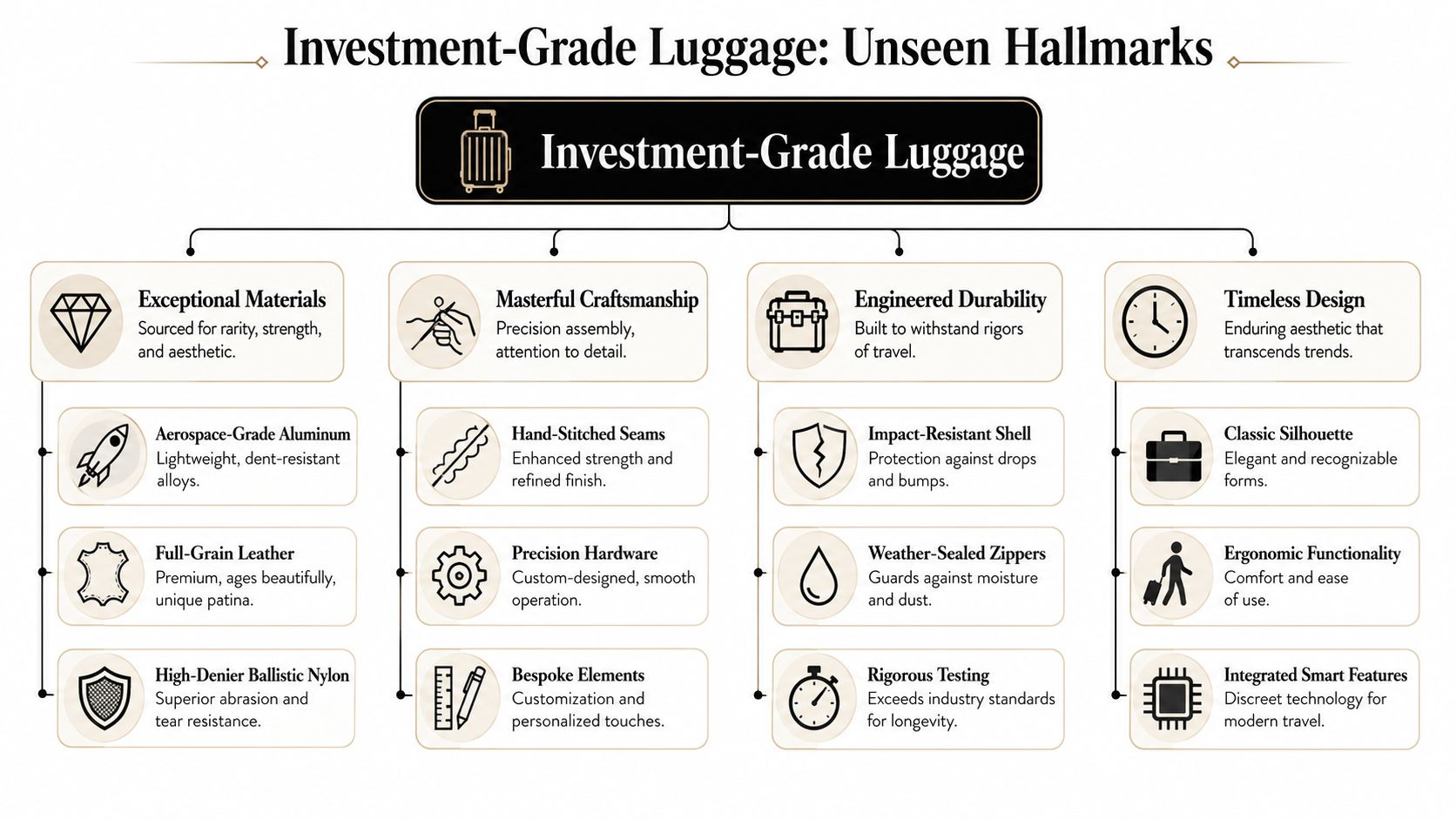
Expensive luggage isn't automatically good luggage. Plenty of premium-priced cases are just polished mediocrity with luxury branding attached. Investment-grade luggage is different. It's designed for years of repeated use, serviceability, and structural performance.
Investment-grade luggage is luggage built around material integrity, structural discipline, repairability, and design that stays relevant longer than the trend cycle.
Materials first, always
For luxury luggage, shell material and frame design are the primary engineering variables that determine real-world durability. Independent luggage guidance consistently emphasizes premium polycarbonate, aluminum, and full-grain leather because these materials better resist cracking, denting, and abrasion than lower-grade plastics and fabrics, as noted in this durability-focused luxury luggage guide.
That distinction matters more than marketing copy. Polycarbonate gives you resilience with less visual drama. Aluminum gives you rigidity, presence, and a surface that can be repaired and lived with, though it usually asks you to accept more weight. Full-grain leather is compelling in the right format, especially for shorter trips and controlled travel environments, but it's a choice for owners who appreciate patina and understand maintenance.
Construction is where brands separate themselves
A shell can look impressive and still be poorly engineered. What matters is how the whole case works together.
Look at these details:
- Frame architecture: A strong frame keeps the case from twisting when it's overpacked or mishandled.
- Handle stability: Loose telescoping handles are a sign of mediocre tolerances.
- Hinges and locks: Premium luggage should open and close with confidence, not with flex or misalignment.
- Wheel assemblies: Smooth movement is not cosmetic. It changes the entire experience of moving through an airport.
Ownership should improve over time
The best luxury luggage brands also understand that ownership doesn't end at checkout. Service matters. Repair access matters. Replacement parts matter. If a brand sells a case that can't be sensibly serviced, it's selling theater, not value.
A useful way to evaluate a brand is to ignore the finish for a moment and ask a blunt question: if this case gets damaged in transit, will the company help me restore it, or will it encourage me to buy another one?
| What to evaluate | Why it matters |
|---|---|
| Material choice | Determines resistance to dents, cracks, and abrasion |
| Frame and hardware | Dictates long-term structural reliability |
| Wheels and handle | Affects daily ease more than any branding element |
| Repair ecosystem | Protects the investment after inevitable wear |
Heritage Icons Rimowa and Louis Vuitton
Choose these brands when recognition serves the trip.
A board meeting in Zurich calls for restraint. A villa arrival on Lake Como, an art fair in Basel, or a yacht transfer in Antibes rewards a different signal. In that setting, Rimowa and Louis Vuitton make sense because they are legible at a glance. One speaks in modern industrial codes. The other carries the authority of old-world travel culture.
The core choice is not just aluminum versus canvas. It is quiet luxury versus heritage status, and whether the journey benefits from being understated or unmistakable.
Rimowa for visible modernity
Rimowa remains the sharper choice for travelers who want prestige without ornament. The grooved shell is instantly recognizable, yet it still reads as engineered rather than decorative. That matters. It gives the case authority in a private terminal, at a premium check-in desk, or in a business hotel lobby without looking theatrical.
Its best pieces suit travelers who move often and care about design discipline. Aluminum has presence and ages with visible wear, which some owners value because it records the trip. Polycarbonate is the more practical option for frequent handling and repeated transfers. In both cases, Rimowa works best for people who want their luggage to look intentional, current, and professionally expensive.
Choose Rimowa if your travel includes:
- International city-hopping
- High-visibility business travel
- Luxury trips where modern design fits the setting
- Itineraries that benefit from prestige without overt branding
Louis Vuitton for cultural authority
Louis Vuitton plays a different game. Its luggage does not need to prove engineering credibility first. It already owns one of the strongest travel narratives in luxury. That heritage changes how the pieces are read. A Louis Vuitton case signals continuity, taste, and comfort with established codes of wealth.
The appeal is not subtle, and that is precisely why it works in the right context. Monogram canvas, leather trim, structured silhouettes, and trunk-making history create a form of status that no newer brand can imitate. You are not buying anonymity. You are buying a house style with deep social recognition.
Louis Vuitton is strategically correct for:
- Resort and leisure travel
- Fashion, art, and social calendars
- Family trips where easy identification matters
- Destinations where visible luxury feels natural
Which one deserves your money?
Pick Rimowa if you want a case that still feels like equipment, even while it signals status. It suits the traveler who values design, pace, and a polished but current image.
Pick Louis Vuitton if the trip is as much about arrival as transit. It suits environments where heritage, symbolism, and presentation are part of the experience.
Both brands are excellent. They serve different objectives. If your luggage needs to disappear into competent efficiency, neither is the final answer. If the journey benefits from recognized luxury, these are still the benchmark names.
Quiet Professionals Tumi and Carl Friedrik
There's another category of traveler. This person doesn't want the luggage to make the introduction. The luggage should work beautifully, look composed, and stay out of the conversation. That's where Tumi and Carl Friedrik become more compelling than the obvious heritage icons.
Recent editorial coverage increasingly treats understated luggage from Tumi, Carl Friedrik, Globe-Trotter, and Sterling Pacific as a modern luxury benchmark, shifting attention away from logos and toward discreet, high-performance design, as seen in this luxury luggage editorial roundup.
Tumi for people who travel hard
Tumi has long been the quiet uniform of executives, operators, and travelers who value reliability more than applause. Its strength is functional confidence. Compartments are usually well judged. The cases tend to feel businesslike rather than decorative. The brand understands movement.
That matters more than people admit. If you spend enough time in airports, a case that opens logically, rolls smoothly, and takes abuse without complaint becomes more luxurious than any overt branding.
Tumi is especially strong for:
- Business-heavy itineraries
- Short-haul and regional flights
- Travel where anonymity is useful
- Trips with repeated transfers and tight timing
Carl Friedrik for restrained elegance
Carl Friedrik appeals to a different kind of buyer. Less corporate, more architectural. The design language is clean, controlled, and modern without trying too hard. It's the sort of luggage that pairs naturally with a navy suit, cashmere coat, and understated watch.
What makes it attractive is the absence of noise. The buyer isn't trying to prove knowledge of luxury. The buyer assumes it. That's the essence of quiet luxury. You notice proportion, finish, material choice, and restraint.
Why discretion can be more powerful than status
In many professional settings, overtly branded luggage works against you. It can feel self-conscious. In some destinations, it can also draw the wrong kind of attention. Quiet luxury solves that problem.
Consider the contrast:
| Travel context | Better choice |
|---|---|
| Board meeting in Zurich | Tumi or Carl Friedrik |
| Low-profile executive travel | Tumi |
| Design-conscious city break | Carl Friedrik |
| Heritage-heavy leisure trip | Rimowa or Louis Vuitton |
The most sophisticated luggage choice is often the one that never needs to announce itself.
Globe-Trotter and Sterling Pacific also belong in this conversation. They offer a more distinctive visual character than Tumi, but still fit the quiet-luxury mindset when chosen in restrained finishes. For travelers who care about craft and silhouette more than logos, this category is where the smartest purchases often happen.
Key Decision Criteria for Frequent Flyers
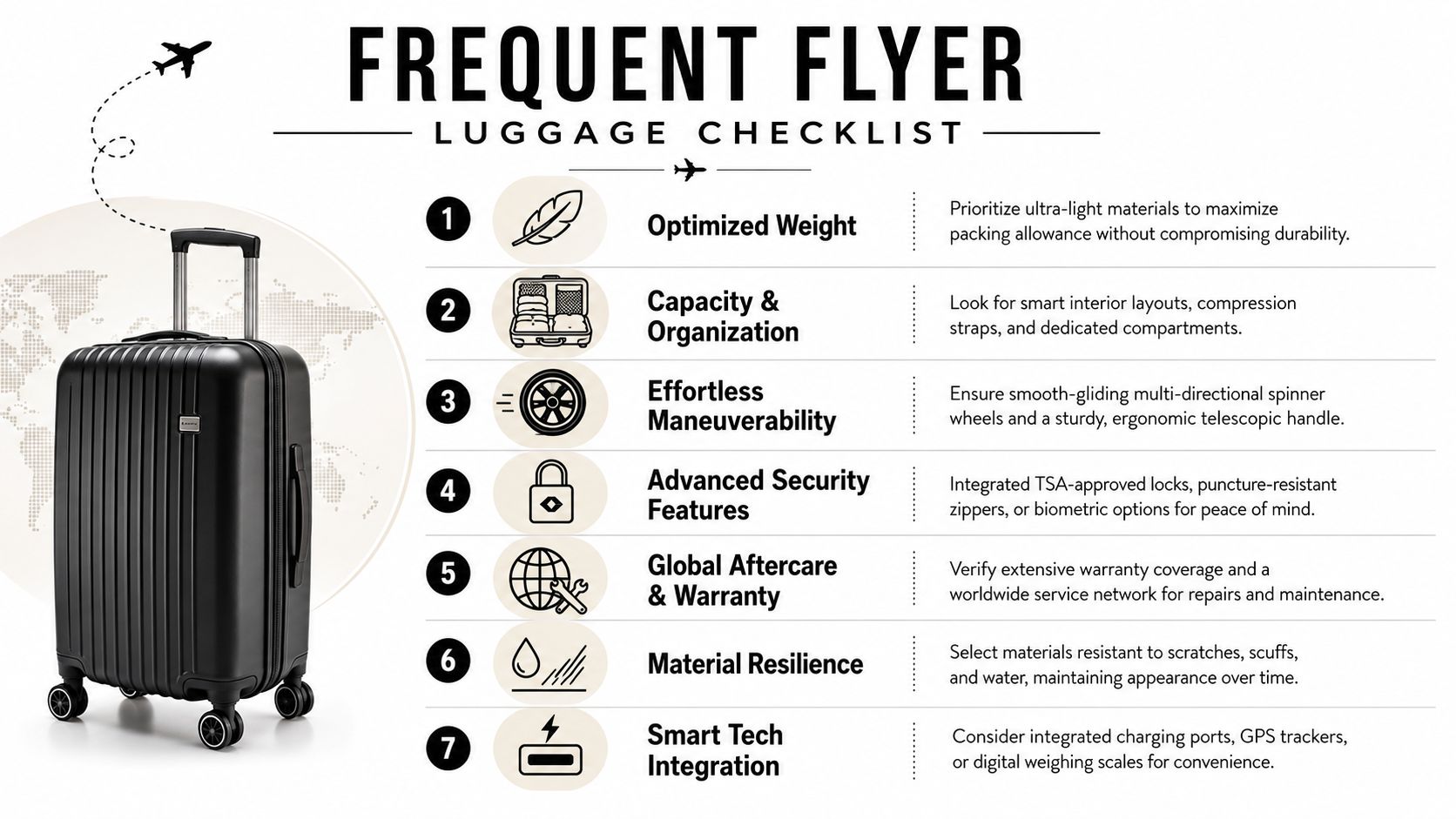
Brand matters, but the spec sheet tells the truth. If you're buying luggage for constant use, read it the way you'd read the details of a charter aircraft or a watch movement. Precision matters.
Start with dimensions and weight
A standard carry-on size on major domestic carriers is 22 x 14 x 9 inches including handle and wheels, and guidance for usability recommends wheeled bags at around 7 pounds or less when empty, according to this luxury luggage market overview with airline size guidance. If a brand can't clearly publish those basics, move on.
For checked luggage, exact measurements matter just as much. One reviewed checked bag measured 29.5" × 20.5" × 13", weighed 11.6 lb, and totaled 62 linear inches, which places it right at a common airline size threshold, as shown in this test-based luggage review. That's the kind of transparency serious buyers should demand.
The best checklist is brutally practical
Use this before you buy:
- Published measurements: If dimensions aren't explicit, you're taking a needless risk.
- Empty weight: Every pound matters once you start packing properly.
- Wheel quality: Spinner wheels should feel planted, not loose or rattling.
- Handle rigidity: Extend the handle and check for wobble.
- Interior logic: Compression, divider placement, and access should suit how you pack.
- Lock and closure design: Integrated systems should feel secure and uncomplicated.
Match specs to how you fly
A weekly traveler should favor speed, compliance, and low handling effort. A seasonal leisure traveler can afford to prioritize visual character more heavily. If your itinerary includes multiple commercial legs, exact carry-on discipline matters more than romance.
This is also where a strong advisor becomes useful. Coordinating aircraft type, transfer style, and luggage profile is part of integrated travel planning, especially when flights and ground arrangements need to work as one system. Haute Black's air travel planning services reflect that larger reality, even if the suitcase itself is your purchase.
Practical rule: Never buy premium luggage until you've checked the numbers, touched the handle, and rolled it on a hard floor.
Beyond the Showroom Bespoke Services and Aftercare
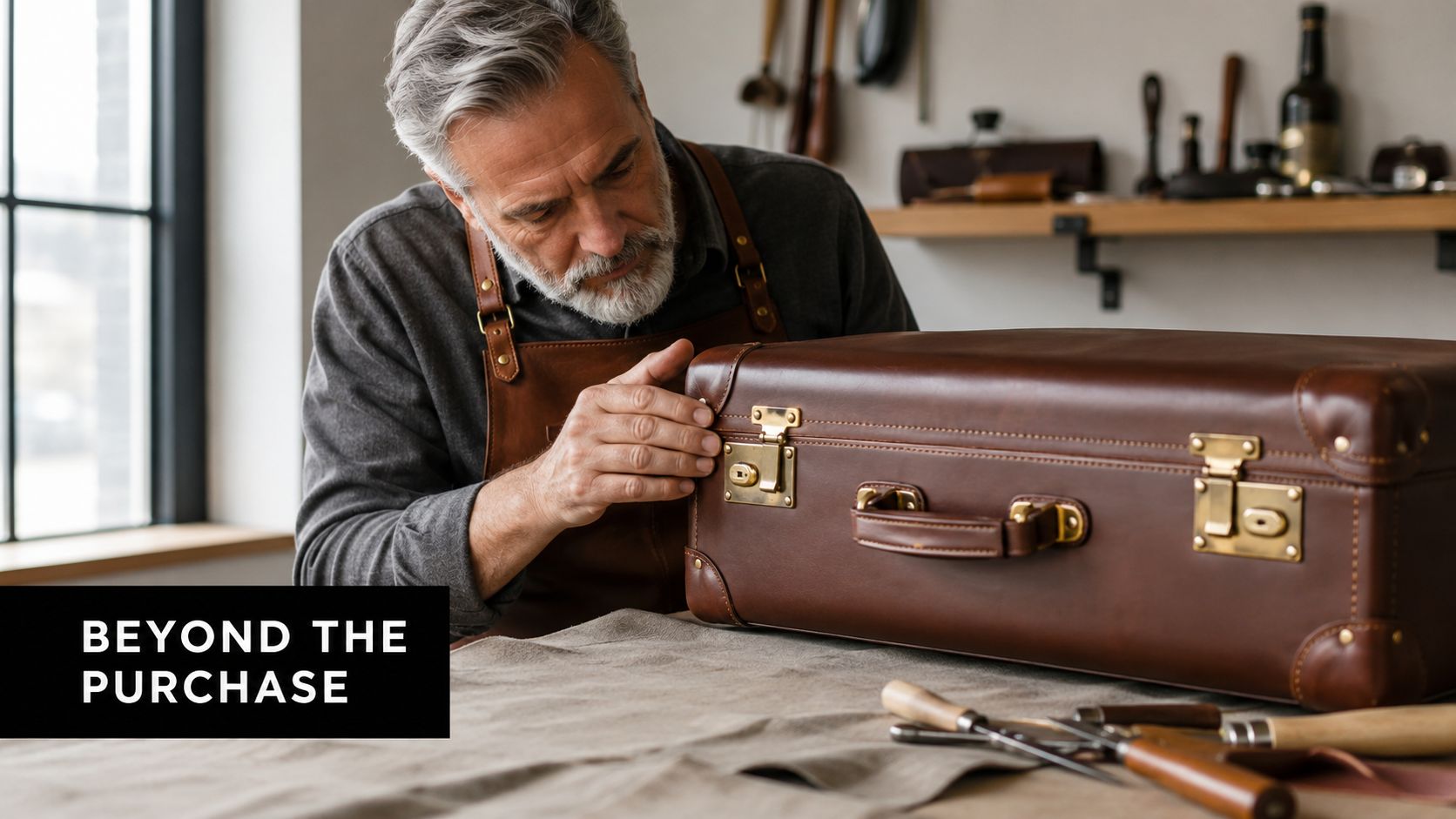
The purchase is the least interesting part of luxury luggage ownership. What matters is what happens after the first dent, the first scuff, the first broken wheel, and the first time the case needs attention in the middle of a busy season.
Real luxury includes continuity
A serious luggage brand should offer a relationship, not just a retail transaction. Personalization is part of that. Monograms, color choices, special finishes, and interior refinements can make a piece feel distinctly yours. But bespoke touches are secondary.
The main differentiator is aftercare.
If you travel often, damage isn't a possibility. It's a certainty. Wheels wear. Corners get hit. Aluminum dents. Leather needs conditioning. What you want is a brand that expects this and has built a service model around it.
Good aftercare has a few clear markers:
- Repairability: Components can be replaced without compromising the case
- Global support: You can get help outside your home city
- Clear warranty terms: Coverage is understandable, not evasive
- Skilled restoration: Cosmetic and functional work is handled by people who know the product
Bespoke travel deserves bespoke maintenance
This is why experienced buyers often prefer brands with established repair cultures. They understand that wear is part of ownership, not evidence of failure. A well-maintained case should age with credibility, not collapse into disposable luxury.
For travelers who think this way about tailoring, watch servicing, and automotive care, luggage should be judged by the same standard. Ownership should become easier over time because the brand knows how to support the product.
A good illustration of how customization fits into broader luxury travel is the rise of highly personalized itineraries and service design. That same mindset appears in travel planning itself, including customized package tours built around individual preferences.
There's also value in seeing how luxury houses frame craft and legacy for themselves:
The point is simple. If a brand can sell you a beautiful case but can't keep it in service, it doesn't belong in the top tier.
Matching Your Luggage to the Journey
Smart travelers match the case to the assignment.
A Monday board meeting in Zurich calls for restraint. A honeymoon on the Amalfi Coast can justify a little theatre. A safari with multiple bush transfers demands something else entirely. Ultimately, the choice lies between quiet luxury and heritage status, and the right answer depends on where you are going, how you are moving, and what you want your luggage to say before you say a word.
The Global Board Meeting
Choose Tumi or Carl Friedrik.
For work travel, discretion wins. You want a carry-on that moves cleanly through terminals, fits standard cabin limits, and looks disciplined in a hotel lobby, not decorative. Tumi is the practical recommendation for heavy business use because its service network is broad and its cases are built for repetition. Carl Friedrik suits the traveler who wants the same restraint with a sharper design point and a more refined feel.
This is quiet luxury doing its job properly.
The Multi-Generational Safari
Prioritize structure, durability, and easy identification over polish for its own sake.
If the trip includes regional hops, vehicle transfers, or soft handling standards outside major hubs, choose a case that can take abuse without looking defeated by day three. Heritage signaling matters less here than reliability and recovery. For longer expedition-style travel, the full plan matters as much as the luggage, especially on trips with remote logistics such as a Patagonia wilderness journey.
A beautiful case is useless if it becomes a burden between airstrip, lodge, and camp.
The Amalfi Coast Honeymoon
Choose Rimowa or Louis Vuitton if the trip rewards visible identity.
Heritage status earns its place among these brands. Rimowa gives you modern iconography with genuine travel credibility. Louis Vuitton brings history, craft, and a social signal that is instantly understood. On a leisure trip built around great hotels, photographed arrivals, and elegant transfers, that visibility can feel appropriate rather than loud.
Pack with the same discipline. A well-cut wardrobe and smart accessories matter more than overpacking, including practical pieces like these flats for stylish European travel, which solve a real packing problem without diluting the look.
The experienced buyer usually ends up with a small rotation. One discreet carry-on for business. One tougher case for family trips and demanding routes. One heritage piece for leisure travel where presence adds to the experience. That is how to buy well. Match the luggage to the journey, and the choice becomes obvious.
Explore Our Guides


Signature Experiences


