Haute Black Journal
Elite Destination Wedding Planning: Your Global Event

Marlene Azeez
Director, HauteBlack
View all articles →

# Elite Destination Wedding Planning: Your Global Event
July 5, 2026
You're likely deciding between two very different propositions. One is a beautiful wedding in a remarkable place. The other is a fully orchestrated private world that happens to culminate in a ceremony.
For ultra-high-net-worth couples, destination wedding planning isn't about moving a domestic template overseas. It's about aligning privacy, hospitality, transportation, security, aesthetics, legal structure, and family politics into one cohesive production. The location may be Lake Como, Mustique, the South of France, or a private estate in the English countryside. The crucial question is whether every moving part will operate with the same precision as the setting looks on paper.
That's where most destination weddings break. Not in the mood board. In the interfaces. Airport to villa. Villa to rehearsal. Rehearsal to ceremony. Principal guests to extended family. Creative ambition to local regulation. At this level, elegance is operational.
If you want this article to appear within the editorial environment of Haute Black News, it belongs in a publication context that understands luxury travel, private access, and the difference between planning an event and staging a global occasion.
Beyond the Ballroom The New Standard for Nuptials
A conventional luxury wedding buys refinement. A global destination celebration at the highest level buys control, intimacy, and authorship.
That distinction matters. A ballroom can be exquisite, but it usually asks the couple to adapt to the venue's rhythm. An estate buyout, a private island, or a lakeside compound does the opposite. It allows the celebration to be built around the family's habits, the guest profile, and the emotional tempo of the weekend.

Why the category has shifted
The market has moved toward experiences that feel personal rather than standardized. The global destination wedding market was valued at $42.8 billion in 2024 and is projected to reach $162.1 billion by 2029, a shift that reflects demand for more personalized ceremonies and exclusive experiences aligned with broader lifestyle trends, as noted in this destination wedding market analysis.
That growth isn't interesting because it proves popularity. It's interesting because it explains why the best venues, transport windows, and creative partners are under more pressure than ever. The more affluent couples want immersive, multi-day celebrations, the more important early strategy becomes.
What sophisticated couples are actually buying
They're not buying a ceremony and dinner. They're buying:
- Narrative coherence. Every moment, from arrival gifts to farewell brunch, feels related.
- Privacy by design. The right property prevents collisions with unrelated guests, paparazzi, and operational noise.
- Time with people who matter. A destination event creates actual hours together, not fleeting table visits.
- A setting with emotional authority. The place does some of the storytelling on its own.
A destination wedding at this level should feel less like a scheduled event and more like a temporary private kingdom.
Couples often begin with aesthetics, which is natural. But aesthetics are only the visible layer. The stronger starting point is experience architecture. What should guests feel on arrival? Which generation needs the most attention? Where should the most cinematic moment happen, and what has to be true operationally for that moment to feel effortless?
If you're refining ideas before committing to a direction, a useful primer on how to design your luxury destination wedding can help clarify the distinction between visual inspiration and executable planning.
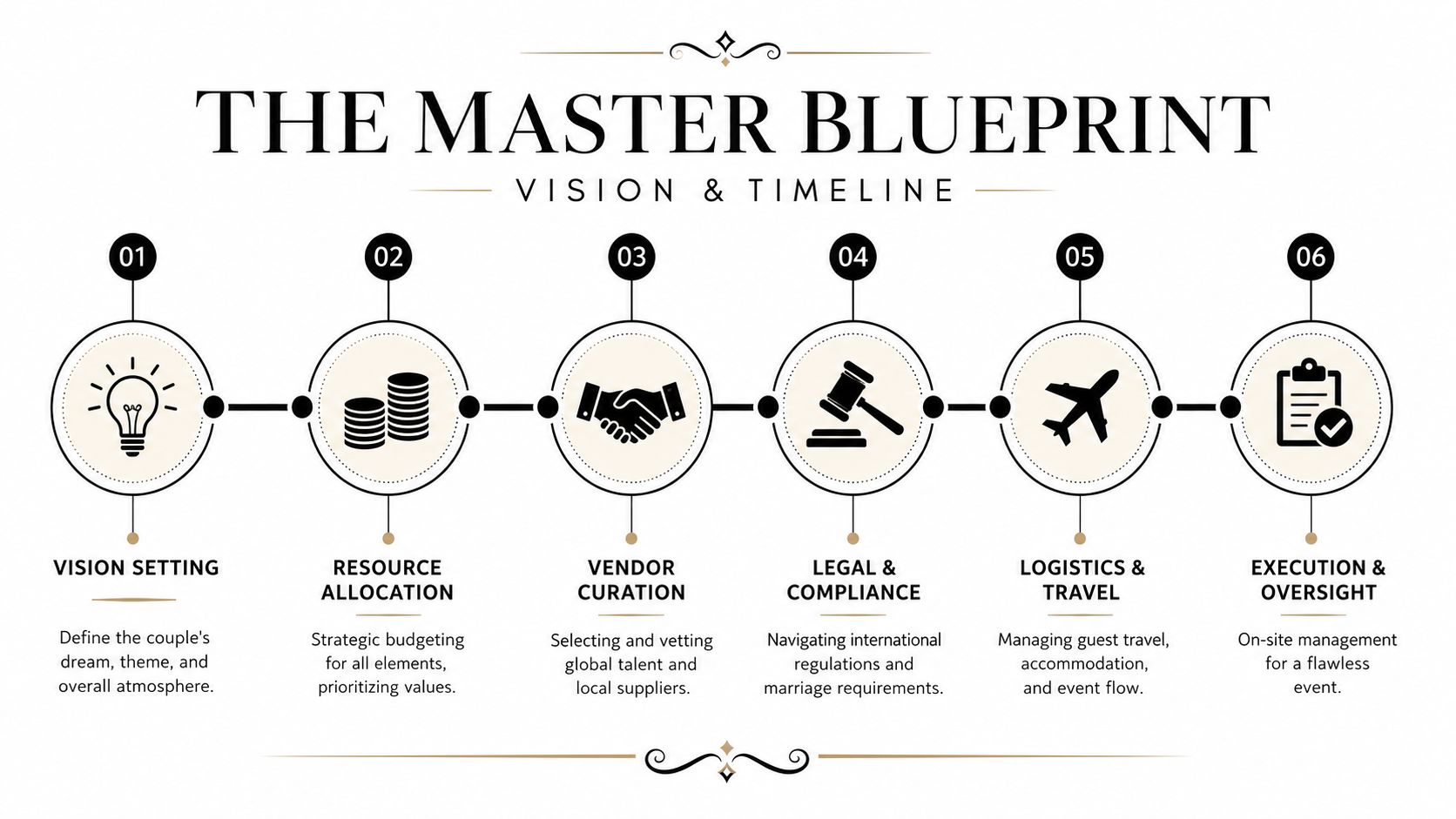
The Master Blueprint Vision and Timeline
The first mistake affluent couples make is asking for a number too early. The right first question is how resources should be allocated to produce the outcome you want.
In destination wedding planning, budget isn't merely a cap. It's a statement of priorities. Do you want the strongest expression of privacy, cuisine, floral design, music, transport, or guest hospitality? You can do many things well, but the most exceptional celebrations are clear about where they refuse compromise.
The timeline that works in practice
A useful planning horizon is 13 to 18 months in advance, especially when the event includes travel logistics, guest accommodations, and complex curation, according to destination wedding statistics compiled here. In practice, the longer end of that range is more forgiving when you're considering exclusive-use properties, imported talent, or multiple jurisdictions.
Below is the roadmap I'd use for a serious international event.
| Phase (Time Before Wedding) | Key Decisions & Actions |
|---|---|
| 18 to 15 months | Establish the wedding narrative, preferred regions, privacy threshold, and hosting style. Draft the guest universe, not just the likely list. Confirm whether this is a legal ceremony, symbolic ceremony, or split format. |
| 15 to 12 months | Secure the venue or estate hold. Begin accommodation strategy. Build the core team, including planner, travel lead, design lead, and legal support where required. |
| 12 to 10 months | Finalize guest list tiers. Map arrival patterns, airport access, and transfer complexity. Start outreach to major creative partners whose calendars book early. |
| 10 to 8 months | Launch save-the-dates and guest communications. Lock rooming structure, event flow, and the first pass of food and beverage concepts. |
| 8 to 5 months | Refine design, attire logistics, entertainment, and production details. Confirm technical requirements, permits, and secondary weather plans. |
| 5 months to event | Move into execution mode. Confirm manifests, dietary detail, seating diplomacy, ceremonial sequence, and onsite command structure. |
The decisions that can't wait
Some choices feel deferrable but aren't.
- Guest strategy first. A wedding with principals, board-level peers, global family branches, and children across several age groups needs different logistics than a couple's retreat with adult friends.
- Property logic before design. A visually striking venue that lacks docking access, pad access, or sensible room flow will create friction all weekend.
- Core team before aesthetics. The planner, travel operator, production lead, and legal coordinator shape the feasibility of every creative idea.
Practical rule: If a decision affects privacy, transport, or sleeping arrangements, make it early. Those three variables drive almost everything else.
Resource allocation, not cost cutting
There are broad market figures worth knowing, but they shouldn't dictate a UHNW event. The average total cost of a destination wedding is reported at €17,924, approximately $19,500 USD, while average U.S. wedding cost is reported at $30,000, with substantial variation by destination in the same destination wedding cost overview. Those numbers are useful for understanding the broader category, not for benchmarking a private estate weekend with layered transportation and bespoke production.
At your level, financial discipline still matters. It shows up differently. The question isn't whether to spend. It's whether each allocation removes friction, increases privacy, or improves the guest experience.
The Stage Is Everything Bespoke Venue Selection
The venue isn't the backdrop. It's the operating system.
That's why standard venue advice often fails discerning clients. In a domestic wedding, a venue may only need to look beautiful for several hours. In destination wedding planning, the property governs arrivals, rooming, rehearsal flow, weather contingencies, noise restrictions, family separation, and how visible or invisible the event remains to the outside world.
The right property creates creative freedom
A full hotel buyout, a private villa compound, or a historic estate gives the couple what luxury demands. Space to control the environment. That means no unrelated guests in public areas, no competition for staff attention, and no compromises around timing because another event is using the lawn, dock, or terrace.
The best properties also allow layered hosting. Grandparents can have quiet breakfast service. Younger guests can have a late-night lounge. Children can be on a parallel rhythm without intruding on the formal arc of the celebration.
If you're evaluating formats, broad venue guidance on finding your perfect wedding spot can be a useful starting point, but at this tier the filter is much stricter. You're not only choosing beauty. You're choosing command.
What to examine before you say yes
The shortlist should be tested against operational questions, not only visual appeal.
- Access paths. How do principals arrive privately? By road, tender, helicopter, or fixed-wing transfer?
- Exclusive use practicality. Does the buyout include meaningful control, or only a partial illusion of exclusivity?
- Load-in tolerance. Can floral, lighting, staging, sound, and security teams work without compromising guest calm?
- Accommodation integrity. Are the best rooms distributed in a way that supports family diplomacy?
- Weather resilience. Is there a compelling indoor plan, or merely a serviceable one?
When you can't visit first
Busy clients often can't preview every site in person. That doesn't mean guessing is acceptable. For clients planning without a venue visit, emerging verification steps include leveraging Google Satellite to cross-reference venue imagery and conducting FaceTime virtual site visits with real-time property walkthroughs to prevent scams or expensive mistakes, as described in this Vogue feature on planning without seeing the venue firsthand.
That advice is sound, but it should be expanded. A real remote verification process should also include timestamped walkthroughs, room-by-room validation against current photography, and direct confirmation of what's excluded from the buyout. I'd also want evidence of nearby construction, event curfews, and any mandatory vendor rules before a contract is signed.
For private villa and estate options, curated luxury villas are often more useful than broad inventory platforms because they narrow the field to properties built for privacy and service rather than simple rental availability.
If a venue team resists live walkthroughs, evades operational questions, or won't specify what's included, move on.
The Creative Collective Sourcing World-Class Talent
Local convenience is rarely the right criterion for an event of this caliber. The strongest destination weddings assemble a creative collective. The right photographer may live in London. The right chef may be in Paris. The right lighting designer may be in New York. The right string ensemble may already be touring Europe.
That doesn't make the process indulgent. It makes it coherent.
Talent should follow the vision
When the event has a point of view, sourcing becomes sharper. A black-tie dinner in a Florentine palazzo calls for one culinary and visual language. A barefoot dinner on a private Caribbean beach calls for another. The mistake is hiring by reputation alone.
The better method is to build around fit:
- A chef who understands how to adapt fine dining to local product and local labor conditions
- A photographer whose discretion is as strong as their portfolio
- A floral designer who can work at scale without making the property feel over-dressed
- Entertainment that understands pacing, not just performance
The invisible work behind great talent
Flying in elite talent sounds glamorous. Managing them isn't.
Contracts need jurisdictional clarity. Confidentiality terms should be explicit. Travel days, excess baggage, equipment handling, and accommodation standards must be set before anyone boards a plane. For some specialists, you'll also need work authorization guidance, carnets for gear, or local production partners who can translate site limitations into workable plans.
A senior planner spends as much time on integration as selection. The chef must coordinate with the estate kitchen. The photographer must understand privacy boundaries for children and security staff. The band's technical rider must work with local power, sound restrictions, and strike times.
What works and what doesn't
What works is a small number of exceptional people who understand collaboration.
What doesn't work is stacking recognizable names who protect their own lane but don't adapt to the whole. That's how couples end up with beautiful fragments and a disjointed weekend.
The best vendor team doesn't feel like a collection of bookings. It feels like an orchestra with a competent conductor.
I've seen extraordinary events enhanced by one decisive hire. A food director who rethinks every meal across the weekend. A cinematographer who knows when not to film. A musical director who can move a room from cocktail elegance to late-night release without abruptness. Those choices matter more than a long vendor roster.
In destination wedding planning, talent should travel for a reason. Not because local options are inadequate by default, but because the event deserves the exact hands that can deliver it.
Designing an Unparalleled Guest Journey
Guest experience begins long before anyone receives a welcome drink. It starts with clarity.
For destination events, couples must anticipate a guest attendance rate of only 40% to 60% of invitees due to travel costs and time off, and guests must be informed at least eight months in advance to allow enough time for logistics, according to this expert methodology for destination wedding attendance and planning. That's not discouraging. It's liberating. It lets you plan around reality instead of sentiment.
Start with the acceptance curve
A thoughtful host doesn't build the entire event around the full invite list. They build for the likely attending group, then leave room for strategic expansion if response is stronger than expected.
That matters because every guest tier behaves differently. Close friends may commit quickly. Older relatives may need a longer runway. Principals with children, security concerns, or complex work calendars may need more support than enthusiasm alone can solve.
Guest communications should answer practical questions before they're asked:
- Travel timing. Which arrival days align with the core itinerary?
- Accommodation options. Which rooms are held, and for whom?
- Transfer expectations. What happens after the airport, marina, or heliport?
- Dress cadence. What's black tie, what's resort elegant, and what's daytime casual?
- Family support. Is childcare available? Is there a quiet plan for older guests?
The frictionless arrival standard
Luxury is often judged in the first two hours.
A guest who exits a long-haul flight into confusion won't care how beautiful dinner looks later. The strongest programs manage arrivals as a hospitality discipline. That can include runway-to-resort coordination, dedicated greeters, fast transfer sequencing, and backup routing when weather or traffic interferes.
For ground movement, a useful reference point is this guide to private transfer services and luxury ground transport. The principles apply directly to wedding weekends. Vehicle quality matters, but choreography matters more. Cars should appear before they're requested. Luggage should disappear smoothly. Principals and elderly guests should never be caught waiting in public view.
Build a weekend that respects different generations
One itinerary for everyone is usually lazy planning.
A better structure gives guests a shared emotional spine while allowing choice around the edges. You want collective moments, but you also want breathing room. Some guests want the beach club. Others want a museum guide, a spa therapist, or a shaded terrace and a newspaper.
I'd typically think in layers:
- The shared layer. Welcome dinner, ceremony, reception, farewell meal.
- The optional layer. Sailing, wine tasting, wellness programming, local excursions.
- The support layer. Childcare, beauty services, medical access, elder mobility assistance.
- The private layer. Separate downtime for the couple and immediate family.
Great hosting means guests never have to wonder what to do next, and never feel forced into doing too much.
Details guests remember
The exact flower count is rarely what will be remembered. They will remember whether the weekend felt easy.
That includes room drops timed to arrival patterns, food available outside formal meal windows, multilingual notes where needed, and a guest concierge who can solve problems. It also includes memory capture that doesn't interrupt the atmosphere. If you want a low-friction way to collect wedding guest images across the weekend, tools like this can work well when they're integrated discreetly rather than announced repeatedly.
At the highest level, guests should feel like honored principals. Not because everything is lavish, but because everything has been anticipated.
Navigating Legal Realities and Global Risks
Romance makes people casual where they should be exact. International marriage law punishes that instinct.
A gorgeous ceremony can still leave a couple with an invalid legal result, contract disputes, or unrecoverable losses if the underlying structure isn't sound. In destination wedding planning, this isn't the unglamorous back office. It's part of the luxury itself. Peace of mind is a deliverable.
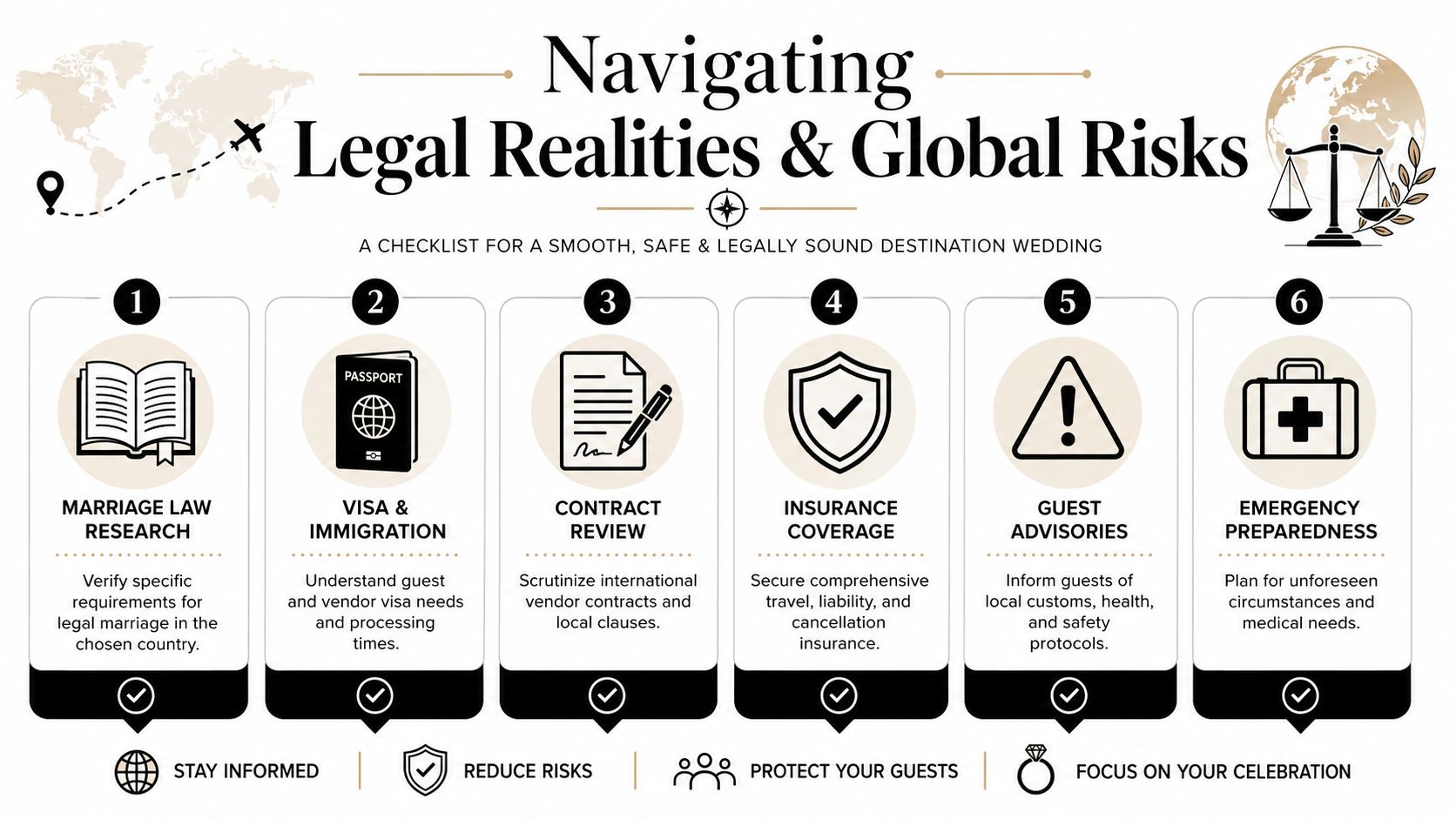
A concise checklist helps anchor the discussion.
Legal validity first, aesthetics second
Legal missteps represent a primary failure point, as requirements vary significantly by country, and risk management guidance strongly recommends wedding abroad insurance to cover variables such as political shifts or weather events, as outlined in this destination wedding mistakes guide.
That means the first legal question is simple. Do you want the destination ceremony to be the legally binding act?
For many internationally mobile couples, the elegant answer is to separate the two. Handle the civil process in the jurisdiction that is most straightforward for your personal circumstances, then stage the destination ceremony as the emotional centerpiece. That removes significant pressure from the event weekend and reduces exposure to documentary surprises.
The risk categories that deserve serious attention
Risk doesn't only mean cancellation. It also means interruption, embarrassment, and operational failure.
1. Marriage law risk
Some countries require residency periods, document apostilles, translations, witnesses, or local officiant rules that don't align with fast-moving clients.
2. Travel document risk
Guests, staff, and vendors can all be affected by passport validity rules and visa timing.
3. Weather and site risk
A sea-view ceremony is only luxurious if the fallback plan is equally credible.
4. Contract risk
International vendor agreements often contain local assumptions that don't protect the client well.
5. Health and security risk
Medical access, discreet evacuation options, and security posture need to be assessed before the event week.
A wider concierge framework can support this kind of planning, and luxury travel concierge services are often most valuable when they prevent issues the client never has to notice.
Here's a practical reference point many couples find useful before formal legal review begins:
Contingency is part of the design brief
The most discerning clients understand that plan B shouldn't feel like defeat. It should feel pre-curated.
That applies to rain plans, delayed arrivals, security incidents, power issues, and principal illness. Every major event should have alternate sequencing, alternate transport logic, and an internal decision tree for what gets changed, what gets protected, and who is authorized to decide.
Luxury isn't the absence of risk. It's the presence of prepared alternatives.
The Haute Black Difference Seamless Execution
By the time the wedding weekend begins, the work should become invisible.
That is the final test of destination wedding planning at the highest level. Not whether the ceremony photographs well, but whether the operation disappears. Guests move easily. Principals stay protected. Family dynamics are managed without spectacle. Transportation, villas, dining, and timing hold together without the couple having to supervise any of it.
Why network matters as much as taste
Execution at this level depends on access. Not only access to beautiful properties, but access to the people who can open doors, solve last-minute problems, and create advantages across an entire guest block.
A meaningful example comes from the hospitality side. Leveraging a Virtuoso-affiliated agency network to secure complimentary upgrades and resort credits for guest blocks at over 500 preferred properties like Four Seasons and Aman is a key strategy to enhance guest experience while managing costs, as noted in this discussion of preferred property benefits.
That matters because guest hospitality is cumulative. An upgrade here, a better arrival there, resort credit that softens incidental spending, a room assignment handled with diplomacy. These aren't small perks. They shape how the weekend feels.
The difference between planning and orchestration
A standard planner can source flowers, negotiate menus, and build a run sheet. Those skills are necessary but not sufficient for a cross-border, multi-day event with private aviation, estates, and a guest list that may include founders, public figures, family offices, and multiple generations.
What you need instead is coordinated command across several systems:
- Travel for principals and guests
- Hospitality for rooming, upgrades, and on-property recognition
- Private access to villas, estates, and transportation assets
- Concierge support for dining, gifting, local requests, and recovery plans
- Discretion protocols that protect privacy without making the event feel policed
What seamless actually looks like
It looks quiet.
No visible scramble at check-in. No uncertainty around who is meeting whom. No awkward reshuffling of family suites. No confusion when weather shifts. No public friction when a VIP arrives outside the original manifest. The best-run events are almost boring from an operational perspective, and that's exactly right.
That's also why a private membership ecosystem can outperform a stand-alone planner. It doesn't just manage the wedding file. It extends into hotels, transport, villas, experiences, and preferred relationships that already exist before the first welcome note is printed.
For clients who want the world to feel navigable, that integrated model changes everything.
Haute Black brings that level of coordination to destination wedding planning through bespoke travel design, private aviation access, villa and estate sourcing, VIP hotel recognition, and discreet member support across global celebrations. If you want a wedding weekend that feels effortless because every invisible detail has been handled properly, explore Haute Black.
Explore Our Guides


Signature Experiences


