Haute Black Journal
China Private Tours: Luxury Itineraries and Logistics

Marlene Azeez
Director, HauteBlack
View all articles →

You've saved the hotels, compared Beijing with Shanghai, and started wondering whether your family could fit Xi'an into the same trip. Then the practical questions arrive: Does your passport qualify for visa-free entry? Will your payment apps work? Can you secure the restaurant you want, rather than whatever's available after sightseeing?
China private tours work best when those questions shape the journey from the beginning. A beautifully chosen hotel won't compensate for an impractical transfer, and a private driver can't fix an entry rule that doesn't cover your route. The aim is to make the arrangements precise enough that you can stop thinking about them once you arrive.
What Makes a China Private Tour Different
A family boards a sightseeing coach after breakfast. Their guide raises a flag, checks a clipboard, and announces the departure time for the next stop. Someone wants longer at the museum; someone else would rather return to the hotel. Neither preference changes the schedule.
That's the familiar group-tour arrangement. The contrast is easy to recognize in the scene below.

Private means control over the design
Think of a group tour as a train with predetermined stops. A private journey is closer to a chauffeured car: you choose the direction and can pause when something deserves your attention. There are still road rules, opening hours, and reservations, but your priorities determine the plan.
For an illustrative family, that might mean a cultural visit while everyone's fresh, a proper lunch rather than a hurried stop, and an afternoon that allows different generations to separate. A couple might prefer a leisurely morning followed by an extended culinary evening. Neither arrangement is more luxurious because it contains more activities.
The distinction is who decides what belongs in the day.
Self-funded travel and bespoke touring aren't identical
China's private-travel market developed after the country's reform and opening-up period, alongside easing overseas travel restrictions and rising disposable income. By 2002, self-funded private travel represented 61% of Chinese citizens' outbound trips, while leisure and holidays accounted for 50%, according to the historical analysis of Chinese outbound tourism.
Those figures describe Chinese travelers going abroad, not international visitors purchasing bespoke tours inside China. They establish the growth of personally financed travel, but they don't measure today's luxury private-tour market. Keeping those categories separate prevents a common misunderstanding.
When comparing proposals, look beyond the word private:
- Routing control: Can you remove destinations, or only choose from a fixed circuit?
- Pacing control: Can the planner accommodate recovery time and different interests?
- Service clarity: Are the guide, vehicle, and activities reserved for your party?
- Decision-making: Who can authorize changes once you're traveling?
A private vehicle attached to a rigid itinerary is still a rigid itinerary. Start with how you want to spend your time, then choose the arrangements that support it.
Sample Bespoke Itineraries by Trip Length
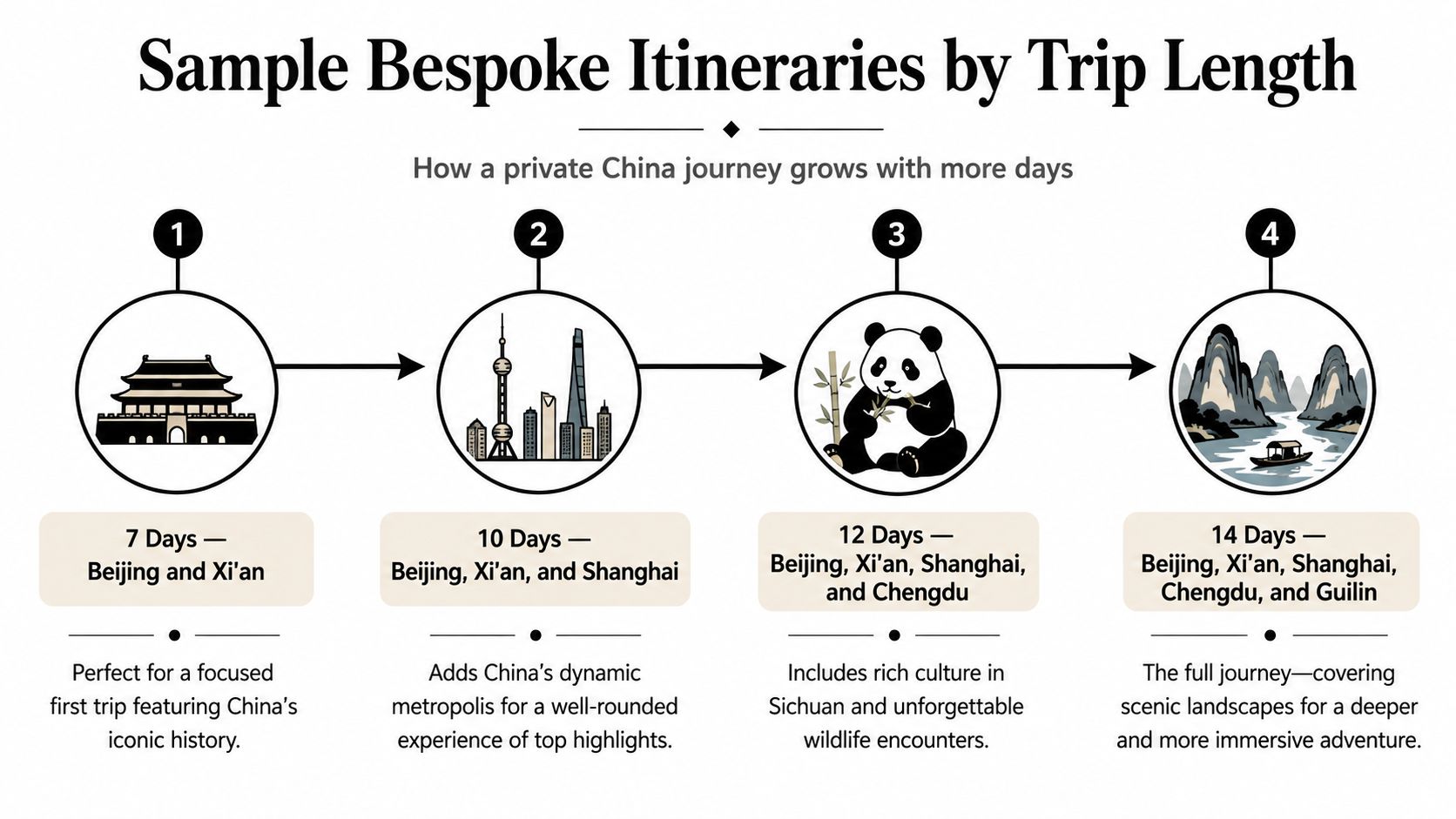
Use 7 to 14 days as a planning frame, not a promise that every destination will fit comfortably. That range follows the premium-journey structure described in this guide to luxury tours of a lifetime. The examples below are suggested designs, subject to entry eligibility, transport schedules, and reservation availability.
This visual shows how the proposed journey expands as more time becomes available.
Choose an arc rather than collecting cities
7 days, Beijing and Xi'an. Begin with arrival assistance and an undemanding evening. Follow with a signature cultural day in Beijing, then leave room for a private culinary evening before the regional transfer. In Xi'an, build the remaining stay around your principal historical interest and finish without another ambitious excursion before departure.
10 days, Beijing, Xi'an, and Shanghai. Keep the same opening, but add Shanghai as a contrasting final chapter. Rather than placing a tasting menu immediately after arrival, allow time to settle in. A guided cultural outing, an evening organized around dining, and an open closing stretch can make the extension feel considered rather than crowded.
12 days, Beijing, Xi'an, Shanghai, and Chengdu. This proposed combination adds culture and wildlife interests, but it also introduces another hotel change. Protect a lighter period around that transfer. If wildlife is a priority, request a clearly described visit with confirmed conditions, not a vague promise of privileged interaction.
14 days, Beijing, Xi'an, Shanghai, Chengdu, and Guilin. Treat this as a fuller scenic proposal rather than the default recommendation. The additional regional movement should earn its place through a genuine interest in natural scenery. If your party dislikes packing and unpacking, spend the extra time deepening an earlier stay instead.
Reserve the essentials and leave breathing room
Think of the itinerary as a wardrobe. The essential pieces must fit before you add accessories.
- Secure first: Hotel rooms, heritage-site entries, premium rail seats, guides, and vehicles.
- Keep adaptable: Shopping, casual meals, neighborhood exploration, and optional cultural encounters.
- Treat selectively: Signature restaurants may need firm reservations even when other dining stays flexible.
A transfer day deserves to be judged door to door, including checkout, luggage, station or airport procedures, and arrival at the next hotel. Don't mistake time seated on a train for the entire travel commitment.
For another visual perspective while considering the route, use the accompanying video.
Private Guides and Cultural Access Tactics
If I were deciding where personal service matters most, I'd prioritize the private guide. A vehicle solves movement; a thoughtful guide helps you understand what you've traveled to see. Translation is only part of that role.
The right briefing gives a guide something useful to work with. Explain whether you're interested in architecture, family history, contemporary art, food, or religious traditions, and say how much detail you enjoy. A traveler seeking a conversation shouldn't receive a continuous lecture.
Brief for curiosity and comfort
A useful guide brief describes both interests and practical limits. Include walking tolerance, preferred breaks, hearing needs, dietary requirements, and whether different family members might occasionally pursue separate activities.
Ask how the guide would adapt a visit if someone becomes tired. The answer should describe workable alternatives, not just assure you that everything is flexible. This private guided travel planning guide provides a useful companion when considering the role of personalized guiding.
Practical rule: Ask what access includes, who confirms it, and what happens if it becomes unavailable.
Early entry, studio appointments, and small-group workshops should all be treated as requests requiring confirmation. A private guide doesn't automatically have permission to bypass venue rules, enter closed areas, or arrange meetings with artists.
Make cultural requests specific
Instead of asking for exclusive access, describe the experience you want. Perhaps you'd enjoy watching a craft process, discussing materials with an artist, or participating in a workshop without joining an unrelated group.
Give the planner enough detail to distinguish a meaningful appointment from an expensive label:
- Purpose: Explain what you hope to learn or experience.
- Privacy: Specify whether you require exclusive use or a quieter setting.
- Participation: Clarify whether you want to observe, discuss, or make something.
- Confirmation: Request the host, venue, format, cancellation terms, and substitute arrangement.
Dining requires the same precision. Beijing's top restaurants generally aren't casual walk-in propositions: reservation books fill quickly, private salons need coordination, and the room or timing can depend on who makes the booking. For business meals, family privacy, or a long tasting sequence, ask your advisor or hotel concierge to arrange the room in advance.
A confirmed table and a confirmed private room aren't interchangeable. Make sure the written reservation reflects the experience you intend to have.
Visa and Entry Checks Before You Book
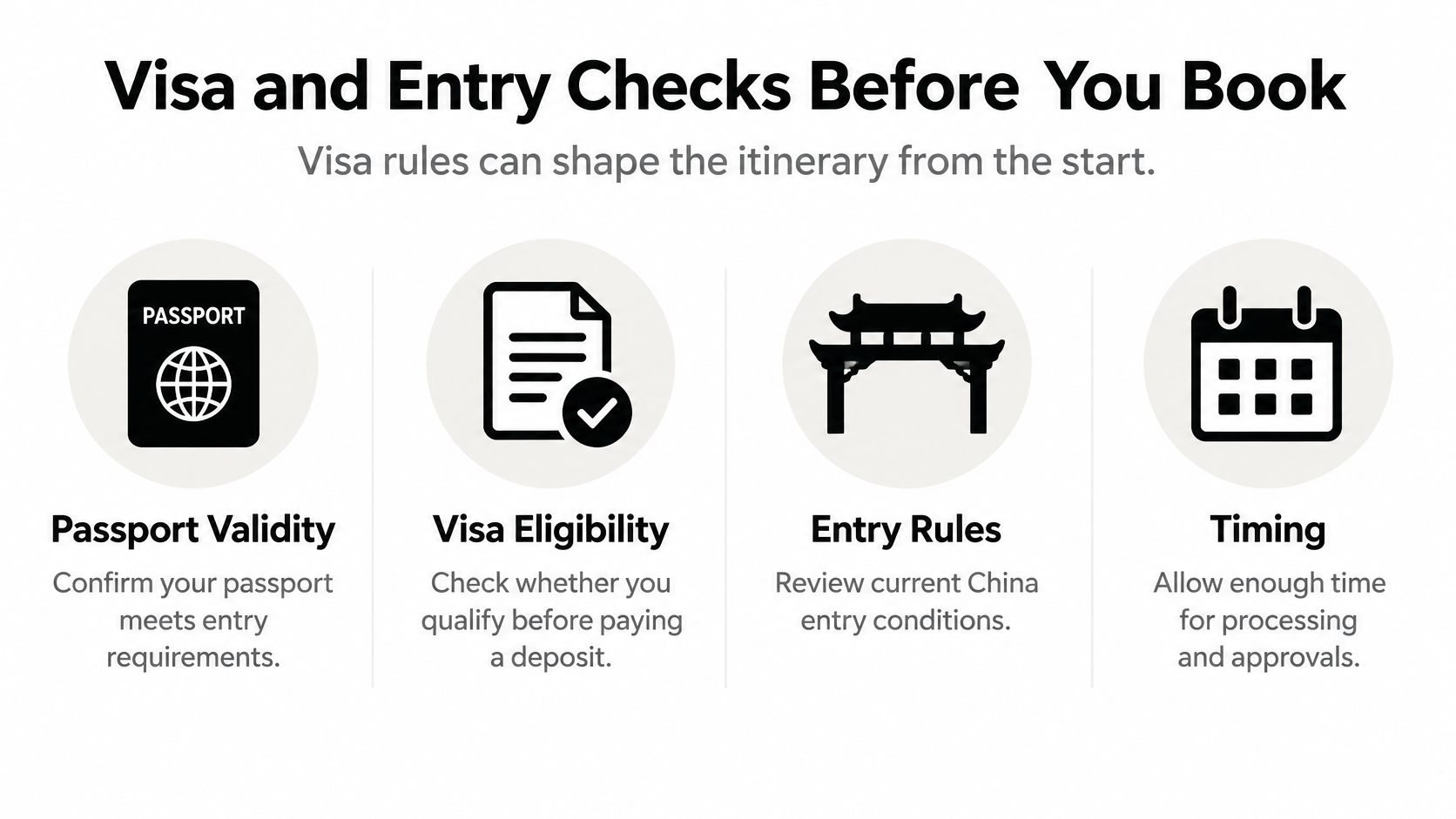
Entry eligibility is part of itinerary design, not an administrative task to postpone. Think of it as checking the permitted route before hiring the car. A booking can be beautifully arranged and still be unsuitable for the passport or entry basis involved.
The checklist below belongs before nonrefundable commitments.
Establish which rule applies
Unilateral visa-free entry, visa-free transit, and destination-specific arrangements aren't interchangeable. Transit eligibility can depend on confirmed onward travel and permitted geography, while Hainan has a separate entry regime. Don't assume that a mainland circuit, a Hong Kong connection, and a Hainan extension share the same conditions.
For example, Chinese embassy visa guidance stated that ordinary-passport holders from Brazil, Argentina, Chile, Peru, and Uruguay could enter for tourism without a visa for up to 30 days during the trial from June 1, 2025, through May 31, 2026. That stated trial had a defined end date; it isn't evidence of eligibility beyond that period. Travelers outside applicable exemptions generally need a visa before entry.
The same guidance describes 24-hour visa-free transit for eligible passengers with confirmed onward tickets who remain within the port of entry, alongside a distinct 30-day Hainan regime for eligible nationalities. Verify the current conditions with the relevant official authority rather than applying a headline to your whole journey.
Check the actual traveler and actual route
Give your advisor or executive assistant a complete proposed flight and destination sequence, then work through these checks:
- Passport: Confirm nationality, passport type, validity requirements, and the document you'll use.
- Purpose: Establish whether the planned activities qualify under the intended entry basis.
- Arrival: Identify the entry point and any port-specific conditions.
- Onward journey: Check destination, ticket requirements, border crossings, and permitted routing.
- Stay: Verify the authorized duration and geographical limits.
- Evidence: Retain the applicable official guidance and confirmation of any required visa.
A change that looks minor on an itinerary can be significant at a border.
Ask for an alternative route that stays within your verified authorization. If flights change or a regional extension becomes impractical, you should know which adjustments remain permissible before approving them.
Payments, Connectivity and Transfers Made Simple
Payment preparation is like packing a spare tire. You hope you won't need the backup, but discovering you don't have one is especially frustrating when a driver is waiting.
Digital-payment adoption doesn't mean every visitor's setup will work automatically. Nearly 2 million foreigners had used WeChat Pay after foreign-card linking was simplified by July 2025, while Alipay reported a 180% increase in inbound-tourist spending during May 1 to 3, 2025, compared with the same period in 2024, according to the official account of payment accessibility improvements. Those figures demonstrate usage, not a guarantee for your card or account.
Prepare the phone before the suitcase
Decide which adults will register Alipay or WeChat Pay, and follow the current identity-verification and foreign-card-linking instructions. Don't build the family's entire payment plan around an assumed shared account; confirm the platform's requirements and give traveling adults appropriate independent backups.
- Card rejection: Carry another payment method and ask which essential expenses can be prepaid.
- Phone failure: Keep hotel, driver, and assistance details somewhere other than the device.
- Connectivity loss: Arrange compatible roaming or an eSIM, checking coverage and whether voice calls are included.
- Vendor limitations: Ask the local team about payment arrangements for rural stops and smaller businesses, including a suitable cash contingency.
For reaching hotels, drivers, or local contacts by phone, review China dialing tips from BubblyPhone. Save the numbers in the format you'll use abroad, and don't assume a data connection also provides ordinary calling service.
Confirm the handoffs
Your arrival instructions should identify the meeting point, contact person, vehicle arrangement, and procedure if the flight is delayed. Pre-booked rail segments should specify who handles tickets, luggage coordination, and the onward pickup.
Carry a local-language emergency card with your hotel address and operational contact. Ask who can authorize alternative transport if the original driver becomes unreachable.
Dining payments deserve equal clarity. The Beijing luxury restaurant planning guide is useful when discussing restaurant arrangements; separately confirm any deposit, cancellation condition, and balance-payment method for your booking.
The practical test is straightforward: could everyone still reach the hotel and settle essential expenses if the principal traveler's phone stopped working?
Choosing Luxury Lodging and a Planning Partner
Choose a hotel for the stay you intend to have, not only for the room photograph. A property may suit an energetic couple yet be inconvenient for relatives who need easy vehicle access, quiet meals, or a dependable place to rest between outings.
For China private tours, I'd assess concierge responsiveness, room configuration, private-dining options, and the practicality of daily pickups. If Chengdu is on your proposed route, the Temple House planning guide offers a property-specific starting point for that conversation.
Self-Planned vs Advisor-Managed China Private Tours
| Planning Factor | Self-Planned Trip | Advisor-Managed Trip |
|---|---|---|
| Hotel selection | You research and contact properties directly | You assess a shortlist against your priorities |
| Reservation timing | You track release dates and confirmations | The advisor coordinates timing and follows up |
| Entry checks | You obtain and interpret official guidance | The advisor can coordinate checks, with official verification still essential |
| Payment contingencies | You organize setup and backups | You request a documented operational plan |
| Changes during travel | You contact each supplier separately | A designated contact can coordinate suppliers |
| Research time | You manage comparisons and correspondence | You provide a brief and review recommendations |
| Service boundaries | You define each supplier's responsibility | You examine the advisor's scope, exclusions, and support arrangements |
Compare responsibility, not just inclusions
Self-planning makes sense if you enjoy detailed research and want direct control of supplier relationships. An advisor-managed trip is worth considering when coordination itself is the burden, especially when several travelers have different requirements.
Neither approach removes the need to examine cancellation terms. Ask who responds outside normal office hours, which services are confirmed, and whether an upgrade is guaranteed or merely requested.
Among advisor-managed options, HauteBlack describes itself as a Virtuoso-affiliated agency with preferred partner status at more than 500 properties. Its service model includes a dedicated advisor and waived planning fees for members, alongside private aviation, first-class and helicopter transfers, and access to 80+ curated events annually, as outlined in its travel and membership coverage.
Those broader capabilities should be matched to the actual China proposal. An aviation service isn't automatically part of a ground itinerary, and membership benefits shouldn't be confused with confirmed hotel inclusions.
Before accepting a proposal: Separate guaranteed arrangements, availability-dependent benefits, and optional additions.
Request written details of breakfast, credits, arrival handling, room placement, and any proposed upgrade. A well-chosen hotel should support your daily rhythm; it shouldn't require you to reorganize the journey around benefits you may never use.
Booking Your First Private China Journey
Start with a useful travel brief rather than a long destination wish list. Your planner needs to understand what a satisfying day looks like before deciding where you should sleep.
Describe the travel window, the people joining you, their generations, and how they prefer to spend time together. Include mobility considerations, privacy expectations, dietary needs, and whether the trip celebrates an occasion or needs to accommodate work.
Give the planner decisions they can use
A practical brief separates essentials from preferences:
- Nonnegotiables: Identify the experiences or arrangements without which you wouldn't book.
- Pacing: Explain whether you enjoy full days or prefer protected downtime.
- Interests: Name the subjects, cuisines, or cultural activities you'd like to explore.
- Comfort: Describe room needs, luggage expectations, and anything that makes transfers difficult.
- Trade-offs: Say what you'd remove first if the proposed route feels too busy.
Be candid about what you don't enjoy. Disliking repeated hotel changes is more useful planning information than saying you want to see everything.
Request a proposal you can evaluate
Ask for a draft that makes the daily sequence understandable. It should distinguish confirmed arrangements from requests, explain regional transfers, identify reservation deadlines, and show where you have room to change your mind.
Request a named guide where available, with a clear briefing process and an explanation of any planned guide changes between regions. Ask the planner to identify the alternative routing and the person responsible for implementing it.
Before payment, review the entry assessment, supplier conditions, outstanding confirmations, and operational preparations already discussed. For any nonrefundable component, understand precisely what you're committing to and what would happen if another essential arrangement fell through.
A useful first conversation can happen this week. Send your travel brief, ask for a route built around your priorities, and request an explanation of the compromises. The right first draft won't merely look attractive; you'll understand why each destination, reservation, and rest period belongs.
HauteBlack offers bespoke itinerary planning, private guides, ground transportation, and concierge coordination for travelers considering a private China journey. Visit HauteBlack with your travel window, party details, and priorities, and ask an advisor for an initial route that accounts for entry eligibility, reservation timing, and your preferred pace.
Explore Our Guides


Signature Experiences


