Haute Black Journal
Business Networking Events for Founders and Executives

Marlene Azeez
Director, HauteBlack
View all articles →
# Business Networking Events for Founders and Executives
Published August 14, 2026 by Marlene Azeez
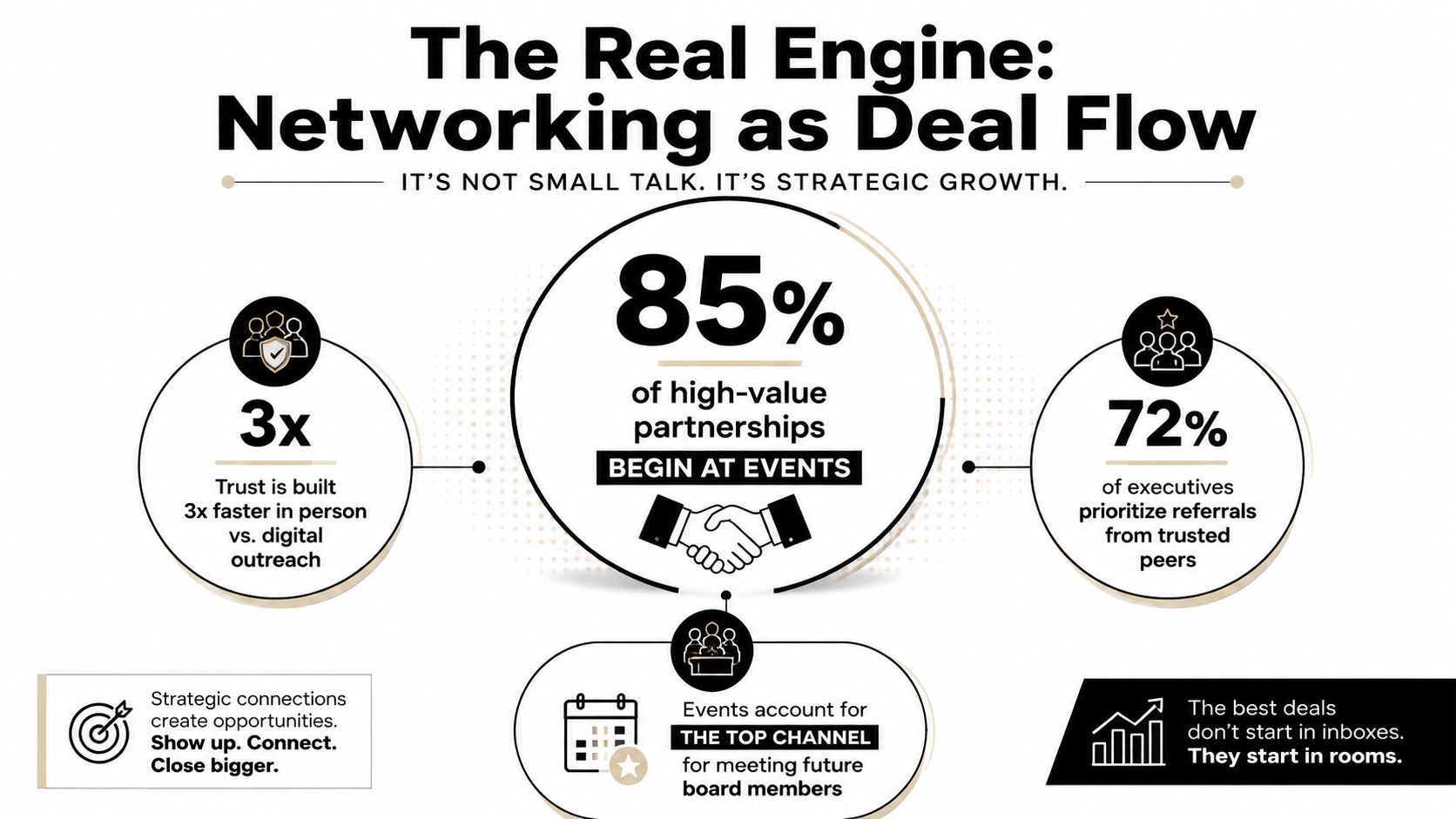
Most business networking events are sold as social rituals, and that's the wrong frame. The best ones behave like deal-flow infrastructure, they compress trust, reveal fit, and move introductions toward partnerships, hiring, and capital faster than digital outreach ever will. That's why the room matters more than the room service.
The scale is real, too. The global B2B event market was valued at $380 billion in 2023, with an average revenue per B2B event of $120,000 according to industry metrics. This isn't hospitality with name tags. It's a commercial system, and founders and executives who treat it casually usually get casual results.
Why Business Networking Events Are Deal Flow, Not Small Talk
The default advice on business networking events is too soft. People talk about handshakes, business cards, and “being authentic,” as if the main value is social comfort. It isn't. The value is trust formation under constrained time, and that's what makes these events one of the highest-impact channels in a founder's or executive's calendar.
The evidence points in the same direction. 78% of organizers say in-person conferences, summits, and conventions are their organization's most impactful marketing channel, and 85% of people prefer in-person meetings over virtual ones for networking Bizzabo. That preference isn't sentimental, it reflects how quickly people decide whether someone is credible, useful, and worth a follow-up.
The strategic model
A good event is an operating system for relationships. It gives you a controlled environment where decision-makers, potential partners, investors, and hires can evaluate each other with fewer delays and fewer filters than email or social media. In person, you get tone, pacing, eye contact, and the small cues that tell you whether a relationship can move forward.
Practical rule: If an event doesn't give you access to people who can make decisions, open doors, or introduce you to someone who can, it's entertainment.
The commercial case is stronger than the social case. Research summarized in industry networking reports says 70% of businesses acquired new leads using trade shows as a networking strategy, while 64% of trade show attendees are not current customers of the exhibiting business Fitsmallbusiness networking statistics. That combination makes business networking events a prospecting engine, not a courtesy call.
The rest of this article treats events that way. You'll see how the formats differ, who shows up, how to prepare without wasting time, how to choose the right room, and how curated membership models change outcomes for high-stakes audiences.
The Main Types of Business Networking Events
The mistake many make is treating every invite as the same kind of opportunity. It isn't. A trade show, a private dinner, and a founder-investor roundtable can all be useful, but they solve very different problems. Read the format first, then decide whether the room matches your goal.
Event formats and what they usually produce
| Format | Typical Size | Audience Profile | Primary Outcome | Best Used For |
|---|---|---|---|---|
| Trade shows | Large | Broad industry mix, vendors, prospects, operators | High-volume introductions | Top-of-funnel visibility |
| Summits | Medium to large | Executives, sponsors, specialists | Thought leadership and selective meetings | Category positioning |
| Private roundtables | Small | Curated peers and decision-makers | Depth, trust, deal exploration | Strategic partnerships |
| Hosted dinners | Small | Senior leaders, founders, investors, trusted guests | Relationship building | Confidential conversations |
| Private chef dinners | Very small | High-fit, high-trust circle | Stronger rapport and warm intros | Elite relationship density |
| Celebrity and cultural evenings | Small to medium | Affluent, visible, cross-sector guests | Social proof and cross-pollination | Access to adjacent networks |
| One-on-one curated introductions | One-on-one | Pre-vetted matches | Direct opportunity discovery | Specific business objectives |
Trade shows are for breadth. They're useful when you need volume, visibility, and rapid market scanning. Summits sit a step higher. They're better when the audience is tighter and the conversation is more strategic, which is why executives often get more value there than in sprawling expo halls.
Private formats are where the signal lives. A hosted dinner, private chef dinner, or founder-investor roundtable compresses the noise and forces relevance. If you need a useful seating resource for corporate formats, PlanSeats corporate seating is the kind of operational detail that affects how the room feels and how conversations start.
The smart way to think about this is simple. Large events broaden your exposure. Small, curated events deepen your access. If you're choosing between them, the right question isn't “Which one is more impressive?” It's “Which one puts me in front of the people who can move my objective forward?”
For a sharper read on executive-only environments, the internal guide on C-suite access and executive networking events is worth reviewing before you accept the next invitation.
Who Actually Shows Up and Why It Matters
Audience composition is the moat. Everything else is decoration. A beautiful venue with the wrong mix of people is still the wrong room, and a simple dinner with the right table can outperform a massive expo for a founder hunting capital or an executive looking for partnership velocity.
The biggest divide is between events heavy on titles and events heavy on actual decision-makers. Some rooms look impressive on paper because the badge scan list is long, but the influence sits elsewhere. Other rooms are curated around founders, operators, investors, athletes, and creators with verified backgrounds, and that changes the tone immediately.
Why curation changes the outcome
When a host vets the guest list, the event stops being random. Conversations get shorter, more relevant, and more commercially useful. People can speak candidly because they know the room was assembled with intent, not filled by whoever clicked RSVP first. That matters in high-stakes environments where reputation, discretion, and fit all matter.
A room with 20 qualified people beats a room with 2,000 mixed attendees when your goal is partnership, hiring, or capital.
That's not elitism. It's efficiency. An executive doesn't need maximum headcount. They need maximum relevance. If the room includes people who can buy, invest, introduce, recruit, or endorse, the event has strategic value. If it doesn't, you're just trading time for noise.
The internal network page reflects the broader idea behind strong curation, which is that access only matters when the people inside the room are useful to each other. In practice, that means the host's job is not to gather bodies. It's to engineer fit.
For founders and UHNW clients, curated membership models win. They reduce the mismatch between ambition and audience. They also make introductions more credible because the event itself has already screened for seriousness, taste, and intent. If you're attending to find partners, backers, or trusted peers, the composition of the room is the first metric that matters.
Preparation, Etiquette, and Follow-Through That Actually Convert
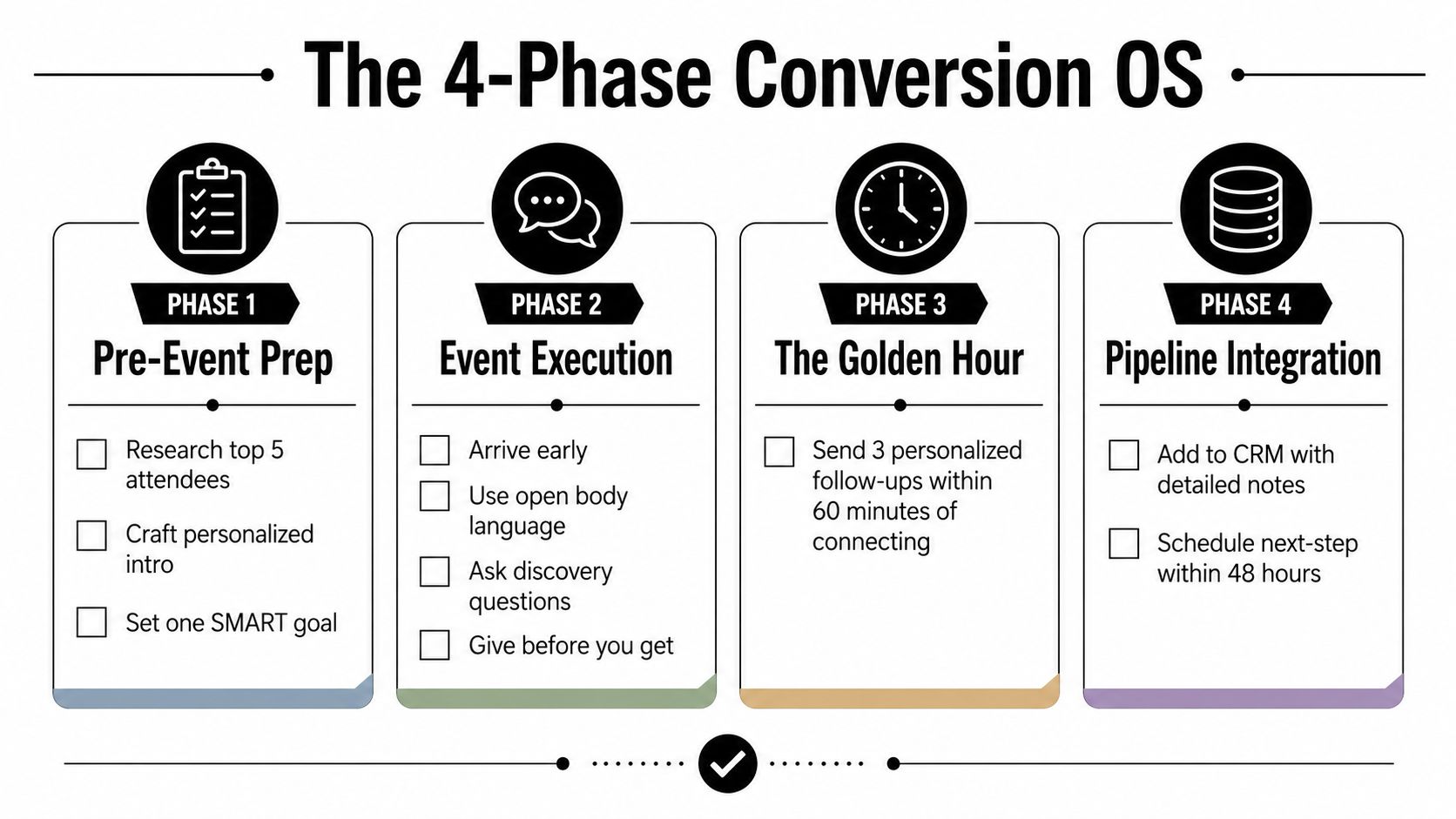
Many lose at business networking events before they arrive. They show up without a clear objective, wander the room, then call it “networking” when nothing lands. Preparation fixes that. If you know exactly what outcome you want, every conversation gets sharper.
Start with one objective. Not five. One. You're either looking for a partner, a client, a hire, an investor, or a strategic introduction. Once that's clear, research the attendee list, the host, and the format so your opening line fits the room instead of sounding generic.
The 4-Phase Conversion OS
In the room
Arrive early. It changes everything. You get cleaner introductions, easier access to the host, and better energy than walking into a packed room where all the good conversations are already formed. If the event has a captive portal for event WiFi, use the access point strategically, but don't hide behind your phone.
Ask discovery questions, not checklist questions. “What brought you here?” is weaker than “What are you focused on this quarter?” The best networkers don't try to impress first. They try to understand fast, then connect the dots where there's genuine fit.
When introducing two people, say why the introduction matters. Don't force a stale triangle of “You should meet.” Give one useful reason, then step back. That tiny bit of context prevents awkwardness and makes the introduction feel intentional.
Follow-through
The golden hour matters. Send a brief, personalized follow-up the same day if you can, and no later than the next morning. Reference something specific from the conversation, then move toward a clear next step within 48 hours if there's real overlap. Keep notes somewhere you'll use them, because memory gets sloppy fast after a full event.
Rule of thumb: If your follow-up doesn't make the next interaction easier, it's too vague.
The goal is not to “stay in touch.” The goal is to convert an introduction into a meeting, then a meeting into a result. That only happens when you treat follow-through like pipeline work, not social courtesy.
How to Choose the Right Business Networking Event
The easiest way to waste a calendar is to attend events by brand familiarity instead of strategic fit. Big logos can be misleading. A well-known conference might be too broad for your objective, while a smaller summit or membership event could be exactly right.
Score the invite before you say yes
Use a simple filter. First, ask whether the audience includes the people you want to meet. Second, ask whether the format supports the outcome you want. A stage-heavy conference helps if you need visibility. A closed dinner helps if you need trust. A roundtable helps if you need depth.
Third, look at the signal-to-noise ratio. If the room is crowded with spectators, vendors, or unqualified attendees, your time gets diluted. Fourth, evaluate the host. Credible hosts attract better guests because serious people trust serious curators.
What to favor and when
- Mass-market conferences: Best when you need broad exposure, industry scanning, or speaker visibility.
- Niche executive summits: Best when you want high-concentration conversations with a more relevant audience.
- Curated membership events: Best when access, discretion, and quality of introductions matter more than scale.
Geography matters less than people admit, but it still matters. If the event is a logistical headache, your energy drops before you enter the room. The best events make it easy to show up prepared, stay focused, and leave with a clear next move.
Post-event value matters too. If the host can introduce you to people who weren't physically in the room, the event keeps paying after the night ends. That's a serious advantage because it turns one conversation into a broader network effect.
The right question is blunt: does this event give me access to a room, or access to an ecosystem? The second one usually wins.
Measuring the ROI of Business Networking Events
If you can't measure the outcome, you're guessing. Badge scans and business cards are vanity metrics. They tell you who entered the room, not who entered your pipeline. The right way to measure business networking events is to separate volume from quality and then trace that quality into actual business movement.
Use a multi-layer KPI stack. Track meetings per attendee, qualified introductions, follow-up meetings booked, sourced pipeline, hires, and partnerships. That's how you tell whether the event created momentum or just activity. Brella's guidance on event networking metrics is useful here because it emphasizes counting users with meetings, total meetings, app downloads, chat messages, and engagement signals instead of relying on attendance alone Brella event networking metrics.
A practical KPI sequence
1. Event volume
Measure how many of the right people attended.
2. Interaction quality
Count meaningful conversations, not just greetings. Qualitative notes matter here because volume alone can mask poor fit.
3. Opportunity creation
Track follow-up meetings and introductions that move into the next stage.
4. Business impact
Count active deals, partnership discussions, interviews, or client conversations that remain live after the event.
For a deeper framework on the financial side, calculating experiential marketing ROI helps anchor event performance in actual business value rather than applause. That matters because a room can feel successful and still produce nothing durable.
Set your baseline before the event. Know what your current conversion looks like from introduction to meeting, and from meeting to real opportunity. Then run a short debrief after the event, not just with your team but with yourself. Which conversations were relevant? Which introductions were weak? Which part of the room produced the best fit?
Pair the numbers with a few blunt questions. Was the room relevant? Were the people useful? Did the event create follow-up-worthy momentum? If the answer is no, the event was entertainment. If the answer is yes, it was a business function.
The Haute Black Model for Curated Business Networking Events
Curated business networking works because it eliminates the two biggest failures of mass events, poor fit and weak follow-through. That's why a membership world like Haute Black matters in this category. It's built on two decades of relationships, and that kind of relational infrastructure changes the quality of who gets in and what happens after they arrive.
The model is straightforward. Instead of throwing everyone into the same room, it creates vetted peer groups, hosted formats, and AI-powered introductions between verified founders, executives, investors, athletes, and creators. That is a different product from a conventional conference. It is not trying to maximize attendance. It's trying to maximize the usefulness of every room.
Why the model works
Haute Black's calendar of 80-plus intimate events annually gives members repeated access to the kind of settings where trust builds quickly. Those settings include private chef dinners with names like Nobu, Daniel Boulud, and Thomas Keller, along with celebrity and cultural evenings that attract people who already operate at a high level. The point isn't novelty. The point is concentration.
That's also where the internal Haute Black events page fits naturally. The strongest curated programs don't just host events, they sequence access so the right people keep crossing paths in settings that make substantive conversation easier.
The AI angle matters, but not because AI is fashionable. It matters because intelligent matching reduces wasted introductions. If a verified founder wants an investor, or an executive wants a peer with overlapping interests, the platform can surface higher-fit connections before anyone has to guess.
Curation turns a social calendar into a relationship engine.
That's the big difference. Mass-market events can create awareness. Curated membership events can create momentum. For founders chasing partnerships, executives seeking strategic hires, and UHNW clients who care about discretion and efficiency, the latter is usually the stronger tool. The room is smaller, but the signal is higher, and in this game, signal always beats noise.
Your Executive Playbook for Business Networking Events
Treat business networking events as a serious commercial channel. If you're a founder or executive, you don't need more generic advice about small talk. You need a system that turns the right room into real pipeline, real partnerships, and real access.
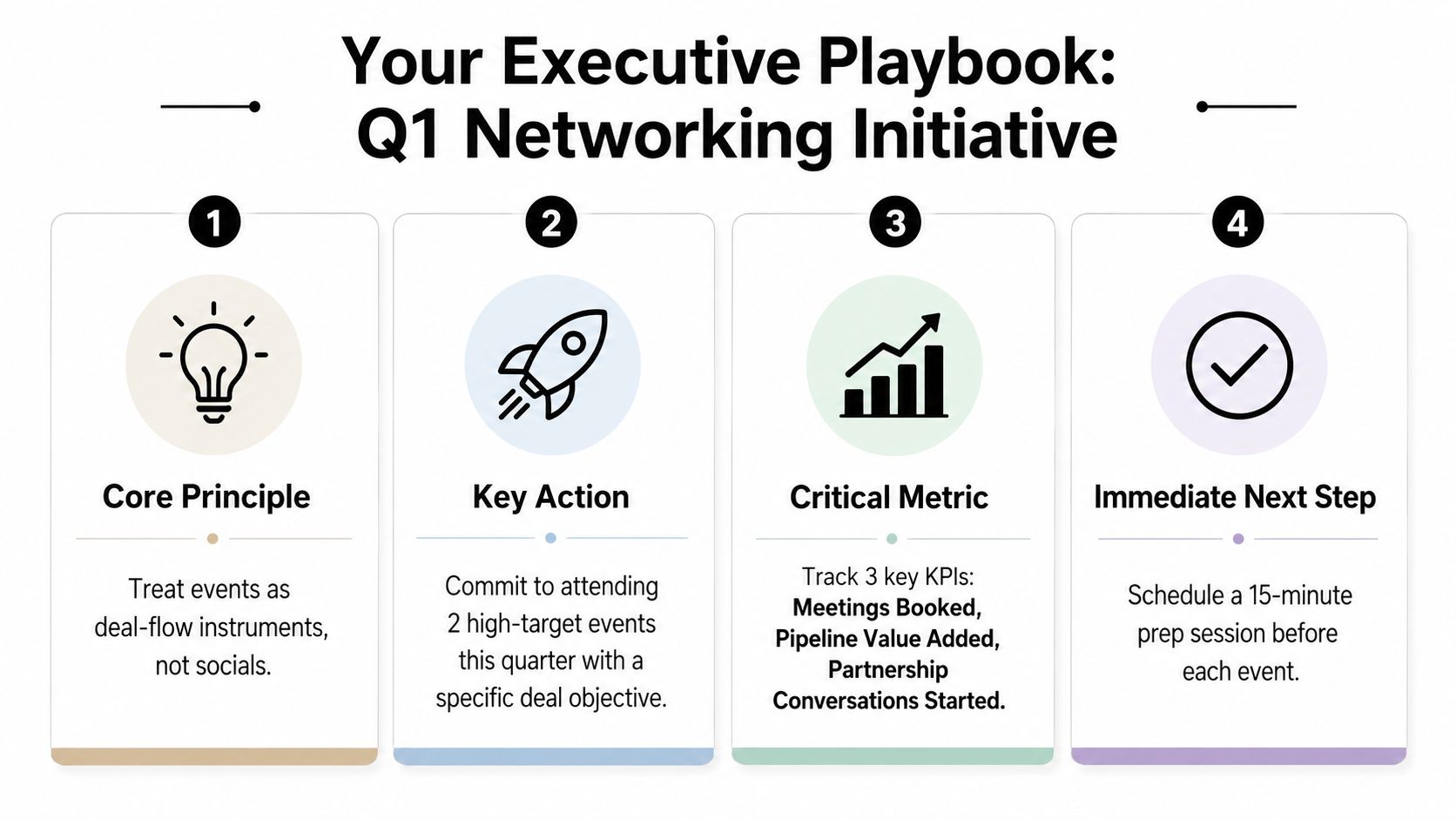
Your next three decisions should be simple. First, define the single objective for the next quarter of events. Second, audit your calendar against the audience, format, and host quality tests you just read. Third, decide whether your current network gives you enough signal, or whether you need to improve your access through a higher-quality membership environment.
What to do next
- Clarify the outcome: Pick one business result you want from networking this quarter.
- Audit every invite: Accept fewer rooms, but choose better ones.
- Upgrade the room: If the current mix is thin, move toward a curated platform with stronger curation and better introductions.
The future of executive networking is already shifting. AI matchmaking, hosted micro-events, and vetted peer networks are changing how leaders find each other and how quickly they decide whether to keep talking. That doesn't make in-person events less important. It makes them more valuable when they're designed well.
If you want a more selective way to approach business networking events, Haute Black is built for people who care about room quality, discretion, and introductions that matter. Visit Haute Black to explore a membership world where the right doors open, and the right rooms are already curated for you.
Explore Our Guides


Signature Experiences


