Haute Black Journal
Best Time to Visit Brazil Rio: 2026 Guide

Marlene Azeez
Director, HauteBlack
View all articles →

# Best Time to Visit Brazil Rio: 2026 Guide
June 23, 2026
At midnight on Copacabana, the beach can feel like the center of the world. A few months later, the same city can hand you a quiet sunrise over Ipanema, a calm lobby at Fasano, and enough breathing room to make Rio feel privately staged for you.
Defining Your Perfect Rio de Janeiro Experience
The best time to visit Brazil Rio isn't a single answer. It depends on whether you want the city at full volume or in its more refined register.
For some travelers, Rio is about spectacle. They want New Year's Eve on Copacabana, a table at the right after-party, a suite with a front-row view, and the kind of itinerary where every reservation matters because everyone else in the city is chasing the same moments. In that version of Rio, energy is the point.
For others, Rio is at its most seductive when it slows down. The beaches still shimmer, Sugarloaf still dominates the skyline, and the city still delivers beauty at every turn. But your experience becomes more private. Staff have more bandwidth. Doors open more easily. The trip feels less like competition and more like curation.
Two versions of Rio
There are really two luxury questions hiding inside the usual search for the best time to visit Brazil Rio.
| Travel style | What you're really asking |
|---|---|
| Event-driven | When will Rio feel most alive, even if logistics are harder? |
| Access-driven | When can I secure the best suite, yacht, table, and timing with less friction? |
| Romance-led | When does the city feel warm, elegant, and unhurried? |
| Family-led | When can everyone enjoy the outdoors without battling heat or rain? |
A generic weather summary won't help much if your actual concern is whether a penthouse terrace dinner can happen without a weather pivot, or whether helicopter logistics will feel smooth instead of oversubscribed.
The right season doesn't just shape the forecast. It shapes your access.
What works and what doesn't
What works is matching timing to intent. If the trip revolves around Carnival, Reveillon, or being seen, then compromise is built in. You accept heat, crowds, and aggressive booking windows because the social calendar is the product.
What doesn't work is booking peak Rio for a privacy-first trip and expecting the city to behave like low season. It won't. The same applies in reverse. If someone wants maximum pageantry, a quieter month may feel elegant but undercharged.
A better way to think about Rio is through contrasts:
- Vibrancy versus discretion
- Festival access versus operational ease
- Summer intensity versus dry-season comfort
- High-social-density travel versus spacious, personalized travel
The luxury lens that matters
At this level, timing changes more than atmosphere. It affects whether top suites are still in play, whether private yacht charters have real flexibility, whether a chef's table can feel intimate instead of rushed, and whether landmark experiences are polished or are crowded.
That is why the calendar matters so much in Rio. Not because one month is universally “best,” but because each season reveals a different city.
The Pulse of Peak Season December to March
I usually know within five minutes whether a client should book Rio in summer. If the brief includes a New Year's Eve table facing Copacabana, a private box for Carnival, or a yacht afternoon that rolls straight into dinner in Ipanema, December through March is the right answer. If the brief is privacy, flexibility, and last-minute choices, this season asks for compromises many luxury travelers do not enjoy.
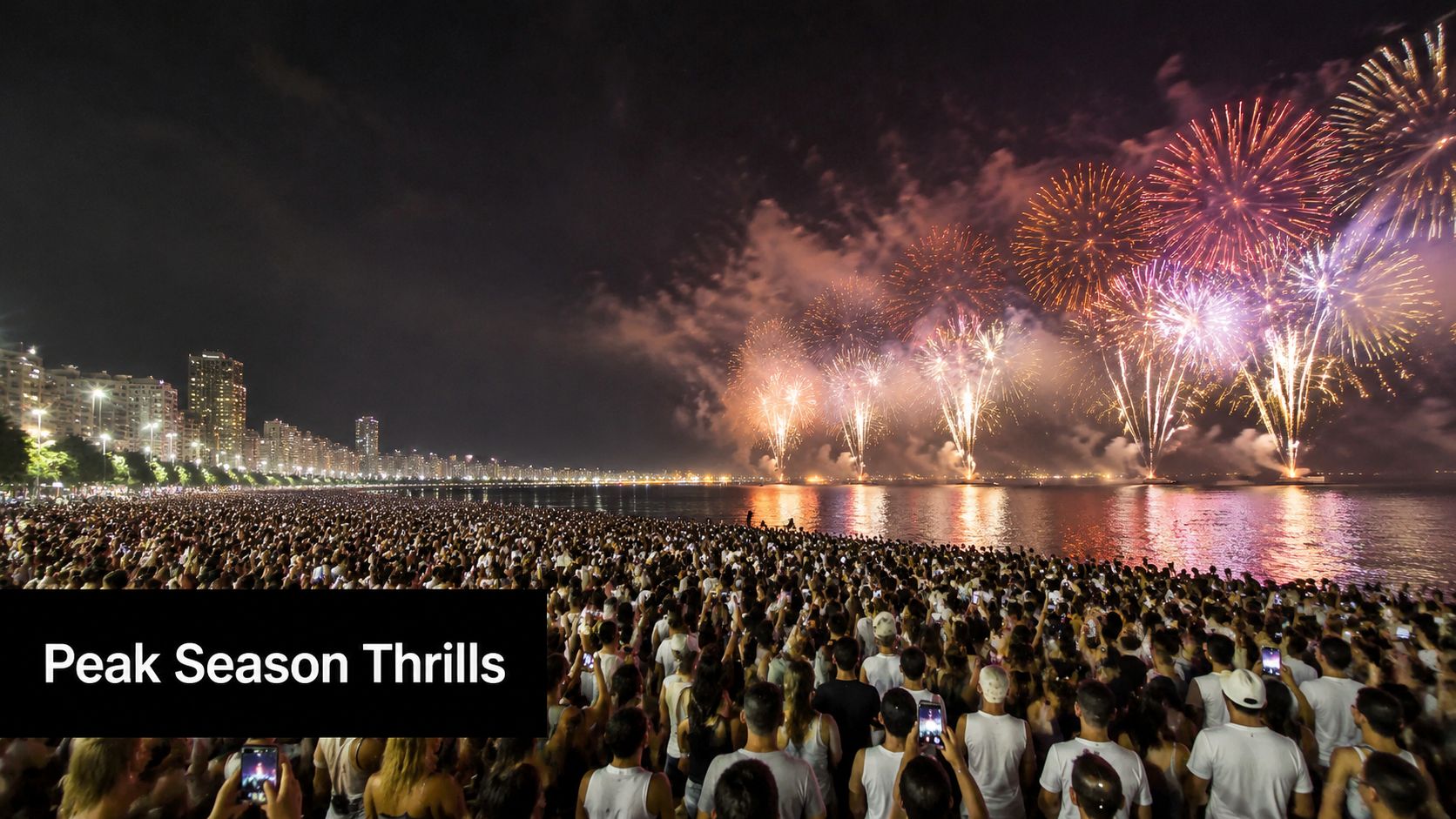
Rio's summer peak is the city at full volume. The beaches are animated, the social calendar is dense, and the atmosphere around Reveillon and Carnival is impossible to replicate in quieter months. Official tourism guidance from Riotur notes that Rio's Carnival period brings millions of revelers to the city, which explains why suite inventory, premium tables, and the best charter windows tighten so quickly, according to Rio's official Carnival information from Riotur.
Why clients still choose peak season
They book this window for access to Rio's defining public moments. A shoulder-season stay can be more polished, but it cannot reproduce the scale of Copacabana on New Year's Eve or the social momentum of Carnival week.
That distinction matters at the top end of the market. Peak season is not just busier. It is more competitive in the categories that matter most, including signature suites, top villa-style accommodations, prime beach club positioning, and yacht charters with strong crews on high-demand dates.
For January-specific trade-offs in weather, booking pressure, and luxury planning, this January Rio luxury travel guide is worth reading before you commit dates.
What “busy” means at the luxury end
Busy starts long before you see a crowd on the sand. It shows up in availability.
The best rooms often disappear first because experienced travelers and top advisors reserve them well ahead of festive dates. Restaurant teams protect prime tables for repeat guests. Marinas run on tighter schedules. Helicopter movements require more discipline because weather, traffic, and holiday congestion leave less room for casual timing changes.
Heat is part of the equation too. Rio's summer is hot, humid, and often draining in the middle of the day, especially for travelers trying to combine beach time with sightseeing and evening plans. The city's own climate profiles show that summer months are among the warmest and wettest, which is useful context when shaping a realistic itinerary, as outlined in the climate overview from Rio's municipal portal.
A well-built peak-season itinerary respects that rhythm:
- Early mornings for Christ the Redeemer, the Botanical Garden, or a guided architectural visit
- Midday for pool time, spa treatments, or lunch back at the hotel
- Late afternoon for the beach, a yacht departure, or a rooftop aperitif
- Evening for the city's strongest dining and social energy
Later in the season, the atmosphere builds even further.
Who should book this season
This is the right season for travelers who want Rio at its most social, most visible, and most kinetic. It works best for milestone trips, festive travel, and clients who are happy to commit early in exchange for front-row access.
Travelers who define luxury as quiet beaches, open schedules, and easier upgrades usually prefer another window. Summer Rio rewards planning, speed, and clarity about what matters most.
The Connoisseurs Choice April to May and September to November
A client once asked for Rio with the city still switched on, but without the feeling that every suite, table, and yacht berth had already been claimed by someone louder. These are the months I recommend for that brief.
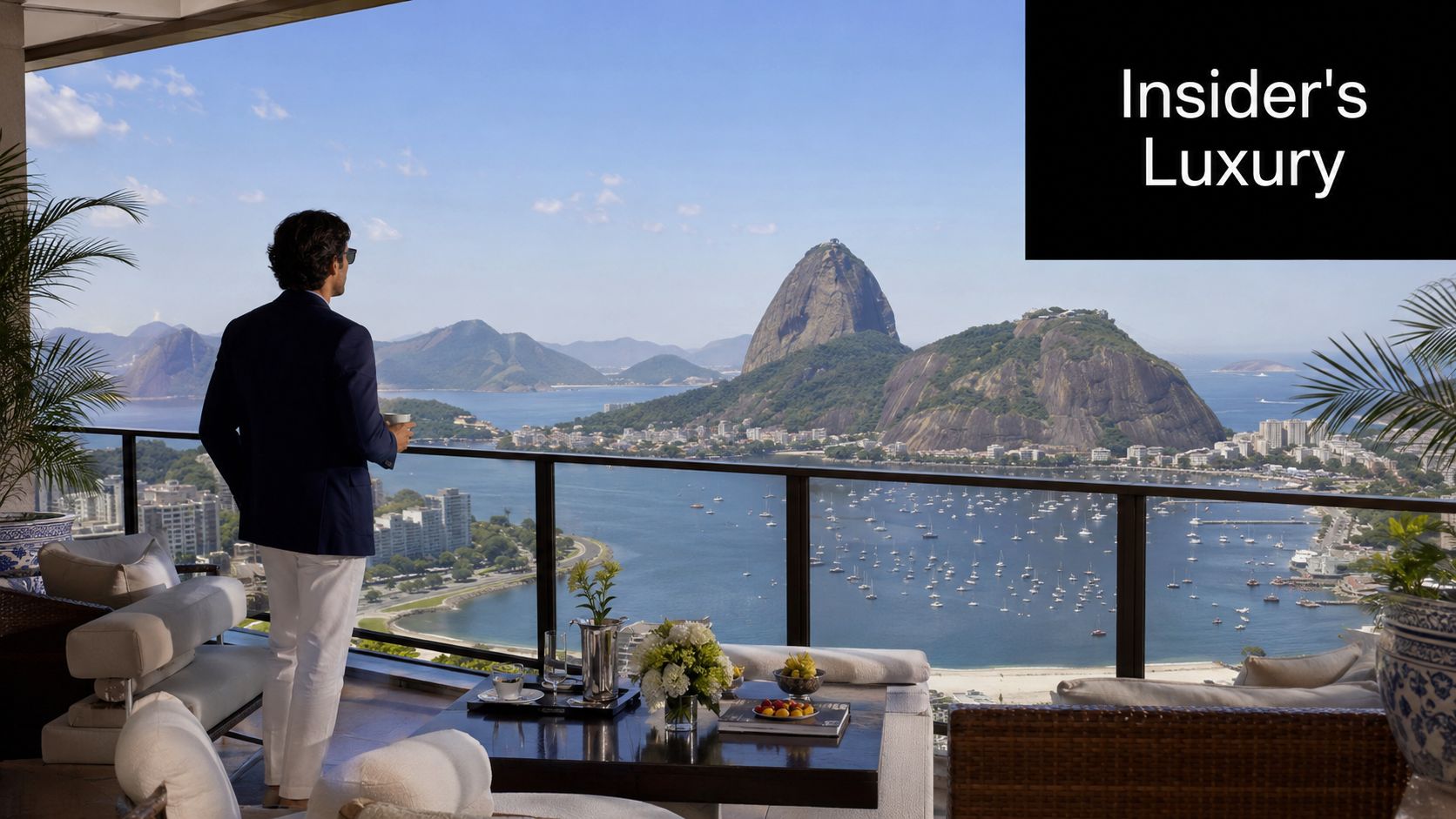
April to May and September to November tend to give Rio its best balance of warmth, access, and composure. Days are still comfortably warm, usually around 22°C to 28°C (72°F to 82°F), but the city feels less compressed than it does in high summer. For a luxury traveler, that shift matters less because of price alone and more because timing starts working in your favor again. As noted in this Brazil shoulder season guide from Jacada Travel, these periods are widely regarded as quieter than the summer rush, with better value and lighter demand.
Why this window performs so well
The advantage here is operational. Top hotels are still lively, beach clubs still have energy, and the city still looks and feels like Rio. But your concierge has more room to shape the trip around your preferences instead of negotiating around scarcity.
That changes the quality of the stay.
At the best addresses, shoulder season usually brings a stronger chance of securing the suite category that truly suits the trip, whether that means a front-facing ocean room in Ipanema or a larger connecting setup for a family. Restaurant bookings also become easier to place at the right hour, not just at whatever time remains. The same applies to private guides, drivers, yacht charters, and last-minute refinements that are much harder to arrange cleanly in peak season.
The real luxury advantage
The primary appeal is not discount hunting. It is control.
In these months, Rio often feels more generous with access. A sunset sail can be timed for light rather than availability. A private art or architecture visit can run at a civilized pace. Even iconic moments, such as Christ the Redeemer or Sugarloaf, are easier to build into the day without forcing the rest of the itinerary into an awkward shape.
That is the trade-off. You give up some of the social voltage of December through March, but you gain a city that is easier to command.
For privacy-minded travelers, this window is often the smartest choice. Beaches feel less theatrical. Hotel terraces feel more relaxed. Staff at top properties usually have more bandwidth, which a seasoned traveler notices immediately in the tone of service.
Who should choose these months
This period works especially well for:
| Traveler profile | Why shoulder season works |
|---|---|
| Couples and honeymooners | Warm weather, a more intimate rhythm, and better odds on the suites people actually want |
| Repeat visitors | More space to explore galleries, neighborhoods, and dining without peak-season pressure |
| UHNW families | Easier logistics, better room inventory, and more flexibility for custom pacing |
| Privacy-minded travelers | Stronger access to exclusive arrangements without the peak-season scramble |
Travelers coming specifically for Carnival-scale spectacle should book another season. Travelers who care more about suite quality, polished service, and clean VIP execution usually find this the most attractive window in Rio.
The Serenity of Winter June to August
Rio in winter surprises people. Not because it stops being Rio, but because it becomes calmer, drier, and easier to command.
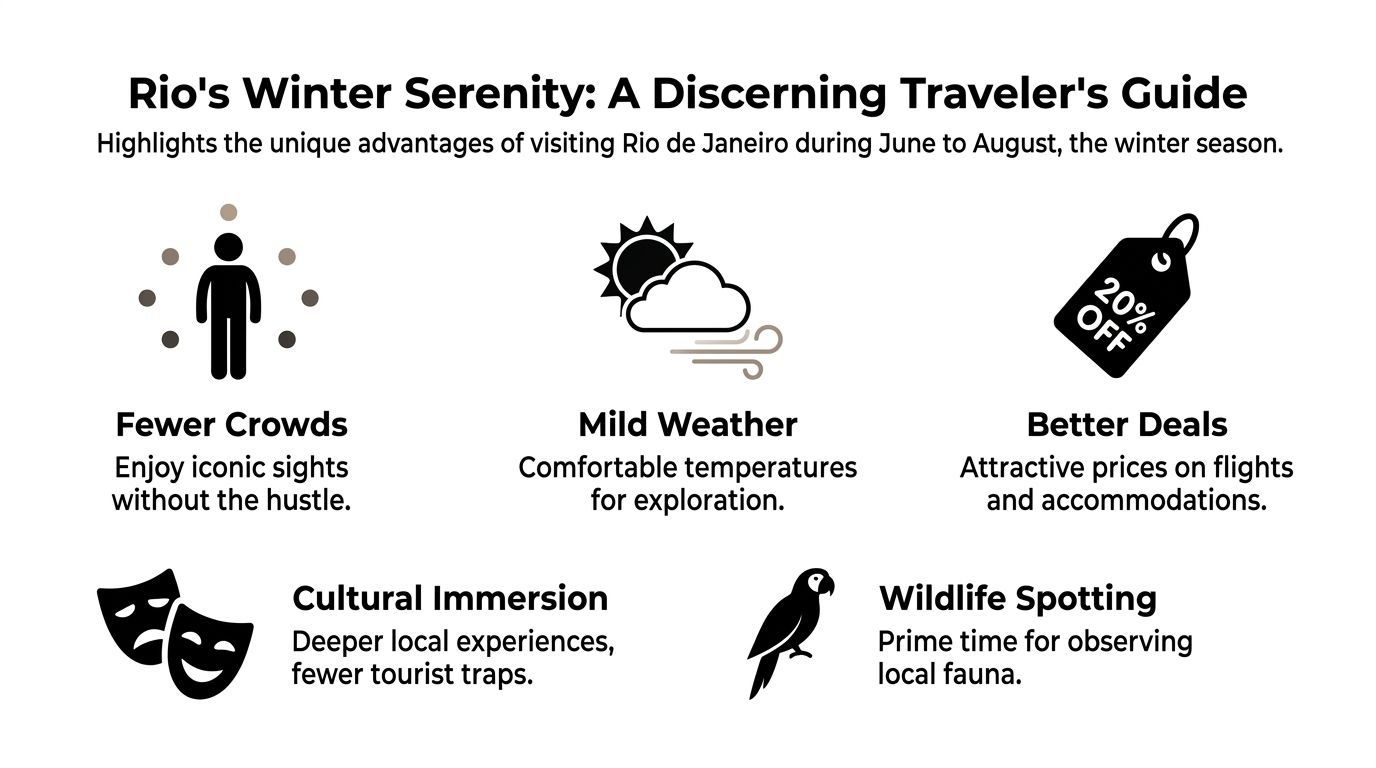
The city's driest and most stable weather occurs from late May to late September, with average temperatures between 18°C (64°F) at night and 28°C (82°F) in the afternoon. This period minimizes the risk of heavy rain, making it ideal for planning high-stakes luxury activities like private yacht charters, helicopter tours, and open-air events, based on this Rio year-round weather analysis.
Why winter is better than many travelers assume
If summer is Rio at full spectacle and shoulder season is Rio in balance, winter is Rio with breathing room. The city still gives you sea, mountains, architecture, and light. But the pressure comes off.
That changes the texture of the trip. You can build around outdoor plans with greater confidence. Scenic flights, yacht days, rooftop lunches, and open-air celebrations become easier to stage because weather is less likely to interrupt the day.
The quieter rhythm also suits clients who dislike overexposed travel. June through August often delivers the version of Rio that feels most composed.
Comparing winter with the rest of the year
| Factor | June to August | December to March |
|---|---|---|
| Atmosphere | Quiet, spacious, polished | High-energy, social, crowded |
| Weather feel | Drier and milder | Hotter and more humid |
| Outdoor logistics | More stable for timing-sensitive plans | More vulnerable to heat and rain disruption |
| Access | Better availability for exclusive arrangements | More competition for premium inventory |
One overlooked advantage is how well winter works for multigenerational travel. Grandparents, children, and anyone sensitive to heat usually move through the city more comfortably in this season. Outdoor lunches last longer. Sightseeing feels less exhausting. The day doesn't need such an aggressive split between activity and recovery.
The version of luxury winter serves best
Winter is strongest for travelers who define luxury as control. Not control in a rigid sense, but control over pacing, privacy, and operational reliability.
That makes it particularly strong for:
- Villa or residence stays where the property itself is part of the experience
- Photo-led trips that need cleaner light and better visibility
- Celebratory travel centered on outdoor hosting
- Family travel where comfort across age groups matters
In winter, Rio stops demanding attention and starts offering space.
What winter doesn't provide is the feverish social atmosphere that many travelers associate with the city from glossy seasonal imagery. If someone wants nonstop motion, this season may feel understated. If they want a city that can be shaped around them, it often feels ideal.
Curating Your Bespoke Rio Itinerary
A client once asked for "the best week in Rio," as if the city offered one perfect answer. It does not. The right week depends on what they want most, and what they are willing to give up to get it. In Rio, timing decides whether you secure the suite everyone wants, get first choice of yacht and helicopter slots, or spend the trip competing with the crowd for access that should have been secured in advance.
For UHNW travelers, the strongest windows are usually April to June and September to November. Those months give me more room to shape the trip properly. The best hotels are less compressed, top tables are easier to hold at the right hour, and private operators have more flexibility for custom routing. December to January works best when the trip is built around a specific social moment such as New Year's Eve or Carnival. In that period, the city's energy is unmatched, but the trade-off is obvious. You are buying atmosphere and access to major events, not ease.
For inspiration on the experiences worth prioritizing, this luxury guide to the best things to do in Rio de Janeiro is a strong companion.
The Carnival insider
Carnival suits travelers who want Rio at full volume. The city is glamorous, social, and demanding. Every strong itinerary starts with protected positioning. That usually means a top suite at Copacabana Palace or Fasano Rio de Janeiro, then building the schedule around the night's headline events rather than trying to layer sightseeing on top.
The best Carnival programs stay disciplined. VIP Sambadrome access matters, but so do controlled arrivals, fast exits, and enough daylight recovery to keep the evenings enjoyable. I usually keep daytime plans deliberately light. A spa treatment, a long private lunch, or time at a villa gives the trip shape and prevents exhaustion from dulling the main event.
What works well:
- VIP Sambadrome seating with escorted logistics
- tightly timed transfers and security planning
- one marquee evening, not too many competing ones
What weakens the trip:
- chasing public attractions between late nights
- assuming premium upgrades will appear last minute
- treating Carnival week like a standard city break
The romantic May escape
May is one of Rio's most flattering months for couples. The city still feels warm and seductive, but the pressure drops. That shift changes everything for a luxury traveler. Hotels feel calmer, service feels more personal, and the day can unfold at a pace that allows for pleasure.
A strong romantic program might include a sea-view suite, a private cooking session, a sunset sail on Guanabara Bay, and one polished dinner balanced with slower lunches in Leblon or Jardim Botânico. The advantage is not only comfort. It is access. In May, it is easier to secure the exact room category, the exact departure time on the water, and the kind of table placement that makes the evening memorable.
Book Rio for romance while the city still feels warm, polished, and unhurried.
The September cultural immersion
September is particularly good for travelers who care about Rio beyond the beach image. This is when the city is easiest to read in layers. Art, design, architecture, and food can take the lead without the itinerary feeling squeezed by heat, traffic pressure, or social overbooking.
A well-shaped September stay often includes an early private visit to Christ the Redeemer or Sugarloaf, an unhurried lunch, an afternoon focused on galleries or design, and a dinner chosen for the room as much as the menu. Santa Teresa works especially well in this season, paired with time in the beachfront neighborhoods so the trip still carries Rio's visual drama. For clients who want a city with texture rather than pure spectacle, September is often the better choice than summer.
The winter family reset
June through August can be the smartest fit for families, particularly when the group includes grandparents, younger children, or anyone who tires quickly in heat. The city becomes easier to handle. Days hold together better. Plans do not need such a sharp split between activity and recovery.
A family itinerary in winter can combine a beachfront hotel stay with a private yacht afternoon, a helicopter overflight, and cultural stops that still feel manageable by midday. That matters more than many travelers expect. Luxury family travel is rarely about doing more. It is about keeping everyone comfortable enough to enjoy what you chose well.
The pattern across all four itineraries is consistent. In Rio, season is not background information. It determines whether the trip feels exclusive, energetic, or beautifully under your control.
Beyond Rio Timing Your Brazilian Journey
Rio is often one stop in a broader Brazil itinerary, and that's where timing mistakes get expensive. The month that works well for beach time in Rio may not be the strongest fit for the rest of the country if the trip includes wildlife, jungle access, or another coastal chapter.
One nuance many mainstream guides miss is that while December through March gets the most attention, the quieter months of June to August offer ideal weather in Rio with lower humidity and highs of 24–27°C, plus greater capacity for securing private boats, heli-tours, and exclusive cultural experiences, as noted in this Rio timing perspective for luxury travelers.
For a wider planning framework, this best time to go to Brazil luxury travel guide helps map Rio against the country's other major destinations.
How to think about multi-stop timing
Start with the trip's primary purpose.
If Rio is the headline and the rest of Brazil is supporting cast, choose the best Rio window first. If wildlife or deep nature is your primary consideration, Rio may need to flex around that.
A practical approach looks like this:
- Choose Rio first if the trip centers on beaches, city glamour, New Year's Eve, or Carnival.
- Choose the Amazon first if comfort in remote lodges and smoother conditions matter more than urban social energy.
- Choose the Pantanal first if wildlife viewing is the emotional centerpiece.
- Choose Bahia and Trancoso in sync with Rio if the goal is a polished coast-to-coast summer or shoulder-season beach journey.
What works by trip style
Rio pairs especially well with a few different Brazil combinations.
| Trip style | Best planning logic |
|---|---|
| Rio plus Trancoso | Strong in summer for beach energy, strong in shoulder season for style with less intensity |
| Rio plus Amazon | Best when you want city glamour balanced by a very different natural setting |
| Rio plus Pantanal | Best when wildlife is central and Rio acts as the elegant urban bookend |
| Rio only | Gives the most control over exact season and access priorities |
The mistake is trying to force all of Brazil into one idealized weather fantasy. Brazil is too large and too varied for that. A strong itinerary accepts that one leg may be about social electricity while another is about serenity or wildlife.
The sequencing matters
In practice, Rio often works best either at the beginning, when clients want to arrive into high service and iconic scenery, or at the end, when the city serves as a polished finale after remote exploration elsewhere in Brazil.
For travelers who value private access, Rio in a quieter month can be the relief valve inside a larger itinerary. It gives you breathing room after complex jungle or inland logistics. For event-driven travelers, it can also be the crescendo.
That sequencing decision matters almost as much as the month.
Essential Planning for Your Rio Voyage
Once you've chosen your season, the remaining work is about protecting the experience. Rio rewards elegant planning and punishes casual assumptions, especially at the top end of the market.
Handle entry and documentation first
Visa and entry requirements depend on passport and nationality, and they can change. Confirm them directly with the relevant official authorities before ticketing flights or locking in non-refundable arrangements.
For executive assistants and family offices, this should be the first checklist item, not the last. Entry compliance is mundane until it ruins a departure day.
Build airport and arrival strategy properly
For premium arrivals, the question is not only how to get from the airport to the hotel. It's how to avoid friction after a long-haul flight.
A good Rio arrival plan usually includes:
- Meet-and-greet support for faster handling through the terminal
- Pre-arranged secure ground transfers with a trusted driver
- Helicopter coordination when appropriate for specific routing or time-sensitive schedules
- Direct hotel communication so the room is fully staged on arrival
This matters more in high-demand periods, when small delays compound quickly.
Match security to profile, not fear
Security in Rio should be calibrated, not theatrical. Publicly visible over-securitization can be as disruptive as underplanning.
For most affluent travelers, the right approach is discreet. Think trusted drivers, careful routing, controlled pickup points, and reservations that reduce unnecessary waiting. Higher-profile clients or families with a significant public footprint may want dedicated protection, but that decision should reflect profile and movement pattern rather than anxiety alone.
The smartest Rio logistics are often the least visible.
Book the right things early
Peak event travel requires a different booking mindset than shoulder or winter travel. If the trip is built around New Year's Eve or Carnival, premium inventory tightens first at the very top of the market. That includes elite suites, best-positioned event access, and highly specific private arrangements.
By contrast, quieter months let you keep more optionality deeper into the planning cycle. That doesn't mean waiting is wise. It means your advantage is greater and your alternatives are stronger.
A practical planning sequence is:
1. Lock dates around the core purpose of the trip.
2. Secure the room category, not just the hotel.
3. Confirm key access items early, especially private air, yachts, and event tickets.
4. Layer dining, wellness, and touring after the backbone is in place.
5. Keep one or two flex windows in the itinerary for weather, mood, or spontaneous invitations.
Pack for the season you actually chose
Rio packing mistakes usually come from assuming “tropical” means one uniform wardrobe. It doesn't.
Summer calls for lightweight fabrics, quick changes, and a plan for heat. Shoulder season benefits from polished daywear and light evening layers. Winter still reads as warm by many standards, but the evenings can justify a sharper outer layer, especially on the water or on a terrace.
The best packing strategy isn't more luggage. It's better editing. Rio is one of those cities where a tightly considered wardrobe performs better than an overpacked one.
If you're planning Rio with privacy, preferred status, and hard-to-secure access in mind, Haute Black can design the trip around the season that fits your goals, whether that means Carnival-level energy or a quieter, fully bespoke escape.
Explore Our Guides


Signature Experiences


