Haute Black Journal
10 Luxury Travel Hacks for VIP Access

Marlene Azeez
Director, HauteBlack
View all articles →

The most valuable luxury travel hacks rarely involve finding a cheaper rate. They involve choosing the right booking relationship, documenting preferences, timing requests, protecting privacy, and coordinating every handoff before arrival. A room upgrade matters more when the property already knows the preferred view, arrival time, dietary requirements, and reason for travel.
That operating model matters to executive assistants and ultra-high-net-worth travelers managing complex schedules. The right advisor can connect hotel recognition, private aviation, villa access, security planning, events, dining, and ground transportation into one coordinated journey instead of a chain of disconnected reservations. The trade-off is simple: a transactional booking may be adequate for a straightforward stay, while a relationship-led booking earns its value when discretion, flexibility, and continuity matter.
HauteBlack is a relevant example of this approach, but every tactic should match the traveler's priorities, itinerary complexity, and need for privacy. A honeymoon, a multigenerational holiday, and an executive trip require different forms of strategic advantage. The best starting point is to decide whether the trip needs a better rate, better access, better protection, or all three.
For destination inspiration, explore these options to find luxury safaris in Africa. Then build the trip around the relationships and timing that will improve the experience before departure.
1. Leverage Virtuoso Affiliation for Unparalleled Hotel Benefits
A luxury hotel reservation should carry more than a confirmation number. Through a Virtuoso-affiliated agency, the booking can be connected to property benefits such as upgrades when available, resort credits, flexible arrangements, and priority recognition. HauteBlack's Virtuoso Advantage turns the booking channel into part of the experience rather than a back-office transaction.
The practical distinction is control. A standard reservation may record dates and room category. A relationship-led reservation can also communicate the preferred suite location, celebration details, arrival expectations, and the type of credit that will be most useful. At a Four Seasons, that could mean prioritizing a villa-style accommodation when inventory allows. At Aman, a traveler may prefer to direct an available resort credit toward a spa treatment or private experience rather than retail.
Turn benefits into decisions
Ask the advisor to document the preferences that matter most, then request that the hotel confirm them before arrival. Upgrade requests should be specific. “Best available upgrade” is less useful than “prioritize a quiet upper-level room with an unobstructed water view.”
Practical rule: Use resort credits for experiences you already intend to book, such as dining, wellness, or guided activities, rather than accepting an amenity that doesn't fit the itinerary.
A Virtuoso booking can also work alongside hotel loyalty status. The two channels serve different purposes, so the traveler should disclose all relevant memberships before the reservation is finalized. The hotel then has a clearer picture of both the commercial relationship and the guest's personal history.
Book early enough for the advisor and property to coordinate special requests, but don't treat an upgrade as guaranteed. The stronger objective is a well-positioned reservation with recognition, useful inclusions, and a documented preference profile.
2. Master the Dedicated Luxury Travel Advisor Strategy
A dedicated advisor should operate as part of the traveler's private office. Give that person decision-making context, not only a destination list. Share pillow and dietary preferences, children's routines, business obligations, preferred pace, privacy requirements, and tolerance for transfers. This information lets the advisor act without repeatedly interrupting the client.
For executive assistants, one accountable contact can coordinate a principal's hotels, family arrangements, transport, dining, and urgent changes while maintaining continuity across journeys. The advisor should also prepare viable alternatives before a delay, cancellation, or security concern becomes an emergency.
Give the advisor operating intelligence
Share preferences before planning begins. If one traveler starts early and another needs a slower morning, build that difference into the schedule. For a multigenerational trip, separate activities by pace while protecting shared meals and the occasions that matter to everyone.
Complex itineraries need a defined planning runway. For travel across several properties, provide business commitments, passport and privacy requirements, dietary information, celebration dates, and fixed arrival windows. Ask for one itinerary file covering transfer details, contact information, cancellation terms, and contingency plans. That document gives the assistant and the traveling party one reliable operating reference.
Virtuoso has reported a 76% increase in consumers seeking travel advisors through its platform. Its 2025 Global Luxury Traveler Report also found that 75% of clients ranked safety and security as a leading planning concern, while 65% identified an advisor's added layer of protection as the main benefit. These figures appear in Virtuoso's fall travel trends report.
Use an advisor when the itinerary involves operational risk, several stakeholders, or meaningful privacy requirements. Direct booking works for a straightforward stay. A complex journey needs a coordinated channel that connects relationships, timing, transport, security, and recovery plans.
3. Optimize Travel Timing Through Seasons and Events
Timing is the most overlooked luxury travel hack because it requires calendar discipline rather than clever checkout behavior. Choose the destination window first, then fit the personal event into it where possible. Shoulder seasons can deliver a quieter property, better staff attention, and more comfortable sightseeing without sacrificing the character of the destination.
The decision should account for weather, crowd density, property availability, cultural programming, and transport. A September Côte d'Azur trip may suit a traveler who wants the region's atmosphere without the intensity of the summer calendar. A villa itinerary in the Caribbean may work better when privacy and availability matter more than being present for the busiest social week.
Build a destination calendar
Create a forward-looking calendar with three layers:
- Seasonal conditions: Identify the period that best supports the trip's central activity, whether that's swimming, skiing, wildlife viewing, or cultural touring.
- Event alignment: Place Art Basel, Cannes Lions, major sporting occasions, or private celebrations into the planning conversation before hotels and aviation are secured.
- Crowd avoidance: Ask the advisor where demand is concentrated and which nearby destination can deliver a comparable experience with greater privacy.
Recent reporting indicates that 45% of Virtuoso advisors say clients are changing plans to avoid peak-season congestion, while 76% choose shoulder or off-peak windows and 75% favor moderate-climate, low-infrastructure destinations. The same 2026 luxury travel coverage reports fall bookings up 25%, European summer bookings down 10%, and villa or private accommodation demand up 7% year over year.
Those figures point to a clear shift. The strongest luxury experience may come from changing the date or the geography, not from negotiating the rate. Ask for the destination's “secret season,” then decide whether the weather and access trade-off suits the traveler.
4. Integrate Private Aviation for Time Multiplication
Private aviation earns its place when time, confidentiality, or routing matters more than comparing fares. It removes the fixed sequence of commercial schedules and lets the itinerary follow the traveler's working or family timetable. For an executive, the cabin also provides a controlled setting for communication and preparation.
Use it selectively. A private aircraft is most compelling when the journey includes an awkward connection, several travelers with different needs, a remote destination, or a same-day business commitment. Families with infants, multigenerational groups, and travelers with medical requirements may value the controlled environment and predictable handoffs.
Match the aircraft to the itinerary
Start with the route, not the aircraft category. Ask the aviation partner to assess departure location, runway access, luggage, pets, medical considerations, ground transfers, and the required arrival window. Then connect the flight plan with the hotel or villa, so the driver, property representative, and staff team are ready at the right moment.
A Miami departure followed by a Caribbean villa arrival shows the advantage. The traveler can hold a morning meeting, board without the conventional airport sequence, and arrive at a property prepared around that same schedule. The gain comes from coordinating aviation, ground transport, and accommodation as one operating plan, not from the aircraft alone.
Private aviation should protect the trip's most valuable constraint, whether that's a board meeting, a family transition, or a confidential conversation.
For a detailed editorial overview, see HauteBlack's private jet luxury travel guide. HauteBlack can coordinate private aviation with hotels, villas, helicopter transfers, and ground transport, allowing the advisor to manage each handoff instead of leaving the traveler to reconcile separate providers.
5. Access Exclusive Private Villas and Estates
A private villa is a coordination advantage, not merely a larger room. It gives families a shared base with private suites, common areas, staff support, and space for different routines. Couples keep their privacy, executives gain a discreet setting for meetings, and families control meals, schedules, and access without splitting the group across hotel floors.
Choose the property around the group's operating needs. An eight-bedroom Côte d'Azur estate with a chef and butler suits a large family gathering. A Turks and Caicos compound can support an executive retreat with separate accommodations and a confidential meeting area. A Bali estate with wellness facilities fits travelers who want yoga, spa treatments, and shared meals without leaving the property.
Inspect the operational details
Request a walkthrough video before confirming an extended stay. Verify bedroom separation, accessibility, pool safety, staff hours, arrival procedures, kitchen capability, internet privacy, and distance to medical support. Photos establish the design. A walkthrough shows whether the estate can handle the actual travelers.
Use a pre-arrival consultation to record dietary requirements, preferred cuisine, children's routines, celebration details, and service expectations. Book the private chef early enough to source suitable ingredients and understand the group's preferences. Set the desired level of staff visibility before arrival, especially when the itinerary includes confidential work or family time.
For property options across the Mediterranean, Caribbean, and Asia, review HauteBlack's private villas and estates service. Pair that search with the Irie Tulum Boutique Hotel villa guide when Tulum fits the destination plan. The advisor should know whether the priority is romance, family connection, wellness, entertaining, or confidential work before recommending a property.
A villa is not automatically more luxurious than a hotel. It is the better choice when the group gains meaningful space, privacy, and control over its daily rhythm. The booking channel matters because the right relationship can align staffing, arrivals, dining, and local support before the travelers land.
6. Cultivate Membership Status for Exponential Benefits Stacking
Membership status becomes valuable when it removes friction across several categories at once. A dedicated advisor, preferred hotel access, private aviation coordination, event invitations, and concierge support can work as one layer around the traveler's existing relationships and loyalty memberships.
Hotel loyalty remains important, but the reward mechanism is moving beyond points alone. McKinsey reports that 68% of luxury travelers, compared with 41% of mass travelers, consider loyalty programs important when choosing accommodations. Its analysis also emphasizes recognition, knowledge of preferences, and exclusive privileges over points redemption. This finding appears in the 2026 luxury travel report coverage.
Measure value by friction removed
Before joining a private travel membership, list the services the household already pays for separately. Include advisor time, itinerary research, emergency coordination, event access, aviation support, villa sourcing, and introductions. Then identify which services would otherwise require separate conversations and repeated explanations.
A frequent traveler may value the membership for continuity. An executive assistant may value a single accountable relationship. A family may value the ability to transfer established preferences from one property to the next without rebuilding the file each time.
The financial calculation isn't the only consideration. Peace of mind has operational value when the itinerary includes several countries, multiple travelers, or high-profile events. Membership should therefore be assessed against the complexity and consequence of the travel, not just the number of nights booked.
Use the event calendar actively, keep the preference profile current, and tell the advisor which benefits matter most. Status only compounds when the traveler gives the network enough information to act intelligently.
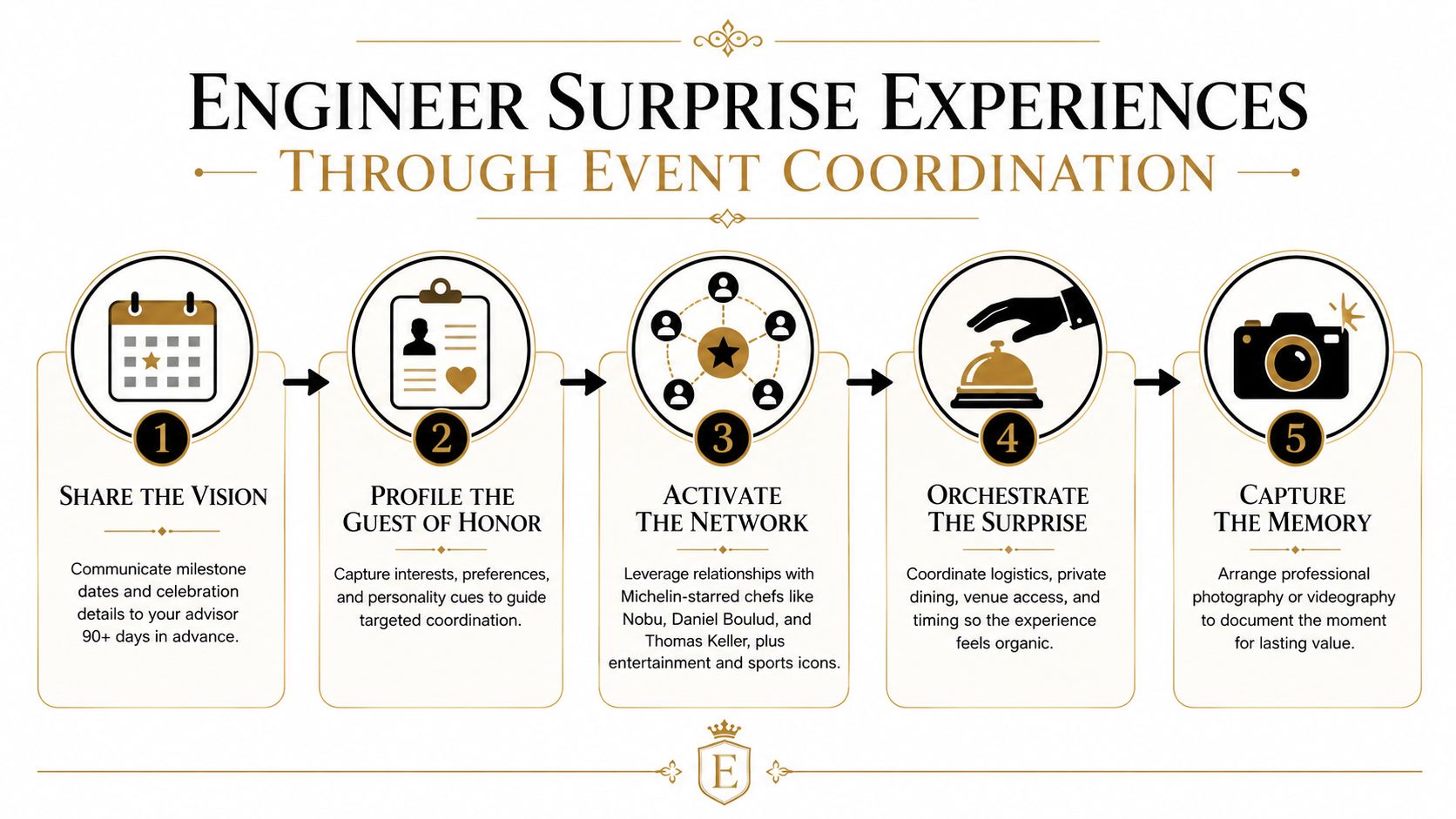
7. Engineer Surprise Experiences Through Event Coordination
A memorable surprise feels spontaneous to the guest, but the advisor should treat it as a production. The work includes access, timing, transport, privacy, dietary coordination, guest-of-honor intelligence, and a fallback plan. This is why a private culinary evening, after-hours cultural visit, or sports access should be discussed well before arrival.
HauteBlack and Haute Living curate 80+ annual events, including private chef dinners and cultural evenings involving names such as Nobu, Daniel Boulud, and Thomas Keller. Those relationships can inform a milestone celebration, but the right match depends on the guest's actual interests. A famous name isn't a substitute for relevance.
Give the advisor the emotional brief
Explain what the celebration should feel like. A 50th birthday may call for a high-energy sporting experience followed by a private dinner. An anniversary may demand intimacy, excellent service, and no public schedule. A business milestone may be better served by a discreet roundtable with compatible founders and executives.
Allow flexibility in the final detail. Surprise experiences need room to adapt to weather, transport, guest energy, and the availability of the people involved. The advisor should know the essentials, but the presentation can remain fluid.
The guest should experience the moment, not the logistics behind it.
Share the date and concept early, then provide the guest's interests, dietary requirements, mobility needs, and preferred level of visibility. Arrange photography or video only if it suits the traveler's privacy standards. A well-produced memory should never create a new security concern.
8. Coordinate Multi-Destination Itineraries for Smooth Transitions
A multi-destination journey succeeds through coordination between stops. Excellent hotels can still produce an exhausting trip if luggage, dietary requirements, transfer timing, check-in expectations, and activity levels are managed independently. The advisor should maintain one operating plan across every handoff.
A detailed itinerary might combine Miami business meetings, a Caribbean villa, a Côte d'Azur hotel, an alpine property, and a London return. That sequence requires more than reservations. It needs transport windows, luggage instructions, arrival contacts, weather contingencies, and a shared preference record available to every responsible team.
Design the journey as one system
Start with fixed commitments, then place time-sensitive inventory around them. Secure villas, aircraft, helicopters, high-demand suites, and event access before adding flexible activities. Leave recovery time between major movements so one delay does not force the traveler to sacrifice the next experience.
Use one preference brief for the entire journey:
- Diet and wellness: Carry allergies, preferred meal timing, fitness routines, and medical requirements from property to property.
- Pace and privacy: Mark which days require quiet and which can support long excursions or social events.
- Luggage and transport: Assign responsibility for transfers, storage, unpacking, and special equipment before departure.
An Asian itinerary might move from Bangkok to Bali, the Maldives, Phuket, and Hong Kong. The traveler should not repeat the same dietary or room requirements at every stop. The advisor and concierge teams should share those details in advance, then confirm only what has changed.
Use private aviation or helicopter transfers when they materially improve the plan. The right test is whether the movement protects time, privacy, or energy. For executive assistants, each transition should have an owner, a confirmation deadline, and a recovery option.
The visual process helps assistants assign ownership before departure. Every stage needs a named person responsible for confirmation and recovery.
Review the final movement plan with the advisor. Confirm arrival calls, vehicle details, luggage handling, and the response if a flight or activity changes. This turns separate bookings into one controlled travel operation.
9. Use Preferred Partner Status to Secure Negotiated Benefits
Preferred partner status gives the booking relationship a direct line to the property. That connection can support practical requests such as room placement, later departures, special amenities, private excursions, and attention from hotel leadership. The value lies in having requests assessed by someone who knows the property's inventory, priorities, and operating limits.
A traveler booking a Four Seasons, Aman, Rosewood, Belmond, or Ritz-Carlton should state the priority clearly. An oceanfront suite, a quiet room away from lifts, adjoining rooms, and a private yacht arrangement each require a different conversation. “VIP treatment” is too vague to guide a reliable result.
Make the request operational
Send the preference profile before arrival. Ask the advisor to identify the property contact handling special arrangements, then mention the booking channel at check-in so the front office can connect the reservation with the relevant partner relationship. A direct reservation should not be expected to receive the same advocacy.
Specific, commercially reasonable requests produce better decisions. Ask for the best available room placement, a later departure if inventory allows, or an experience that suits the purpose of the stay. The property can then provide a clear approval, refusal, or alternative.
Peak periods increase the value of this relationship because rooms and staff attention are limited. Preferred status does not override availability, but it can improve communication when the hotel is busy. It also gives the property useful information for personalizing the visit.
Choose a booking channel that advocates before arrival, rather than just processing payment. The room category sets the baseline. The relationship around that category often determines whether the stay feels standard or deliberately arranged. For executive assistants, record the preferred contact, request deadline, and approved fallback so the relationship remains useful across future bookings.
10. Cultivate AI-Powered Networking Within a Verified UHNW Community
Luxury travel membership can extend beyond hospitality by connecting travelers with a curated professional community. HauteBlack's AI-powered network connects verified founders, executives, investors, athletes, and creators through shared interests, locations, business priorities, and values.
Introductions become useful only when the underlying profile is specific. A detailed profile helps an advisor distinguish between an industry conversation, an investment discussion, a board-level connection, and a social introduction during a particular trip. Executive assistants should keep those preferences current, including geography, sectors, relationship goals, and privacy boundaries.
Treat networking as part of the itinerary
An Aspen visit could include an introduction to a founder in a relevant sector. A Miami stay might create an opportunity to meet a peer managing a similar regulatory or operating challenge. Coordinate these conversations around the traveler's schedule, with appropriate discretion and context. An introduction is an invitation, not an obligation.
Complete the profile with genuine interests and values. Opt into introductions deliberately, then tell the advisor which business priorities deserve attention. Attend private events selectively. In-person context gives the network better information and creates a natural setting for conversation without forcing a transactional meeting.
After an introduction, respond professionally. A brief acknowledgment, relevant follow-up, and respect for the other person's time work better than an aggressive pitch. The advisor can frame the connection so the recipient understands why the introduction fits, while the traveler decides whether to continue the relationship.
The result may be a business partnership, an investment conversation, a board opportunity, or a useful professional relationship. The operating advantage comes from coordinating the profile, timing, advisor, event, and follow-up in one trusted system. Curated access and trust matter more than collecting contacts.
10 Luxury Travel Hacks Comparison
| Strategy / Item | Implementation Complexity (🔄) | Resource Requirements (⚡) | Expected Outcomes (⭐ / 📊) | Ideal Use Cases (💡) | Key Advantages (⭐) |
|---|---|---|---|---|---|
| Leverage Virtuoso Affiliation for Unparalleled Hotel Benefits | Moderate 🔄, requires certified agency access and property coordination | Low–Moderate ⚡, book through agency; minimal client effort | High ⭐📊, upgrades, resort credits, VIP recognition; measurable value | Luxury hotel stays, peak-season bookings, multi-property plans 💡 | Exclusive amenities, priority access, cost savings ⭐ |
| Master the Dedicated Luxury Travel Advisor Strategy | Moderate–High 🔄, ongoing relationship and profile management | High ⚡, membership/advisor fees, time to build preferences | High ⭐📊, personalized itineraries, time savings, off-market access | Frequent travelers, C-suite execs, multi-gen trips 💡 | One-to-one service, problem-solving, bespoke access ⭐ |
| Optimize Travel Timing Through Seasons and Events | Moderate 🔄, calendar analysis and event coordination | Low ⚡, date flexibility and advisor insight | High ⭐📊, fewer crowds, better conditions, cost reductions | Leisure travel, nature experiences, event-attendance planning 💡 | Better experience quality and price efficiency ⭐ |
| Integrate Private Aviation for Time Multiplication | Moderate 🔄, flight logistics and provider coordination | Very High ⚡, significant cost premium and scheduling needs | Very High ⭐📊, saves 4–6 hrs/journey; privacy and routing flexibility | Business-critical travel, families, same-day multi-destination legs 💡 | Major time savings, privacy, bespoke routing ⭐ |
| Access Exclusive Private Villas and Estates | Moderate 🔄, estate coordination and staff management | High ⚡, estate pricing, staffing, lead time (90–180 days) | High ⭐📊, superior privacy, customization, group efficiency | Multi-family reunions, intimate retreats, executive retreats 💡 | Full customization, dedicated staff, privacy ⭐ |
| Cultivate Membership Status for Exponential Benefits Stacking | Moderate 🔄, membership onboarding and active engagement | High ⚡, membership fee; travel frequency needed for ROI | High ⭐📊, waived fees, event access, compounded perks | Frequent complex travelers, UHNW network seekers 💡 | Benefit multiplier, networking, long-term cost offsets ⭐ |
| Engineer Surprise Experiences Through Event Coordination | High 🔄, months of orchestration and talent activation | High ⚡, advisor time, celebrity/chef access, advance notice | High ⭐📊, unforgettable milestone experiences and elevated status | Milestone celebrations, high-impact client or personal events 💡 | Authentic-feeling surprises and exclusive talent access ⭐ |
| Coordinate Multi-Destination Itineraries for Seamless Transitions | High 🔄, complex multi-vendor, multi-mode logistics | Very High ⚡, extensive planning, vendors, possible private aviation | Very High ⭐📊, stress-free transitions, consistent service across stops | Extended multi-country journeys, business + leisure combos 💡 | Seamless continuity, unified preferences, real-time support ⭐ |
| Cultivate AI-Powered Networking Within Verified UHNW Community | Moderate 🔄, platform curation and matched introductions | Moderate ⚡, profile completion, engagement, privacy controls | Variable ⭐📊, high-value introductions; outcomes depend on engagement | Business development during travel, peer networking, deal sourcing 💡 | Curated, high-quality introductions and scalable social capital ⭐ |
Build the Trip Around Leverage
Begin with the traveler's priorities. Decide whether the trip is primarily about privacy, time, family connection, business continuity, recognition, celebration, or access. Then rank those priorities, because every itinerary contains trade-offs. A couple may place privacy above flight frequency. An executive may place schedule control above conventional fare comparison. An executive assistant may place accountability and backup planning above a marginally lower rate.
Document the preferences that will affect decisions. Include room location, dietary requirements, mobility needs, communication protocols, arrival times, children's routines, preferred pace, security considerations, and the level of staff interaction desired. A preference file turns personal knowledge into an operating tool that can be shared across hotels, villas, aviation providers, drivers, and restaurants.
Choose the advisor and booking channel before selecting every individual component. A dedicated advisor can determine whether the trip should use a preferred hotel relationship, a private estate, private aviation, a helicopter transfer, or a combination. For straightforward travel, direct booking may be enough. For multigenerational travel, executive travel, honeymoons with multiple stops, and high-privacy journeys, fragmented booking creates unnecessary exposure to missed details.
Secure time-sensitive inventory next. Villas, private aircraft, distinctive suites, event access, and high-demand dining should be addressed before flexible sightseeing. Ask the advisor to identify what requires an early decision and what can remain open until arrival. Build buffer time into the route so the traveler doesn't spend the trip recovering from an overpacked schedule.
Then coordinate the benefits. Confirm the booking channel, recognition, room preferences, credits, check-in expectations, and departure requests. Align the property with the driver, aviation team, villa staff, event organizer, and concierge. The traveler should receive one coherent itinerary rather than separate instructions from multiple suppliers.
Finally, decide whether networking belongs in the journey. If it does, complete the profile, communicate the business or social objective, and allow the advisor to make introductions that fit the destination and timing. The result should feel natural because the preparation happened well in advance.
These are the most effective luxury travel hacks because they work together. Timing improves availability. Relationships improve recognition. Documentation improves consistency. Aviation protects time. Villas protect privacy. Event coordination creates access. A capable advisor ties each advantage to the traveler's actual priorities instead of adding luxury components without purpose.
For related travel intelligence and luxury travel insights, visit the HauteBlack Journal news page. HauteBlack also provides tailor-made travel, private aviation, villa and estate sourcing, concierge support, and membership services through its travel and membership platform.
HauteBlack offers dedicated luxury travel advisors, preferred hotel access, private aviation, villas and estates, concierge coordination, and curated member experiences for travelers who value time, privacy, and recognition. Visit HauteBlack to plan a journey built around the relationships, timing, and operational details that make VIP travel work.
Explore Our Guides


Signature Experiences


