Haute Black Journal
10 Interesting Facts About the Galapagos Islands

Marlene Azeez
Director, HauteBlack
View all articles →
# 10 Interesting Facts About the Galapagos Islands
July 4, 2026
The Galápagos deserve more than a spot on a wish list. They are one of the rare places where protected nature still sets the terms of the journey, and that changes everything about how you should experience them.
A smart traveler arrives here looking past scenery. The value here lies in understanding why the archipelago feels so singular, why wildlife encounters carry unusual intensity, and why access demands precision. The most interesting facts about the Galápagos Islands are not decorative trivia. They are the framework for a better voyage, one shaped by expert guiding, privileged access, and the judgment to choose the right yacht, the right islands, and the right season.
That is the standard Haute Black brings to the experience. Each fact in this guide points to something larger than natural history. It points to the kind of Galápagos journey that is private, intellectually rich, and executed with comfort that never distracts from the setting. The reward is a trip that feels rare for the right reasons.
You are not coming here to collect sightings. You are coming to understand one of the world's most extraordinary archipelagos in a way that few travelers ever do.
The ten facts that follow explain why the Galápagos matter, and how to experience them with depth, discretion, and style.
1. Darwin's Finches Evolution in Real Time
No wildlife encounter in the Galápagos rewards intelligence more handsomely than a finch sighting. These small birds helped turn the islands into one of the most influential places in scientific history, and they still offer the clearest lesson in how isolation shapes life.
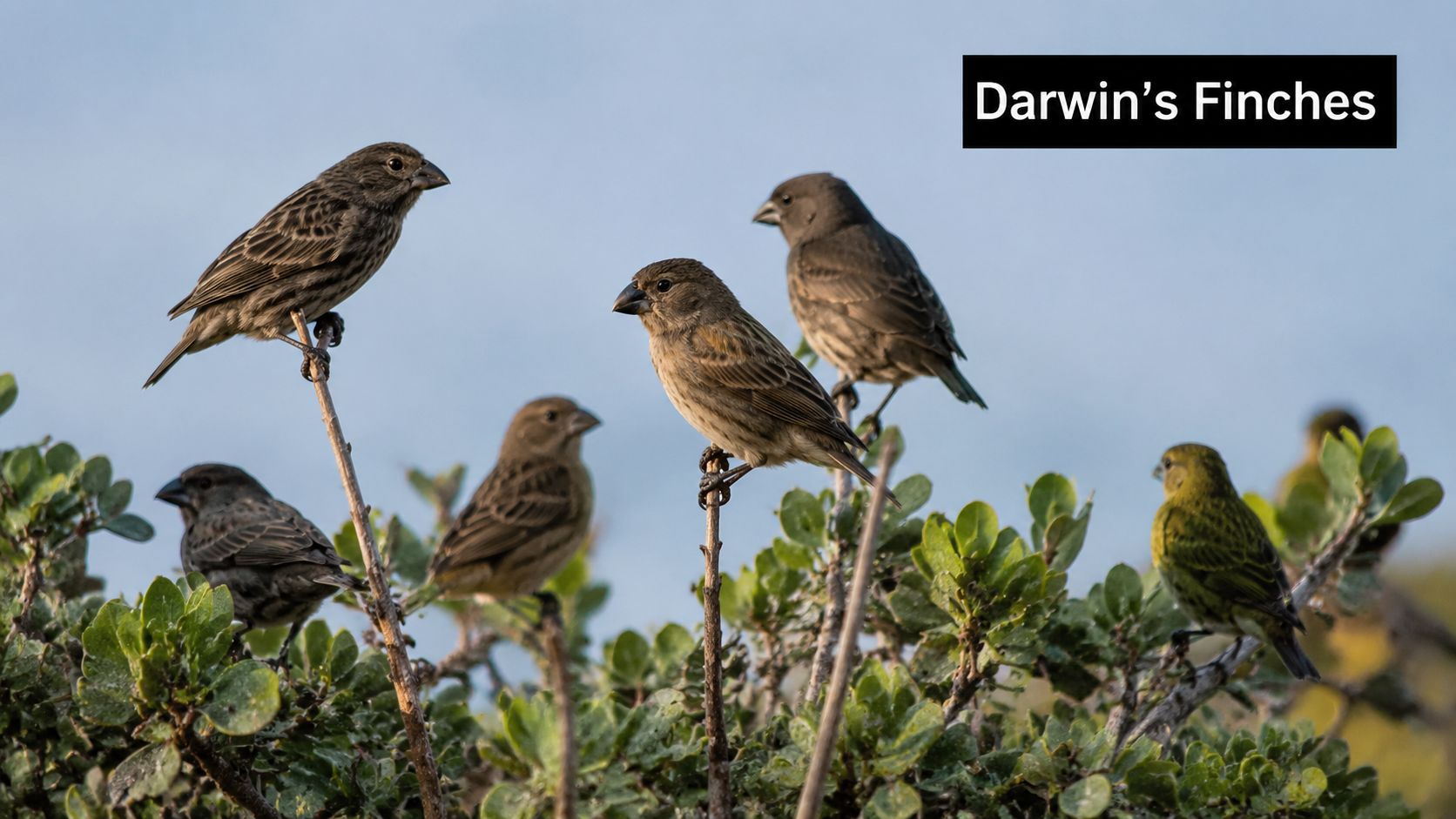
Handled well, this is one of the most profound experiences in the archipelago. You are not admiring color or spectacle. You are watching adaptation reveal itself in beak shape, feeding behavior, and habitat preference across different islands. A casual visitor sees little brown birds. A first-rate guide shows you one of the clearest field lessons in evolution anywhere on earth.
That difference matters.
The finest Galápagos itineraries treat finch viewing as an intellectual privilege, not a filler walk between larger animal encounters. On one landing, your guide may point out a heavier beak suited to cracking seeds. On another, you may watch a finch work through cactus habitat or forage for insects with a narrower profile. Those distinctions are the experience. They turn a quiet shore excursion into the kind of private, high-level natural history encounter that stays with serious travelers long after the voyage ends.
How to experience this well
Private or top-tier guiding is the right choice because finches reward interpretation. Without it, you miss the point.
- Insist on exceptional naturalist guiding: Choose a guide who can explain how island separation produced visible differences, and do it clearly in the field.
- Prioritize multi-island variety: The more ecological contrast your itinerary includes, the easier it becomes to read adaptation with your own eyes.
- Build in time for observation: Rushed landings waste this experience. Quiet, unhurried walks produce far better sightings and far better conversation.
- Add a proper post-excursion briefing: Reviewing what you saw over lunch or on the sundeck turns a smart outing into a defining memory of the trip.
Practical rule: In the Galápagos, the most exclusive experience is often the one that sharpens how you see.
2. Giant Galápagos Tortoises Ancient Mariners of the Islands
The giant tortoises are the emotional center of the Galápagos. They carry the authority of the islands in a single glance. Age, endurance, and isolation all become visible when one of these animals emerges from misty highland grass or crosses a dark volcanic path with complete indifference to your schedule.
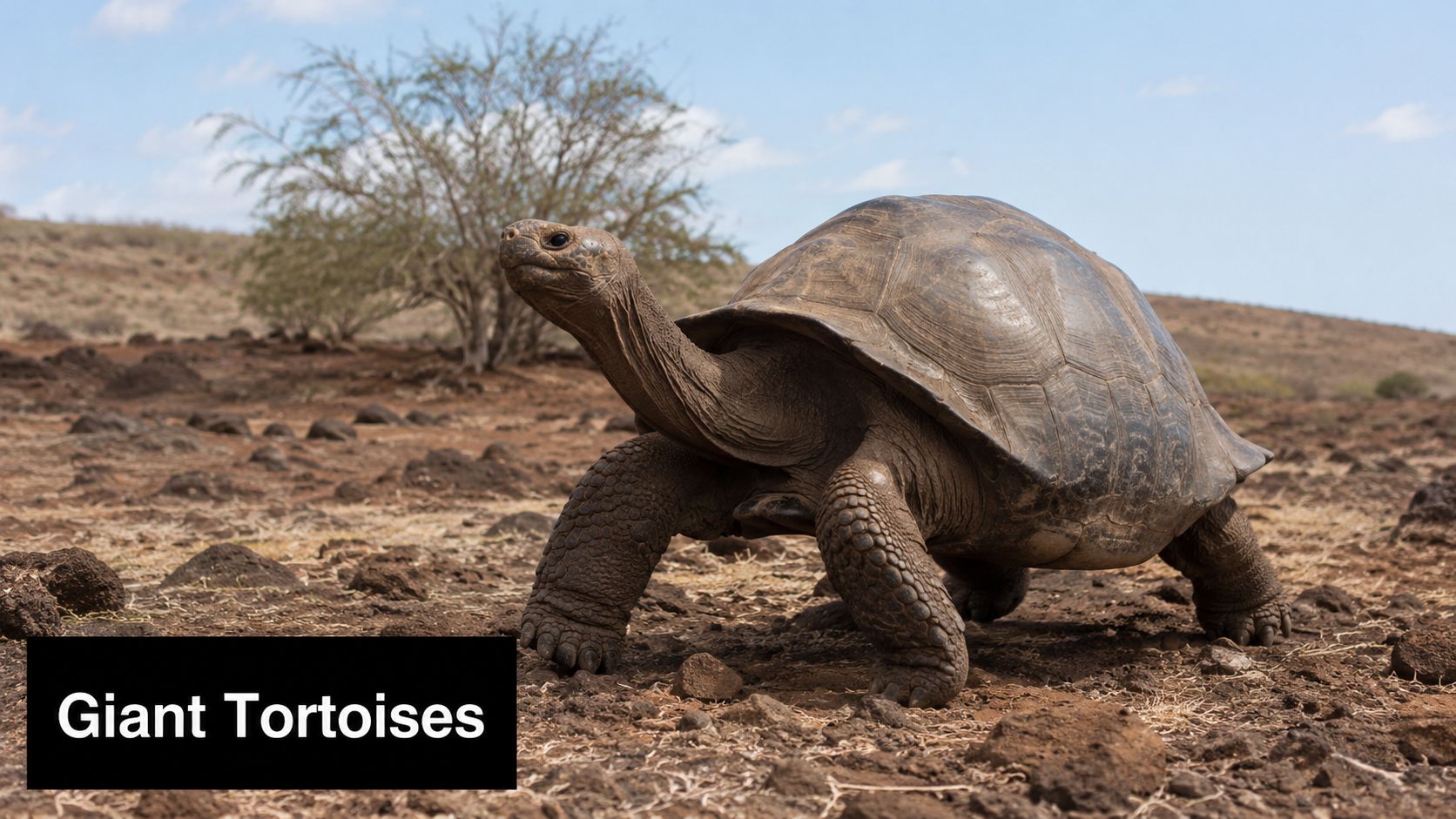
Their importance goes beyond longevity. Tortoises evolved into distinct forms across different islands, with shell shapes and posture tied to local conditions. For a discerning traveler, that makes this encounter far more than an iconic wildlife sighting. It becomes a study in place. A domed shell seen in lush highlands and a saddle-backed form associated with drier terrain tell you that the archipelago shaped life with remarkable precision.
You should treat tortoise viewing as a priority experience, not a token stop between marine outings. The strongest itineraries place it in the right setting. Santa Cruz highlands visits can be highly rewarding if the pacing is calm and the guiding is sharp. Breeding centers add a second layer, especially for travelers who want conservation explained properly rather than reduced to a few sentimental lines.
Where luxury and conservation meet
High-end Galápagos travel should give you access with context. If your operator cannot arrange meaningful time with an excellent naturalist or a well-run conservation visit, choose a better operator.
- Choose quality of setting over convenience: Wild encounters in the highlands often feel more powerful than a rushed pass through a crowded site.
- Ask for serious interpretive guiding: You want a guide who can explain why shell variation matters and how restoration efforts have shaped the species' recovery.
- Give this encounter real time: Tortoises reward patience. Ten unhurried minutes can be more memorable than an overpacked afternoon of box-checking.
- Pair the visit with comfort: Return to a vessel or lodge that matches the gravity of the experience with privacy, excellent service, and a thoughtful debrief over lunch or cocktails.
The right tortoise encounter does not feel like trivia brought to life. It feels like private access to the Galápagos at its most ancient and most commanding.
3. The Galápagos Marine Reserve Shapes an Oceanic Wilderness
The Galápagos is an ocean journey first. Clients who treat the sea as background scenery miss the archipelago's real power.
The reserve turns each crossing, snorkel, and skiff ride into part of the main event. Sea lions cut through clear water beside you. Rays pass over volcanic shelves. Penguins appear in waters where they seem geographically absurd. Marine iguanas slip from black lava into surf with prehistoric confidence. Viewed properly, the islands are not a chain of land excursions with some boating in between. They are a marine wilderness punctuated by land.
That distinction should shape every booking decision. Choose an itinerary that spends serious time in wildlife-rich channels, along remote coastlines, and at landing sites with strong in-water access. If a voyage gives more attention to cabin decor than expedition design, pass. In the Galápagos, comfort matters. Reach matters more.
Why this matters on itinerary design
The strongest luxury trips make marine access feel effortless without stripping away the expedition character that makes the islands exceptional. You want a vessel with refined service, yes, but also fast skiff operations, excellent naturalists, and a route built around the water rather than squeezed around it. Haute Black's approach to safari-style conservation travel is a useful benchmark for this kind of high-touch, wildlife-first planning.
Before you watch the sea itself, this film gives useful context for the marine atmosphere of the archipelago.
- Prioritize marine-heavy routes: Western and central itineraries often deliver stronger time on the water and more dramatic coastal wildlife encounters.
- Ask about guiding in practical terms: You want naturalists who brief you well before each outing and stay sharp in the water, not guides who recite facts and rush the landing.
- Choose expedition logistics, not just polish: Easy embarkation, quick skiff deployment, and well-run snorkel operations will improve the trip far more than another layer of onboard formality.
- Protect private time: The best journeys balance shared exploration with enough space to return to your suite, reset properly, and absorb what you have just seen.
Done well, the marine reserve does not feel like a sightseeing backdrop. It feels like privileged access to one of the most extraordinary ocean environments on Earth.
4. Endemic Species Concentration Creates a Living Natural Laboratory
The Galápagos rewards travelers who notice differences, not just spectacles. Endemism is the point. Species evolved here in isolation, and that concentration gives the islands their intellectual and emotional force.
You see it in forms that make no sense anywhere else until you stand in the habitat that shaped them. Marine iguanas feeding along black lava, flightless cormorants adapted to a coastal life, and tortoise lineages that differ from island to island turn a well-planned itinerary into far more than wildlife viewing. The islands function as a living field study, and the value of the journey rises sharply when you experience those distinctions firsthand.
Travel strategy for seeing variation
Do not reduce the Galápagos to one comfortable base and a checklist of famous sightings. You need movement between islands, careful guiding, and enough time ashore to compare one ecosystem with the next. That is how the archipelago reveals its real sophistication.
For travelers who prefer wildlife experiences with stronger structure and discretion, Haute Black's approach to privately curated safari journeys and conservation-led exploration is a smart model for building an itinerary with depth.
- Visit multiple islands: Endemic wildlife makes more sense when you see how habitat, altitude, and shoreline conditions shift from island to island.
- Insist on a naturalist with interpretive skill: A polished guide should explain adaptation, isolation, and ecological contrast clearly, not deliver memorized trivia.
- Use photography as a record of comparison: Document beaks, shells, lava fields, vegetation, and coastlines so the patterns stay with you after the voyage.
Done properly, this section of the trip feels exacting and rare. You are not merely collecting sightings. You are watching evolution expressed with unusual clarity.
5. The Galápagos Penguin Defies Geography
The Galápagos penguin is the fact that stops polished dinner-table conversation cold. A penguin at the equator sounds incorrect, which is exactly why seeing one on black lava feels so rare and so satisfying.
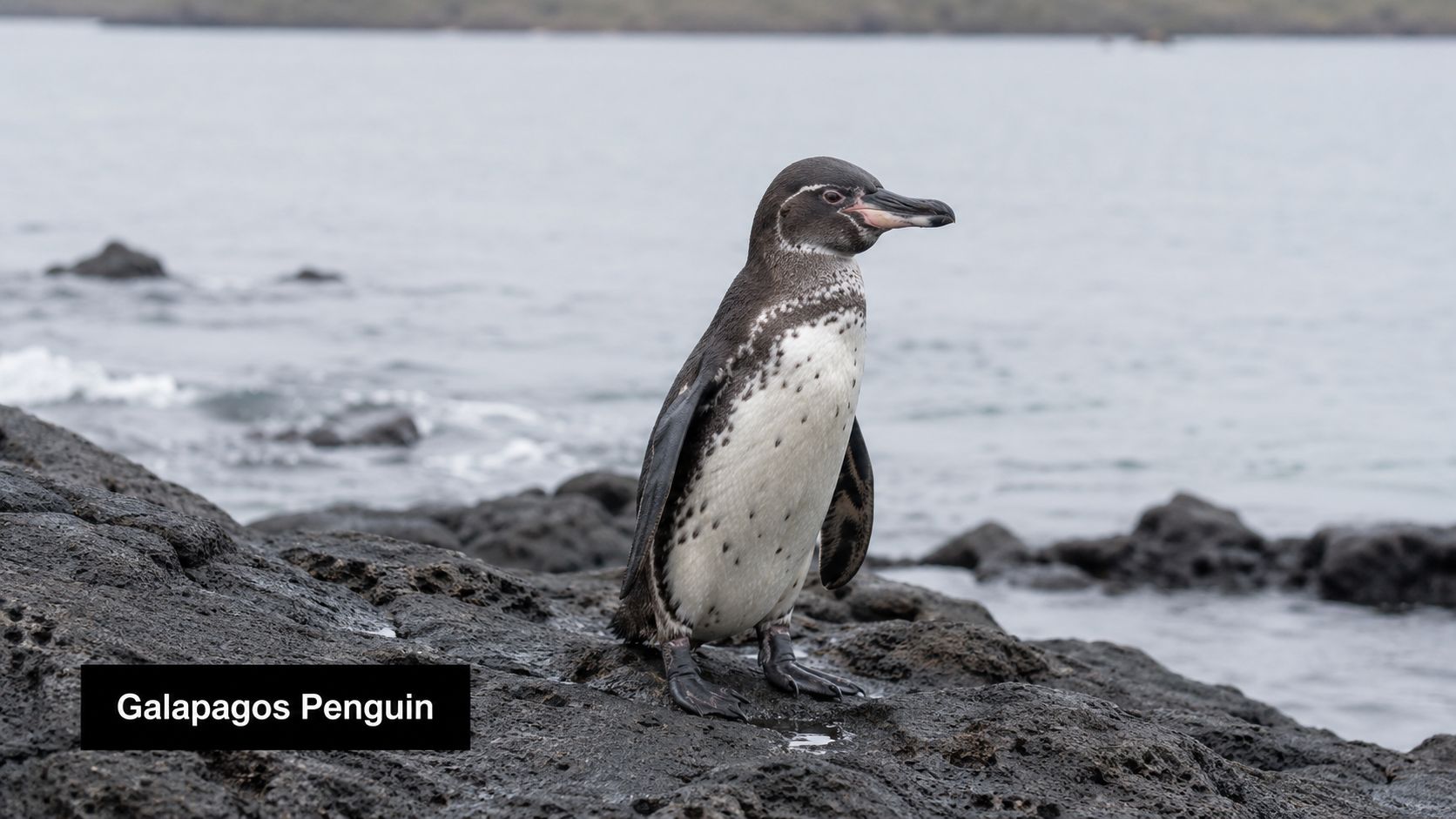
This is not a headline-grabbing spectacle in the Antarctic sense. It is better than that. The sighting is subtle, strange, and geographically elegant. You are watching a species that should feel out of place, yet looks perfectly at home against volcanic rock and cold, nutrient-rich water.
That contrast matters for trip design. Penguin viewing rewards precision, not volume. You need western-island planning, patient shoreline exploration, and a guide who knows where birds rest, feed, and slip in and out of view. Travelers who already appreciate how volcanic islands shape wildlife encounters often respond to Haute Black's perspective on Hawaii island hopping and volcanic contrast, but the Galápagos version is far rarer and far more biologically surprising.
Best way to look for them
Treat penguins here as a privilege, not a guarantee. The right approach is measured and highly selective.
- Prioritize the western islands: That is where the strongest habitat and the most rewarding search conditions tend to be.
- Choose naturalists with real field judgment: The best guides read tides, light, and bird behavior well enough to position you unobtrusively and at the right moment.
- Use small-scale coastal time well: Slow zodiac passes and discreet shoreline observation produce better encounters than rushed transit.
- Keep your standards high, but your expectations intelligent: A short sighting can be the standout memory of the voyage because it feels so improbable.
The Galápagos penguin turns a familiar animal into a collector's sighting. Done properly, this is not simple wildlife viewing. It is access to one of the archipelago's most refined contradictions.
6. Galápagos Geology Is Still Shaping the Islands
The Galápagos are not a static museum piece. They are a volcanic archipelago with visible youth, raw edges, and a sense of formation still in progress. That is exactly why discerning travelers find the setting so powerful. The islands do not serve up pretty tropical backdrops. They present black lava, fractured coastlines, exposed calderas, and shorelines that feel newly made.
Geology deserves the same attention as wildlife. Ignore it, and you miss half the experience.
On a well-designed journey, the difference between islands becomes part of the pleasure. Some feel harsher and more austere, with younger volcanic surfaces and a more severe visual character. Others show more weathering, softer contours, and richer ecological layering. That progression gives the archipelago its intellectual and aesthetic depth, and it rewards travelers who want more than animal sightings.
Travelers drawn to stark island formations often respond to Haute Black's perspective on Hawaii island hopping and volcanic contrast, but the Galápagos offer a rarer proposition. Here, geological drama is tied directly to scientific significance, restricted access, and the privilege of seeing places that still feel unfinished.
How to experience the geology properly
A stronger Galápagos itinerary treats volcanic form as a core part of the trip, not scenic filler between wildlife excursions.
- Choose guides who can explain the islands, not just point out animals: You want interpretation of lava flows, calderas, uplift, erosion, and how each island's age shapes what you see.
- Build in contrast across the itinerary: Younger and older islands should sit side by side in the route. That is how the archipelago becomes legible.
- Prioritize dawn and late-afternoon landings: Angled light gives volcanic surfaces texture, depth, and photographic authority.
- Favor travelers and operators who respect geological fragility: Good environmental conservation travel is not abstract here. It protects terrain that can be damaged by careless access and superficial trip design.
Handled well, Galápagos geology turns the voyage into something far more refined than wildlife tourism. It becomes an encounter with islands that are still defining themselves.
7. Introduced Species Have Tested the Archipelago's Fragility
The Galápagos are not a museum piece. They are a protected system that has already been stressed by species that never belonged here, from grazing animals to invasive plants and pests that disrupt breeding, feeding, and habitat recovery. Any traveler with high standards should understand that before setting foot on a landing site.
That reality changes how you should travel here. Biosecurity checks, controlled landings, strict guiding, and route limits are not bureaucratic clutter. They are the price of access to one of the world's most sensitive island environments.
What a responsible luxury traveler should do
Choose operators who treat conservation discipline as part of the product, not as an apology for restrictions. The best voyages in the Galápagos are defined by restraint, excellent guiding, and intelligent access. Haute Black's perspective is clear. Real exclusivity here means getting closer to the islands' ecological truth while leaving less behind.
For travelers who care about the broader ethics of place-sensitive itineraries, this perspective on environmental conservation travel aligns with the kind of discipline the Galápagos demand.
- Respect biosecurity checks: Clean footwear, inspected bags, and controlled transfers protect habitats that can be altered by a single careless arrival.
- Choose operators with conservation credibility: Ask direct questions about wildlife distance, landing protocols, naturalist quality, and support for local conservation work.
- Prioritize low-impact access over busy itineraries: Fewer, better landings with serious interpretation will always outperform a rushed schedule built for bragging rights.
- Support substance over spectacle: The finest Galápagos journey is the one that gives you rare access without asking the islands to absorb your footprint.
8. The Humboldt Current Drives the Drama
The single most important fact about the Galápagos is not on land. It is in the water. The Humboldt Current brings cold, nutrient-rich flow up from the south, and that shift in temperature is what gives the archipelago its startling density of life. Without it, the islands would still be beautiful. They would not feel this alive.
You see the effect immediately once you know what to watch for. Feeding frenzies gather offshore. Sea lions become more active. Seabirds work productive water with purpose, not chance. The best guides explain these patterns as they happen, because a Galápagos voyage is far more rewarding when you understand why one channel is full of action while another sits quiet.
Luxury travel to the Galapagos should become more exacting. Do not buy the islands as a generic wildlife cruise. Book for water conditions, island routing, and guide quality. A well-designed itinerary uses the current as an advantage and places you in the right zones when marine life is at its most dynamic.
Plan for ocean conditions, not just travel dates
The equatorial setting fools first-time visitors into expecting sameness. The Galápagos never work that way. Water temperature, visibility, and wildlife activity can change the entire mood of a departure.
- Choose June to November for cooler, more energetic marine conditions: This period often brings stronger cold-water influence and richer offshore activity.
- Ask specifically about western and nutrient-rich itineraries: If you care about serious marine spectacle, route matters as much as season.
- Insist on a top naturalist guide: Species identification is basic. You want someone who can explain currents, feeding behavior, and timing.
- Build in repeated water access: One snorkel or one panga ride is not enough if your goal is a high-level Galápagos experience.
Clients who understand the current do not simply see more. They choose better voyages, in better waters, with far better odds of witnessing the islands at full force.
9. The Charles Darwin Research Tradition Gives the Islands Intellectual Weight
The Galápagos are beautiful. What makes them distinguished is that they're also one of the world's great scientific reference points. Master Liveaboards describes the islands as a globally significant scientific benchmark and a unique living laboratory that directly informed Darwin's thinking after his visit in 1835.
That heritage changes the tone of a visit. You're not only moving through beautiful scenery. You're entering a place where observation still matters, where field science still shapes conservation, and where the most rewarding traveler is the curious one. A stop connected to the Darwin research tradition can be one of the most grounding parts of the itinerary, especially for families who want the trip to carry intellectual value across generations.
How to make this stop count
Don't treat any research-oriented visit as a quick cultural errand between wildlife outings. Ask for a guided experience with enough depth to connect current conservation efforts to the islands you've already seen.
- Schedule with a strong interpreter: Context matters more than speed.
- Use it to connect the voyage: Research, breeding work, monitoring, and restoration all make field sightings more meaningful.
- Bring children or grandchildren into the conversation: This is one of the rare destinations where luxury travel and serious science fit naturally together.
10. UNESCO Status Confirms the Islands' Global Importance
UNESCO recognition put the Galápagos in the top tier of protected places on earth. Treat that designation as a practical signal, not a badge on a brochure. It tells you the islands are managed to an international standard, with rules, access limits, and conservation priorities that shape every worthwhile visit.
That is exactly why the right trip feels so rare. You are not booking a generic island escape. You are entering a protected archipelago where privilege comes from access handled properly, guides chosen well, and logistics designed to respect the setting instead of overpower it.
The smart booking decision is simple. Build around operators and planners who understand protected destinations at a high level and can deliver comfort without compromising the place itself. That is the difference between expensive travel and well-judged travel.
If you want a stronger point of view on protected, design-led journeys, start with Haute Black's luxury travel guides.
Why this should shape your booking choices
UNESCO status should make you more selective.
- Choose providers with a serious conservation ethic: In the Galápagos, restraint signals quality.
- Prioritize access with context: The best guides explain why route controls, landing rules, and visitor protocols exist, then make the experience feel polished and easy.
- Favor smaller, well-run experiences: Privacy matters, but so does fit. The best itineraries match the scale of the islands.
- Travel like a custodian, not a consumer: That attitude produces a better journey and protects the privilege of visiting at all.
Galápagos Facts: 10-Point Comparison
| Item | 🔄 Implementation Complexity | ⚡ Resource Requirements | 📊 Expected Outcomes | Ideal Use Cases | ⭐ Key Advantages / 💡 Tips |
|---|---|---|---|---|---|
| Darwin's Finches: Evolution in Real Time | Moderate, long-term population monitoring and permitting | Low–Moderate, field teams, longitudinal funding, basic lab support | High, direct, publishable evidence of speciation and adaptation | Evolutionary research, educational/eco tours, field studies | ⭐ Classic natural-selection example; 💡 compare beak traits across islands |
| Giant Galápagos Tortoises: Ancient Mariners of the Islands | High, captive breeding, repatriation, habitat management | High, breeding centers, vets, long-term care resources | Significant, species recovery and flagship conservation outcomes | Long-term conservation programs, exclusive wildlife encounters | ⭐ Insights into longevity and adaptation; 💡 visit dry season, support breeding centers |
| Galápagos Marine Reserve: World's Second-Largest MPA | Very High, marine zoning, enforcement across 133,000 km² | Very High, patrol vessels, monitoring tech, enforcement personnel | Major, biodiversity protection, fisheries recovery, research platform | Marine research, diving/snorkeling expeditions, large-scale conservation | ⭐ World-class marine biodiversity; 💡 coordinate trips with marine biologists |
| Endemic Species Concentration: Living Natural Laboratory | Moderate, multi-island surveys and strict biosecurity | Moderate, taxonomic experts, targeted monitoring, transport logistics | High, unique evolutionary insights and comparative datasets | Multi-island expeditions, biodiversity inventories, evolutionary studies | ⭐ Unparalleled endemism rates; 💡 visit several islands, engage naturalists |
| Galápagos Penguin: The World's Most Northerly Penguin Species | High, intensive monitoring and rapid-response protection | High, targeted protection, rescue capacity, climate adaptation measures | Critical, species survival indicator, high conservation priority | Species-specific conservation, climate impact studies, exclusive viewing | ⭐ Extremely rare and ecologically informative; 💡 visit cooler months (Jul–Oct) |
| Galápagos Hotspot Geology: Island Formation Laboratory | Moderate, geological surveying and safe volcanic access | Moderate, geologists, field gear, safety/logistics | Strong, real-time insights into volcanism and island aging | Geological expeditions, educational tours, volcanology research | ⭐ Living example of hotspot dynamics; 💡 use expert guides, time for visibility |
| Introduced Species and Ecological Disruption | Very High, multi-year eradication and restoration programs | Very High, eradication campaigns, quarantine, long-term monitoring | High but costly, ecosystem recovery possible with sustained effort | Restoration projects, eradication pilots, conservation policy work | ⭐ Drives innovation in conservation methods; 💡 support eradication and biosecurity |
| Humboldt Current: Engine of Galápagos Biodiversity | Low–Moderate, ongoing oceanographic monitoring and modeling | Moderate, sensors, vessel time, oceanographic expertise | High, explains marine productivity and seasonal wildlife patterns | Seasonally optimized wildlife viewing, oceanography research, fisheries planning | ⭐ Fundamental driver of productivity; 💡 plan trips Jun–Nov for peak conditions |
| Charles Darwin Research Station: Gateway to Discovery | Moderate, institutional coordination, permit and visitor limits | Moderate, labs, staff, long-term datasets, captive facilities | Major, central hub for conservation science, monitoring, species recovery | Research collaborations, educational visits, captive-breeding support | ⭐ Access to long-term data and experts; 💡 schedule guided tours, support research |
| Galápagos as UNESCO World Heritage Site | High, international governance and multi-stakeholder management | High, regulatory frameworks, funding channels, enforcement capacity | Significant, global protection, funding, and conservation frameworks | Policy development, sustainable tourism planning, international partnerships | ⭐ Global recognition and protection; 💡 choose UNESCO-aligned operators and respect regulations |
Crafting Your Own Galápagos Legacy
The Galápagos is not a place to visit casually. It is one of the few destinations on earth where poor planning flattens the experience and precise planning turns it into something unforgettable.
The difference comes down to choices that many travelers underestimate. Your vessel determines how quietly and comfortably you move between islands. Your guide determines whether a wildlife sighting feels like a pleasant photo stop or a layered lesson in evolution, geology, and marine ecology. Your route determines whether the trip unfolds with momentum or feels like a string of disconnected landings.
Luxury matters here, but only if it is paired with intelligence. The right journey balances contrast and cadence. Follow a morning with giant tortoises in the highlands with an afternoon snorkel through clear, fish-rich waters. Pair a volcanic landing with expert context that explains how the islands are still being formed. Include a visit shaped by the Darwin research tradition so the experience gains depth instead of relying on spectacle alone.
Travel style matters just as much. The Galápagos is heavily protected for good reason, and the best itineraries respect that framework at every step. Choose operators with disciplined landing practices, strong naturalist teams, and a serious view of conservation. Choose experiences that treat the archipelago as a living system, not a backdrop for social media.
That is where the trip becomes personal.
For families, the islands create a rare kind of shared memory. Children respond to the drama of blue-footed boobies, sea lions, and lava fields. Adults respond to the intellectual weight of the place. For couples, the appeal is privacy, rarity, and the pleasure of seeing something extraordinary without manufactured excess. For seasoned travelers, the Galápagos often delivers what they thought was no longer available. Authentic discovery.
Haute Black approaches the islands with that standard in mind. The objective is not to overstage the destination. It is to arrange it properly. That may mean a fluid expedition aboard a top-tier vessel, private expert briefings that sharpen every landing, or carefully arranged conservation-focused access that standard itineraries rarely consider. The result is a journey with substance, comfort, and discretion. In the Galápagos, that is the only version worth booking.
Haute Black creates bespoke Galápagos journeys for travelers who want more than a standard cruise itinerary. Explore Haute Black for private, high-touch planning that combines exceptional vessels, insider access, and the kind of polished coordination that lets you experience the islands with depth, comfort, and discretion.
Explore Our Guides
Signature Experiences