Haute Black Journal
Taiwan Travel Packages for the Ultra-Luxury Traveler

Marlene Azeez
Director, HauteBlack
View all articles →
# Taiwan Travel Packages for the Ultra-Luxury Traveler
Published August 13, 2026 by Marlene Azeez
You're probably trying to solve the same problem a lot of smart travelers run into, assembling a Taiwan trip that feels special instead of generic. You don't want a noisy, one-size-fits-all package with too many transfers, too much Taipei, and not enough substance. You want a trip that works for two people, or for a family, or for a wider Asia circuit, and you want the logistics handled cleanly.
Taiwan can absolutely deliver that, but only if the package is designed properly. The island sits inside a much larger regional travel system, and that matters because Taiwan's tourism base is already broad, with 7,857,686 inbound visitors in 2024 and leisure travel making up 5,376,199 arrivals, or 68.47% of inbound travelers, according to the Taiwan Tourism Administration's 2024 tourism snapshot. For high-end travelers, that's a significant opportunity; Taiwan works best when it's treated as a high-touch circuit island, not as a filler stop between Japan and Southeast Asia.
A good benchmark for that mindset is a strong itinerary guide like Le Private Chef's Riviera travel guide, because the logic is the same, the destination only feels refined when pace, access, and sequencing all work together. Taiwan deserves that same level of design. The rest of this briefing is about how to separate the serious trips from the lazy ones, and what to buy if you care about comfort, control, and access.
Why Taiwan Belongs on the Ultra-Luxury Map
A Taiwan trip should not start with a hotel shortlist. Start with the kind of trip you want, then build the island around it. Taiwan fits couples who want design-led stays, serious food, and private dining. It also fits families that need calm transfers, flexible pacing, and enough variety to keep everyone engaged without turning the holiday into a moving day after every stop.
Taiwan works because it can hold contrast without feeling forced. You can combine city energy, mountain air, tea country, coastal roads, and quiet resort time in one itinerary, which is exactly why it deserves a place on the ultra-luxury map. The island is not a filler stop between better-known destinations. It is a self-contained high-touch circuit island that gives a private advisor room to shape the pace, the route, and the level of access.
Stop treating Taiwan like a side trip
The right way to plan Taiwan is to ask what the island rewards. It suits couples who want design hotels, tea country, and private dining. It suits multi-generational families that need comfortable transfers and a slower rhythm. It also fits executives folding Taiwan into a larger East Asia circuit, because the island's travel patterns are built around short-haul regional movement, with 16,849,683 outbound trips by Taiwanese citizens in 2024 and 93.09% of those trips within Asia, led by Japan with 6,006,116 travelers Taiwan Tourism Administration snapshot.
That regional connection matters. Taiwan is already used to being part of a wider itinerary, so a well-built luxury trip can connect cleanly into Japan, Southeast Asia, or another regional stop without losing its own identity. That gives you options, and options matter more than a fixed sightseeing route.
The luxury case is experience, not noise
Taiwan's luxury appeal sits in the details. The best trips are built around quieter village stays, mountain roads, tea culture, coastal drives, and private meals that feel considered rather than staged. A useful benchmark is the way a strong itinerary guide like Le Private Chef's Riviera travel guide handles place and pacing. The destination feels refined only when access, sequence, and rhythm are handled properly. Taiwan needs the same treatment.
Market structure backs that up. Euromonitor's sample data shows online travel sales and travel intermediary sales both rising, which points to a market where advisor-led and packaged travel still has real weight Euromonitor sample PDF. For high-end travelers, that is a practical advantage. It means well-designed itineraries can work, because the market already supports more than simple point-to-point booking.
Practical rule: If your Taiwan trip is only Taipei plus one famous scenic stop, you are wasting the island. Build for contrast, not checklist travel.
Taiwan's place on the ultra-luxury map is simple. The strongest trips are not obvious on paper. They come together through pace, access, and smart sequencing, which is exactly where a membership-based advisor and the right package design make the difference.
Bespoke Versus Curated Packages
The phrase Taiwan travel packages covers two very different products, and travelers waste money when they treat them as the same thing. One is built from scratch around the trip you want. The other starts from a strong template and gets upgraded. Choose the wrong one, and you pay for fit you do not use.
What bespoke actually buys you
For a bespoke Taiwan package, we start with your dates, your sleep style, your appetite for driving, your tolerance for moving hotels, and the rhythm you want on the road. From there, the advisor builds the route around those preferences instead of forcing you into a preset sequence. That matters most for travelers who want private guides, off-peak access, or an itinerary that does not revolve around Taipei.
Bespoke also gives you control over the friction points that shape the whole trip. If you hate early mornings, the route can be softened. If you want a tea-focused journey, the trip can center on the mountains and cut wasted transit. If you are traveling as a family, the vehicle class and daily mileage can be set around children or older parents instead of a generic group standard.
What curated packages do well
A curated package is better than a mass-market listing, but it still follows a template. The hotel selection is stronger, the transfers are cleaner, and the overall experience is more polished, yet the structure usually stays fixed. That is the right choice if you want convenience and do not need unusual access. It also works well if this is your first luxury Taiwan trip and you want a reliable route without starting from zero.
The trade-off is flexibility. Curated packages usually keep the itinerary tighter, which helps with pricing and execution, but they do not adjust as easily for specific interests. If you want a private art viewing, a custom food route, or a very particular coastal rhythm, bespoke is the better buy. If you want a tested itinerary with premium touches, curated is the smarter choice.
Decision rule: Choose bespoke when your travel style matters more than the destination list. Choose curated when you already like the structure and only need it upgraded.
Bespoke vs Curated Taiwan Packages
| Dimension | Bespoke | Curated |
|---|---|---|
| Itinerary design | Built from scratch around your preferences | Based on a pre-tested framework |
| Flexibility | High | Moderate |
| Pace | Fully adjustable | Mostly fixed |
| Room upgrades | Can be targeted through relationships | Usually depends on availability |
| Cultural access | Easier to customize deeply | Strong, but more standardized |
| Best for | Couples, families, executives, repeat travelers | First-time luxury travelers, time-constrained clients |
| Value logic | Highest fit, highest control | Easier decision-making, faster booking |
If you want a plain definition of the bespoke lane, the internal guide on customized package tours is the right comparison point. For Taiwan, that distinction changes the trip day by day.
A Romantic Taiwan Itinerary Built Around Two Travelers
A strong couple's Taiwan trip should feel like a slow reveal, not a checklist. Start in Taipei for the energy, then move into the center of the island for calm, then end on the coast where the pace naturally drops. That sequencing creates emotional contrast, and contrast is what makes the trip memorable.
Seven nights done properly
The first two nights belong in Taipei, ideally at a flagship property such as the Mandarin Oriental or a comparable top-tier hotel. Keep the first day light. Arrive, settle in, and let the city do the work with one excellent dinner and an evening walk instead of forcing a full schedule. A private arrival transfer is worth it here because it removes the airport friction that tends to flatten the first night.
On the third and fourth nights, shift to Sun Moon Lake. Here, the trip changes pace. A private lakeside villa or a high-end retreat gives the couple a quieter setting, and it's the right place for a private tea ceremony in the central mountains or a chef's table dinner built around local produce. The setting matters more than the activity count. Slow is the point.
For the final two nights, finish at a design-led coastal property. That last move gives the trip a cleaner finish than ending in the city again. It also makes the return home feel like a proper landing instead of a rushed departure.
What actually makes the itinerary romantic
The romance is in the transitions. A museum after-hours experience in Taipei, a private tea session inland, and a final coastal dinner all feel different, but they belong to the same trip because the pacing stays controlled. That's what most package pages miss, they list attractions but don't create emotional shape.
- Taipei arrival: Use a flagship hotel and keep the first evening quiet.
- Central mountain days: Build in tea, art, and slower transfers.
- Sun Moon Lake: Book privacy, not just scenery.
- Coast finale: End with a property that feels like a reset before departure.
The most useful mindset is to stop treating luxury as “more activities.” It's usually the opposite. It's fewer transitions, better rooms, and more deliberate timing. That's what makes a couple's Taiwan trip feel intentional instead of assembled.
Family, Cultural, and Active Itineraries Side by Side
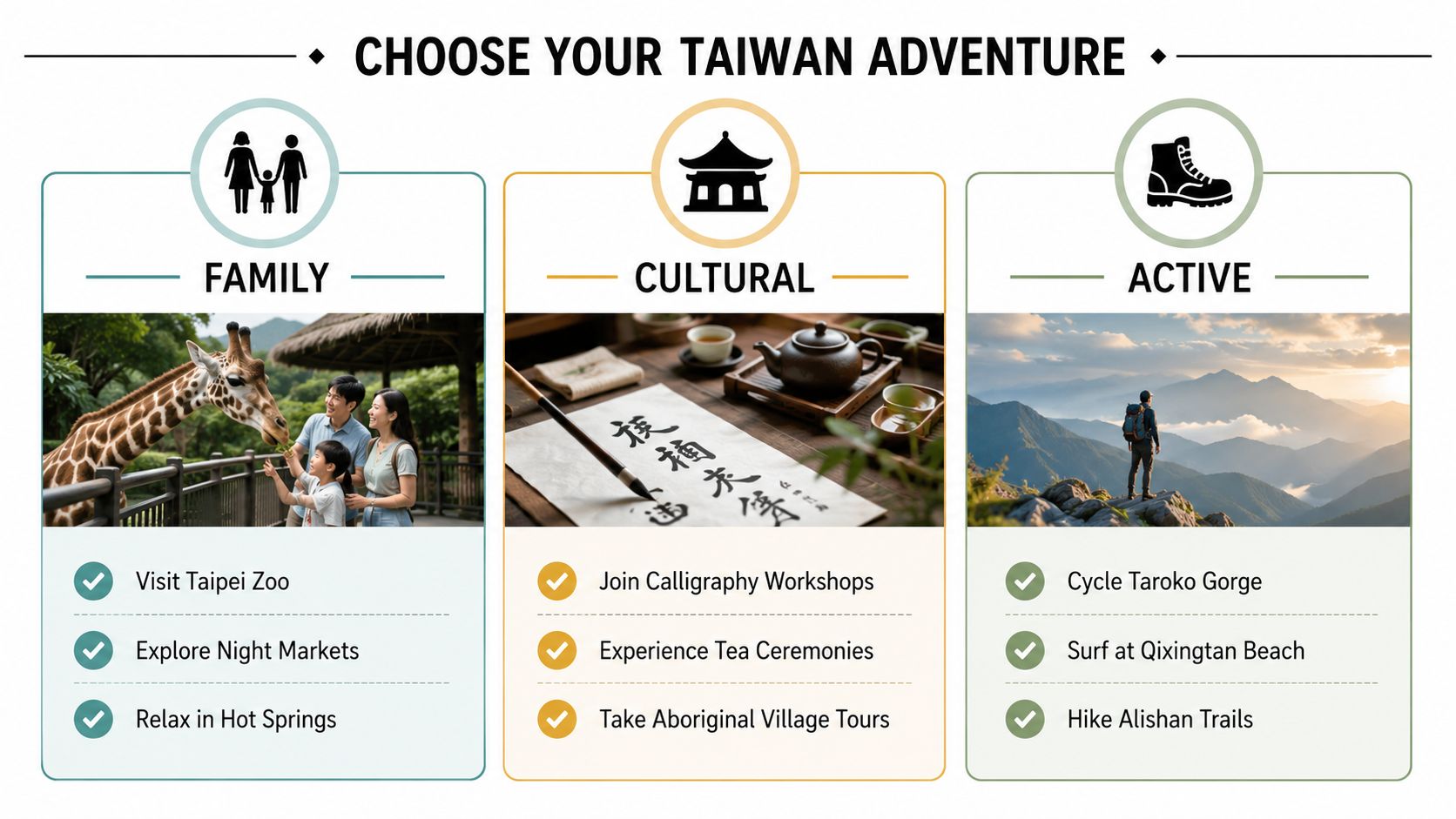
A strong Taiwan itinerary starts by matching the route to the traveler, not forcing everyone onto the same polished circuit. Families need comfort and short transfers. Culture-focused travelers need guide continuity and time to absorb context. Active travelers need tighter planning, cleaner handoffs, and a real backup plan when weather or terrain changes the day.
Family journeys need comfort first
For a multi-generational trip, overbooking sightseeing is the mistake to skip. Keep the route centered on a private driver, the same guide whenever possible, and short daily movement. A family with children or older parents should be managed around energy, not attraction count.
Use the city for easy wins, then let the rest of the island do the heavy lifting. Taipei Zoo, night markets, and hot springs work because they give variety without draining the group. Vehicle size matters more than most travelers expect, especially once luggage, strollers, or mobility needs enter the picture. If the car is too tight, the day starts to fall apart before the sightseeing even begins. For a deeper look at our approach, see our guide to luxury family travel.
Cultural routes need continuity
A serious cultural itinerary should go beyond the usual museum-and-temple routine. Taiwan's aboriginal communities, tea culture, and temple traditions deserve real time, not token visits. The best route is guided by someone who can carry the thread across several days, so the traveler is not forced to rebuild context at every stop.
That continuity is what makes the trip feel considered. One day can center on Taipei's institutions, another on tea country, another on living ritual and local craft. The point is to build a sequence that feels connected, not a stack of unrelated stops.
Active trips need tougher planning
Active Taiwan packages can be excellent if they respect the island's terrain and recovery time. Hiking, coastal cycling, and hot-spring recovery work well together because they balance effort and rest. What fails is stacking long drives, demanding hikes, and late dinners into the same day.
Operational rule: The more active the itinerary, the more important the vehicle, the guide handoff, and the backup plan become.
The weak point is usually the transfer, not the activity. A premium day can unravel during a rushed pickup, a poorly timed lunch stop, or a guide change that breaks the pace. Handle those handoffs well and the trip feels controlled. Ignore them and the whole package starts to feel like work.
Where the True VIP Advantage Comes From
The hotel is rarely the main differentiator. The advantage comes from who booked it, how the booking sits in the luxury distribution system, and whether the advisor can use that relationship on your behalf. That is the difference between a nice trip and a VIP one.
Preferred-partner benefits matter in the right hands
In a preferred-partner setup, the client can receive complimentary upgrades when available, daily breakfast, late checkout, and resort credits. Those benefits are not automatic, and they are not guaranteed every time, but they are materially better than a naked direct booking when the property participates in the right program. That matters in Taiwan because the strongest trip is often built around a small number of strong stays, not a long string of average ones.
The advisor's value shows up in the details. A direct booking gives you a room. A strong advisor relationship can get you the room plus the context, the timing, the introductions, and the confidence that the property knows what kind of traveler is arriving.
The membership layer: the decisive advantage
A membership-based agency adds another layer, a dedicated advisor, better handling around planning, and access that does not show up on public package pages. The point is not that every client needs every possible perk. The point is that the package becomes more responsive when a human is responsible for the outcome, not just the reservation.
Here, the difference between a public listing and a luxury advisor-led journey becomes very clear. Public package pages can sell the room, the transfer, and the named experience. They usually cannot sell the relationship behind the scenes. That relationship is what makes room allocation, dining requests, and event access much more reliable.
A membership model also helps when you want travel to feel connected beyond the hotel. If the trip includes private dining, curated cultural access, or a special arrival, the advisor can make those components fit together instead of leaving them as disconnected add-ons.
Some clients think the hotel is the product. It isn't. The service layer around the hotel is the product.
For travelers comparing options, that is the question to ask. Are you buying a room, or are you buying a trip that behaves like a VIP experience from the first transfer to the last departure?
Logistics, Entry Rules, and Private Aviation Options
Handle the entry rules first, then the flight, then the ground transfer. Reverse that order and you end up building a polished itinerary around a clumsy arrival, which is how luxury trips start feeling cheap.
Entry and packing details matter more than most people think
For many U.S. travelers, Taiwan allows visa-free entry for up to 90 days, but only if the passport is valid for more than 90 days. If the passport has less than 90 days of validity left, entry is limited to the passport's expiration date, and no extensions or status changes are permitted AIT guidance. UK travelers can enter without a visa for up to 90 days, and that stay can be extended by another 90 days once in Taiwan, for a maximum short-stay window of 180 days UK government advice.
Independent entry guidance also points to a practical checklist, a passport with at least 6 months' validity, a confirmed return or onward ticket, proof of accommodation, sufficient funds, and a completed TWAC within 3 days before arrival Taiwan entry requirements overview. For a luxury trip, the advisor should treat entry compliance as part of the itinerary build, not as last-minute admin. Taiwan's process is straightforward, especially beside destinations with more complex rules, such as the World Driving Permit Bhutan information.
Carry-on rules and transport discipline
For Taiwan-bound flights, power banks and spare lithium batteries need to stay in cabin baggage. Typical limits run up to 100Wh without approval, 100Wh to 160Wh with airline approval, and anything above 160Wh is prohibited EVA Air restrictions. Liquid limits also matter, with 100ml per container in a 1-liter bag applying in the usual airport routine. If you travel with camera gear, backup batteries, or a heavy phone-and-laptop setup, this is not a minor detail.
Private ground handling matters just as much. In a Taiwan itinerary source, a 5-seater sedan is described as only comfortable for a maximum of 3 passengers on a one-day trip without luggage, and another vehicle specification requires 2019 model year or newer plus a replacement vehicle within one hour if there's a mechanical fault Taiwan travel guide source. Write vehicle class and contingency response into the package brief. Do not leave either to assumption.
For travelers who want the cleanest arrival, the private aviation option makes the most sense when the Taiwan segment is part of a broader regional circuit. If you are combining Taiwan with another Asia stop, the value comes from compression, not spectacle.
Use the right arrival pattern
Taipei Songshan works better for some premium itineraries, especially if you are already moving around the region and want to preserve time on the ground. Private aviation, first-class ground transport, and a pre-arranged transfer plan create a much calmer start than hoping a taxi queue behaves on arrival. That is the difference between a smooth landing and an avoidable mess.
Booking Timeline and Budget Framework
Book Taiwan like a serious luxury trip, not like a last-minute city break. If you want the right hotel, the right guide, and the right private arrangements, timing matters.
Start earlier than you think
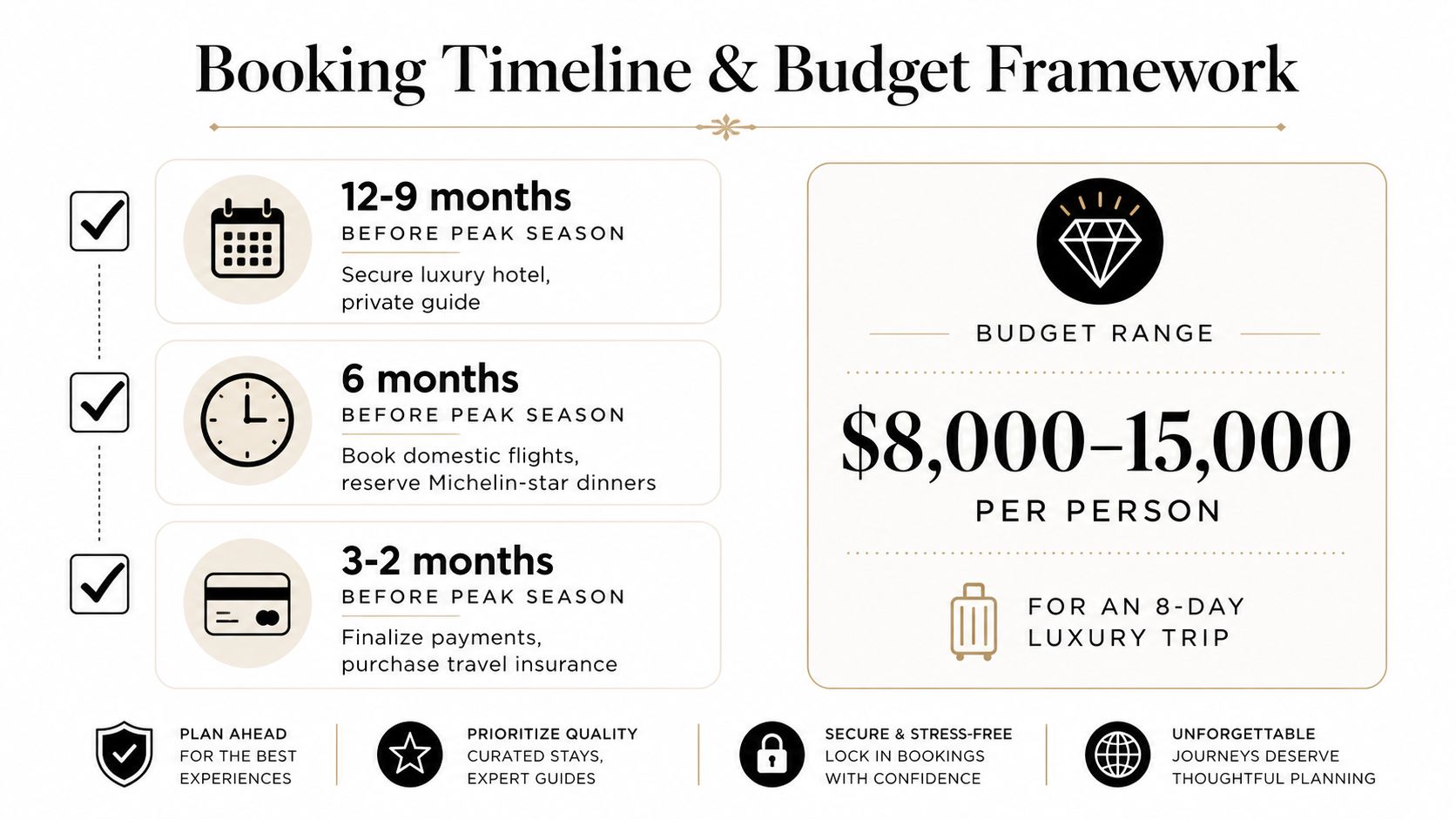
For peak travel dates and signature properties, book 12 to 9 months ahead. That's the window that gives you the best shot at the room you desire, especially if you need a specific suite category or a private guide with strong local fit. For shoulder season, 6 months ahead is usually enough if your dates are flexible and you're not chasing the most in-demand stay.
The useful rule is simple. The later you book, the more you're buying what's left. Luxury Taiwan works best when you reverse that equation.
Understand the budget spread
The biggest misconception about Taiwan travel packages is that all of them are cheap. They aren't. Public listings often advertise low headline prices, but those usually reflect a very different product from a customized luxury journey. At the other end of the market, premium itineraries with better hotels, private transfers, and curated experiences sit in a completely different band.
For a true luxury trip, plan around the fact that the package is paying for comfort, access, and control, not just transport and a bed. If you're comparing an aggregator deal with an advisor-led itinerary, you're not comparing like for like. You're comparing volume product with a managed experience.
Use this filter before you buy
- If you want the cheapest headline price, expect a standard product with little flexibility.
- If you want premium rooms and private movement, buy earlier and expect a higher spend.
- If you want a circuit-style luxury trip, build around transfers and pacing first, then select hotels.
- If you want a clean decision process, choose between curated and bespoke before you start comparing properties.
Best move: Decide your travel style first, then your package type, then your dates. People do it backwards all the time, and that's why they end up disappointed.
If you want this done properly, stop shopping Taiwan as a generic package destination and start treating it like a private circuit that needs design. Haute Black builds trips that match that standard, with advisor-led planning, VIP hotel relationships, and the kind of routing that fits how you travel. Visit Haute Black and ask for a Taiwan itinerary built around your dates, your pace, and the level of access you expect.
Explore Our Guides

Signature Experiences


