Haute Black Journal
Spring Break Travel: Luxury Guide by HauteBlack

Marlene Azeez
Director, HauteBlack
View all articles →
# Spring Break Travel: Luxury Guide by HauteBlack
May 17, 2026
The worst spring break advice is also the most common: avoid it entirely. That's sensible if you're booking late, flying through the obvious hubs at the obvious times, and hoping a marquee beach resort will somehow feel calm under peak load.
For a discerning traveler, that approach leaves value on the table. Spring break travel now sits inside one of the busiest leisure windows on the calendar. The issue isn't whether demand exists. It's how you move through it without accepting the usual compromises: chaotic terminals, mediocre room placement, overbooked transfers, and a resort atmosphere that feels public instead of private.
That distinction matters because the peak is real. Mainstream coverage often focuses on destination roundups, while practical planning for premium travelers gets ignored. Yet U.S. travel volumes remain high during this period, with TSA screening about 2.99 million passengers on March 31, 2024, and 2.91 million on March 30, 2025, according to The Points Guy's discussion of spring travel demand and crowd patterns. If you know how luxury travel works during compressed demand, spring break can still deliver privacy, ease, and excellent weather. If you don't, even a beautiful destination can feel operationally sloppy.
Reclaiming Spring Break From The Masses
Spring break deserves a better reputation than it gets. The phrase still suggests crowded pools, loud beach clubs, and service teams stretched too thin to recognize returning guests. That version exists, but it's only what happens when travelers enter the season without a strategy.
The more useful frame is this: spring break is a high-pressure booking and logistics environment. That changes how smart clients should think. Instead of asking where everyone is going, ask which destinations can absorb demand gracefully, which properties still protect privacy under strain, and which arrival patterns keep you out of the weekend crush.
What usually goes wrong
Most disappointing spring break travel follows a familiar pattern:
- Wrong destination mix: Travelers choose places known for nightlife, then expect serenity.
- Wrong room category: They book a base room at a flagship resort and assume upgrades will sort themselves out.
- Wrong flight timing: They arrive with the largest bank of inbound leisure traffic and lose half a day to queues.
- Wrong transfer plan: They leave ground transport to the hotel desk or airport taxi line.
Practical rule: In peak season, luxury is less about the brochure and more about what has been secured before departure.
That's why the season is recoverable for travelers who plan properly. A Four Seasons residential-style suite, an Aman villa with genuine separation, or a discreet arrival routed around the busiest windows can turn the same travel period into something polished and restful.
What works instead
The clients who enjoy spring break most aren't the ones who “wing it well.” They're the ones who choreograph the friction out of the trip.
A private island stay in the Maldives, a villa compound in Los Cabos, a quieter corner of Costa Rica with strong family programming, or a St. Barths property that controls beach access can all work beautifully. The difference lies in pacing, room selection, and who is managing the details that ordinary booking platforms can't see.
The New Rules of High-End Spring Travel
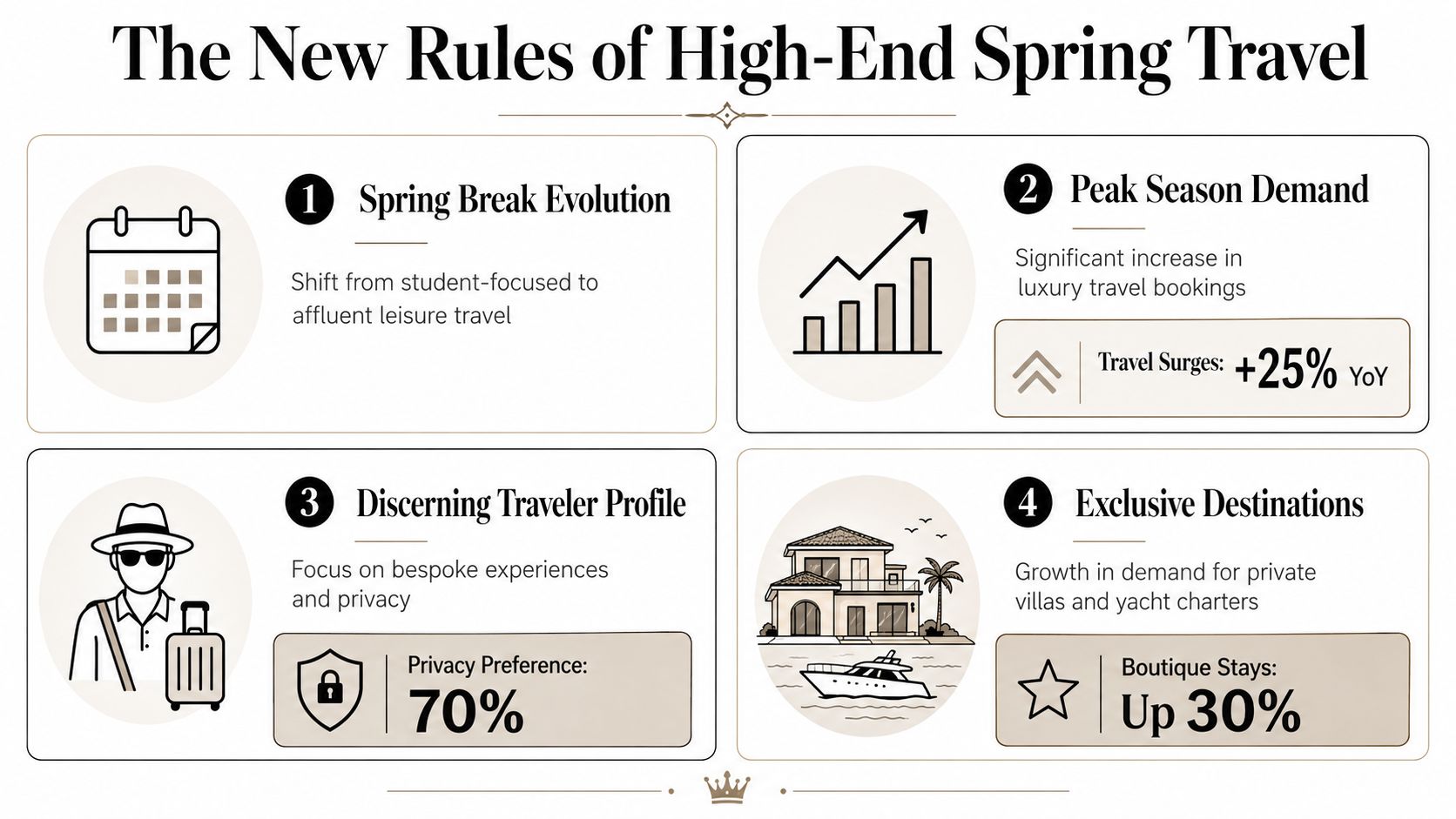
Spring break is no longer a narrow student event. It's a broad leisure season that runs across much of March and April, and the market behaves accordingly. In 2025, United Airlines said it expected to fly more than 24 million passengers by the end of April, while Dallas-Fort Worth International Airport alone saw about 4.8 million flyers over the spring break period, as reported by CBS News on record spring break travel demand. Once that volume shows up in the system, premium inventory tightens fast.
Why old booking habits fail
The old method was simple. Pick a destination after the holidays, reserve a nice resort, and expect the rest to fall into place. That still works in soft periods. It doesn't work in a compressed leisure window when high-end rooms, villas, and preferred flight times are all under pressure at once.
Luxury travelers feel that compression in three places first:
| Pressure point | What happens in spring break travel | What smart travelers do |
|---|---|---|
| Air access | Preferred cabins and ideal departure times narrow quickly | Lock flights early or use private aviation for key legs |
| Room inventory | Entry categories remain, but premium suites and villas disappear | Secure specific categories, not just the property |
| Transfers and arrivals | Airports, roads, and resort check-ins stack up | Pre-arrange meets, fast-tracks, and private transfers |
What doesn't work is relying on generic availability. A resort may still be “open,” but the room category that makes the stay feel worthwhile may already be gone. The same applies to villas, yacht days, and last-minute dinner requests at in-demand properties.
The season rewards specificity
Spring break planning should become narrower, not broader. Instead of searching “best beach destinations,” narrow your decisions to property type, arrival pattern, and privacy level. A family that wants strong kids programming should not be dropped into the same setup as a couple wanting seclusion and late lunches. A friend group needing private space should not be forced into adjacent standard rooms at a full resort.
For travelers weighing villa stays in Mexico, a useful reference is this guide to luxury villas in Riviera Maya, which helps illustrate why standalone space often outperforms a classic hotel layout during crowded holiday periods.
The key spring break question isn't “Which destination is trending?” It's “Which exact combination of room, arrival, and local setup protects the experience I actually want?”
That's the new rule set. Spring break travel can be elegant, but only when the trip is designed around operational reality, not marketing imagery.
Curated Destinations for Discerning Travelers
Some destinations look glamorous in spring and still perform poorly under load. Others hold up well because the layout, room stock, and local transport make exclusivity easier to preserve. That's the filter that matters.

For families who want space and structure
Luxury family spring break travel succeeds when children have enough to do and adults don't feel trapped inside a loud resort ecosystem. That usually means choosing destinations with strong residential accommodations, reliable private guiding, and enough outdoor breadth that the property never feels overrun.
Costa Rica works well for this. It gives families a blend of beach, wildlife, and soft adventure without forcing every day into the same rhythm. The strongest family setups pair a polished resort base with private excursions: guided nature walks, boating, surf instruction, and early-access wildlife outings before public traffic builds.
Hawaii also performs well when booked selectively. The mistake is choosing the most obvious room category at the most obvious resort. The better move is a residence, suite, or villa arrangement at brands that know how to serve multigenerational travelers without making the stay feel juvenile. Four Seasons properties tend to handle this balance elegantly, especially when grandparents, teens, and younger children all need different things from the same trip.
A few decision points matter more than destination branding:
- Residential inventory: Book a layout with a real living area and outdoor space.
- Activity architecture: Prioritize destinations where private guiding is easy to arrange.
- Dining flexibility: Choose properties that can accommodate early dinners, in-villa meals, and dietary preferences without friction.
For couples who want privacy, not scene
Couples often make the mistake of booking a place known for romance but not for calm. During spring break, those are not the same thing. The best choices are destinations where privacy is built into the geography or the accommodation style.
The Maldives remains one of the cleanest answers. Overwater and beach villas can still feel secluded when the property has enough spacing, disciplined service, and a strong house reef or marine program. For travelers considering that route, this Maldives private island experience reflects the kind of setup that works when the goal is separation rather than spectacle.
St. Barths can also be excellent for couples, but only if you accept the trade-off. You go for style, dining, and beach culture, not total isolation. To keep it refined, stay in a villa or a discreet hotel with strong concierge control, then build your days around private boating, beach timing, and off-peak dining reservations.
Couples should book for silence first, aesthetics second. The property that photographs beautifully but leaks noise, foot traffic, or thin service won't feel romantic by day three.
Aman properties are often strong in this category because they understand rhythm. Space between accommodations, low-key service, and a sense of retreat matter more in peak periods than overt social energy.
Later in the planning process, it helps to visualize how a destination feels once you move beyond brochure language.
For groups who want togetherness without compromise
Small groups of friends or extended family need a different answer. The goal isn't just a beautiful destination. It's shared space without loss of privacy.
Cabo San Lucas works when the group wants sunshine, dining, golf, and easy marine access. The right format is usually a staffed villa or branded residence rather than multiple hotel rooms. That gives the group a natural social center, allows for chef meals and pool time, and avoids the fragmented feel of a traditional resort stay.
The Caribbean remains a strong charter market for groups who value movement and privacy. A yacht itinerary changes the spring break equation because you're not competing for pool loungers, beach setups, or transfers each day. You're creating your own ecosystem.
For groups, use this simple filter:
1. Choose shared private space over adjacent rooms.
2. Build one anchor experience per day, not a packed schedule.
3. Use staff and transport to protect spontaneity.
That's what keeps a group trip from turning into a coordination exercise.
Sample Itineraries A Glimpse into Bespoke Journeys
The difference between a well-booked trip and a well-built one becomes obvious once you look at the flow. Luxury spring break travel should feel edited. No dead time, no avoidable friction, no “good enough” substitutions after arrival.

A family journey through Japan
A family of four arrives in Tokyo during cherry blossom season with airport assistance already arranged and a driver waiting airside-side of formalities. The first nights are deliberately light. A suite in a polished luxury hotel, a private evening food tour paced around the children, and a next-morning guide who knows when to avoid the most photographed parks.
From there, the itinerary shifts to Kyoto by premium rail with luggage sent ahead. Days include a private temple visit timed for quieter hours, a hands-on cultural workshop that keeps younger travelers engaged, and a countryside afternoon that breaks the city rhythm before it becomes tiring. One dinner is formal and memorable. The next is in-suite because balance matters more than proving stamina.
The final portion moves to a ryokan-style stay with enough comfort for international family travel. There's space to slow down, private bathing, and the kind of service that makes children feel welcomed rather than merely accommodated.
A couple's week built around privacy
A couple wants warmth, stillness, and no social obligation. The answer is a villa-led stay at an Aman property in a destination where the environment does half the work. The trip begins with an effortless arrival, direct transfer, and lunch already held so there's no awkward first-day drift.
The week is structured loosely, but not lazily. A spa afternoon on day one resets the pace. A private boat day follows once the couple has settled into the property rather than before. One evening is reserved for a chef-led dinner in the villa. Another is left open because some of the best luxury decisions happen when nothing is overprogrammed.
A polished itinerary never feels busy. It feels inevitable, as though each next step appeared at the right moment.
There's also discipline in what's omitted. No public excursions that require waiting around. No overdesigned “signature experiences” that interrupt the mood. No dining times that force guests into the room's least flattering hour.
Why these itineraries work
Both journeys rely on the same principles:
- Pacing over volume: Fewer commitments, better timed.
- Room choice as strategy: The stay is built around the accommodation, not treated as an afterthought.
- Private access where it counts: Arrival, transport, and key experiences are handled behind the scenes.
- Flexibility inside structure: The trip has shape, but not rigidity.
That's what bespoke spring break travel should feel like. Precise enough to avoid friction, open enough to feel personal.
VIP Logistics The Art of Seamless Arrival
In peak season, logistics are part of the luxury product. They aren't separate from it. A beautiful suite doesn't compensate for losing hours to airport bottlenecks, baggage confusion, traffic queues, and disorganized handoffs between air, road, and resort.
Spring break demand is also highly compressed. Safelite notes that peak demand centers on only a few weeks in March, that 37.5% of trips are beach-led itineraries, and that this concentration puts pressure on premium inventory and ground transfers in coastal markets, according to Safelite's spring break travel data. That's why arrival design matters so much more than most travelers expect.

What seamless actually looks like
An effortless arrival usually involves several small decisions that compound in your favor. Private aviation is the clearest example because it eliminates many of the pinch points entirely. For travelers comparing operators and service models, this overview of choosing a luxury jet charter is a useful starting point before making a more customized decision.
Even when flying commercial, the principle is the same. You want structure around the vulnerable moments.
- Airport handling: Meet-and-greet, expedited formalities where available, and someone accountable for the handoff.
- Ground transport: A named chauffeur, confirmed vehicle type, and a route that matches the property's access realities.
- Property arrival: The hotel knows your timing, preferences, and room readiness status before you're en route.
Where premium trips break down
Most failed luxury arrivals don't collapse dramatically. They fray at the edges. The car is technically there, but not where expected. The villa manager has your notes, but housekeeping timing wasn't coordinated. The resort is delighted to welcome you, but your suite isn't ready and lunch service has just ended.
That's why many travelers now treat aviation and transfers as a single ecosystem rather than separate bookings. Private aviation arrangements are one option within that approach, especially when timing, privacy, or airport avoidance are central priorities.
The arrival should feel like a continuation of the trip, not an obstacle course before it begins.
The logistics that matter most
If I had to narrow spring break logistics to the elements that protect the experience most effectively, it would be these:
| Priority | Why it matters | Common mistake |
|---|---|---|
| Exact arrival timing | Reduces overlap with the busiest inbound waves | Booking for convenience without considering destination traffic patterns |
| Pre-secured transfers | Prevents delays and quality downgrades | Assuming hotel taxis will be sufficient |
| Specific accommodation control | Ensures the trip is built around the right room or villa | Booking by property name alone |
| Single-point oversight | Keeps changes from cascading into confusion | Letting each supplier manage only its own piece |
That's the hidden architecture of high-end spring break travel. When it's handled well, clients barely notice it. They just feel that the trip moved cleanly from one moment to the next.
Your Luxury Spring Break Booking Timeline
Luxury spring break planning is less about finding a deal and more about protecting optionality. Once the premium layers of a destination start to go, they don't return in the same form. A property may still have rooms, but not the category you want. Flights may still exist, but not on the schedule that preserves the trip's rhythm.
There's also a real price signal in the market. AAA reported that the average roundtrip domestic spring break airfare was $820, up 7% year over year, while U.S. hotel stays averaged $660, up 8%, according to AAA's 2025 spring break travel trends. That doesn't just argue for early booking on cost. It argues for early booking on quality.
Nine to twelve months out
This is when top villa stock and the most desirable branded residences should be secured. If you want a specific Four Seasons residence, an Aman villa category, or a family suite with both view and layout advantages, this is the window.
This is also the moment to decide the trip's architecture. Resort versus villa. One base versus split stay. Private island versus classic beachfront. Those choices shape every downstream decision.
Six to nine months out
Air strategy should be finalized here. For commercial itineraries, that means deciding whether the best routing is nonstop convenience, a better premium cabin via connection, or a gateway that supports a quieter transfer plan. For private aviation, this is the right period to confirm aircraft strategy and airport access preferences.
At this stage, travelers should also lock major on-property categories that disappear first:
- Spa villas or treatment suites
- Chef experiences and in-villa dining formats
- Private boats and yachting days
- Holiday-week dining patterns
Late booking usually doesn't remove the trip. It removes the version of the trip you actually wanted.
Three to six months out
This is the refinement period. Private guides, beach club arrangements, children's activity planning, cultural experiences, and restaurant strategy should all be tightened here. It's also the right time to confirm whether the destination needs extra buffer on arrival or departure days.
For executive assistants and family offices, a clean planning document matters most. Put flights, drivers, confirmations, dining holds, and local contacts in one place. Peak-season travel punishes fragmented communication.
Within the final stretch
The final weeks aren't for major sourcing if the trip was designed well. They're for reconfirmation, preference updates, and contingency planning. Check passport validity, baggage strategy, dietary notes, weather-sensitive alternatives, and arrival sequence.
A concise booking rhythm looks like this:
1. Define the accommodation strategy first.
2. Build air around the stay, not the reverse.
3. Secure high-friction experiences early.
4. Use the final stretch for polish, not rescue.
That's how spring break travel stays elegant even when the broader market is crowded.
The HauteBlack Advantage Value Beyond Price
At the top end of the market, the value conversation changes. Price still matters, of course, but it stops being the only useful measure. The better question is what the traveler avoids losing: time, privacy, room quality, recognition, and the subtle ease that separates an expensive trip from a well-executed one.
That difference is especially clear in spring break travel. Congestion is predictable. Inventory pressure is predictable. Service dilution at popular properties is predictable. What isn't predictable is whether a traveler has someone protecting the details that most booking engines can't control.
Where access changes the trip
Preferred partner relationships matter because they can influence the parts of a stay that guests feel most acutely. Not every benefit is visible at booking. Sometimes it's about priority on upgrades when available, a property taking preferences more seriously, or a stay being handled with the right internal notes before arrival.
For travelers who want a more relationship-driven model, HauteBlack membership offers access to a dedicated advisor structure, waived planning fees for members, and broader support across travel and private experiences. In practice, that matters most when the trip includes moving parts that need active stewardship rather than passive confirmation.
What value looks like in real terms
The strongest advisory relationships tend to create value in a few specific ways:
- They narrow the field quickly: You spend less time reviewing options that were never right.
- They secure the right inventory: Not just a room, but the room that protects the trip's tone.
- They coordinate across suppliers: Air, villa, resort, and ground teams operate from the same plan.
- They advocate: When something shifts, the traveler doesn't have to become the project manager.
During peak periods, long-standing relationships with brands like Four Seasons, Aman, Rosewood, Belmond, and Ritz-Carlton become practical rather than ornamental. Recognition matters more in peak periods because staff triage becomes sharper. The guests with clear notes, established channels, and well-managed bookings tend to experience fewer rough edges.
Luxury is often judged at the margins. The room assignment. The airport handoff. The dinner that was already understood without a second reminder.
Why this matters in spring
Spring break doesn't forgive casual planning. It exposes every weak point in an itinerary. But for travelers who want warm-weather timing, family scheduling convenience, or a polished couple's escape before summer, that doesn't mean stepping back from the season. It means entering it differently.
The best spring break trips aren't louder, busier, or more elaborate. They're more controlled. They feel private at the moments that count and effortless at the moments travelers often expect to be difficult.
If you want spring break travel that feels calm, private, and intelligently handled from departure to return, HauteBlack can help you design the right version of the season.
Explore Our Guides


Signature Experiences