Haute Black Journal
Mongolia Vacation Packages: A Definitive Luxury Guide

Marlene Azeez
Director, HauteBlack
View all articles →
# Mongolia Vacation Packages: A Definitive Luxury Guide
May 15, 2026
Dawn on the steppe is silent in a way few destinations still allow. When a private ger has been set properly, tea arrives before the wind rises, your guide is already coordinating the day's route, and the horizon belongs to no one else.
An Introduction to the Mongolian Frontier
Mongolia isn't luxurious in the conventional sense. It isn't about gilded lobbies, dense restaurant scenes, or polished urban ease. Its appeal sits somewhere rarer: space, solitude, cultural depth, and the kind of access that still feels undiscovered.
That's why discerning travelers have started looking at Mongolia differently. It has moved beyond its old identity as a specialist adventure trip and entered the wider luxury conversation because the infrastructure is catching up to the dream. According to reported tourism figures on Mongolia's recent rise, the country welcomed 808,900 international visitors in 2024 and generated approximately USD 1.6 billion in tourism revenue. For the high-end traveler, that matters less as a headline than as an operational signal. More premium inventory exists now. More strong local teams are in market. Better journeys are possible.
Why Mongolia feels different now
A good Mongolia trip has always been memorable. A great one used to depend too heavily on tolerance for discomfort. That's changed.
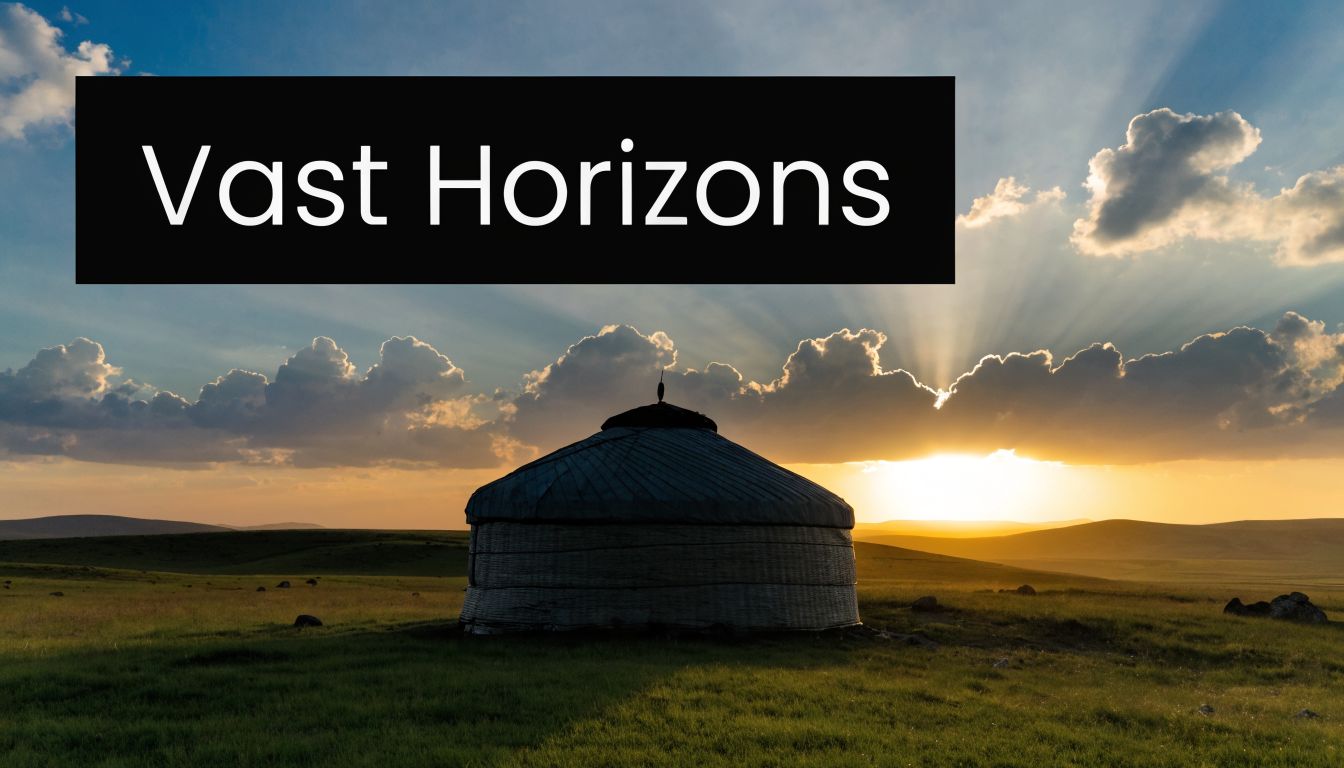
Today, the best mongolia vacation packages can combine remote vistas with private guiding, elegant camp design, thoughtful food, and pacing that respects both the terrain and the traveler. You can spend a morning riding across open grassland, return to a well-run camp with proper hot water and a refined dinner, then sleep beneath a sky with almost no ambient light.
Mongolia rewards travelers who want privacy with meaning, not privacy for display.
The new frontier for cultured travelers
Mongolia also draws people who have already done the expected circuits. They've seen East Africa well, know the best lodges in Patagonia, and no longer need another destination that feels over-produced. What they want is authenticity without chaos.
That's where Mongolia stands apart. The strongest itineraries create a direct line between the terrain and culture: monasteries, horse culture, desert silence, nomadic hospitality, and festivals that still feel rooted in place. If your interest leans toward western Mongolia and its ceremonial traditions, this Golden Eagle Festival luxury guide offers a useful lens into the kind of planning such experiences require.
The frontier here isn't just geographic. It's experiential. A refined Mongolian journey still feels like a discovery.
Defining the Luxury Mongolia Experience
In Mongolia, luxury is logistical mastery. If a package promises “five-star Mongolia” but leaves you in long convoy drives, rigid timings, and camps chosen for volume rather than privacy, it has misunderstood the destination.
The best mongolia vacation packages don't try to make Mongolia feel like Paris or Kyoto. They respect that it is rugged. Then they remove friction from that ruggedness. That is the difference.
What luxury actually means on the ground
A proper high-end journey usually begins with a private 4x4, a skilled local driver, and a guide who can read both the terrain and the client. That sounds simple. It isn't. In Mongolia, road quality, weather shifts, and distance between regions make transport the foundation of comfort.
Then come the lodging decisions. The strongest camps aren't always the flashiest on paper. They're the ones with the right setting, the right spacing between gers, reliable service, and an operations team that can handle dietary requests, late arrivals, and changing conditions without visible strain.
A luxury package should also build in flexibility. If the light is exceptional at sunset, you stay. If a family would rather linger with a nomadic host than rush to the next stop, the day adjusts. If a couple needs a private dinner away from the main dining ger, that should feel natural, not complicated.
Practical rule: In Mongolia, privacy is rarely created by décor alone. It's created by vehicles, routing, camp selection, and time.
Why prices vary so dramatically
The public market gives a useful clue about how the category works. According to listed private and luxury Mongolia tour pricing, packages range from about US$1,340 for a 6-day itinerary to more than US$13,766 for a 9-day private journey. That spread tells you almost everything important. The largest cost drivers are not souvenirs or surface-level “upgrades.” They are private vehicle support, expert guiding, and premium accommodation across long distances.
For that reason, the smartest luxury buyers rarely try to cover too much ground. A focused route with excellent execution feels richer than a country-spanning sprint with diluted service.
Markers of a package worth considering
When I assess a Mongolia itinerary, I look for these signs:
- Vehicle strategy: One dedicated vehicle for your party, with enough space for comfort, photography gear, and day supplies.
- Camp positioning: Properties or private set-ups removed from the busiest circuits, with a sense of place rather than throughput.
- Pacing: Days that respect drive times and leave room for weather, fatigue, and spontaneous moments.
- Dining quality: Fresh, well-managed meals adapted to location, not generic luxury language on a brochure.
- Off-grid comfort tools: Thoughtful operators increasingly pay attention to infrastructure details such as power, ambient lighting, and camp resilience. Even broader conversations around solar lighting for glamping are useful because they show how much guest comfort in remote settings depends on smart systems, not ornament.
In Mongolia, that's the true definition of luxury. Ease in a place where ease doesn't come automatically.
Strategic Timing Your Mongolian Journey
Timing shapes a Mongolian trip more than almost any hotel choice. This is a country of strong contrasts, and the same region can feel exhilarating or punishing depending on when you arrive.
The key fact is simple. Mongolia has an extreme continental climate, and the most reliable travel window is generally late spring through early autumn, as outlined in this Mongolia planning overview focused on seasonal trade-offs. For luxury travelers, that window still requires strategy. Weather, road conditions, festival demand, and the kind of experience you want all pull in different directions.
The real trade-offs by season
July is culturally electric. If Naadam matters to you, it can be the right answer. But it also brings more movement, more competition for top guides and premium camps, and less solitude in the most popular circuits.
September is often the connoisseur's choice. The light is exceptional, temperatures are comfortable, and photography tends to be especially rewarding. The trade-off is that days grow shorter, and some remote operations begin to tighten their season.
Late spring and early autumn often suit travelers who care most about balance. You get strong scenery, fewer pressure points than peak summer, and a calmer rhythm at camp.
July is for travelers who want atmosphere. September is for travelers who want refinement, clarity, and beautiful light.
Mongolia Seasonal Travel Planner
| Period | Key Experiences | Climate & Conditions | Haute Black Insider Tip |
|---|---|---|---|
| Late spring | Green steppe landscapes, cultural touring, comfortable overland circuits | Conditions are generally favorable within the main travel window, but roads can still require flexibility | Choose regions that don't require aggressive pacing. A softer first days' schedule helps after long-haul arrival |
| July | Naadam-linked itineraries, classic Gobi and steppe journeys, high summer energy | Peak demand, livelier atmosphere, and more festival-driven movement | Secure top camps and guides early if privacy matters. Build buffers around festival dates |
| August | Broad access across the main circuits, family-friendly travel, strong camp operations | Still within the prime season, often easier for travelers who want summer without a singular festival focus | Good month for multi-stop trips if you want cultural depth without centering the entire journey on Naadam |
| September | Photography, cooler temperatures, golden tones, quieter luxury pacing | Comfortable temperatures and shorter days, with strong visual conditions | Prioritize sunrise and sunset planning. The light is part of the itinerary |
| Early autumn | Elegant shoulder-season travel, introspective landscapes, lower on-ground intensity | Beautiful but more sensitive to operational timing in remote areas | Keep the routing disciplined. This is not the time to overextend into too many distant regions |
Matching the month to the traveler
The mistake I see most often is choosing a date first and a style second. Mongolia works better the other way around.
If your priority is festival access, plan around that and accept the energy that comes with it. If your priority is photography and quiet, lean into September. If you're traveling as a family and want the broadest comfort margin, aim for a stable summer window with realistic drive days and strong camp support.
For the Gobi, moderate conditions matter more than people expect. For horseback riding and hiking, ground conditions and daily temperature swings deserve more attention than generic “best month” advice. For western Mongolia, where specialized cultural encounters can define the trip, timing becomes even more dependent on your exact objective.
The right month doesn't just improve comfort. It changes the emotional tone of the whole journey.
Sample Bespoke Itineraries
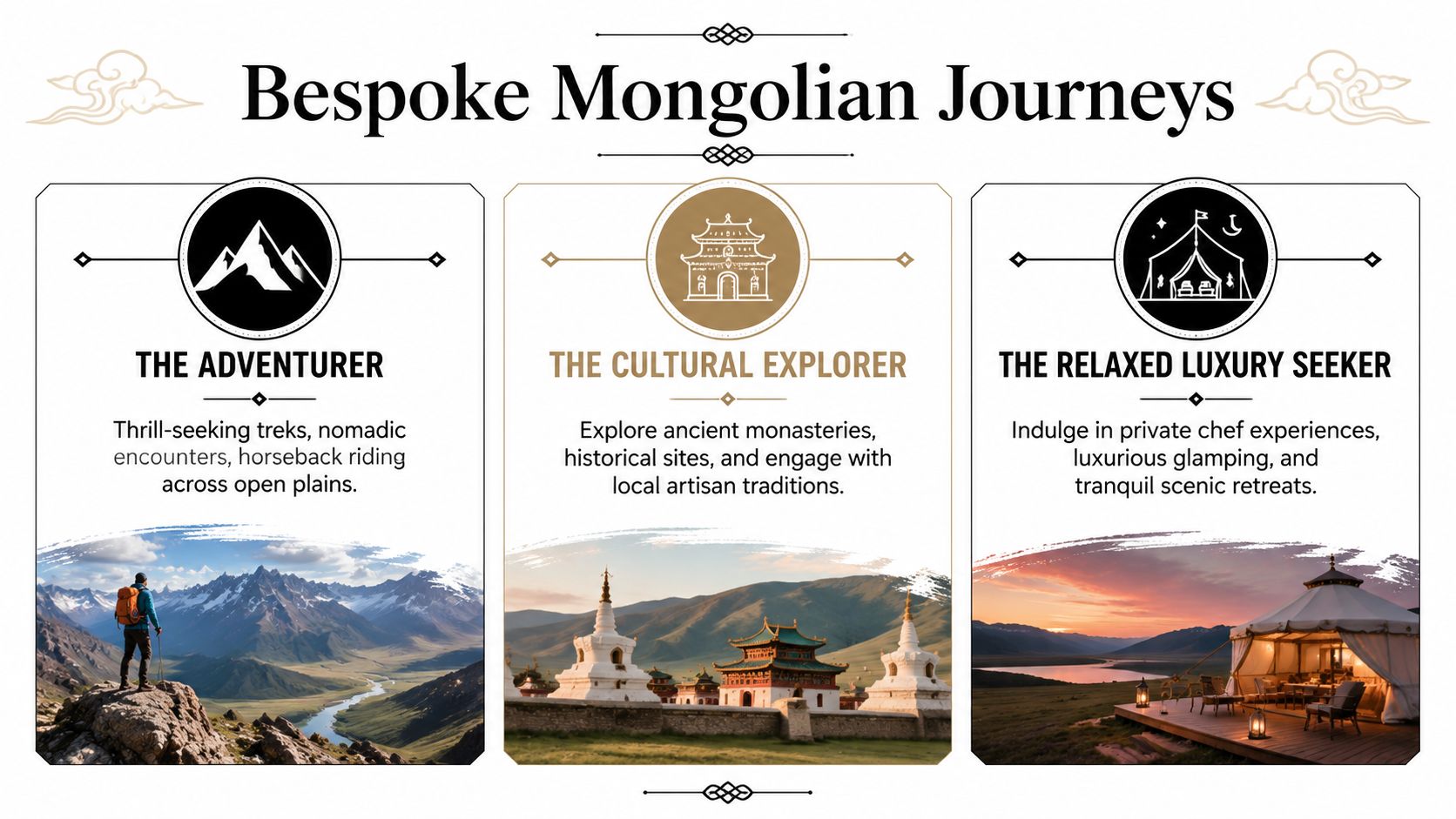
The best mongolia vacation packages begin with duration, not destination. According to specialist trip planning guidance for Mongolia itineraries, the market naturally divides into 5 to 7 day highlight trips, 10 to 14 day multi-region routes, and 2 to 3 week expeditions for more remote areas such as the Altai. That structure isn't arbitrary. Mongolia's distances are real, and luxury comes from respecting them.
For travelers comparing styles, this overview of customized package tours is a useful companion to the itinerary logic below.
The Romantic Steppe
A couple's Mongolia should never feel like a compressed group route made private. It should feel cinematic and unhurried.
A refined version usually works best over roughly a week to ten days, with no more than two core regions. Start with a soft landing in Ulaanbaatar, enough to reset after the international journey, then move quickly into the natural environment. The Orkhon Valley works beautifully for this style because it offers culture, horseback experiences, and broad open scenery without the harsher transit profile of a more aggressive routing.
From there, a move into the Gobi can be spectacular if it's done with discipline. Not every desert stop needs to be included. Better to choose fewer, better moments: a dramatic dune setting, a beautifully run camp, a private sunset aperitif, and a dinner that feels intimate rather than performative.
The romance in Mongolia is rarely staged. It comes from scale, stillness, and the luxury of time.
- Best for: Honeymooners, anniversaries, couples who have already done the classic safari-and-beach pattern
- Ideal rhythm: Late starts when desired, long golden-hour drives, one or two signature private meals
- What to avoid: Too many one-night stops, overly ambitious west-to-south combinations
A Family Expedition
Families do best in Mongolia when the trip is built around engagement, not constant motion. Children tend to remember the tactile parts: riding, meeting herding families, learning simple camp routines, climbing dunes, and seeing how life functions outside cities.
A strong family itinerary usually sits in the ten to fourteen day range because it gives breathing room. The route might combine Ulaanbaatar, central Mongolia, and one regional contrast such as the edge of the desert. Camps need space, reliable heating or cooling as conditions require, sensible food options, and guides who know how to modulate tempo.
Multi-generational groups need even more editing. Grandparents may enjoy cultural encounters and scenic drives but not endless overland hours. Teenagers need activity. Younger children need recovery time. The package only works when each generation has a version of the trip that feels designed for them.
The best family itineraries in Mongolia are less about “seeing the most” and more about avoiding unnecessary fatigue.
Useful touches include private folklore performances, felt-making workshops, easier riding options, and dining that can shift from formal to family-style depending on the evening.
The Executive Disconnect
For founders, investors, and senior executives, Mongolia works best as a deliberate decompression environment. The point isn't to be busy. It's to disappear well.
This itinerary style often lands in the seven to ten day band. It usually starts with one short city segment for cultural orientation, then moves into a remote camp or lodge setting where decisions decrease, digital noise fades, and the day is shaped by the surroundings rather than calendar alerts. Activities should be optional and well-guided: a dawn ride, a monastery visit, a drive to a dramatic viewpoint, a quiet lunch in the field.
A longer version can add a second region, but the test is simple. Does the addition deepen the experience, or does it just make the schedule look impressive?
For this profile, the highest luxury is control over mental bandwidth. That means:
1. Minimal repacking
2. Consistent guiding
3. Strong food and sleep
4. Routes with visual reward but low operational chaos
5. Enough flexibility to do less without feeling that the trip has failed
Mongolia excels here because it strips away noise without feeling empty.
Elevating Your Journey with VIP Access
There's a meaningful difference between a private tour and a VIP journey. A private tour gives you exclusivity within an existing framework. VIP access changes the framework itself.
In Mongolia, that might mean cutting a long overland transfer with air support, creating a camp experience around your party rather than around general inventory, or arranging cultural moments that aren't packaged for passing visitors.
What helicopter and private air support actually do
Clients often ask whether air support is worth it in Mongolia. Sometimes it isn't. Sometimes it changes the entire quality of the trip.
True value is not found in glamour. It is time compression and energy preservation. If a routing includes a punishing surface transfer that would consume a full day and leave everyone depleted, helicopter or fixed-wing support can protect the mood of the journey. It also expands what can be realistic for shorter high-end itineraries, especially when privacy matters more than checking off intermediate stops.
For those considering that level of movement, private aviation options through Haute Jets show the kind of transport layer that can be integrated into a broader trip plan.
Private camps and controlled environments
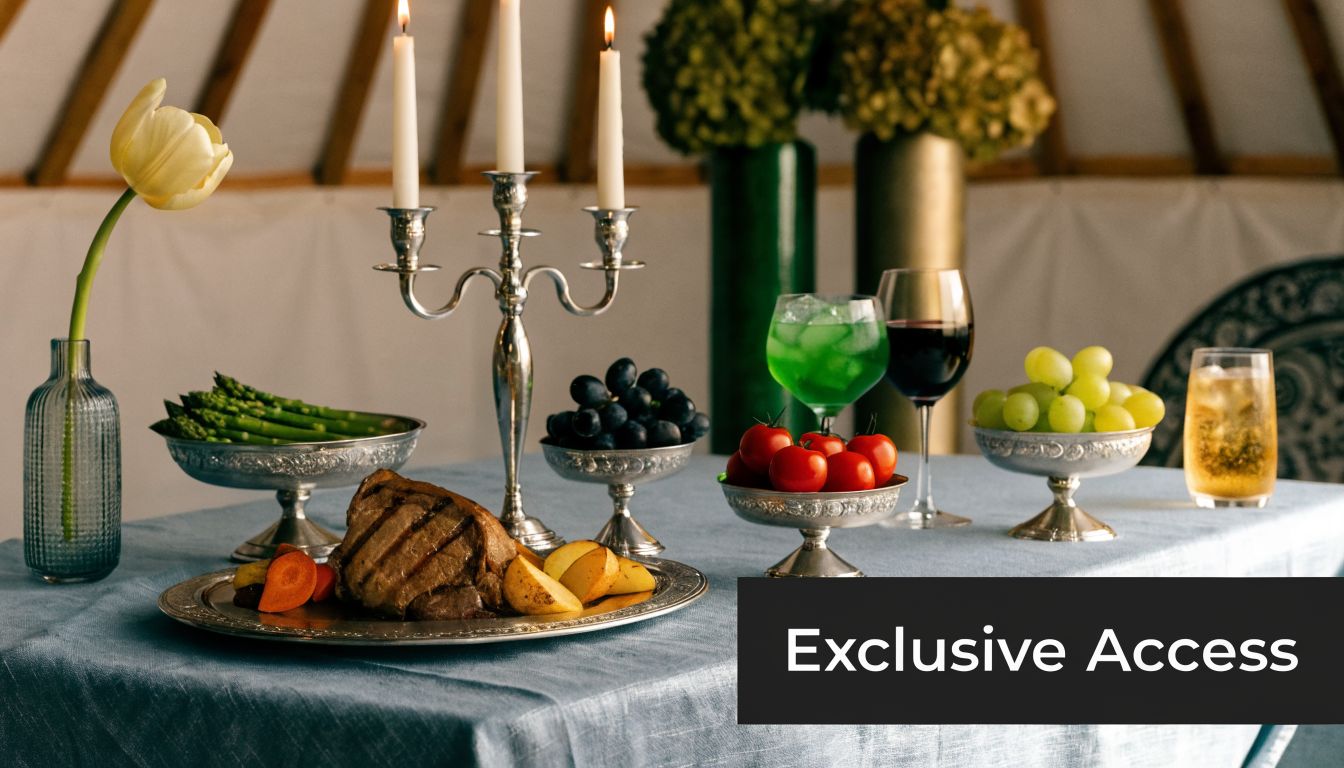
A truly private ger set-up is not the same as booking the nicest tent in a standard camp. It involves site selection, staffing, power, food service, sanitation planning, furnishing, and weather readiness. If done poorly, it's expensive inconvenience. If done well, it's one of the most memorable hospitality experiences in the world.
A worthwhile private camp should deliver:
- Isolation with purpose: You're there for silence, views, and freedom of movement, not for novelty alone.
- Operational competence: Bathrooms, heating, lighting, meal timing, and service flow must be solved in advance.
- Visual restraint: The setting should still feel Mongolian. Luxury should support the natural setting, not overwrite it.
Cultural access that feels private, not staged
Local relationships matter most. A standard itinerary can include a performance. A better one can arrange a more intimate musical encounter in the right setting. A standard route can pass through a family visit. A stronger one creates enough time and context for genuine hospitality to emerge.
VIP access in Mongolia is at its best when it feels quiet, respectful, and difficult to replicate.
That might be a private throat-singing performance, a carefully arranged artisan introduction in Ulaanbaatar, or a festival vantage point that avoids the crush without removing you from the atmosphere. These aren't interchangeable “add-ons.” They require judgment, timing, and trust on the ground.
Essential Logistics for a Seamless Trip
A Mongolia itinerary can be elegant, but it won't be effortless unless the logistics are handled early and cleanly. That's especially true now. According to 2025 Mongolia tourism reporting and visitor pace data, the country had already welcomed 617,000 international visitors by September 10, 2025, with a stated ambition to reach 1 million foreign tourists by the end of 2025. For travelers, the operational implication is straightforward: strong demand affects flights, guide availability, and access to the best camps.
Flights and arrival strategy
Most international journeys route through Ulaanbaatar. The right flight plan depends less on airfare and more on recovery, onward connection logic, and whether the first night should be in the capital or near the airport.
For high-end travelers, the useful question is not “Can I get there?” It's “How do I arrive with my energy intact?” That often means avoiding a schedule that forces immediate long-distance ground travel after a long-haul flight. A properly planned first night can prevent the rest of the itinerary from feeling compressed.
Documents, health, and on-ground comfort
Visa rules depend on passport and change over time, so they should be checked close to departure through official channels and local operating partners. That sounds basic, but it's one of the easiest ways for premium travel to become needlessly stressful when assumptions replace verification.
Health planning should be equally pragmatic. Mongolia is remote by nature, so medical contingencies, diet, hydration, and communication protocols need to be solved before departure rather than improvised in the field.
A polished logistical brief should include:
- Document checks: Passport validity, visa status if applicable, and copies stored securely
- Medical preparation: Personal medications, a clear understanding of nearest support points, and travel insurance aligned to the trip style
- Connectivity planning: Expectations for weak or absent signal outside the capital and a conscious decision about how connected you want to remain
What to pack if comfort matters
Packing for Mongolia is less about volume than about precision. Conditions can shift quickly, and even an elegant journey still involves dust, wind, and temperature swings.
Bring:
- Layered clothing: Light base layers, insulating pieces, and an outer layer that handles wind well
- Proper footwear: One pair for camp and city comfort, another for uneven terrain
- Sun and dust protection: Sunglasses, hat, and a scarf or buff for exposed drives
- Refined practicality: Neutral, easy-care clothing that transitions from outdoors to camp dining without fuss
The travelers who enjoy Mongolia most are usually the ones who pack for function without sacrificing polish.
The Haute Black Difference Personalization and Access
Mongolia is one of those destinations where money alone doesn't solve the problem. It can buy privacy, but it can't automatically buy judgment. The country is too vast, the conditions too variable, and the difference between a good trip and an extraordinary one too dependent on who is designing the route.
That matters because mongolia vacation packages are often marketed through scenery and themes. Almost all of them promise the Gobi, nomadic culture, and a sense of adventure. Far fewer show an understanding of sequencing, camp selection, transit fatigue, weather resilience, or the nuance required for travelers who expect their time to be protected.
Why personalization matters more here
In a compact destination with dense luxury infrastructure, a strong hotel can carry a mediocre itinerary. Mongolia doesn't work like that. The journey is the product.
That means the best advisor isn't just reserving rooms. They're calibrating drive lengths, deciding when private air support is sensible, matching the right guide to the personality of the party, and protecting the tone of the trip from avoidable friction. For some clients, that means romance and stillness. For others, it means children remain engaged, the executives' disconnect is complete, or a festival experience feels privileged rather than chaotic.
Access is built through relationships
Preferred partnerships, long-standing operator relationships, and trusted local fixers matter enormously in a destination like this. They help when weather shifts, when inventory tightens, when a route needs to be rebalanced, and when a cultural encounter needs care rather than speed.
The strongest travel design also creates one point of accountability. That's especially valuable in Mongolia, where transport, accommodation, guiding, and special access are closely interdependent. If each piece is handled separately, small problems stack quickly.
The finest Mongolia journeys feel effortless to the guest because someone else has done the difficult thinking in advance.
That is the core value of bespoke planning. Not extravagance for its own sake, but coherence. In a country defined by openness and distance, coherence is what turns movement into elegance.
For travelers ready to experience Mongolia at its highest level, Haute Black designs bespoke journeys that pair operational precision with rare access. From private air support and remote camp planning to preferred partner benefits, VIP recognition, and a dedicated advisor who manages every moving part, Haute Black turns an ambitious frontier trip into a smooth, highly personal escape.
Explore Our Guides


Signature Experiences


