Haute Black Journal
Luxury Villa Rentals Greece: Top Regions & Booking Tips

Marlene Azeez
Director, HauteBlack
View all articles →

You're choosing between a whitewashed villa above the Aegean and a quieter estate surrounded by olive groves. One offers effortless access to restaurants, beaches, and a yacht crew. The other promises deeper privacy, cooler evenings, and room for a family to settle into a slower rhythm. The wrong choice isn't necessarily an inferior property. It's a beautiful property in the wrong location, with the wrong service model, booked during the wrong weeks.
That distinction matters in a country that recorded 36.0 million inbound tourist arrivals in 2024, up from 32.7 million in 2023, while international tourism receipts rose from €19.7 billion to €20.6 billion, a 4.3% increase. Greece's tourism figures describe a major international leisure market, not a niche destination where exceptional inventory can be found casually.
A Practical Way to Think About a Greek Villa Stay
Consider a couple I'll call Alexander and Sofia. They're deciding between Mykonos, where a private estate would put them close to beach clubs and their yacht, and a secluded Ionian villa where the sea is calmer, the architecture feels more residential, and the itinerary depends on a dedicated local team. Both options can be luxurious. They produce completely different holidays.
The most reliable approach to luxury villa rentals in Greece is a three-layer decision.
Start with the region
First ask what the destination needs to do for you. Is the priority a yachting base, a discreet honeymoon setting, a multigenerational house with easy logistics, or a culinary journey? Transfer friction belongs here, before you fall in love with the photographs. A villa that requires a connection, a ferry, and a long road transfer may be the right answer for privacy, but not for a short stay with elderly parents or young children.
Then assess the property character
Next decide how you want to live once you arrive. A cliffside Cycladic house creates a sense of place and dramatic views. A mainland estate may offer lawns, orchards, a working vineyard, and more flexible entertaining space. Neither is automatically superior. The right property makes the daily rhythm feel effortless.
Look beyond bedroom counts. Ask whether bedrooms have independent climate control, whether the kitchen supports a professional chef, whether outdoor dining remains shaded through the afternoon, and whether the pool, gym, spa room, and staff areas function independently. A villa is a temporary residence, not a photograph.
Finally, define the service layer
The final question is how much of the stay should be delegated. Some clients want a chef, driver, yacht coordinator, security contact, and concierge operating in the background. Others prefer a housekeeper and a local point of contact, with the rest arranged day by day.
The three questions to answer before discussing price: Where should we base ourselves? How should the property function? Which services must be handled without involving us?
That framework prevents the common error of choosing the most photographed home on a shortlist. A high-value stay succeeds when the region, villa, and service team all support the same idea of a holiday.
Choosing the Right Island or Region
Greece rewards specificity. Mykonos is not Santorini, Corfu is not Rhodes, and a Peloponnese estate solves a different problem from a Crete compound. Start with the experience, then narrow the geography.
Mykonos suits clients who want social energy, beach access, dining, and a polished yachting rhythm. Expect contemporary whitewashed villas, strong outdoor entertaining areas, and proximity to the island's most popular venues. The trade-off is exposure to demand and activity. It's a strong choice for couples, friend groups, and clients who want their villa to function as a private base between reservations.
Santorini is more architectural and atmospheric. Oia and Imerovigli offer caldera-facing villas, private pools, and a naturally romantic setting, while Akrotiri provides a quieter base away from the densest visitor flow. Sunset, dining, transfers, and villa inventory need careful coordination. Santorini suits honeymooners and couples who want intimacy, design, and a tightly curated itinerary.
Corfu brings a different visual language, with Venetian influence, mature gardens, larger residences, and a softer Ionian scenery. It works particularly well for families and groups who value space, swimming, boating, and a villa that feels like a private country house. Transfers can be straightforward when air access aligns, but the final drive and local road conditions still deserve advance planning.
Rhodes offers a practical Dodecanese base for clients combining beaches, history, and resort infrastructure. Villas range from modern coastal homes to larger estates suited to families and groups. It's less dependent on the singular visual identity of Santorini and can support a broader itinerary, including cultural touring and beach time.
Crete is the most versatile choice. Its scale supports different styles of trip, from a refined coastal compound to an inland estate built around food, wine, and private excursions. The island suits families, culinary travelers, and clients who want more than a few beach days. Distances matter, so the villa's position should be selected around the actual itinerary rather than the island name alone.
Mainland Peloponnese estates are the choice for clients who want privacy, land, and a slower pace. Neo-classical residences, olive groves, vineyards, and spacious grounds create a more residential experience. The compromise is transfer complexity and less spontaneous island-hopping. For a final recovery phase, family gathering, or private celebration, that trade is often worthwhile.
| Region | Signature villa style | Transfer friction | Best for |
|---|---|---|---|
| Mykonos | Contemporary whitewashed estate | Usually simple air access, with local road transfers | Yachting, beach clubs, social groups |
| Santorini | Cycladic cliffhouse with caldera views | Airport transfers and crowded local routes require planning | Honeymoons, couples, private dining |
| Corfu | Venetian-influenced manor with gardens | Air access can be convenient, final road transfer varies | Families, boating, extended stays |
| Rhodes | Coastal modern villa or larger island estate | Generally practical, with broad island touring distances | Beaches, history, mixed-age groups |
| Crete | Coastal compound or inland country estate | Longer internal transfers, but broad itinerary potential | Food, families, exploration |
| Peloponnese | Neo-classical estate with land and vineyards | Athens connection and private road transfer | Privacy, recovery, celebrations |
For a first shortlist, use HauteBlack's Greece destination guide to compare the island experience with the itinerary you want, not the island that appears most often in social feeds.
What an Ultra-Luxury Villa Actually Includes
A luxury villa listing can describe a beautiful house. An ultra-luxury villa must explain how the house operates.
Start with staffing. “Concierge available” may mean a responsive local contact, not a team stationed at the property. “Private chef available” may mean an external chef who can cover selected meals, subject to availability. Ask who is on site, who is on call, which meals are included, whether provisioning is handled, and who coordinates wine, transfers, boats, spa treatments, and restaurant reservations.
Read the inventory like an operator
The useful questions are practical:
- Staff coverage: Who handles housekeeping, turn-down, pool care, maintenance, guest requests, and late arrivals?
- Chef scope: Is the chef dedicated to your party, or shared across properties? Are menus, ingredients, service, and clean-up included?
- Wellness facilities: Does the spa have a treatment room, massage table, steam shower, and qualified therapists, or is it a room described as a spa?
- Beach access: Is there a private cove, a direct path, or access through another hotel or beach club?
- Privacy controls: Can staff move discreetly through separate service areas? Is the property gated? Can arrivals and departures happen without public exposure?
- Family readiness: Are pools, stairs, terraces, and water access suitable for children and older guests?
A staff-to-guest ratio often matters more than the number of bedrooms. A large house with thin coverage creates delays at breakfast, uneven housekeeping, and a concierge who's forced to choose between competing requests. Request a written service schedule before paying a deposit.
The same scrutiny applies to climate. A Mediterranean residential simulation using Athens conditions calculated annual cooling demand of 3,290 kWh, compared with 2,483 kWh for heating, and a maximum modeled cooling load of 2.99 kW on 26 August. The Mediterranean cooling simulation illustrates why cooling capacity deserves the same attention as views and finishes.
Check for zoned air-conditioning, independent bedroom controls, dehumidification, shaded glazing, quiet night operation, and backup power for critical systems. Pre-cooling bedrooms before arrival and maintaining the system before July are sensible operating practices, but the manager should be able to explain how the equipment performs under full occupancy.
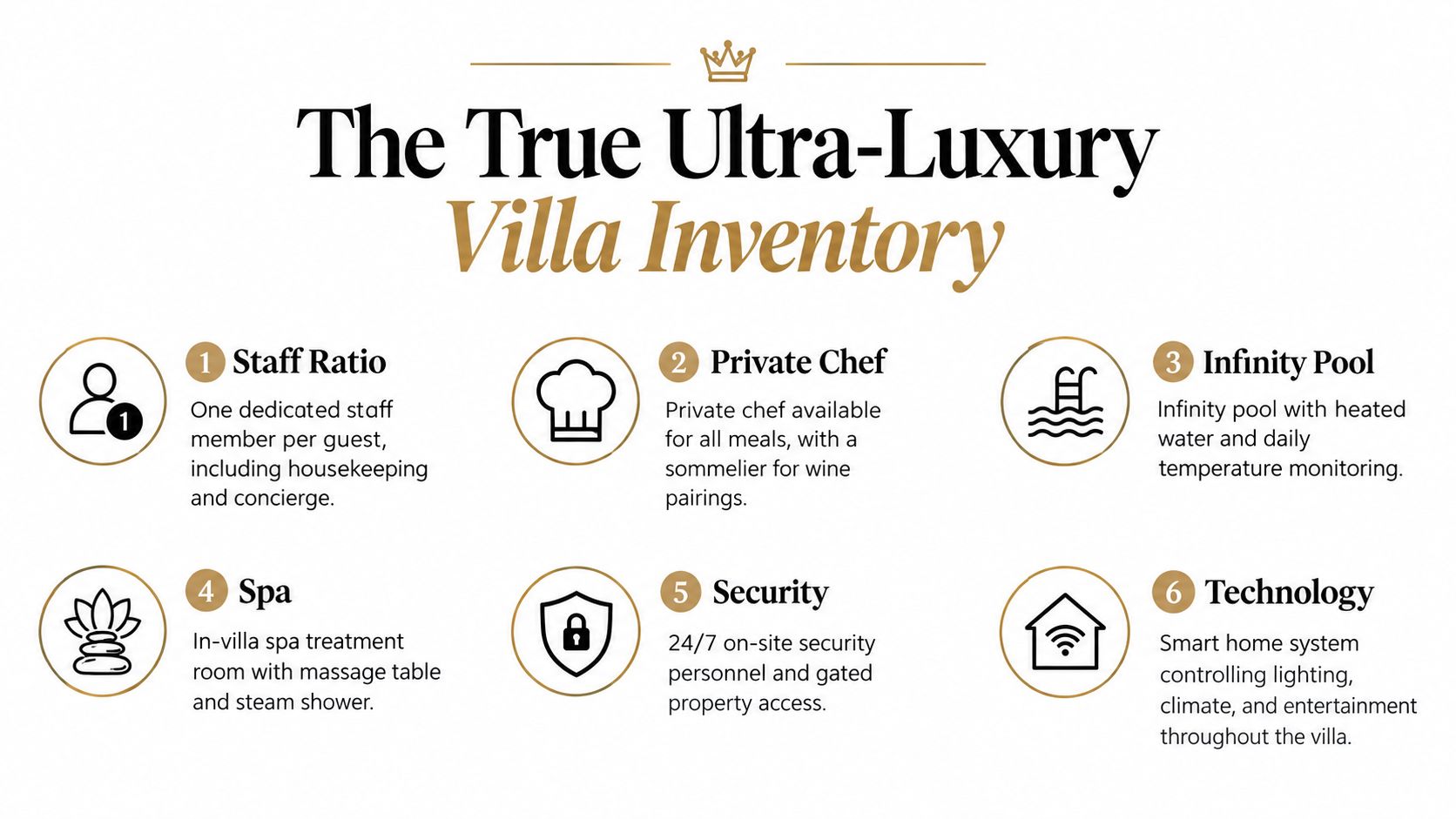
For a useful benchmark when reviewing service language, compare the property brief with Global's luxury rental management guide. The point isn't to copy another operator's inventory. It's to distinguish a defined operating model from decorative marketing.
Compliance, Safety, and the Villa Dossier
A villa's luxury positioning doesn't prove that its operating documentation is complete. For international guests, executive assistants, and family offices, compliance should be treated as a pre-arrival control.
Greece's revised short-term-rental framework requires primary-use spaces with natural lighting, ventilation, and air-conditioning, alongside civil-liability insurance, fire extinguishers, smoke detectors, electrical safety equipment, first-aid supplies, pest-control documentation, and emergency information. Available short-term accommodation reportedly reached 246,000 in July, the highest level recorded since 2019, which makes documented differentiation more important as supply expands. The compliance framework and accommodation-market context should be part of the booking conversation, not an afterthought.
What the manager should provide
AADE requires short-term properties to be entered in the Short-Term Stay Property Registry, with the relevant property identifier displayed in listings. Declarations are generally due by the 20th day of the month following the guest's departure, according to AADE's short-term-rental guidance. Direct bookings and concierge-arranged stays aren't outside the framework just because no major platform processed the reservation.
Ask for the property identifier and confirm that it matches the contracted villa. Request the insurance certificate, emergency contacts, fire-safety records, electrical-safety documentation, pest-control record, first-aid location, and a clear emergency plan. The manager should also explain how guests reach the property, where an ambulance can access it, and what happens if power or water fails.
Keep services cleanly separated in the paperwork. A villa lease and separately contracted services such as chefs, drivers, security, excursions, or yacht charters may be treated differently from a single bundled “fully serviced villa” package. Clear contracts improve auditability and reduce confusion about what the property itself provides.
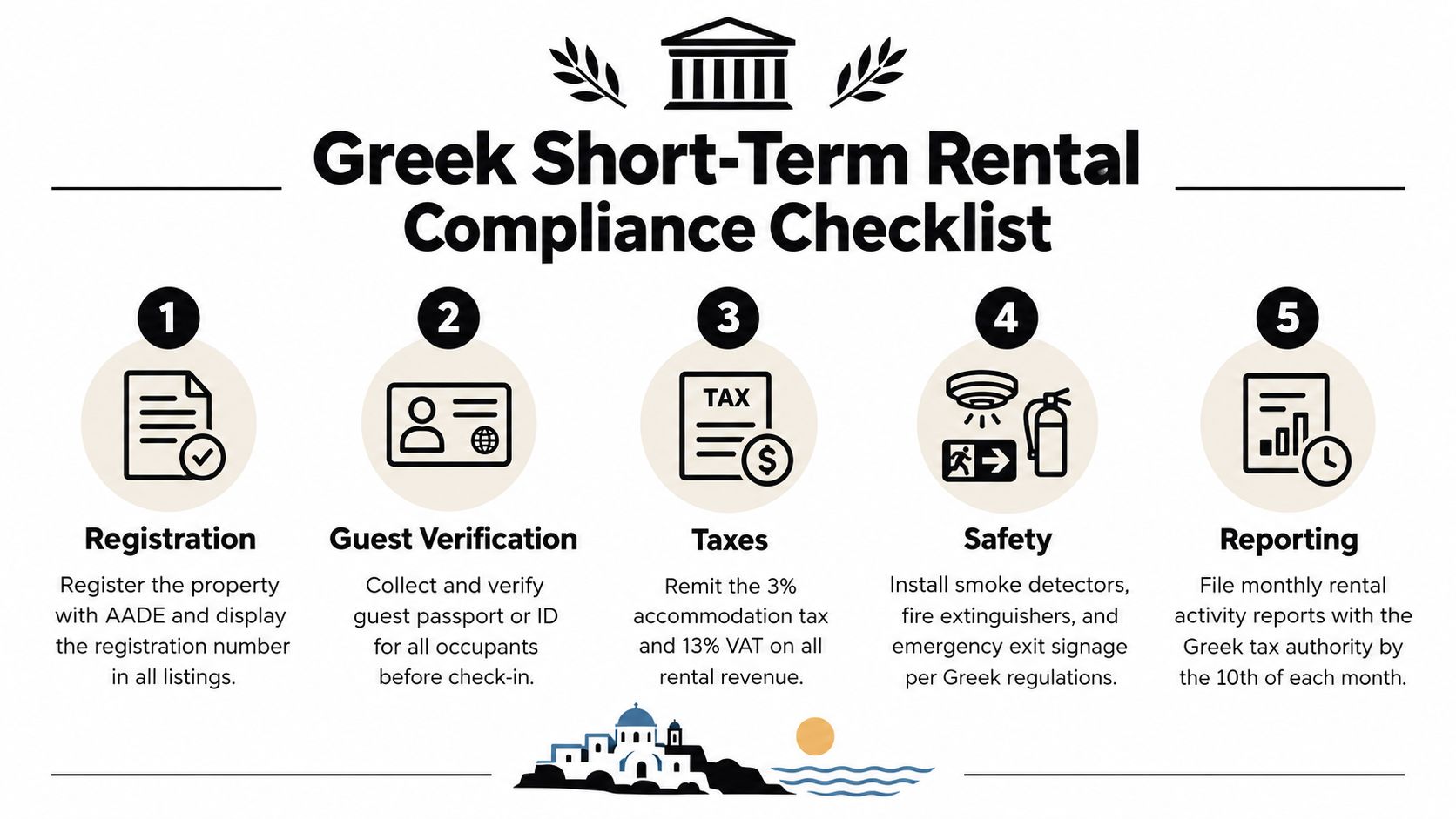
Request before confirming the deposit: registry status, insurance certificate, emergency plan, staff credentials, backup-power details, child-safety provisions, and a written division between included and separately contracted services.
That dossier won't replace local legal advice, but it will reveal whether the property manager runs a disciplined operation or just sells attractive availability.
Seasonality, Heat, and Climate Resilience
July and August aren't automatically the best weeks for a Greek villa. They're the most obvious weeks, which is different.
Recent reporting describes repeated 2025 heatwaves, temperatures exceeding 43°C in some areas, tropical nights, heightened wildfire risk, and growing pressure on water resources. The regional heat and resilience reporting matters because extreme conditions affect more than comfort. They can change the quality of outdoor events, the reliability of transfers, the practicality of hiking, and the experience of sleeping in a villa that looks perfect on paper.
Inspect resilience, not just scenery
Before booking, ask:
- Shade: Are terraces and dining areas protected during the hottest afternoon hours?
- Power: Is there generator or battery backup for air-conditioning, refrigeration, security, and communications?
- Water: What is the municipal supply like, and how does the property manage pool water and interruptions?
- Fire planning: Are evacuation routes, access roads, and local emergency procedures documented?
- Medical access: How far is the nearest reliable medical facility, especially for older guests and children?
- Transport: Can private vehicles reach the house comfortably, including during busy periods?
Late April through May and September into early October often create the strongest balance between comfortable weather, swimming, service availability, and inventory. Late June and early September can work as compromise windows for clients who need a more conventional summer calendar. Mid-July through August offers the most intense demand and the greatest exposure to heat, crowding, and operational pressure.
Santorini illustrates the point particularly well. A private villa in Imerovigli or Akrotiri can provide seclusion, but the itinerary still needs protected dining, sensible transfer timing, and a plan for hot afternoons. The best date is the one that lets the property perform properly, not the one that appears first on a calendar.
Booking Workflow and Negotiation
A high-value villa booking should feel more like an acquisition process than a quick online checkout. The sequence below protects both the guest and the operator.
Build the enquiry properly
Send the full party profile, ages, dietary requirements, preferred rhythm, arrival method, security needs, children's requirements, and likely use of chefs, boats, drivers, or wellness providers. A vague request produces a generic villa shortlist. A precise brief lets the advisor eliminate properties that can't support the stay.
Ask for a soft hold or option while the shortlist is assessed. Then review the contract before transferring funds, with particular attention to cancellation terms, force majeure, damage liability, rebooking rights, guest-count rules, service inclusions, and payment dates.
Verify, then pay
The property dossier should arrive before the final commitment. Confirm the registry information, insurance, staffing, cooling, power, water, access, and safety provisions. The contract should identify the villa itself and distinguish the residence from separately arranged services.
Negotiation works best around value rather than blunt price reduction. Shoulder-week flexibility can support better terms. A manager may add a chef evening, boat day, spa therapist, transfer upgrade, or additional provisioning rather than reduce the headline rate. Repeat clients booking several properties can also ask for coordinated pricing or service enhancements.
For Santorini and Mykonos, don't wait until arrival to begin. HauteBlack advises reserving the preferred Santorini villa and yacht before arrival, with sunset reservations in Oia made at least six months ahead for peak season. Late April to May or September can offer a more manageable balance of availability and weather, according to HauteBlack's Santorini planning guidance.

A week before arrival, hold a final briefing covering airport or marina arrival, staff introductions, preferred meal timing, security protocols, medical contacts, weather contingencies, and the handling of last-minute changes. HauteBlack's villa service is designed around this kind of coordinated property and itinerary planning.
Sample 10-Night Greek Villa Itinerary
The strongest multi-stop journeys assign each villa a job. Don't move just to collect addresses. Move when the next property changes the pace, setting, and service experience.
Nights one through four in Santorini
Begin with four nights in a private villa in Imerovigli or Akrotiri. This is the privacy base, with a caldera-facing setting, private pool, and concierge handling dining, transfers, and a private yacht day. Use the boat for a measured day around the volcano and hot springs, then return to the villa for a chef-led dinner away from the busiest areas.
HauteBlack describes curated estates in these areas as potentially offering private infinity pools, dedicated chef services, and a personal concierge who can arrange dining reservations and private security. That makes the villa a staffed base for logistics, not merely a place to sleep. Its Santorini location guidance supports choosing Akrotiri or Imerovigli when privacy matters more than being inside Oia.
Nights five through seven in Mykonos
Take a private transfer and flight connection, or coordinate the most efficient available air movement, to Mykonos. The three-night stay becomes the social anchor. Choose a private estate outside the core town, with enough outdoor space for a chef evening and a practical route to a quieter cove for a beach day.
Keep the schedule deliberately light. Mykonos works when the villa team controls the movement between the house, beach, marina, and dinner rather than leaving guests to solve transport in real time.
Nights eight through ten in the Peloponnese
End with three nights at a mainland estate among olive groves and a working vineyard. This is the recovery phase, with cooler sleep, spa treatments, slow meals, and less pressure to fill every hour. A private road transfer from Athens keeps the final movement controlled, while the estate provides the space that island villas often cannot.
The route works because each stop has a distinct function: Santorini delivers atmosphere and maritime access, Mykonos supplies energy and social options, and the Peloponnese restores privacy and pace. For a combined island itinerary, HauteBlack's Mykonos and Santorini experiences provide a useful starting point for pairing the two without treating them as interchangeable.
How to Decide and What to Do Next
The final decision is a triangle of inventory scarcity, service intensity, and personal privacy. Santorini and Mykonos pull you toward early booking and tighter logistics. Corfu, Crete, and the Peloponnese give you more room to shape the stay around family, food, recovery, or land. A villa's photographs matter less than its verified dossier, staff structure, cooling, access, and backup plans.
Choose the region by traveler profile. Choose the property by documentation and operating capability. Choose the dates by climate, availability, and the events you want to attend. Then delegate the on-island layer to a Virtuoso-affiliated advisor with preferred-partner access, rather than asking the property manager to coordinate every unrelated element.
HauteBlack operates as a Virtuoso-affiliated luxury travel company with preferred partner status at 500+ properties, alongside private membership, AI-powered introductions, Haute Jets, helicopter transfers, private villas, and concierge dining. This model can place the villa inside a larger journey instead of treating it as an isolated reservation.
This week, prepare a one-page brief with your preferred region, guest profile, dates, service requirements, and climate-resilience questions, then request a documented shortlist before any deposit is paid.
HauteBlack can source private villas and estates, coordinate chefs, yachts, transfers, dining, and on-island support, and build the compliance and service questions into the booking process. Visit HauteBlack to begin a Greece itinerary designed around how you want to travel.
Explore Our Guides


Signature Experiences


