Haute Black Journal
Luxury Travel Reviews: 7 Sources and Services for 2026

Marlene Azeez
Director, HauteBlack
View all articles →

Two five-star hotels can look identical on paper, yet one rating may come from a multi-night anonymous inspection while the other reflects a single editor's stay. That difference matters when you're choosing a suite, private villa, honeymoon base, or premium flight with little tolerance for avoidable compromises. A review is only as useful as the criteria behind it, and a star badge rarely explains service consistency, room-category accuracy, privacy, upgrade potential, or recovery when plans go wrong. This roundup covers seven sources and services for luxury travel reviews, from formal inspection systems to first-hand aviation specialists and member-level itinerary design. Each has a distinct strength, a predictable blind spot, and a practical role in the booking process. For a broader operational perspective on managing hotel reviews, it also helps to separate public reputation from the private booking intelligence that shapes the stay.
1. HauteBlack Services
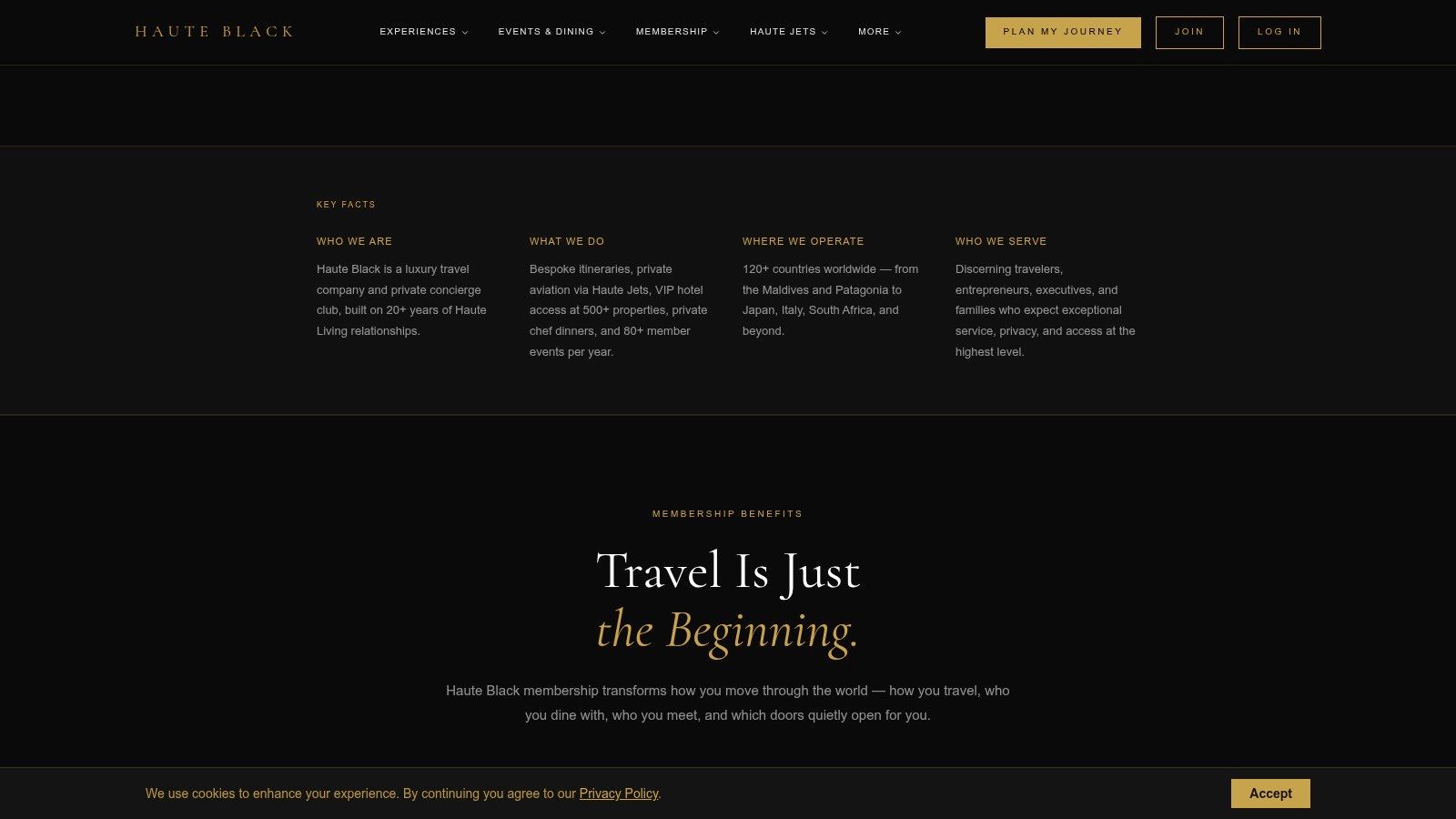
HauteBlack Services is less a review destination than a buying tool for travelers who need a reservation turned into a fully managed journey. Its model combines bespoke itinerary design, VIP recognition, private aviation, ground logistics, villas, estates, and on-ground concierge support. That distinction is important. A published review can tell you whether a hotel's design is impressive, but a specialist advisor can test whether the right room category is available, whether arrival notes have been understood, and whether the itinerary works from airport to final transfer.
HauteBlack's preferred-partner access includes more than 500 properties, including Four Seasons, Aman, Rosewood, Belmond, and Ritz-Carlton. Benefits can include complimentary upgrades, resort credits, and flexible privileges when available, though none should be treated as automatic. Availability, booking channel, room inventory, and advance planning all matter. The service also connects accommodation with Haute Jets private aviation, first-class and helicopter transfers, private villas, estates, dining, and transport coordination.
Practical rule: Treat a public rating as a quality signal, then ask what your booking channel can add to the experience.
What the membership layer changes
Members receive a dedicated advisor, waived planning fees, and priority access to 80+ intimate, invitation-only experiences each year, including private chef dinners, cultural evenings, and curated networking opportunities. HauteBlack's AI-powered network is designed to introduce verified founders, investors, athletes, and creators for private roundtables and meaningful connections. The broader travel network reaches 120+ countries, supported by Haute Living's two decades of industry relationships.
The trade-off is clear. This is a premium, membership-focused service, and its value is strongest for clients booking complex, high-touch travel rather than a simple room. Some upgrades, credits, event invitations, and access arrangements depend on availability or direct inquiry. For independent researchers, the service may feel less transparent than a public review platform. For UHNW travelers, executive assistants, and families coordinating multiple moving parts, that private layer can be more useful than another generic score.
For a contrasting collection of design-led stays, compare the Yeti Retreats luxury cabin portfolio. It's a useful reminder that the property itself is only one part of the decision.
2. Forbes Travel Guide
Forbes Travel Guide is the strongest starting point when you want a formal, third-party benchmark for luxury service. Its inspectors conduct anonymous, multi-night evaluations against hundreds of standards, then publish annual Five-Star, Four-Star, and Recommended distinctions across hotels, restaurants, spas, and cruises. That structure makes it easier to compare properties without relying entirely on a writer's personal preferences.
The system's main strength is consistency. An inspector evaluates the operational details that travelers often notice only after checking in, including service timing, communication, recognition, room presentation, and the handling of requests. Standards are updated through an advisory committee of hospitality leaders, which helps keep the framework relevant as expectations change.
For a shortlist of internationally recognized luxury hotels, that makes Forbes a highly efficient filter. A Five-Star result doesn't tell you whether the hotel suits a honeymoon, a toddler, a multigenerational group, or a guest who values a quiet room over a fashionable address. It does provide a credible indication that the property has been assessed against a demanding service framework.
Where the rating stops
Forbes' coverage is selective, so an excellent independent retreat or new boutique property may not appear. Its editorial descriptions are also more concise than a long-form trip report. You won't always learn how the hotel feels across different seasons, how a particular villa sits on the land, or whether the most expensive room justifies its premium over a well-positioned entry category.
Use Forbes to confirm baseline quality, not to make the entire decision. Pair the rating with a narrative source for atmosphere and with a specialist advisor for current inventory, recognition, and upgrade strategy. That combination is more useful than treating a badge as a complete verdict.
3. Condé Nast Traveler
Condé Nast Traveler excels at the part of luxury travel reviews that formal rating systems struggle to capture, namely atmosphere, sense of place, design, and the emotional texture of a stay. Its first-person hotel, cruise, and destination coverage is supported by major editorial collections such as the Gold List, Hot List, and Readers' Choice awards.
A strong Condé Nast Traveler review can explain why a property feels romantic rather than merely attractive, whether a remote lodge earns its travel time, or how a new opening fits into its destination. Its contributors cover a wide range of global regions, and the writing often gives affluent travelers enough context to understand who the hotel is really for. That's especially valuable when two properties offer similar room sizes and amenities but very different identities.
The limitation is standardization. An editor's experience may be highly informed, yet it remains an editorial perspective rather than an inspection against a consistent checklist. Coverage can also age before a property is revisited, which matters in hotels where leadership, service culture, restaurants, and room condition change quickly.
How to use the editorial lens
Read the review for the details that help you choose a fit. Look for comments about privacy, noise, arrival, dining rhythm, wellness, family practicality, and the distance between the advertised experience and the lived one. Don't rely on a list placement alone. A Gold List property may be exceptional, but it still needs to match your dates, traveling party, and priorities.
For a honeymoon or anniversary, Condé Nast Traveler may be more useful than a standardized score because narrative reveals mood and occasion. For a business trip requiring dependable service and a precise room setup, combine it with Forbes or a trusted advisor who can verify current conditions.
4. Travel + Leisure
Travel + Leisure occupies a practical middle ground between inspiration and trip planning. Its editors publish first-hand hotel reviews, destination coverage, travel news, and influential collections such as the It List for new hotels and T+L 500 for reader-backed favorites. That combination makes it particularly useful when you're tracking a new opening or comparing an established icon with a property currently generating attention.
The publication's reviews tend to include the details travelers need before booking, such as location, room features, dining, wellness, family considerations, and the broader experience around the hotel. Its U.S.-focused readership also makes the perspective useful for American travelers assessing domestic resorts and long-haul destinations through a familiar planning lens.
The trade-off is breadth. Not every review can explore a property with the depth of a specialist trip report, and reader-influenced lists can reflect popularity as much as inspection rigor. A hotel may rank well because it has strong recognition and broad appeal, while a quieter property with exceptional privacy or highly personalized service receives less attention.
A useful role in the shortlist
Use Travel + Leisure to identify candidates, especially for new openings, resort comparisons, and established properties with strong reader recognition. Its guide to the best luxury all-inclusive resorts worldwide is particularly relevant when the value equation depends on what's included, not only on the nightly room rate.
Before committing, investigate the exact package and season. “All-inclusive” can describe very different levels of dining, transfers, activities, and premium beverages. A public review may establish that a resort is attractive and well run, but a booking advisor can clarify whether the inclusions work for your family, celebration, or preferred travel style.
5. Robb Report Travel
Robb Report Travel approaches luxury travel from the perspective of premium design, high-touch service, suites, privacy, and insider access. Its recurring “Checking In” series uses an explicit 10-point rubric, giving readers more structure than a purely impressionistic hotel feature. That transparency helps when you're comparing flagship suites or deciding whether a property delivers substance beyond its visual appeal.
Robb Report is particularly good at identifying details that matter to affluent travelers but disappear in broad hotel coverage. Room proportions, materials, privacy, service culture, and the quality of soft touches receive more attention than they would in a general destination article. Its best-of lists also help position a hotel within a luxury lifestyle context rather than treating every five-star property as interchangeable.
The weakness is that the rubric isn't equivalent to an anonymous inspection system. A transparent score is useful, but readers still need to understand the reviewer's priorities and the circumstances of the stay. Some content may also sit behind a subscription or paywall, limiting the amount of evidence available during a quick comparison.
When the review earns weight
Robb Report is strongest when the suite itself is central to the purchase. Read it alongside room plans, recent photography, and advisor feedback about renovation status, adjoining-room options, and privacy. A grand suite can look compelling in editorial images yet be less suitable for a family, a couple seeking seclusion, or an executive needing a discreet working environment.
Its aviation coverage can complement the hotel decision. HauteBlack's guide to luxurious private plane options is relevant when the journey's comfort depends as much on the aircraft and transfer plan as on the resort at the destination. A beautiful hotel loses some of its appeal when the arrival experience is poorly coordinated.
6. The Points Guy
The Points Guy is the most useful source in this group for travelers making a cash-versus-points decision or evaluating the hard product of a premium flight. Its reviews cover airlines, hotels, lounges, cruises, and related travel services, with first-hand reporting on cabins, seat layouts, lounges, routes, aircraft changes, and elite-status value.
That granular focus makes TPG valuable before a long-haul first- or business-class booking. A hotel review may tell you that the resort is worth the journey, but TPG can help determine whether the flight itself delivers a private suite, a competitive lounge, a practical bed, or a disappointing configuration on the aircraft assigned to your route. Its early coverage of new cabins and routes is also helpful when a trip depends on a recent product launch.
The site's commercial environment requires judgment. Credit-card and loyalty content sits close to the reviews, and the volume of publishing means depth varies by writer and subject. Hotel coverage is selective, so TPG shouldn't be your only source for a remote villa, a wellness retreat, or a destination property where local service matters more than points mechanics.
Read the review for the decision in front of you
If the trip is centered on aviation, TPG's strengths are unusually practical. Check the exact aircraft, seat map, lounge access, change conditions, and redemption logic rather than assuming that the airline's cabin name tells the full story. For hotel stays, use it as a secondary source unless the property is part of a loyalty strategy.
Its discussion of the best travel loyalty programs for 2026 can help frame the broader booking decision. Loyalty value is only worthwhile if it supports your actual itinerary, dates, flexibility, and preferred properties. A member benefit that looks attractive on paper may be less valuable than a well-managed direct booking with recognition and the right room.

7. One Mile at a Time
One Mile at a Time is built for readers who want detail rather than a quick recommendation. Its trip reports examine first- and business-class flights, airline lounges, and luxury hotels through extensive photography and candid commentary. The site's active comments community adds another layer of useful intelligence, especially when readers challenge a conclusion, report a changed product, or confirm a recurring service pattern.
The independent voice is a major advantage. OMAAT is quick to identify service misses, inconsistencies, weak lounge offerings, or a premium cabin that looks better in marketing than it feels in practice. That candor is valuable when a flight or hotel carries a significant opportunity cost.
The blind spot is perspective. Many reports reflect solo-traveler itineraries, aviation interests, and the author's own schedule. A cabin that works brilliantly for one person may be less suitable for couples who want privacy together, families needing flexible seating, or executives who prioritize uninterrupted sleep. The destination range is also narrower than that of the large travel magazines.
Use the comments as a second opinion
Read the main report for hard details, then examine the comments for recent confirmation and disagreement. Pay attention to the date of the flight or stay, aircraft swaps, renovation work, and whether the author experienced a normal operation or an unusual disruption. OMAAT's public ethics and advertising policies provide useful context, but transparency doesn't eliminate personal bias.
For premium aviation, it's one of the best sources for understanding what you're buying. For hotels, combine the report with a formal benchmark and current advisor intelligence. That approach keeps a vivid, candid review in perspective without dismissing the details that make it valuable.
Luxury Travel Reviews: 7-Source Comparison
| Service / Source | Complexity 🔄 | Resource Needs ⚡ | Expected Outcomes 📊⭐ | Ideal Use Cases 💡 | Key Advantages ⭐ |
|---|---|---|---|---|---|
| HauteBlack Services | High, bespoke, multi-party orchestration 🔄 | Very high, dedicated advisors, private aviation, global partner ops ⚡ | Seamless VIP travel, upgrades, curated events and introductions 📊 ⭐ | UHNW travelers seeking end-to-end luxury and exclusive access 💡 | Preferred status at 500+ hotels; full logistics; exclusive events & networking ⭐ |
| Forbes Travel Guide | Medium, inspector program and standards-based audits 🔄 | High, trained anonymous inspectors, standards maintenance ⚡ | Consistent, objective star ratings for benchmarking service quality 📊 ⭐ | Vetting top-tier properties and service-consistency benchmarking 💡 | Credible third‑party standard; global coverage; inspector-led rigor ⭐ |
| Condé Nast Traveler | Medium, editorial trips and narrative curation 🔄 | Moderate, experienced editors, on-the-ground reporting ⚡ | Immersive, narrative reviews and curated “best of” lists that inform taste 📊 ⭐ | Discovering standout hotels/destinations and experiential recommendations 💡 | High editorial standards; Gold List and deep storytelling ⭐ |
| Travel + Leisure | Medium, editorial testing plus reader-driven lists 🔄 | Moderate, editorial team, reader input and data ⚡ | Trend-focused coverage and practical planning details for mainstream-luxury 📊 ⭐ | Tracking buzzy openings, U.S.-focused travel planning and inspiration 💡 | Balanced inspiration + practical detail; strong U.S. audience ⭐ |
| Robb Report (Travel) | Medium, rubric-driven luxury reviews with editorial context 🔄 | Moderate, specialized luxury writers, membership tie‑ins ⚡ | Detailed luxury/suite-focused appraisals tailored to affluent tastes 📊 ⭐ | Comparing flagship suites, ultra-luxury service and design choices 💡 | Luxury-first lens; transparent scoring (Checking In); affluent audience ⭐ |
| The Points Guy (TPG) | Low–Medium, product reviews + points analysis 🔄 | Moderate, staff test trips, loyalty research, editorial ops ⚡ | Granular cabin/lounge comparisons and actionable redemption guidance 📊 ⭐ | Optimizing points/miles, premium cabin vs cash decisions, loyalty value 💡 | Deep loyalty coverage; timely cabin/product updates; practical guides ⭐ |
| One Mile at a Time (OMAAT) | Low–Medium, solo deep-dive trip reports 🔄 | Low–Moderate, independent author resources, photo documentation ⚡ | Candid, photo-rich trip reports and frank evaluations of premium products 📊 ⭐ | In-depth reviews of new premium cabins, flagship lounges, and trip details 💡 | Independent voice; extensive photos; engaged expert readership ⭐ |
Turning Reviews Into a Bespoke Plan
The right source depends on what you're trying to reduce. If service consistency is the primary concern, begin with Forbes Travel Guide. If atmosphere, design, and destination character will determine whether the trip feels special, read Condé Nast Traveler or Travel + Leisure. If the suite, privacy, or soft service matters most, Robb Report offers a more luxury-specific lens. For aircraft, lounges, points, and route-level decisions, use The Points Guy and One Mile at a Time together. When the journey involves multiple hotels, private transfers, villas, aviation, or a complex family schedule, HauteBlack belongs in the decision before the booking is finalized.
Cross-check at least two independent reviews for every property on a serious shortlist. Look for agreement on the issues that are difficult to repair after arrival, including room-category accuracy, noise, privacy, service responsiveness, dining limitations, transfer time, and whether the hotel suits your traveling party. If one review praises an experience and another reports a serious weakness, don't average the scores. Investigate the dates, season, room type, renovation status, and purpose of the stay.
Price context matters just as much as the published rating. A resort may make sense during one season and feel poor value during another, while a city hotel's convenience may justify a premium for a short stay but not for a longer one. The review should help you form the question. Your advisor should help you answer it with current availability, benefits, and logistics.
The best luxury travel review doesn't make the decision for you. It tells you which questions to ask before money, time, and a carefully planned occasion are committed.
Share your dates, budget, destination interests, and priorities with a HauteBlack advisor before you book. The team can shape a bespoke itinerary, coordinate preferred properties, request benefits where available, and connect accommodation with private aviation, first-class or helicopter transfers, villas, dining, and local access. Members also receive dedicated advisory support, waived planning fees, and priority consideration for curated experiences, while non-members can book signature journeys and tailor-made trips.
The finished roundup belongs on HauteBlack's luxury travel news page, where the focus remains practical: not just which property earns praise, but which combination of room, recognition, access, transport, and timing will deliver the right journey.
HauteBlack turns luxury travel reviews into an actionable booking plan, combining preferred-property access, VIP recognition, bespoke itineraries, private aviation through Haute Jets, and coordinated transfers across 120+ countries. If you're comparing suites, villas, resorts, or premium flights, visit HauteBlack and share the dates and priorities that matter most.
Explore Our Guides


Signature Experiences


