Haute Black Journal
A Luxury Tour of India: The Ultimate 2026 Guide

Marlene Azeez
Director, HauteBlack
View all articles →

# A Luxury Tour of India: The Ultimate 2026 Guide
May 9, 2026
At sunrise in Agra, the best luxury moments happen before the gates feel busy. A historian is waiting, the car is already positioned for the next departure, breakfast is set elsewhere, and the day unfolds without friction.
Envisioning Your India An Unforgettable Journey
A well-designed luxury tour of india has very little to do with rushing between landmarks. It has everything to do with perspective, pacing, and insulation from the unnecessary. India can be exhilarating, but for a high-net-worth traveler, the right version of India feels composed. You move from a lantern-lit courtyard to a private salon, from a sacred riverbank to a quiet suite, and the country reveals itself in layers rather than noise.
That matters more now because the luxury ecosystem is expanding in a meaningful way. India's luxury hospitality segment reached USD 8.5 billion, supported by international hotel brands, strong boutique properties, and government-backed tourism development such as the Swadesh Darshan scheme, which promotes theme-based circuits centered on heritage, culture, and spirituality, according to Ken Research's India luxury hotels and resorts market overview. For the traveler, that translates into a better ground game: stronger properties, more refined regional access, and more destinations that can support white-glove execution.
India through a quieter lens
The mistake most travelers make is assuming India should be consumed in volume. It shouldn't. The country rewards selectivity.
A stronger approach is to frame each stop around a distinct mood:
- Delhi for orientation: not just monuments, but private context, design, and cuisine.
- Agra for precision: one monumental visit, done properly, then onward.
- Jaipur or Udaipur for atmosphere: where architecture, textiles, and hospitality create emotional depth.
- A retreat, lodge, or palace stay for exhale: where the trip shifts from sightseeing to inhabiting a place.
India is most luxurious when it stops performing as a checklist and starts feeling like a private world built around your tempo.
That also applies to cultural detail. Tea service in India, for example, can be as nuanced as wine in Europe. If you want a quick primer before building a more food- and ritual-led journey, this guide to Indian tea varieties is useful context. It gives texture to one of the everyday pleasures that becomes far more memorable when someone curates it well.
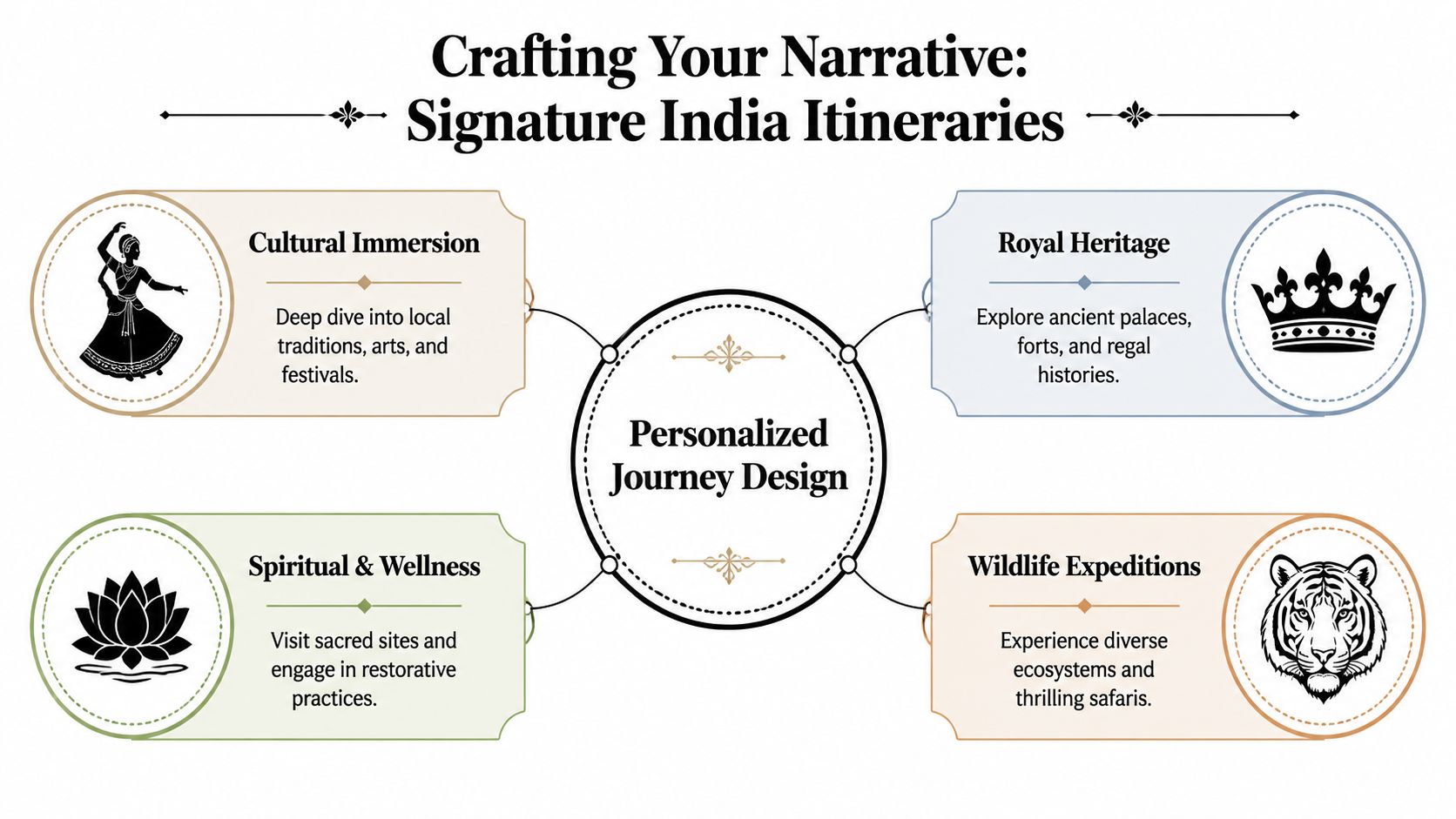
Crafting Your Narrative Signature India Itineraries
The strongest itineraries don't begin with cities. They begin with intent. Premium operators use dialogue-driven, intention-based itinerary construction, and that distinction matters because it shifts the conversation from “What should we see?” to “How should this trip feel?” As noted in this overview of bespoke luxury touring in India, that planning model also supports specialized channels such as the Maharajas' Express, described there as the world's most luxurious train, with multi-day journeys priced at $8,000 to $15,000 per person.
Start with the emotional center
Every successful luxury tour of india needs a central narrative. Without one, even beautiful trips can feel fragmented. With one, the route becomes coherent.
Three themes work especially well.
Royal Rajasthan
This is the itinerary for travelers who want grandeur, design history, and a strong sense of place. The route usually leans into cities where palace architecture, courtly traditions, and old-world hospitality still shape the experience.
What works:
- Longer stays in fewer cities so each palace or fort feels inhabited, not skimmed
- Private guides with historical fluency rather than generic sightseeing commentary
- Suite-led booking strategy because room category changes the entire mood in heritage properties
What doesn't:
- Trying to combine too many desert towns in one pass
- Using Rajasthan only as a backdrop for photos
- Moving every night, which turns regal travel into logistical churn
A royal itinerary should feel theatrical, but never exhausting.
Spiritual and wellness sanctuaries
This theme is for travelers who want India to restore something, not just impress them. It can include sacred river cities, Himalayan foothills, meditation, temple architecture, and quiet luxury retreats where the body and nervous system are given equal attention.
The key is balance. Too much ritual and the journey can become abstract. Too many hotel comforts and it loses meaning. The best version combines contemplative experiences with excellent accommodation, deliberate downtime, and private access to teachers, practitioners, or interpreters who can make the experience legible.
Advisor's rule: If every day is “important,” none of it lands. Build in protected space for digestion, rest, and spontaneity.
Wildlife and wilderness
India's wilderness offering is often underestimated by first-time luxury travelers. That's a mistake. A wildlife itinerary can deliver some of the most emotionally charged moments in the country, especially when paired with refined lodges and strong naturalists.
This theme works best when travelers accept one important truth: safari is about rhythm, not guarantees. The right advisor manages that expectation early. You're not buying certainty. You're creating the best possible conditions for extraordinary encounters.
A strong wildlife structure often includes:
1. A serious lodge with excellent guiding
2. Enough nights to settle into the reserve's pace
3. A clean contrast afterward, such as a palace stay or urban design hotel, so the journey keeps evolving
The train as a delivery system
Luxury trains can be brilliant in the right context. They are not automatically superior to flying or driving, but they can create a particular type of continuity. For travelers who enjoy old-world formality, polished service, and a sense of procession, the Maharajas' Express can become the spine of the trip rather than a novelty folded into it.
The trade-off is control. A train journey offers atmosphere and convenience, but less flexibility than a fully private route. Some clients love that. Others prefer a private car and driver because it allows detours, pace changes, and access to quieter hours at major sites.
How to choose the right narrative
| Travel priority | Best-fit narrative | Best avoided |
|---|---|---|
| Heritage, interiors, regal atmosphere | Royal Rajasthan | Overpacked multi-region routing |
| Reflection, restoration, sacred context | Spiritual and wellness sanctuaries | Monument-heavy days back-to-back |
| Nature, photography, raw contrast | Wildlife and wilderness | Too-short lodge stays |
The best itineraries often combine two themes, not three. Pairing Rajasthan with wellness works. Wildlife with palace hotels works. Trying to do palaces, tigers, Himalayan retreat, Goa, and South India in one sweep usually doesn't.
The Sanctuaries of Splendor Palaces Private Estates and Premier Hotels
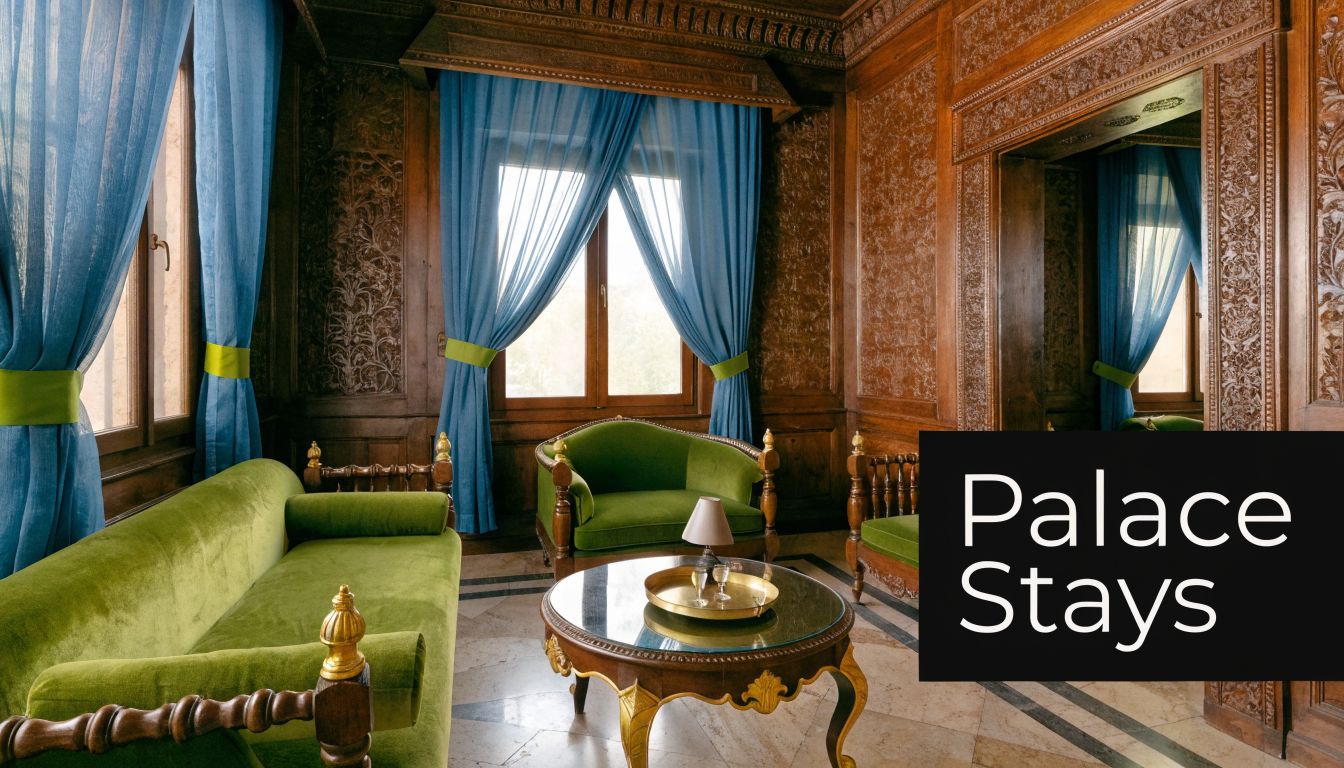
Where you sleep in India isn't a supporting detail. It often becomes the emotional anchor of the trip. In practice, most ultra-luxury journeys fall into three accommodation families: heritage palaces, contemporary sanctuaries, and private estates. Each serves a different traveler.
Heritage palaces
A restored palace can deliver something no modern hotel can replicate. You're not just receiving service. You're stepping into a living narrative of lineage, ceremony, and architectural memory.
The upside is obvious. Scale, romance, decorative richness, and a sense of occasion often begin the moment you arrive. The trade-off is that heritage inventory can vary more by room category. Some rooms are magical. Some are merely large. At this point, curation matters.
Best for:
- Couples
- Milestone trips
- Travelers who want atmosphere over minimalism
Less ideal for:
- Guests who prioritize sleek contemporary design
- Travelers who want every operational detail to feel standardized
Contemporary retreats
Properties in the Aman mold offer a different proposition. Here the luxury is silence, restraint, space, and discipline. The design recedes. The service sharpens. These hotels are often ideal after intense cultural touring because they help the body reset.
They're also dependable for clients who know exactly what they like. If a traveler values serenity, architectural clarity, and discreet service rhythms, this category usually outperforms the most famous palace stay.
Some travelers think “more ornate” means “more luxurious.” In India, the opposite is often true once the trip is in motion.
Private estates and villas
For families, entertainers, and travelers who need privacy at the highest level, a private estate can be the most intelligent choice. A fully staffed residence changes how the journey works. Meals happen on your schedule. Security is more controlled. Children move more freely. Entertaining becomes easy.
These properties also solve a common problem. Some clients want India's beauty without the social exposure of a grand hotel. A private estate offers insulation without sacrificing service. For travelers comparing styles, a specialist can help match the right accommodation profile through a curated luxury hotel planning approach.
A practical comparison
- Palace hotel: best for drama, romance, and historical immersion
- Modern retreat: best for calm, wellness, and design discipline
- Private estate: best for privacy, family logistics, and schedule control
The right luxury tour of india usually blends at least two of these. Palace after palace can become visually repetitive. Modern retreat after modern retreat can flatten the sense of destination. Contrast is what makes the trip feel composed.
Beyond the Velvet Rope Exclusive Access and Unforgettable Experiences
Access is where luxury stops being cosmetic and starts becoming meaningful. Anyone can reserve a suite. Far fewer travelers can enter a place at the right hour, meet the right host, or experience a site without the usual layer of public friction.
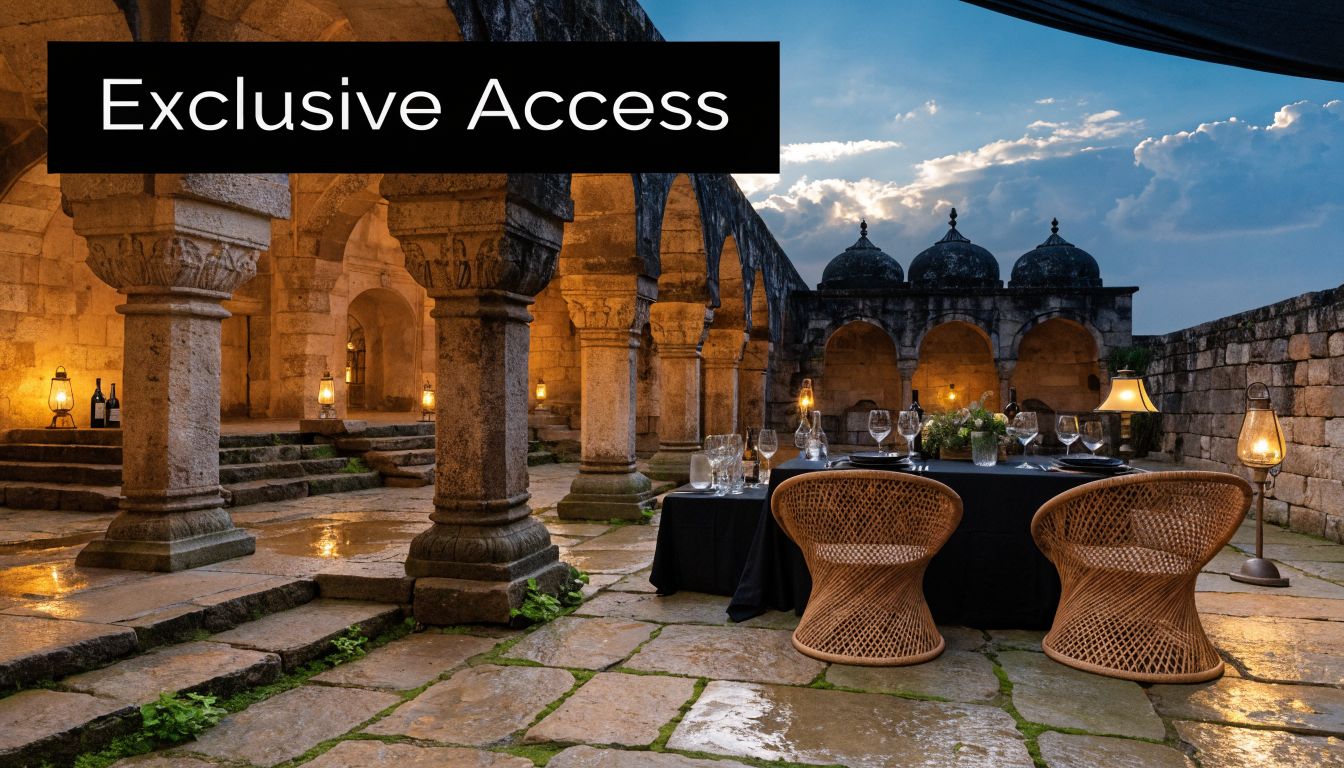
A private dinner in a historic courtyard is a good example. On paper, it sounds simple. In execution, it isn't. The mood depends on permissions, timing, lighting, music restraint, culinary quality, weather backup, and service choreography. When those details align, dinner becomes memory rather than meal.
What exclusive access actually looks like
It rarely means spectacle for its own sake. It means removing the dead space that weakens a journey.
That can include:
- A monument visit timed around stillness, not crowds
- A private host or scholar who adds context unavailable in standard touring
- Closed-door shopping and atelier appointments where craft is explained, not merely sold
- Fort, haveli, or palace dining arranged with enough production value to feel elegant, not staged
The important distinction is whether an experience changes your relationship to the place. If it doesn't, it's decoration.
Wellness is no longer optional
One of the clearest weaknesses in much luxury India programming is the failure to integrate serious wellness. As noted in this discussion of gaps in current India trip design, many luxury tours still center monuments while neglecting India's deeper traditions in Ayurveda and yoga, even though affluent travelers increasingly want mental clarity, physical recovery, and spiritual alignment built into the trip itself.
That shift has changed how good advisors design the route. Wellness can't sit awkwardly on the edge of the itinerary. It has to be built into the architecture.
What that often looks like in practice:
- A palace stay followed by a quieter retreat where sleep, bodywork, and nutrition are prioritized
- Private yoga or meditation sessions scheduled at points of real fatigue, not inserted for optics
- Consultation-led wellness, where treatments respond to the traveler rather than default spa menus
- Lighter cultural days after long flights or emotionally dense sacred experiences
A luxury journey through India should leave you expanded, not depleted.
Experiences that hold their value
The best exclusive moments usually share the same traits. They are private without being sterile. Refined without being overproduced. Rooted in a place rather than portable.
A well-run advisor will often steer clients away from over-advertised “VIP” add-ons and toward experiences with better emotional return:
1. An intimate meal in a remarkable setting
2. A thoughtful encounter with a keeper of local knowledge
3. A transition moment, such as a scenic helicopter transfer or elegant rail segment, that changes the feeling of the journey
For a visual sense of how these more cinematic journeys can unfold, this short film is worth watching before planning the shape of the route:
The common mistake is overbooking “special” moments until none of them feel special. India responds better to selectivity. One extraordinary evening can do more than five premium add-ons piled into the same week.
The Art of Seamless Travel Logistics for a Flawless Journey
In India, logistics determine whether a trip feels graceful or draining. The country is too large, too layered, and too variable for casual planning to hold up at the highest end. Elegant travel here depends on invisible structure.
Why private ground handling changes everything
A dedicated car and driver is not a luxury flourish. It is the operating system of the trip. It protects pacing, allows for soft adjustments during the day, and spares the traveler from a constant stream of small frictions. A strong driver and a strong on-the-ground team can rescue timing, preserve mood, and make ambitious routing feel light.
That matters most in India's transition moments:
- airport to hotel after a long-haul arrival
- city touring when traffic and security patterns shift
- monument visits that require exact timing
- hotel changes where poor coordination can burn half a day
When those handoffs are managed well, the traveler barely notices them.
Practical rule: In India, the less you think about logistics during the trip, the better the logistics were.
When to charter and when not to
Private aviation is useful, but not always necessary. The mistake is treating every route as a jet route. Sometimes a private charter saves a day and opens up a property that would otherwise feel too remote. Sometimes a short commercial hop with proper VIP handling is the smarter choice.
The decision usually comes down to three questions:
| Situation | Best choice | Reason |
|---|---|---|
| Tight multi-stop journey with remote lodge access | Private aircraft | Protects time and reduces fatigue |
| Simple city-to-city connection with strong direct service | Premium commercial with VIP support | Efficient without overspending energy |
| Scenic, ceremonial, or highly time-sensitive arrival | Helicopter or private air transfer | Enhances both access and experience |
For travelers building India around multiple regions, access to well-managed private and premium air travel planning becomes especially useful because the route often matters as much as the destination.
Seasonality, health, and formalities
A polished itinerary is seasonal. Rajasthan, the Himalayas, central India, and the south all perform differently throughout the year. The right advisor does not merely ask when you're free. They ask what conditions you want. Crisp sightseeing weather, greener surroundings, better safari rhythm, quieter city energy, or retreat time all suggest different routing choices.
Formalities should also be handled before they become distractions:
- Visa planning: requirements can change, so documents and timing should be checked well in advance.
- Health guidance: this should be personalized through your physician or travel clinic, especially if the trip covers multiple regions.
- Arrival resilience: the first day should never be overscheduled. Even private travel needs room for adaptation.
Most travelers underestimate how much comfort comes from not having to think ahead every hour. In India, the experience is meticulously designed for continuity, not improvised.
Understanding Ultra-Luxury Budgeting in India
Price in India can be misleading if you look only at hotel names or star categories. Two trips can visit the same cities and feel worlds apart in quality because the underlying cost drivers sit beneath the surface. The question isn't “How expensive is India?” The question is “What level of control, access, and insulation do you want?”
That's one reason the broader market matters. India's luxury travel market is valued at USD 75.7 billion in 2025 and projected to reach USD 106.5 billion by 2034, according to IMARC's India luxury travel market analysis. The same analysis notes that safari and adventure tourism holds the largest revenue share at 35.18%, and affluent consumers are allocating 58% of their discretionary spending toward travel experiences. That tells you where demand is moving: toward experience-rich, high-touch travel rather than simple room acquisition.
What changes the budget fastest
Accommodation is only one layer. In practice, these are the most significant budget shapers:
- Room and suite category: the difference between an entry room and a signature suite in a palace or premier resort is often the difference between “beautiful trip” and “defining trip.”
- Transport model: private car and driver is one threshold. Charters, helicopters, and rail suites create another.
- Access design: private hosts, special venue use, and unusual operating hours often matter more than the hotel line item.
- Pacing: shorter trips with harder routing can cost more operationally than longer, calmer ones.
A useful way to think about value
There is a substantial difference between a premium trip and an ultra-luxury one. The premium version buys comfort. The ultra-luxury version buys friction removal.
You see that in details such as:
1. How quickly you move through each transition
2. Whether your room category changes the emotional tone of the stay
3. Whether your guide is merely informative or truly outstanding
4. Whether special experiences feel private and elegant, or packaged
Budgeting for India works best when you price the journey by standard of execution, not by destination count.
Where travelers often overspend
Counterintuitively, adding too many destinations can dilute value. More flights, more unpacking, more room for delays, more guide changes, more operational drag. Many travelers get a better return by spending more on fewer stops.
A sharper budgeting strategy usually looks like this:
- choose fewer cities
- upgrade the suite level
- invest in standout access moments
- protect downtime
- use private aviation only where it meaningfully improves the route
That approach tends to produce a stronger luxury tour of india because it funds what the traveler feels.
The Haute Black Advantage The Architecture of a Bespoke Journey
Booking a famous hotel in India is straightforward. Very few can compose the full journey with the right sequence, the right room, the right host, and the right access points so the trip feels inevitable rather than assembled.
That's where a real advisory model matters. The best journeys are architected, not purchased. They begin with preference mapping, continue through highly selective supplier coordination, and rely on continuity from the same advisor who understands the traveler's rhythms. That continuity is often the difference between a trip that looks luxurious and one that feels effortlessly personal.
What bespoke architecture looks like
A strong advisor isn't just securing reservations. They're making judgment calls that shape the entire emotional contour of the trip.
That usually includes:
- Choosing the right narrative, so the route has coherence
- Protecting energy, so high-impact experiences are placed at the right points
- Matching accommodation style to personality, not just reputation
- Securing preferred recognition, so the stay begins with status, not explanation
- Maintaining optionality, so the itinerary can bend without breaking
This is also where relationship capital counts. A network built over years can produce better rooms, better handling, and better outcomes when plans shift.
Why partnership ecosystems matter
In ultra-luxury travel, access is rarely the result of one reservation. It comes from layered partnerships across hotels, air, transport, concierge, and local fixers. If you want to understand how that broader support ecosystem functions in practice, this perspective on an MLR Worldwide Service concierge is a useful complement to the travel advisor model.
For travelers evaluating who should handle a complex India itinerary, look for a team that can do three things well:
1. Think editorially about the trip, not mechanically
2. Operate with precision on the ground
3. Advocate for the client before, during, and after travel
A bespoke journey also benefits from seeing how other curated itineraries are structured. This example of customized package tours illustrates the broader principle well: the value is in orchestration, not inventory.
The real advantage
The highest level of luxury is not excess. It is confidence. Confidence that the room is right. Confidence that the transfer will be there. Confidence that a sacred place will be approached with tact. Confidence that if weather shifts, a better plan already exists.
That's the architecture behind a memorable luxury tour of india. Not louder indulgence. Better decisions, made earlier, by people who know which details matter.
For travelers who want India handled with that level of precision, Haute Black brings together dedicated advisory, preferred partner access, VIP recognition, and the quiet operational control that turns a beautiful itinerary into a life-defining journey.
Explore Our Guides


Signature Experiences


