Haute Black Journal
Intimate Destination Weddings: A High-End Planning Guide

Marlene Azeez
Director, HauteBlack
View all articles →
# Intimate Destination Weddings: A High-End Planning Guide
August 5, 2026
You are probably staring at a guest list that's already too big, a venue shortlist that all looks identical on Instagram, and a budget that keeps climbing every time someone says “private transfer” or “full buyout.” That's exactly where intimate destination weddings either become elegant and controlled, or turn into a pretty mess with weak attendance, scattered logistics, and too many people making decisions at once. The winning move is to treat the wedding like an operation, not a mood board.
What an Intimate Destination Wedding Actually Means
An intimate destination wedding is not just a smaller wedding in a prettier place. It's a deliberate trade, fewer guests, more time together, higher per-guest spend, and tighter control over privacy, pacing, and the guest experience. At the luxury tier, that usually means a celebration built around a curated group rather than a crowd, with the couple spending more on each person and less on scale.
The category is moving in that direction for a reason. A 2026 WedMeGood destination wedding report, as reported by mid-day and Times Now, projects destination weddings will account for 30 to 32% of all Indian weddings by 2028, up from nearly one in four currently. The same reporting says spending has risen 8% year on year, with the average domestic destination wedding budget at Rs 58 lakh and international destination weddings averaging over Rs 1.5 crore. That's not bargain hunting. That's couples buying control, atmosphere, and time.
Intimacy changes the economics
The smartest couples stop asking, “How many people can we invite?” and start asking, “How much experience do we want each guest to have?” A 2026 survey found the “magic number” sits around 30 to 70 guests, and industry data shows the average guest count has fallen to 34 with 31% of destination weddings now hosting 30 or fewer guests (Wedinspire). That's the definition of intimacy at this level.
A smaller group changes everything. You need fewer rooms, fewer transfers, fewer place settings, and fewer moving parts, but you usually spend more per guest because the couple is concentrating the budget into design, dining, and high-touch hospitality. That's why these weddings feel more like private hospitality programs than conventional receptions.
Practical rule: If the guest count is small but the agenda is still generic, you've just paid luxury pricing for an average wedding.
The best intimate destination weddings are multi-day, highly edited, and psychologically calm. Guests don't feel like they've been processed through a ceremony factory. They feel hosted.
The Market Forces Behind the Intimate Wedding Boom
This category isn't a fleeting aesthetic. It's a structurally growing luxury travel segment. Independent market research values the destination wedding market at USD 34.2 billion in 2025 and forecasts USD 36.4 billion by the end of 2026, growing at a 6.4% CAGR to USD 67.7 billion by 2036 (Future Market Insights). Another analysis places the market at USD 36.49 billion in 2024 and projects USD 137.16 billion by 2029, implying a 30.2% CAGR (Condor Ferries). Different methodologies, same message, this market is expanding fast.
Fewer guests, more leverage
The economics only make sense if you understand where the money is moving. An average destination wedding guest list of 50 guests and average cost of $28,000 are cited in one industry summary (Rustic Pathways). Another planning guide says destination weddings typically attract 65 to 86 guests, with 60 to 70% of invited guests attending, an average stay of 4 to 5 nights, and average per-person guest spending of $2,000 (Anatole Wedding). Those figures vary by market, but they all point in the same direction, the event is becoming more intimate and more hotel-like.
| Metric | Intimate Benchmark | Why It Matters |
|---|---|---|
| Guest count | 30 to 70 guests | Fewer moving parts, more control over the room |
| Average guest count | 34 guests | Confirms the format is already small by design |
| Smallest cohort share | 31% with 30 or fewer guests | Shows how common true micro-scale events have become |
| Celebration length | 3.2 days | More days means more touchpoints and more planning discipline |
| Domestic budget | Rs 58 lakh | Privacy and experience cost money |
| International budget | Over Rs 1.5 crore | Global intimacy is a premium product |
Why couples are paying more for less
The rise in destination spending, the longer celebration window, and the smaller guest count all point to the same behavior. Couples are trading scale for precision. They want the dinner to feel considered, the transfer to feel effortless, and the room to feel private, not merely decorated.
That's why the planning logic has changed. You're not arranging one event, you're designing a sequence of high-touch moments across multiple days. If you don't control the guest count and the pacing, the budget leaks into logistics instead of experience.
Choosing the Venue and the Date as One Decision
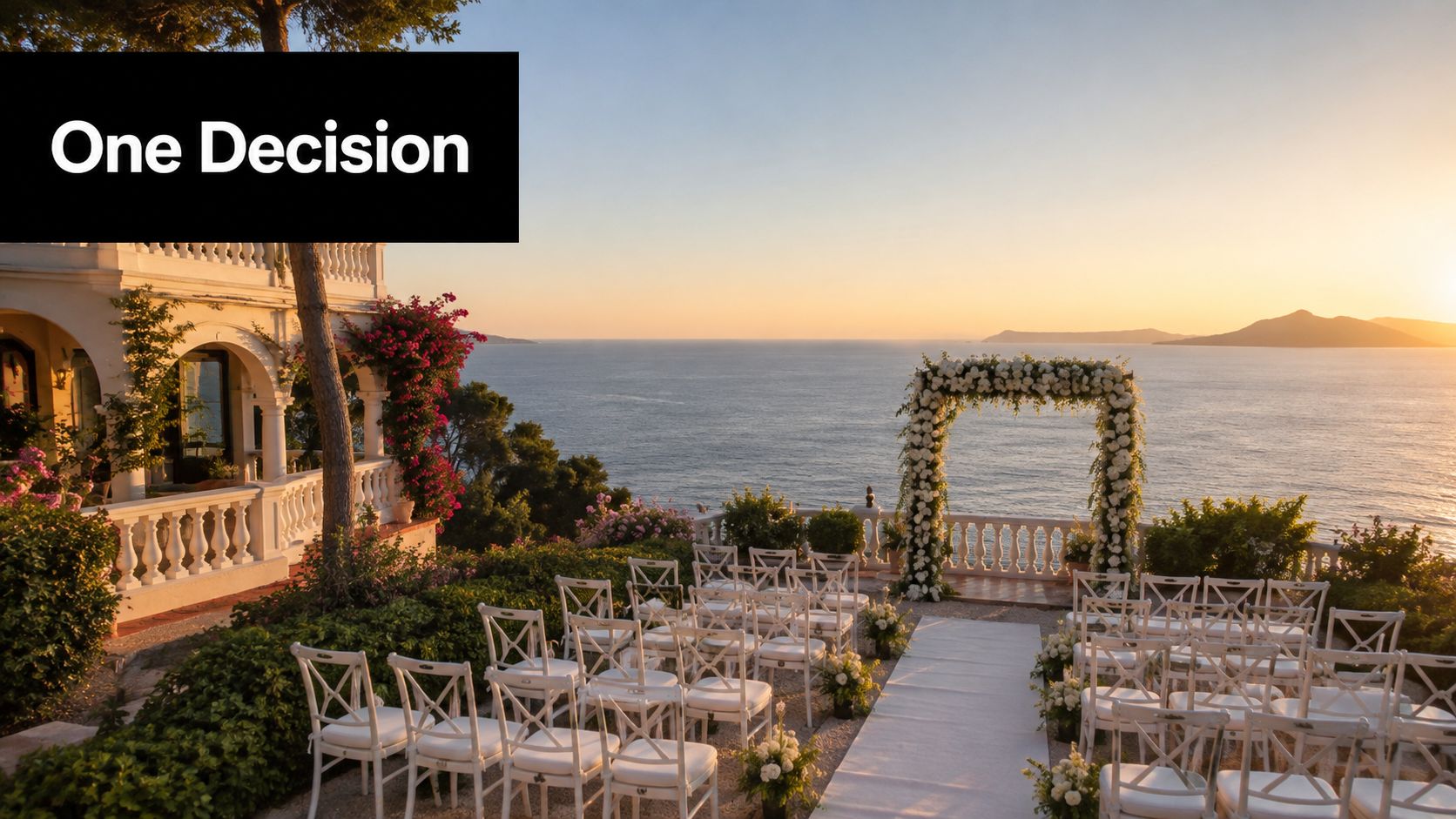
Venue and date are inseparable in intimate destination weddings. A property can look perfect in photos and still be wrong if the weather window is weak, the buyout terms are rigid, or the hotel can't completely disappear the rest of its operation for your group. Privacy is not a vibe, it's a contractual and operational outcome.
Start with the guest profile, then choose the climate window. If grandparents, children, or high-profile guests are coming, the destination has to be easy enough to access without turning the journey into a test of endurance. If the celebration depends on outdoor dining or a ceremony at sunset, shoulder-season conditions matter more than the social calendar.
Shortlist venues by privacy architecture
The properties that work best for this format tend to fall into a few categories, private islands, cliffside estates, historic riads, safari lodges, and ski-in chalets. Each one solves a different privacy problem. A private island reduces incidental traffic. A riad or estate can turn inward and make the whole event feel sealed off from the street. A safari lodge or chalet adds remoteness, which is useful when the goal is total immersion.
Use a three-part test before you even request a proposal.
- Buyout Feasibility: Can the property give you the whole place, or only promise “exclusive use” in theory?
- Guest Fit: Will the oldest and youngest guests be able to move comfortably through the space and the arrival process?
- Visual Logic: Does the site support ceremony, dinner, and portraits without requiring excessive production?
For couples comparing compact venues, ABC Hire's small wedding venue guide is a useful way to think about scale, not just scenery. And if you're deciding on a warm-weather escape, the timing logic around the best time to visit the Maldives matters just as much as the resort itself.
Venue rule: A beautiful property that can't shut out the rest of the hotel is not a true intimate wedding venue.
Once you've narrowed to three properties, pressure-test each one against arrival flow, privacy, and whether the date gives you enough influence on rates and availability. That's the true shortlist, not the one with the best terrace photo.
Engineering Guest Logistics for a Globally Distributed Group
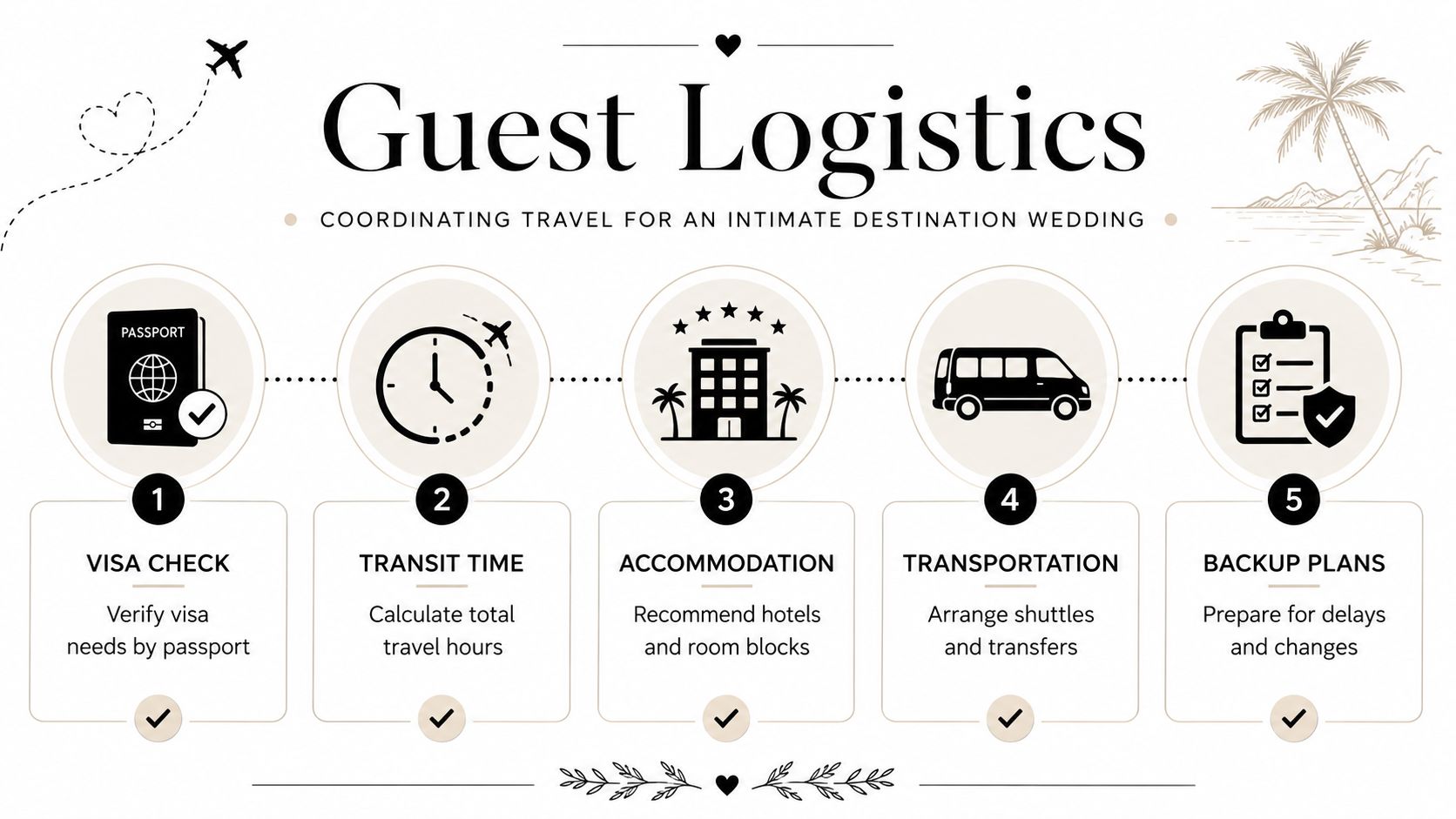
Intimate destination weddings can become either graceful or chaotic. A small guest list sounds easier until you realize the core challenge is not headcount, it's friction. Visa requirements, total transit time, arrival windows, luggage handling, and transfer reliability all decide whether people show up.
Treat guest logistics like a friction audit. Start with passports, because a destination that works for one market may be a headache for another. Then map the longest journey in the room, not the shortest. If the oldest guest, the youngest guest, or a high-profile guest has to connect three times to arrive, you've chosen the wrong place or the wrong routing.
Build the logistics dashboard early
The practical planning stack should include a clean arrival window, a room inventory plan across one or more properties, and a transfer system that doesn't depend on guests figuring it out themselves. If you're distributing guests across villas, suites, or nearby hotels, the transfers matter as much as the rooms. A wedding concierge compresses all of that into one point of contact, which is what makes the event feel calm instead of fragmented.
For couples who need premium routing and arrival coordination, Haute Black's air travel services fit naturally into the logistics plan. And if you're handling pre-arrival details for guests, browse wedding pre orders so welcome gifts, room drops, and event touchpoints don't become a last-minute scramble.
- Visa Check: Verify visa needs by passport before you confirm the date.
- Transit Time: Calculate total travel hours, not just flight duration.
- Accommodation: Recommend hotels and room blocks that match the guest profile.
- Transportation: Arrange shuttles and transfers with buffers, not wishful timing.
- Backup Plans: Prepare for delays, missed connections, and weather changes.
Attendance is the real test
Intimacy collapses if the destination is harder to reach than it is beautiful. That's the contrarian truth most romantic planning articles skip. If the trip is too punishing, the guest list may be small on paper but weak in practice, and that defeats the whole point.
This is why the best planners think in terms of accessibility, not just exclusivity. A lower-friction destination with clean routes and dependable transfers usually beats a more glamorous one that makes everyone nervous before they even board.
Legal, Cultural, and Symbolic Requirements Couples Miss
A beautiful destination can still create a legal headache. Marriage license rules vary by country, and some locations require residency periods, apostilled documents, translated certificates, or specific filing windows before the ceremony is legally valid. Couples who ignore this early usually end up splitting the legal wedding from the symbolic one, which works only if it is planned on purpose and becomes a mess if it is not.
Start with one decision, then build everything around it. Either the wedding is legally binding at the destination or it is symbolic only. A local legal adviser handles the jurisdiction-specific paperwork, and a cultural consultant keeps the event from feeling tone-deaf instead of polished.
Read the room, then read the rules
Religion, same-sex recognition, dress expectations, photography restrictions, and alcohol rules all vary by place. Those are not decorative details, they shape the ceremony itself. A venue coordinator who has handled these issues repeatedly is valuable because the property's relationships can move paperwork and permissions faster than a couple can on their own.
Private memberships and high-touch travel relationships matter most here. The right property often knows which officiants are available, which documents the local office wants first, and how to avoid delays that derail the wedding week. That kind of connection saves time in ways that never show up on a mood board.
Don't assume the resort knows your legal plan. Confirm whether the ceremony is symbolic or binding, then have the paperwork reviewed by someone who works in that jurisdiction.
The strongest intimate destination weddings respect the place they are held in. The couple, planner, and venue should understand the local customs before anyone books flights or buys attire. Once that is in place, the wedding feels rooted in the destination and far more credible to the people attending.
Designing a Multi-Day Program Worth Flying For
A destination wedding should feel like a private festival, not a single ceremony stretched into a long weekend. The right structure is usually three or four days, welcome reception, experience day, ceremony, farewell brunch. Each day needs its own purpose, because guests can tell when an itinerary has been padded instead of designed.
The welcome night should lower the temperature. Keep it warm, social, and easy to enter. The experience day should earn the trip, which is where private boats, vineyard visits, yacht days, helicopter rides, or a chef's-table dinner make sense. The ceremony day should be focused and beautiful, with enough quiet built in that the couple experiences it instead of rushing through it.
Design the rhythm, not just the events
The strongest programs build emotional momentum. A sommelier-led tasting can work as a pre-dinner anchor. A Nobu chef's table, a private concert on a sandbank, or a surprise cultural guest appearance can make the weekend feel singular without turning it into a spectacle. The point isn't to stack activities. It's to sequence them so guests feel increasingly invested.
A simple planning frame works better than overprogramming.
1. Arrival and welcome dinner.
2. One signature shared experience.
3. Ceremony and dinner.
4. Farewell gathering that closes the loop.
That structure gives the couple room to add branded moments, thoughtful gifts, or one-off entertainment without making the weekend feel scripted. It also protects the most valuable thing in a luxury wedding, emotional pacing.
If the wedding has a private-membership layer, use it for access rather than noise. A better table, a quieter venue, a more exclusive performance, or a smaller guest-list event often lands harder than an overproduced show.
Budgeting Without Surprises and the Leverage of Membership
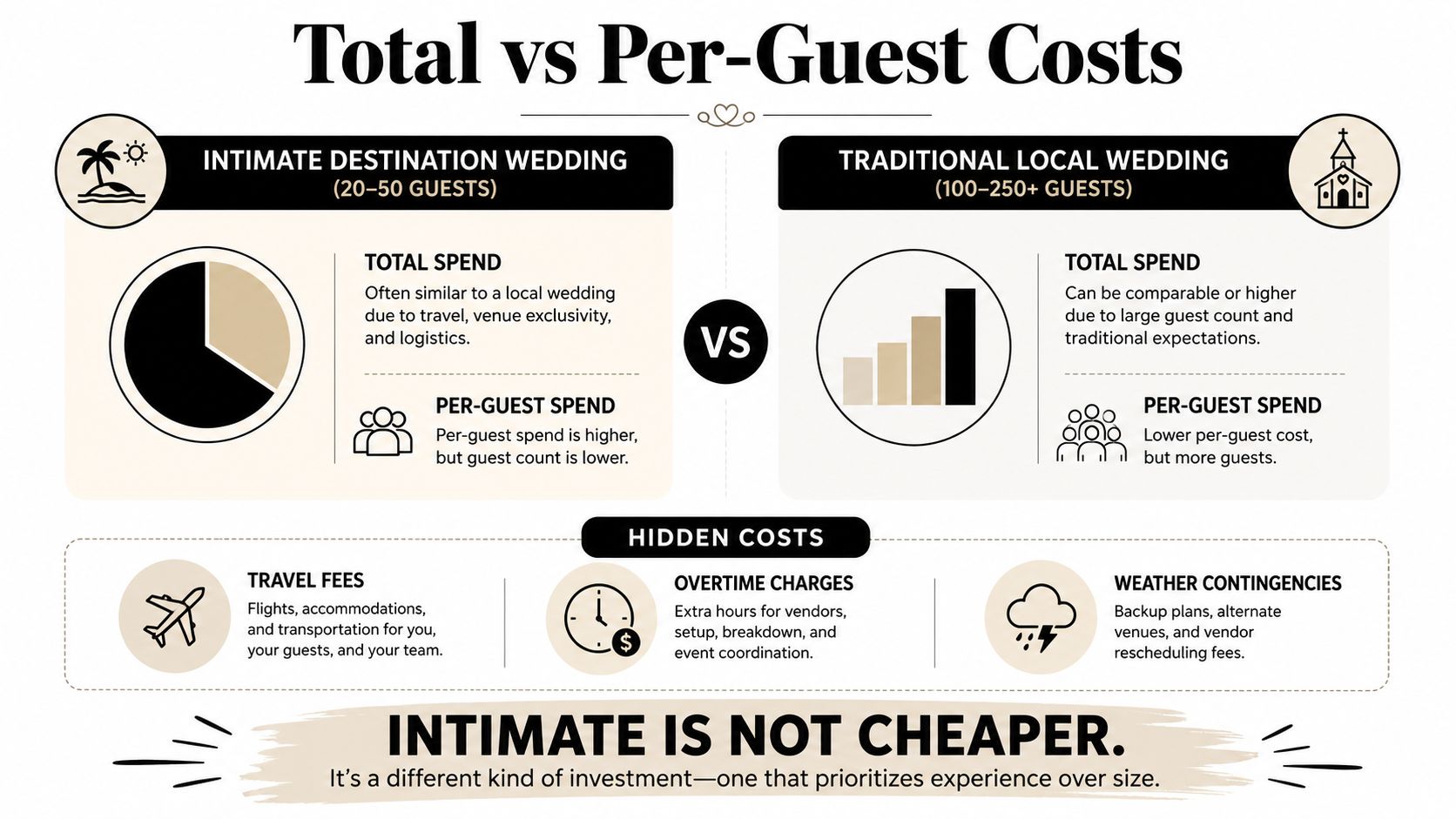
Intimate destination weddings are not automatically cheaper. They can be more expensive per person and, at the luxury level, sometimes more expensive overall once you add private transfers, multi-day food and beverage, buyout fees, vendor flights, and guest hospitality. That's why anyone selling “small equals savings” is oversimplifying the category.
The cleanest way to budget is to separate per-guest spend from total spend. If the guest list drops but the standard rises, the couple may spend less on scale and more on finish. That's not a problem, it's the point, but only if you know where the money is going.
The hidden costs are the real costs
Look at the line items people forget. Room blocks can be more expensive than expected, especially when you need privacy and adjacency. Transfers stack up fast when guests are moving between airport, hotel, rehearsal dinner, ceremony site, and farewell brunch. And once the weekend stretches into multiple days, food and beverage becomes a hospitality program, not a single reception meal.
For a grounded comparison on compact ceremonies, dreamy sunset elopement ideas are useful because they show how intimacy changes the spending profile without pretending the event is free. The same logic applies here, smaller guest counts don't remove expense, they just shift it into quality and coordination.
Membership changes the negotiation
Preferred-partner access matters. A Virtuoso-affiliated advisor with relationships at 500+ properties can often secure upgrades when available, resort credits, flexible benefits, and cleaner communication with the hotel, according to the publisher's own positioning. That doesn't erase the budget, but it changes the terms of it. The same is true when planning fees are waived for members and the advisor has direct relationships with villas, estates, and luxury hotels that already understand wedding execution.
A good advisor doesn't make a wedding cheap. A good advisor makes the value proposition better.
Budget rule: Intimate is not cheaper, it's more concentrated. If the guest count falls but the service level rises, expect the budget to move with it.
How a Private Membership Concierge Changes Everything
A private membership concierge turns an intimate destination wedding from a scattered project into one managed relationship. That matters because the couple stops juggling separate calls with hotels, transfer companies, aviation teams, and vendors. One advisor handles the venue shortlist, the hotel negotiations, the travel architecture, and the execution cadence.
That model fits Haute Black, a luxury travel company and private membership world with preferred-partner status at over 500 properties, Virtuoso affiliation, private aviation support, first-class and helicopter transfers, and curated events across the year. In practice, the couple is not starting from zero with every supplier. They are stepping into a network that already knows how to move quickly and discreetly.
What the engagement should look like
The first call should narrow the destination based on guest accessibility, privacy, and the mood of the weekend. After that, the advisor should return a shortlist that respects the guest profile, not just the scenery. The next layer is vendor curation, which should include the hotel team, transport providers, dining partners, and any special access needed for private dinners or surprise programming.
At the operational stage, the concierge becomes the control tower. Room assignments, arrival timing, transfer coordination, and on-the-ground adjustments all run through one person who already understands the property and the couple's priorities. That single point of control saves time and prevents the kind of errors that make a private wedding feel improvised.
The hidden costs are the decisive costs
Private membership shows its value in the margins. Better room placement, clearer communication with the property, and faster answers from the right people all reduce friction before it becomes expensive. If a group needs a late change to transport or a special request for a private dinner, a connected advisor can make it happen without forcing the couple to chase three departments and wait for approval loops.
The post-wedding relationship matters too. The best advisors keep the door open for the anniversary trip, honeymoon extension, or the next hosted event. That continuity is part of the service, and it matters more than a glossy presentation or a polished deck.
For couples who want a clear view of how that broader service model works, Haute Black's guide to luxury travel concierge services is the right reference point. It shows why a concierge is the backbone of this format, not a decorative add-on.
The format will keep growing because couples still want two things at once, privacy and meaning. As the guest list becomes more distributed, one person orchestrating the whole event becomes the difference between controlled and chaotic.
Haute Black handles the moving parts that make intimate destination weddings either effortless or exhausting, from property access and private aviation to guest arrivals and post-wedding travel. If you want the wedding to feel private, polished, and manageable, visit Haute Black and start with a conversation built around your guest list, your destination, and the level of control you want.
Explore Our Guides


Signature Experiences