Haute Black Journal
Expert Tips for Luxury Vacation Rental Success

Marlene Azeez
Director, HauteBlack
View all articles →

You’re probably looking at a glossy villa deck right now. The photography is immaculate, the pool is lit like a film set, and the listing promises privacy, service, and effortless living. None of that tells you what matters most.
A serious luxury vacation rental decision isn’t about whether the home is beautiful. It’s about whether the property can protect your time, your privacy, your family, and your standards without creating friction behind the scenes. For ultra-high-net-worth travelers, founders, public figures, and the executives who book for them, the wrong villa isn’t just disappointing. It creates exposure.
The unwritten rule is simple. Start with a private standard, not a public listing. Then verify everything.
Establishing Your Bespoke Rental Blueprint
Most rental searches fail before anyone opens a browser. The brief is too vague.
“Beachfront, modern, private, fully staffed” sounds specific until you realize it could describe a polished but unsuitable six-bedroom house with weak Wi-Fi, no secure staff protocols, poor bedroom flow, and neighbors close enough to watch dinner from their terrace. In this tier, luxury has to be defined in operational terms.

Define the property before the destination
A disciplined brief starts with the house itself. Not the island, not the headline rate, not the sunset angle.
Specify the elements that change the stay in practice:
- Architectural pedigree: Do you want a contemporary glass pavilion, a historic estate, a minimalist tropical compound, or a branded residence with hotel-level operating standards?
- Privacy threshold: Decide whether you need gated entry, distance from neighboring homes, natural shielding, or a full estate perimeter.
- Staff profile: “Fully staffed” is meaningless unless you define whether you need a discreet house manager, a formal butler, a family-friendly nanny, security-trained chauffeurs, or a chef with fine dining credentials.
- Work capability: Ask for enterprise-grade secure Wi-Fi, backup connectivity, private office space, sound-isolated rooms, and strong mobile reception.
- Wellness specification: A pretty gym isn’t enough if the client wants treatment space, sauna, cold plunge, Pilates reformer, or a therapist room that can function like a private spa suite.
That brief saves time because it eliminates attractive but irrelevant inventory.
Practical rule: If a requirement would cause you to reject the property on arrival, it belongs in the written brief before the search begins.
Build around how the group actually lives
The floor plan matters more than many travelers realize. In luxury markets, 3 to 4 bedroom properties outperform smaller units by 30% in RevPAR, and for multi-generational stays, layouts with ensuite bathrooms for all bedrooms and separate adult and children wings see 40% higher booking rates and guest satisfaction, according to Key Data Dashboard’s analysis of top short-term rental builds.
That performance data matters because it reflects guest behavior. The homes that book well tend to work well.
For families and mixed-age groups, ask these questions early:
1. Who needs separation? Teenagers, grandparents, security personnel, and staff each change the ideal layout.
2. Who needs quiet? A founder taking board calls has different needs from children on holiday.
3. Who needs equal rooms? Uneven bedroom quality creates tension fast on family trips and group travel.
Write the brief like an operating memo
A useful rental profile reads less like a wish list and more like a principal’s office memo.
A strong version includes:
| Requirement | What to specify |
|---|---|
| Arrival style | Helipad access, private dock, fast airport transfer, discreet side entrance |
| Service level | Daily housekeeping, laundry turnaround, chef schedule, nighttime service |
| Security needs | Controlled access, vetted staff, camera positioning, secure communications |
| Lifestyle fit | Child-safe pool, art-focused interiors, cigar terrace, wellness pavilion |
| Non-negotiables | No shared boundaries, no pass-through bedrooms, no public beach access nearby |
One more refinement separates experienced travelers from casual luxury buyers. Distinguish between what must be in the house and what can be brought in. A chef can sometimes be upgraded. A bad layout can’t. A massage therapist can be arranged. A house with poor privacy setbacks remains exposed.
A rental profile should disqualify more homes than it approves.
That’s the point. Precision isn’t restrictive. It’s protective.
Accessing the World's Most Exclusive Properties
The finest villas are often absent from the obvious places. Public platforms are useful for broad market scanning, but they are weak tools for serious ultra-luxury sourcing.
That gap is growing because the category itself is growing. The global luxury vacation rental market is projected to expand from USD 28.5 billion in 2025 to USD 63.7 billion by 2034, and the luxury villas and estates segment held 49% market share in 2024 and is projected to grow at around 10% through 2034, according to this market projection overview. More demand brings more supply, but it also brings more noise, more polished misrepresentation, and more inventory that looks interchangeable online.
Why public platforms fall short
Mass-market luxury portals do a good job of merchandising aspiration. They do a poor job of guaranteeing discretion.
The core problems are familiar:
- Privacy is inconsistent: A listing may conceal nearby properties, public shoreline access, or service traffic patterns.
- Quality control varies: The photography may be current while the staffing, maintenance standards, and operating rhythm are not.
- Descriptions blur distinctions: “Private chef available” can mean anything from a local cook on request to a distinguished culinary program.
- Inventory is public by default: For some clients, the issue isn’t just quality. It’s traceability.
The result is simple. Public inventory often works for affluent leisure travelers. It rarely works as the sole sourcing channel for principals who need confidence before they travel.
The three channels that matter
The best homes usually surface through one of three routes.
Specialist villa brokers
A strong villa broker doesn’t just hold inventory. They know what won’t survive client scrutiny. That matters when the client is paying for discretion, not novelty.
The best brokers keep informal off-market books, know which estates have stable management, and can tell you whether the owner is engaged, absent, or difficult. Those details never appear on listing pages.
Private membership and partner networks
Relationship-led travel networks can access branded residence collections, private homes connected to hotel groups, and owner inventory that isn’t released broadly. That’s where private villa sourcing through curated partner channels becomes useful. It gives advisors and clients a cleaner way to review homes that have already passed a higher threshold for service alignment and discretion.
Personal network intelligence
Trusted referrals still matter. Family offices, private jet teams, estate managers, and seasoned EAs often know which homes perform well under pressure and which ones only photograph well.
A worthwhile habit is cross-checking a destination through local market context, not just travel channels. For example, Atlantique Sud's 2026 villa analysis is useful because it frames luxury villa inventory through the lens of location, ownership, and destination positioning rather than just vacation marketing language.
Access is only valuable if it is filtered
Exclusive inventory sounds impressive. It becomes valuable only when someone narrows it correctly.
Use this lens when evaluating any sourcing channel:
- Can they explain why this home fits your brief, not just why it’s desirable?
- Do they know the staff structure and ownership context?
- Can they identify what won’t work before presenting it?
- Can they secure quiet access and discreet logistics around arrival and stay?
The right property often isn’t the rarest one. It’s the one with the fewest operational surprises.
That’s why experienced clients don’t chase inventory volume. They want curation, context, and restraint.
Performing Due Diligence on Elite Rentals
A polished brochure is marketing. Due diligence is risk control.
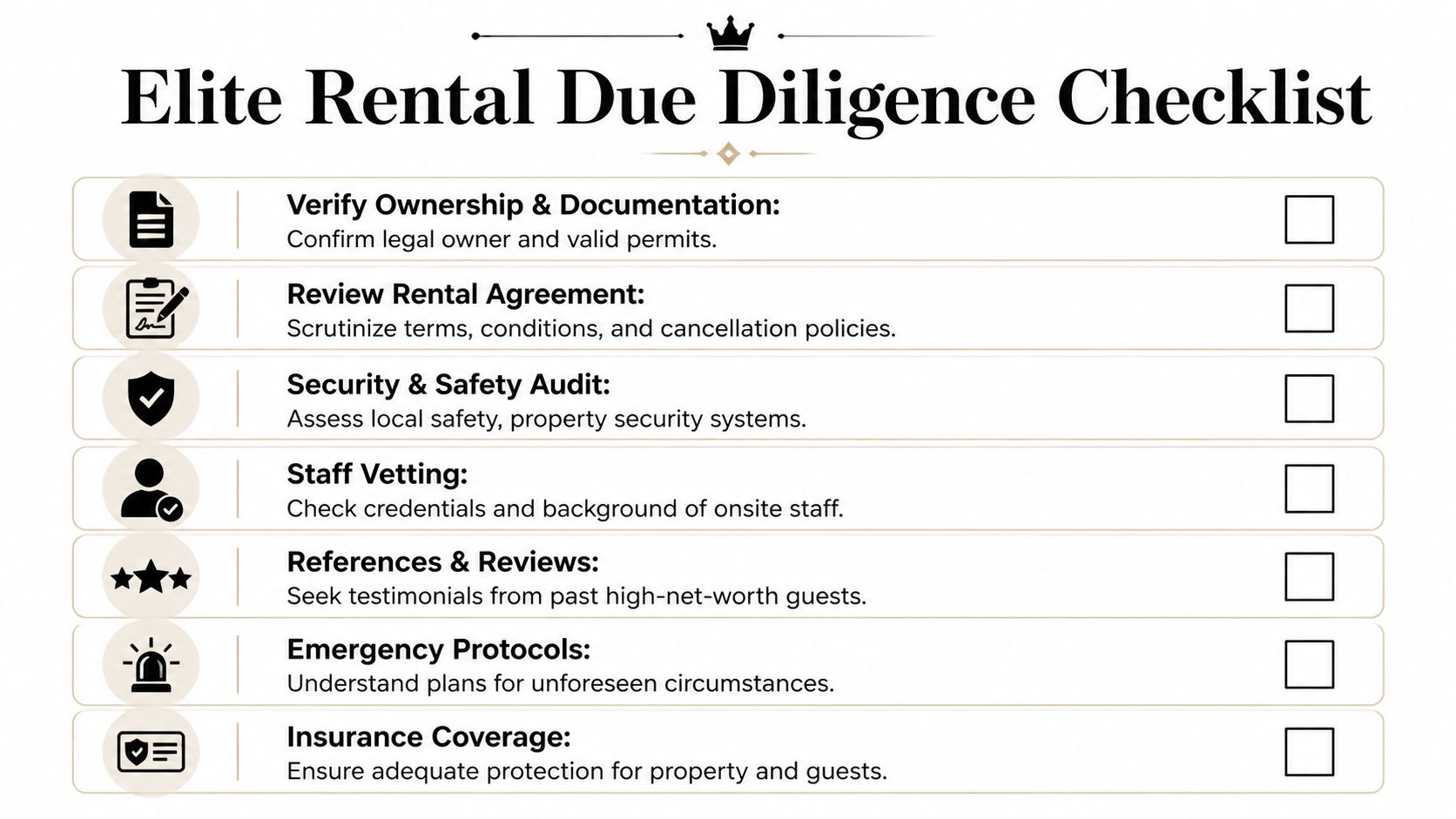
At this level, verification has to move beyond “the reviews looked good” or “the agent seemed reputable.” You’re not just checking whether the home exists. You’re checking whether it can deliver safely, legally, and discreetly under real conditions.
Start with legal control and booking authority
The first question is basic. Who controls the property?
That means confirming ownership, understanding whether the booking intermediary is formally mandated, and checking that local permits and operating permissions are in place where applicable. A beautifully presented villa can still be wrapped in a weak agency chain with unclear authority to contract.
Review the paperwork with the same discipline you would use for a high-value service vendor:
- Ownership trail: Confirm the legal owner or authorized operating entity.
- Mandate clarity: Verify the agent or manager has authority to lease the property.
- Permit position: Check whether the home is properly allowed to operate as a short-term rental in that jurisdiction.
- Insurance proof: Ask for current documentation, not verbal assurance.
If anyone resists ordinary verification, move on.
Audit security as if the principal were arriving tomorrow
Security review should cover both physical and digital exposure. Many homes look private in daylight and feel less private once deliveries, drivers, staff circulation, and neighboring sightlines become obvious.
A remote audit should examine:
| Area | What to verify |
|---|---|
| Perimeter | Gate control, blind spots, neighboring visibility, pedestrian access |
| Arrival | Vehicle approach, tarmac-to-villa routing, paparazzi exposure, secondary entrance |
| Internal security | Alarm coverage, safe rooms if relevant, lock quality, staff access zones |
| Digital environment | Secure Wi-Fi setup, separate guest network, smart home controls, camera policy |
| Emergency readiness | Medical response plan, evacuation route, backup power, local contacts |
Request a live, unedited video walkthrough. Not a highlight reel. A live pass through the property at ordinary pace tells you more than any still photography ever will. You can assess ambient noise, visible sightlines, water pressure, room adjacency, road sound, and whether the staff areas feel polished or improvised.
Ask the person holding the phone to open taps, step onto terraces, stand in bedrooms with the doors closed, and walk the route from the primary suite to the main entertaining spaces.
That one exercise exposes a surprising amount.
Vet the staff, not just the stonework
Luxury is often won or lost by the house manager.
Interview the manager directly when the stay matters. You’re listening for precision, discretion, and anticipation. A polished manager answers operational questions calmly and specifically. A weak one leans on vague reassurance.
Good questions include:
1. Who will be on property during the stay, and who rotates in?
2. How are vendors handled, announced, and restricted?
3. What happens if the principal requests a last-minute schedule change?
4. Who handles media sensitivity or uninvited visitors if they appear nearby?
If the answers sound improvised, the stay will feel improvised.
Verify sustainability claims the same way you verify security claims
Eco language is now common in villa marketing. Verification is not.
A 2025 to 2026 Phocuswright report notes that 74% of HNW travelers now filter for sustainable luxury rentals, up 22% year over year, and certified green rentals command 18% higher ADR in markets like Malibu and the Exuma Cays, yet few properties provide verifiable metrics for their eco-claims, as summarized by Natural Retreats’ sustainability market discussion. That gap matters because many premium listings now borrow the language of sustainability without the documentation.
If a property claims carbon-neutral operations, regenerative landscaping, water recycling, or formal green certification, ask for documentation. If none exists, treat the claim as aesthetic positioning, not verified operating fact.
Read reviews selectively
Public reviews can help, but they rarely tell the full story for top-tier homes. Many principals value privacy enough that they never leave public feedback.
The more useful signal is private reference quality. Ask whether prior guests with comparable expectations have returned, whether the house is used by families or event-heavy groups, and whether the manager can provide reference commentary through appropriate channels.
A luxury vacation rental should survive scrutiny from three angles at once: legal legitimacy, physical security, and operational maturity. If one of those pillars is weak, the property isn’t ready for a serious client.
Structuring Contracts and Payments for Ultimate Protection
A high-value villa booking should be structured like a controlled transaction, not an enthusiastic transfer of funds.
The contract is where discretion, financial protection, and flexibility become real. If the paperwork is sloppy, the stay can still happen, but the client absorbs unnecessary risk.
Book through the right entity
For many principals, booking through a dedicated legal entity makes sense. It can help separate the traveler’s personal identity from the reservation record and keep contracting cleaner when assistants, family office staff, or outside counsel are involved.
The right structure depends on the jurisdiction and the client’s legal framework, but the operating principle is straightforward. Reduce personal exposure where you can, and make sure the named party on the contract reflects how the client prefers to hold risk and privacy.
That same discipline should apply when the stay intersects with local tax obligations or ownership structures. For clients comparing destinations or longer-use scenarios, Invexa's guide to 2025 property tax is a useful reference point for understanding how non-resident property income can be treated in certain markets.
Stage payments, don’t rush them
Payment timing tells you a lot about the professionalism of the other side.
Well-run bookings usually have a clear deposit schedule, documented payment milestones, and sensible triggers for the balance due. Aggressive pressure for immediate full payment, especially before verification is complete, should slow the process down.
Use a checklist before funds move:
- Identity match: Confirm the contracting entity matches the payment instructions.
- Banking verification: Validate remittance details through a second channel.
- Condition precedent: Make sure key deliverables are confirmed before final payment.
- Damage handling: Clarify whether the security deposit is held, pre-authorized, or insured.
- Refund process: Identify the actual mechanism and timeline.
An escrow structure can be appropriate in some cases, especially where the booking value is substantial or the jurisdiction is less familiar. The point isn’t to complicate the deal. It’s to make sure the release of funds matches the delivery of obligations.
Negotiate where leverage actually exists
Many travelers assume luxury villa contracts are fixed. They often aren’t.
Owners and managers understand yield. They know that pricing changes with seasonality, lead time, event demand, and market conditions. According to PriceLabs’ discussion of vacation rental pricing mistakes, implementing dynamic pricing can uplift revenue by 15% to 25%, top performers achieve 20% to 30% higher RevPAR by adjusting for seasonality and events, and ignoring this can lead to underpricing by 15% to 20% or overpricing by 25%. That matters to renters because it reveals where owners are flexible and where they are not.
A practical negotiation table looks like this:
| Clause area | What to push on |
|---|---|
| Cancellation | More practical notice windows, rebooking credit, force majeure wording |
| Privacy | Express confidentiality obligations for owner, staff, and local vendors |
| Occupancy terms | Day guests, security staff, children, visiting therapists or trainers |
| Service language | Named staffing levels, chef availability, housekeeping schedule |
| Arrival condition | Inventory readiness, pool heating, backup systems, airport transfer clarity |
A lower rate is nice. A better cancellation clause and a stronger confidentiality section are often worth more.
Read the clauses that people skip
Three clauses deserve particular attention.
First, liability waivers. Some are routine. Some are drafted so broadly that they leave the guest carrying too much of the operational burden. Second, damage language. Distinguish ordinary wear, accidental guest damage, and pre-existing issues. Third, privacy terms. If privacy matters to the client, it should appear in the agreement, not just in email promises.
A luxury vacation rental contract should feel boring in the best possible way. Clear parties, clear payment path, clear obligations, and no ambiguity when plans change.
Beyond the Villa The Art of Curated Experiences
A beautiful house is only the container. What people remember is how the stay unfolded.
The difference between ordinary concierge work and genuine curation is anticipation. One reacts to requests. The other designs a sequence of moments so the trip never feels assembled in real time.

The villa should behave like a private club
A well-curated stay often starts discreetly. The pantry is stocked to the client’s real preferences, not generic luxury staples. The children’s rooms are set up with age-appropriate details. The principal’s preferred tea, cigar cut, training slot, and wake-up routine are already understood.
Then the trip expands.
One evening may call for a restrained dinner by the pool with a chef who knows how to cook for privacy-sensitive clients without turning service into theater. Another day may need a yacht departure timed around sea conditions, a hidden beach lunch, and a return that leaves enough room for massage appointments before guests arrive for cocktails.
That level of planning requires people who know the difference between access and noise.
Culinary programming changes the rhythm of a stay
Food is one of the easiest places to spot the gap between surface luxury and thoughtful service. “Chef included” can mean family-style comfort cooking, which may be perfect. It can also disappoint a client expecting tasting-menu precision.
For families who want more range, specialist providers can help source talent beyond the house kitchen. A practical starting point is reviewing the scope of luxury private chef services to understand what can be arranged for in-villa dining, dietary management, and event-style meals during a private stay.
A polished culinary plan usually includes a mix, not a single format:
- Arrival meals: Light, restorative, timed to flight fatigue.
- Signature dinner: One standout evening with stronger presentation and wine direction.
- Wellness meals: Clean breakfast and lunch flow for spa or fitness-focused days.
- Flexible children’s service: Not separate in spirit, just separate in timing and execution.
The best in-villa dining doesn’t try to imitate a restaurant. It uses the privacy of the house to do something a restaurant can’t.
That might mean a chef serving on the terrace after a late swim, or a sommelier-led tasting that feels intimate instead of performative.
A short visual reference helps show the atmosphere clients often want from a private stay.
Access should feel private, not packaged
The strongest itineraries include one or two elements that money alone usually can’t secure on short notice. A closed-door gallery viewing. A discreet training session with a known athlete. Backstage cultural access. A private table arranged because someone involved knows exactly whom to call.
That’s where curated private travel experiences become relevant in practical terms. The value isn’t more activity. It’s tighter orchestration, better introductions, and fewer visible seams.
A luxury vacation rental works best when the home, the service team, and the off-property calendar all feel like one operating system. Guests shouldn’t have to switch mental gears between “villa time” and “outside arrangements.” If the stay is built properly, everything feels native to the same standard.
The Haute Black Advantage Seamless Execution and VIP Value
At the top end of the market, the hardest part isn’t finding a gorgeous villa. It’s aligning sourcing, screening, contracts, transport, staffing, dining, and local access without making the client manage the moving pieces.
That’s where a membership model can be useful. It compresses a long chain of separate decisions into one coordinated process.

One advisor should hold the whole picture
When villa sourcing is split across a broker, a travel agent, a security consultant, a house manager, and an assistant, details get dropped. Not because any one party is careless. Because nobody owns the entire operating picture.
A dedicated advisor changes that by acting as a single control point. The property brief stays consistent. The arrival plan matches the client’s privacy profile. The staffing requests are translated accurately. The off-property calendar doesn’t clash with security movement or family rhythms.
That kind of coordination is especially relevant when the traveler expects branded-hotel precision inside a private home. Preferred relationships across major hotel groups and private residence channels can help align villa stays with the service culture clients already trust from Four Seasons, Aman, Rosewood, Belmond, and similar brands.
Membership matters when discretion and recognition both count
Some clients want seclusion. Others want selective access.
That distinction is often overlooked in villa content, which tends to treat privacy as the final goal. It isn’t always. A key underserved angle in luxury travel is integrating rentals with exclusive networking. Data shows that 68% of UHNW individuals prioritize professional connections during vacations, as noted in this discussion of the networking retreat gap in luxury rentals. For the right traveler, the ideal villa stay isn’t socially empty. It is socially filtered.
That’s where structured membership can add a different kind of utility. Through private membership access, the rental can become more than a retreat. It can support private dinners, curated introductions, or small-format roundtables with verified founders, investors, athletes, and creatives who are already in-market.
Privacy and connectivity aren’t opposites. For many UHNW travelers, the real luxury is deciding when each one applies.
The value is in execution, not in promises
The practical advantage of a coordinated network shows up in details that rarely make marketing copy.
A principal lands and the transfer is already aligned with baggage timing and privacy needs. The villa has been stocked to actual preference, not a generic “VIP setup.” A dinner reservation doesn’t just exist. It exists at the right table, under the right name protocol, with the right level of recognition. A chef dinner, cultural event, or peer introduction happens because someone involved has the standing to arrange it cleanly.
This is also where a luxury vacation rental stops feeling like an isolated asset and starts functioning like part of a broader private travel system. Private aviation, ground handling, villa management, concierge dining, and member introductions work better when they are coordinated under one standard rather than patched together by message thread.
For executive assistants, that matters just as much as it does for principals. Fewer moving parts means fewer exposed edges. Less repetition. Less room for the client to discover that one supplier interpreted “discreet” very differently from another.
The strongest villa stays are almost invisible in execution. Nothing flashy. Nothing strained. Just a sequence of decisions made correctly, early, and by people who understand that the client is not paying for effort. The client is paying for friction not to appear.
If you want a luxury vacation rental handled with that level of discretion, screening, and itinerary design, Haute Black is built for it. The platform combines bespoke villa sourcing, advisor-led planning, VIP travel access, and a private network for members who want both privacy and meaningful connection while they travel.
Explore Our Guides


Signature Experiences


